Sputum Smear vs. Culture for TB: What the Difference Means

A sputum smear looks for TB bacteria under a microscope and reports within about a day. A sputum culture grows the bacteria in a lab and takes weeks, but it is the more sensitive test and the one that confirms TB disease. For immigration applicants, both tests matter only in a specific situation: when a civil surgeon finds signs that TB disease may be active. Most I-693 applicants never provide a sputum sample.
Below, we explain how the two tests differ, why doctors order both, what the results mean, and what happens to a Form I-693 when sputum testing is required.
TL;DR
- A smear is a quick microscope check for acid-fast bacilli (AFB). A culture grows the organism and confirms whether it is M. tuberculosis.
- Smear results come back within 24 hours. Culture takes roughly 2 to 8 weeks, depending on the method.
- A negative smear does not rule out TB disease. Smears miss a large share of culture-confirmed cases.
- For an I-693, sputum testing is required only when a chest X-ray, symptoms, or HIV status point to possible TB disease. A routine TB blood test alone does not trigger it.
- Only Class A TB (clinically active and communicable) makes an applicant inadmissible, and it must be treated before medical clearance.
Table of Contents
- Sputum smear and sputum culture in plain terms
- Side-by-side comparison
- Speed: hours versus weeks
- Accuracy: why a negative smear is not the end of the story
- How sputum samples are collected
- Combining the tests: what the results look like together
- When an I-693 applicant needs sputum testing
- How results affect your I-693
- How to prepare for your I-693 exam
- Our perspective
- Start your exam with a specialist
- FAQ
- Sources
Sputum smear and sputum culture in plain terms
Both tests start with the same thing: a sample of phlegm coughed up from the lungs. What happens to the sample is different.
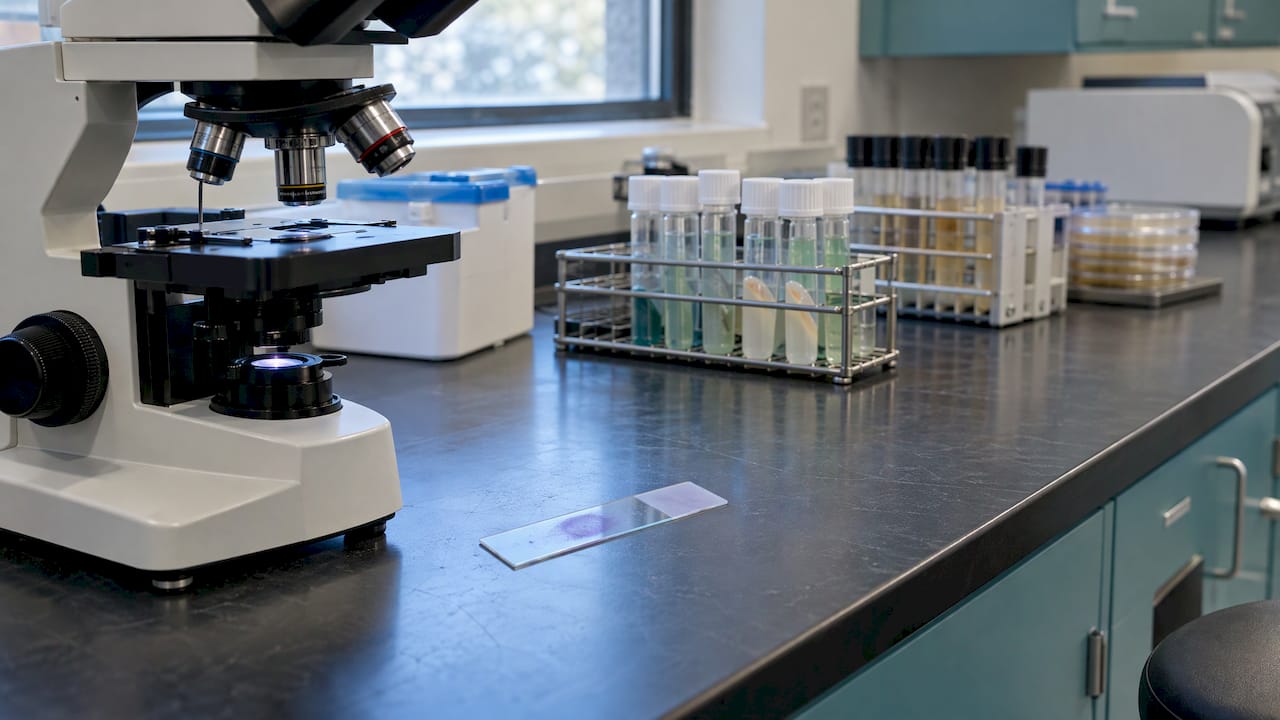
Smear microscopy. The lab spreads sputum on a glass slide, stains it, and looks for acid-fast bacilli. According to the CDC’s clinical and laboratory diagnosis guidance, results are available within 24 hours, but the finding is only presumptive, because AFB can be organisms other than M. tuberculosis.
Culture. The lab places the specimen on solid or liquid growth media and waits to see whether mycobacteria grow. The same CDC page describes culture as the gold standard for laboratory confirmation. A positive culture for M. tuberculosis confirms TB disease. A negative culture does not automatically rule it out.
Think of the smear as a fast screen and the culture as the verdict. Neither one replaces the other, which is why guidance calls for running both.
Side-by-side comparison
| Feature | Sputum smear (AFB microscopy) | Sputum culture |
|---|---|---|
| What it does | Stains the sample and looks for AFB under a microscope | Grows mycobacteria on solid or liquid media |
| Speed | Within 24 hours of collection | About 2 to 8 weeks, depending on method |
| Sensitivity | Detects less than half to about 80% of culture-confirmed pulmonary cases, by CDC estimates | Detects far lower bacterial loads |
| Bacteria needed | About 5,000 to 10,000 per mL | About 10 to 100 |
| Can confirm M. tuberculosis? | No, only presumptive | Yes |
| Main use | Quick read on infectiousness | Confirmation, drug susceptibility testing, tracking treatment |
The figures come from CDC sources, which we detail in the next sections.
Speed: hours versus weeks
The CDC Core Curriculum on Tuberculosis says smear results should be ready within 24 hours when the specimen is delivered promptly. Culture turnaround ranges from four days to eight weeks after the lab receives the sample, depending on the method and how fast the organism grows.
The same document explains that commercial broth systems detect most mycobacterial growth in 4 to 14 days, compared with 3 to 6 weeks for solid media. Labs also hold cultures for a long time before calling them negative. The APHL specimen submission guidelines say cultures should be held at least six weeks before a negative report.

That gap is the practical reason applicants ask about this topic. A smear result can arrive while you are still thinking about the visit. A culture result can take much of two months.
Accuracy: why a negative smear is not the end of the story
Smear microscopy is fast and inexpensive, but it needs a lot of bacteria in the sample to show anything. The CDC Core Curriculum puts the threshold at 5,000 to 10,000 bacilli per milliliter for a stained smear, while a positive culture needs only 10 to 100.
That explains the sensitivity numbers. The CDC’s updated guidelines on nucleic acid amplification testing report smear sensitivity of 45% to 80% among culture-confirmed pulmonary TB cases. They also report a positive predictive value of only 50% to 80% where nontuberculous mycobacteria are commonly found. In other words, some positive smears are not TB, and some TB cases have negative smears. A separate CDC document, Testing to Diagnose Tuberculosis Disease in the United States, says smear microscopy generally detects less than half of culture-confirmed pulmonary cases.
What a negative result does and does not tell you
Per the CDC Core Curriculum:
- A negative smear means the person is probably not infectious at that moment. It does not rule out TB disease, because the culture may still be positive.
- A negative culture means no live tubercle bacilli were found in that specimen. It does not rule out TB disease either, because bacteria could be in other specimens or body sites.
This is why clinicians do not decide from one test. They combine sputum results with the chest X-ray, symptoms, history, and other tests.
How sputum samples are collected
Quality matters more than most people expect. Saliva or a quick throat clear is not a usable sample. The APHL guidelines stress that specimens should be collected under the direction of a trained health care professional. When a patient cannot produce sputum on their own, sputum induction or bronchoscopy may be used so that smear and culture results are valid.
For people presumed to have pulmonary TB, the CDC guidance calls for at least three consecutive sputum specimens, collected 8 to 24 hours apart, with at least one collected early in the morning. Collection happens in an airborne infection isolation room or a sputum collection booth. All specimens are cultured, regardless of what the smear shows. The APHL guidelines add that specimens should reach the laboratory within 24 hours.
Combining the tests: what the results look like together
Labs report smear results by grade. According to the CDC, when AFB are seen they are counted and classified as 4+, 3+, 2+, or 1+, and a higher count suggests a more infectious patient.
Molecular tests (nucleic acid amplification, or NAA) add a third layer. The CDC’s guidelines say NAA has a positive predictive value above 95% in smear-positive specimens where nontuberculous mycobacteria are common, and it can confirm M. tuberculosis in 50% to 80% of smear-negative, culture-positive specimens.
The CDC Technical Instructions for Panel Physicians show how the pieces combine in an immigration setting. If the NAA and smear are both positive, the person is presumed to have TB and treatment starts while culture results are pending. If the molecular test is negative and at least one culture is positive, the applicant must be diagnosed with Class A infectious TB. If the molecular test is positive and all cultures are negative, the physician uses clinical judgment.

When an I-693 applicant needs sputum testing
Most applicants never reach this step. The usual TB screening in an immigration medical exam is a blood test (IGRA) for applicants who need it, and a chest X-ray when indicated. You can read how that works in our guide to TB screening for Form I-693 and our overview of QuantiFERON TB Gold.
Sputum testing comes into play only when something suggests active disease. Under the USCIS Policy Manual, applicants with chest X-ray findings suggestive of TB, signs or symptoms of TB, or known HIV infection must be referred to the health department for sputum testing.
The CDC Technical Instructions for Civil Surgeons set out the requirements for an applicant with an abnormal chest radiograph suggestive of active TB:
- Provide three sputum specimens on separate days within a 7-day time frame.
- Have collection supervised.
- Have all three specimens examined for AFB and cultured for M. tuberculosis.
A positive blood test alone is not an automatic sputum referral. If you tested positive on an IGRA, our page on what happens after a positive TB test at an I-693 exam walks through the next step, which is normally a chest X-ray. If you tested positive years ago, see whether you need a new TB test.
Symptoms that make a doctor think of sputum testing
Persistent cough, coughing up blood, fever, night sweats, and unexplained weight loss are the classic warning signs of active TB. If you have any of them, tell the physician at the start of your exam. If you are coughing up blood or feel seriously ill, see a doctor or urgent care first, because our practice handles immigration exams only, not sick visits.
How results affect your I-693
The immigration consequences depend on the final classification, not on a single test.
- According to Chapter 6 of the USCIS Policy Manual, only a Class A TB diagnosis makes an applicant inadmissible, and under current CDC guidelines Class A means TB that is clinically active and communicable.
- The CDC Technical Instructions for Civil Surgeons say an applicant with Class A TB, whether smear positive or culture positive, cannot be medically cleared until completing a recommended course of treatment of at least six months.
- The civil surgeon cannot sign the I-693 until all TB-related follow-up requirements are met, per the same technical instructions.
The key point: a negative result in the right circumstances lets the process move forward, while a positive result moves the case into health department care and treatment. Either way, timely follow-up is what keeps the form from stalling.
Why timing matters
Because cultures can take weeks, a sputum referral often adds time to an application. Applicants who know their history (prior TB treatment, an old abnormal X-ray, or past positive tests) can save time by gathering records before the visit. Our guide to records for applicants with prior TB lists what to bring. Our page on TB testing for immigration medical exams covers the broader picture, and the one on TB risk countries explains what actually applies based on where you have lived.
How to prepare for your I-693 exam
A few habits prevent most TB-related delays:
- Bring prior records. Past TB test results, chest X-ray reports, and treatment documents help the civil surgeon classify your case. Ask your previous provider for printed copies.
- Be accurate about symptoms and history. The exam is a medical screening for immigration purposes, and complete answers keep the right tests in the right order.
- Bring your vaccination records. They are reviewed in the same visit, and missing documents are a common cause of delays.
- Ask about existing lab work. Some prior results may be usable. See our explanation of using recent lab results for an I-693.
- If you are referred for sputum testing, follow the instructions exactly. Early-morning samples, correct collection, and prompt delivery all affect whether the lab can use the specimen.
Our perspective
We have performed immigration medical exams since 2007, and the most common source of confusion we see is the belief that every applicant has to give a sputum sample. They do not. Sputum testing is a targeted step for people whose screening points toward possible active TB.
What we see in practice is that delays come from paperwork and sequencing, not from the tests themselves. An old chest X-ray report that nobody kept, a positive blood test that was never followed by imaging, or a form signed before the follow-up was complete can each send an application back to the start. We frequently help applicants who arrive after an exam elsewhere left them with delays, errors, or incomplete documentation.
Because our practice does only immigration exams, with no primary care or sick visits, our whole process is built around getting the I-693 completed correctly the first time. We keep the exam, labs, vaccine review, and form preparation in one place, and our internal quality review checks each form for USCIS compliance before it is sealed.
If your screening does call for a health department referral, we explain what comes next in plain terms and what we need back to finish your form.
ImmigrationMedicalExams Medical Team
Start your exam with a specialist
If you need a Form I-693, we handle the civil surgeon exam, required lab testing, vaccination review and required vaccinations when appropriate, and preparation of the form at one location serving Southern California. We use a flat-package approach designed to minimize unexpected costs. Standard processing takes about 3 days, with a 2-day expedited option.

You can book online 24/7 through our USCIS Form I-693 exam page, or compare the standard 3-day exam and the 2-day expedited exam.
FAQ
Which is more accurate, a sputum smear or a culture?
Culture is more accurate. The CDC calls it the gold standard because it can detect very small numbers of bacteria (10 to 100) and confirm M. tuberculosis. A smear needs 5,000 to 10,000 bacilli per milliliter and can only suggest TB.
Does a negative sputum smear mean I do not have TB?
No. A negative smear means you are probably not infectious at that time, but it does not rule out TB disease, because the culture can still be positive. Doctors weigh it together with your X-ray, symptoms, and other tests.
How long do sputum smear and culture results take?
Smear results should be ready within 24 hours of collection. Culture takes about 2 to 8 weeks, depending on whether the lab uses faster liquid broth or slower solid media. Labs hold cultures at least six weeks before reporting them negative.
Do all green card applicants need sputum testing?
No. Under the USCIS Policy Manual, referral for sputum testing applies to applicants with chest X-ray findings suggestive of TB, signs or symptoms of TB, or known HIV infection. If your TB screening is normal, sputum testing is not part of your exam.
Can I get my green card with a positive sputum result?
A positive result that leads to a Class A TB diagnosis makes an applicant inadmissible until treatment is complete. Civil surgeon instructions require at least six months of recommended treatment before medical clearance. Your health department physician manages that treatment and clearance.
Sources
- CDC: Clinical and Laboratory Diagnosis for Tuberculosis
- APHL: Guidelines for Submission of Sputum Specimens for TB Testing
- CDC Core Curriculum on Tuberculosis
- CDC MMWR: Updated Guidelines for the Use of Nucleic Acid Amplification Tests
- CDC: Testing to Diagnose Tuberculosis Disease in the United States
- CDC: Technical Instructions for Panel Physicians, Tuberculosis
- CDC: Technical Instructions for Civil Surgeons
- CDC Technical Instructions for Civil Surgeons (AILA copy)
- USCIS Policy Manual, Volume 8, Part B, Chapter 6