TB Risk Countries and Form I-693: What Actually Applies

If you are applying for a green card from inside the United States, the country you were born in does not change the tuberculosis (TB) screening on your Form I-693. A U.S. civil surgeon screens every applicant age 2 and older with a blood test called an IGRA, whether you come from a high-burden country or not. The “TB risk country” lists you see online matter mainly for exams done overseas by panel physicians. Below we explain how the lists work, what the civil surgeon must do, and what to expect if a result is positive.
TL;DR
- Under CDC instructions for civil surgeons, every I-693 applicant age 2 or older gets an IGRA blood test, regardless of country of origin.
- The 20-cases-per-100,000 WHO threshold decides IGRA use for overseas exams, based on the country where the exam takes place.
- A positive IGRA leads to a chest X-ray. It is a screening result, not a diagnosis of active TB.
- Only suspected infectious TB sends you to the health department, and the civil surgeon cannot sign your I-693 until that evaluation is documented.
- Class B findings do not make you inadmissible on health grounds. Class A TB does until it is resolved.
Table of Contents
- Which countries have the highest TB burden
- Does your country of origin change your I-693 TB screening?
- The TB steps in a civil surgeon exam
- What a positive IGRA means
- Class A and Class B: why the distinction matters
- If the civil surgeon refers you to the health department
- What about 2026 projections?
- What else can make an I-693 problem
- Get your I-693 done in one place
- How to prepare for the TB part of your exam
- FAQ
- Sources
Which countries have the highest TB burden
The most cited ranking comes from the World Health Organization. Its Global Tuberculosis Report 2025, covering 2024 data, estimates that 10.7 million people fell ill with TB worldwide in 2024 and 1.23 million died. That is an incidence rate of 131 per 100,000 people.
The same report says 30 high-burden countries accounted for 87% of estimated new cases. Eight of them made up two thirds of the global total:
| Country | Share of global estimated cases, 2024 |
|---|---|
| India | 25% |
| Indonesia | 10% |
| Philippines | 6.8% |
| China | 6.5% |
| Pakistan | 6.3% |
| Nigeria | 4.8% |
| Democratic Republic of the Congo | 3.9% |
| Bangladesh | 3.6% |
Two details are easy to miss. First, this table ranks countries by their share of total cases, which depends partly on population size. A smaller country can have a higher rate per 100,000 people without appearing in the top eight. Second, WHO publishes these figures as estimates, and it updates them each year. The 2024 data is what the latest report covers, so treat any older list you find as out of date.
Does your country of origin change your I-693 TB screening?
For an exam in the United States, no. This is the question most applicants search for, and the confusion comes from two different sets of CDC rules.
Overseas exams (panel physicians). The CDC’s technical instructions for panel physicians require a chest X-ray for all applicants age 15 and older. Applicants age 2 and older examined in a country with a WHO-estimated TB incidence of 20 or more cases per 100,000 people must also have an IGRA. The trigger is the country where the exam happens, which is why people connect “TB risk countries” with immigration medicals. The CDC Yellow Book describes the same approach.
Exams in the U.S. (civil surgeons). The CDC’s technical instructions for civil surgeons say all applicants age 2 and older must have an IGRA. The USCIS Policy Manual says the same: the initial TB screening test is required for everyone 2 or older. Children under 2 are tested only if they have symptoms suggestive of TB or known HIV infection.

So if you are in Los Angeles, Orange County or San Diego for an adjustment of status, you are on the second track. Your birth country does not add or remove a test. What changes your path is your result, your symptoms and your health history.
The TB steps in a civil surgeon exam
Per the CDC’s civil surgeon instructions, a complete TB screening has these parts:
- Medical history and physical examination. The civil surgeon asks about symptoms and past TB exposure or treatment.
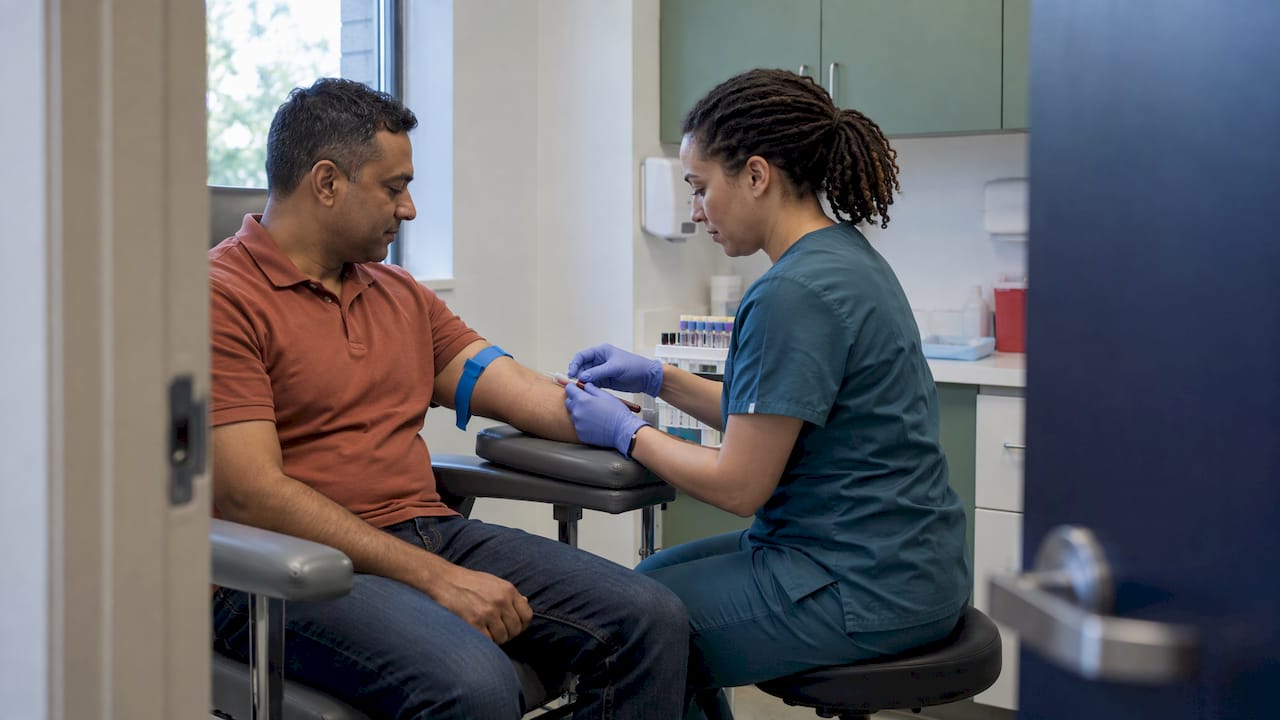
- IGRA blood test. Required for applicants 2 years and older.
- Chest X-ray, only when required. It is done if the IGRA is positive, if you have signs or symptoms of TB disease, or if you have known HIV infection.
- Referral to the local health department, only when required. This applies if the X-ray suggests infectious TB, if you have symptoms of infectious TB, or if you have known HIV infection. The health department handles sputum testing.
For X-rays, the CDC specifies a posteroanterior view for applicants 10 and older. Applicants under 10 get an anteroposterior or posteroanterior view plus a lateral view.
In practice most applicants only complete steps 1 and 2. A negative IGRA with no symptoms means no X-ray and no referral, and the TB portion is finished.
What a positive IGRA means
A positive IGRA shows that your immune system has reacted to TB bacteria at some point. It does not tell the doctor whether you have active disease. That is why the next step is a chest X-ray, not a diagnosis. Many people with a positive result have latent TB infection (LTBI), meaning they carry the bacteria but are not sick and cannot spread it.
After a positive IGRA, one of three things usually follows:
- Normal chest X-ray and no symptoms. The civil surgeon can continue with the exam. Civil surgeons also report LTBI results to the local health department where you live, according to the CTCA reporting instructions. This is routine public health reporting and not a mark against your application.
- Abnormal X-ray or symptoms. You are referred to the health department of jurisdiction for sputum testing and evaluation.
- Known HIV infection. This also triggers an X-ray and a health department referral under the CDC instructions.
If you have a cough lasting weeks, fever, night sweats or unexplained weight loss, tell the civil surgeon at the start. These symptoms change the pathway. If you have a positive result and symptoms, see your own doctor or the health department promptly, because TB disease is treatable.
Class A and Class B: why the distinction matters
The CDC’s surveillance report on U.S.-bound immigrants explains the classifications. Class A conditions make an applicant inadmissible. For TB, that means infectious TB disease. Class B TB covers the lower-risk categories:
- B0: completed successful TB treatment overseas.
- B1: signs or symptoms suggestive of TB, but tests ruled out current infectious TB.
- B2: diagnosed with latent TB infection.
- B3: close contact of a person with TB disease.
The USCIS Policy Manual says a Class A condition is conclusive evidence of inadmissibility on health grounds. A Class B condition does not make you inadmissible on health grounds, though an officer could consider other grounds, such as public charge, in the overall case. A waiver may be available to applicants who are inadmissible because of a medical condition.
The CDC’s surveillance report also notes that a follow-up TB exam is recommended after arrival for people with Class B TB. If you are in that group, your own doctor can guide this after your case is settled.
If the civil surgeon refers you to the health department
A referral is the one situation that adds real time to your I-693. The CDC instructions say the civil surgeon must not classify you, issue TB medical clearance, sign the I-693 or submit the eMedical record until you return from the local health department with documentation of your infectious TB evaluation. The USCIS Policy Manual adds that referral, testing and treatment can take a long time.
If TB disease is diagnosed, the CDC Yellow Book describes the overseas requirements: culture, drug-susceptibility testing and directly observed therapy through the end of treatment before immigration. For applicants in the U.S., the practical message is the same. The civil surgeon waits for the health department’s documentation, and you cannot rush a medical clearance that depends on completed treatment.
Bring your TB history with you
If you were ever treated for TB or had a positive skin test, bring the paperwork. The U.S. Department of State medical examination FAQs say applicants with a previous positive skin test should provide a certificate from the attending doctor describing the circumstances, any treatment and its duration. Anyone ever diagnosed with TB should present a signed written certification that treatment was adequate. That guidance is written for visa applicants, and the same kind of records help any civil surgeon understand your history quickly.
What about 2026 projections?
People often search for which countries will have a high TB burden in 2026. WHO does not publish a forward-looking list of countries. Its report gives estimates for a completed year, and the latest covers 2024. The high-burden list is revised periodically, so treat any list labeled for 2026 as a restatement of recent data.
For your I-693, the projection question does not matter. The civil surgeon’s IGRA requirement applies to everyone age 2 and older, so no future change to a country list alters the test you will take in the U.S. Check the current CDC and USCIS instructions if you want to confirm the rules in force when you apply.
What else can make an I-693 problem
TB is one part of the public health review. The CDC addendum to the technical instructions states that applicants are inadmissible if they have a communicable disease of public health significance, a physical or mental disorder with associated harmful behavior, a history of such a disorder with behavior likely to recur, or if they are drug abusers or addicts. Most applicants clear all of these. Vaccination documentation and a correctly completed, sealed form are where we see most avoidable delays.
Our perspective
We have performed nothing but immigration medical exams since 2007. In that time the most common worry we hear about TB is a fear tied to the applicant’s birth country. People arrive believing a certain passport means extra testing, X-rays or a failed exam. The rule for a U.S. civil surgeon is simpler: everyone age 2 and older gets the same IGRA, and a chest X-ray follows only when the result or symptoms call for it.
What matters is not where you come from but how the exam is run. A positive IGRA should be handled in the correct order: X-ray, symptom review, and a health department referral only if the CDC criteria call for it. The form should not be signed early, and it should not be held back without reason. Because we do only I-693 exams, our team sees these pathways every week. We aim for accuracy, USCIS compliance and a completed I-693 that is right the first time.
We also frequently help applicants who come to us after delays, errors or incomplete vaccination documentation from exams done elsewhere. If you are in that position, bring everything you have: prior forms, vaccine records and any TB paperwork. We can show you what is usable and what is missing.
ImmigrationMedicalExams Medical Team
Get your I-693 done in one place
Our practice handles the civil surgeon exam, required lab testing, vaccination review and required vaccinations when appropriate, and preparation of your Form I-693, all at one location. We offer a flat-package approach designed to minimize unexpected costs, with standard processing in about 3 days and a 2-day expedited option. Learn about the USCIS immigration medical exam, or compare the standard 3-day exam and the 2-day expedited exam. Online scheduling is available 24/7, and we serve applicants across Southern California.

Families can book together, and we also see children, seniors and applicants sent by attorneys. See our full list of services for details.
How to prepare for the TB part of your exam
- Write down symptoms. Note any cough, fever, night sweats or weight loss, with dates.
- Gather TB history. Bring records of any past TB diagnosis, treatment or positive test, ideally from the treating doctor.
- Bring vaccination records. TB screening is only one part of the I-693, and the vaccine review happens at the same visit. If a record is missing, ask us about titer testing and additional vaccinations.
- Bring ID and any prior I-693. If an earlier exam was incomplete or contained errors, bring that too.
- Do not open the sealed envelope. The I-693 goes to USCIS sealed, as the form instructions direct.
- Tell the civil surgeon about HIV status if you know it. Known HIV infection triggers a chest X-ray under the CDC instructions, and that is a medical safety step.
FAQ
Which countries have the highest TB risk?
By WHO’s 2024 estimates, India, Indonesia, the Philippines, China, Pakistan, Nigeria, the Democratic Republic of the Congo and Bangladesh account for two thirds of global cases. WHO also lists 30 high-burden countries in total. These rankings describe disease burden worldwide and do not change the TB test for an I-693 exam done in the U.S.
What happens if my TB test is positive on my immigration medical exam?
The civil surgeon orders a chest X-ray. If it is normal and you have no symptoms, the exam usually continues. If the X-ray or symptoms suggest infectious TB, you are referred to the health department, and the civil surgeon cannot sign your I-693 until that evaluation is documented.
What can cause you to fail an immigration medical exam?
The exam is not pass or fail in the usual sense, but a Class A condition makes you inadmissible on health grounds. For infections, that includes infectious TB disease, infectious syphilis, gonorrhea and infectious Hansen’s disease. Other grounds include certain disorders with harmful behavior and drug abuse or addiction. Waivers may be available in some cases.
Is a chest X-ray required for everyone?
Not in the U.S. A civil surgeon orders a chest X-ray only after a positive IGRA, or when you have TB symptoms or known HIV infection. Overseas panel physicians follow a different rule that requires an X-ray for applicants 15 and older.
Do children need a TB test?
Children age 2 and older need the IGRA. Children under 2 are tested only if they have signs or symptoms suggestive of TB or known HIV infection, according to the USCIS Policy Manual.
Sources
- WHO Global Tuberculosis Report 2025
- CDC technical instructions for panel physicians: tuberculosis
- CDC Yellow Book: pre-arrival medical screening
- CDC technical instructions for civil surgeons: tuberculosis
- USCIS Policy Manual, Volume 8, Part B, Chapter 6
- USCIS Policy Manual, Volume 9, Part D, Chapter 1
- CDC MMWR: disease surveillance among U.S.-bound immigrants
- CTCA reporting instructions for civil surgeons
- U.S. Department of State medical examination FAQs
- CDC addendum to the technical instructions