Laboratory Resource Center
Required Laboratory Tests
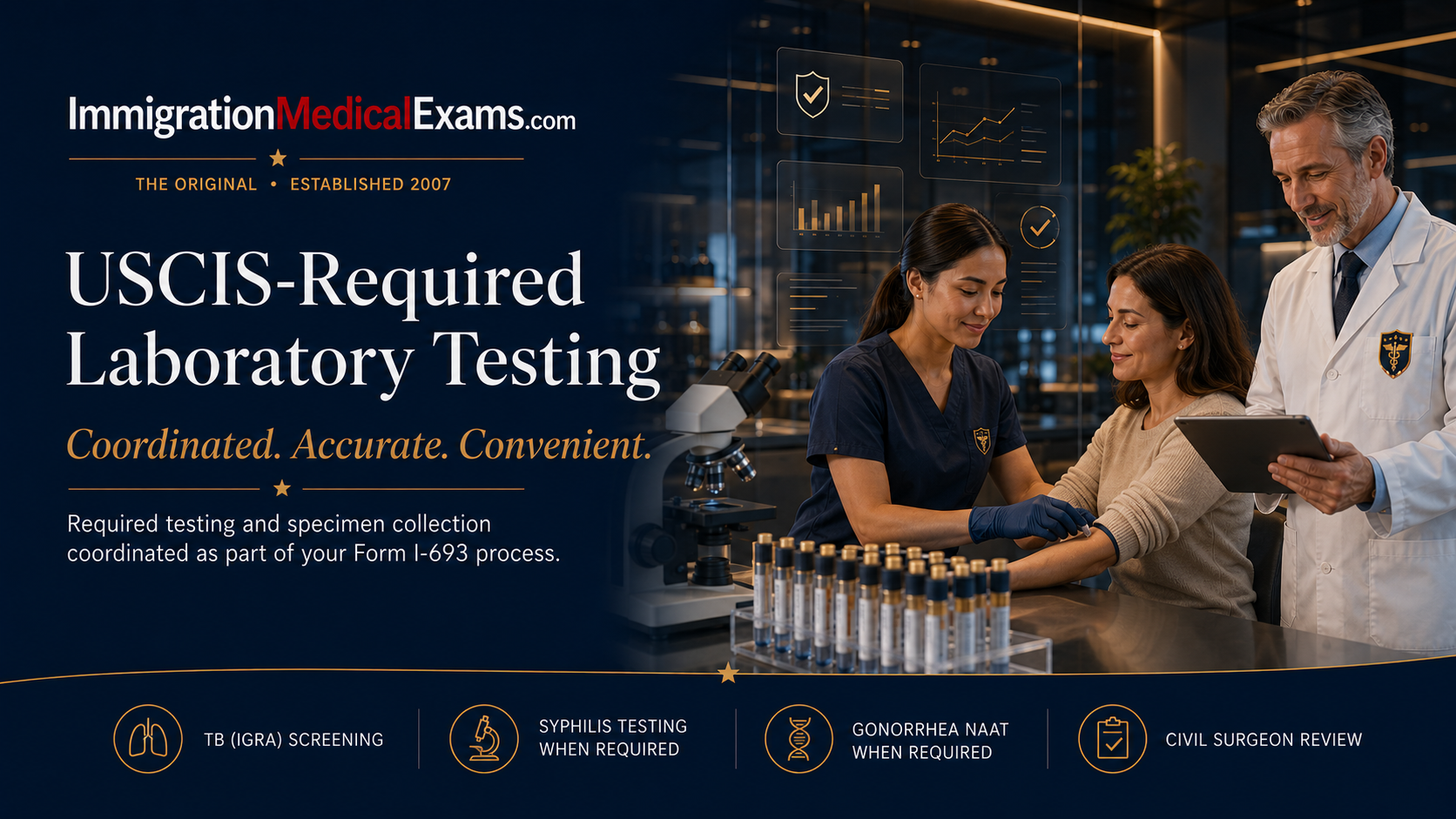
USCIS requires specific laboratory tests as part of the immigration medical exam. Which tests are required depends on the applicant's age and clinical findings — not all tests apply to all applicants. Here is what is required and who needs each test.
Syphilis (RPR)
Required: Ages 18–44; others when clinically indicatedUnder current CDC Technical Instructions, routine syphilis testing (RPR) is required for applicants age 18 through applicants under age 45. Applicants younger than 18 or age 45 and older must be tested when there is reason to suspect syphilis infection. Reactive results require confirmatory testing (FTA-ABS or TP-PA). Testing must be ordered by the civil surgeon at the time of the immigration medical examination.
Gonorrhea (NAAT)
Required: Ages 18–24; others when clinically indicatedUnder current CDC Technical Instructions, routine gonorrhea nucleic acid amplification testing (NAAT) is required for applicants age 18 through 24. Applicants younger than 18 or older than 24 must be tested when there is reason to suspect gonorrhea infection. For asymptomatic applicants without risk factors, the civil surgeon uses the least-invasive acceptable specimen type. Testing must be ordered by the civil surgeon at the time of the immigration medical examination; outside or previously completed gonorrhea tests are not automatically acceptable.
TB (QuantiFERON-TB Gold)
Required: Applicants age 2 and olderApplicants age two and older generally require an interferon-gamma release assay (IGRA) for tuberculosis screening under current CDC Technical Instructions. TST has only a limited role in children younger than two when clinically indicated. A chest X-ray is not a substitute for the required initial IGRA in applicants age two and older. Chest radiography is performed when indicated by a positive IGRA, signs or symptoms of tuberculosis, HIV status, prior history, or other current CDC criteria.
Deep-Dive Lab Guides
Comprehensive articles covering every aspect of immigration laboratory testing — written by our civil surgeon team.
Complete Guide to Immigration Lab Tests
Every USCIS-required laboratory test explained — who needs each test, what the results mean, and how they are documented on Form I-693.
Syphilis RPR Testing for Immigration
In-depth explanation of the RPR syphilis screening test, reactive vs. non-reactive results, confirmatory testing, and what a positive result means for your case.
Gonorrhea NAAT Testing for Immigration
How gonorrhea NAAT testing works, who is required to be tested, turnaround times, and how results are handled on Form I-693.
QuantiFERON-TB Gold Test for Immigration
The required IGRA blood test for TB screening in applicants age 2 and older — how it works, indeterminate results, and what happens if you test positive.
Titer Testing for Immigration Vaccines
When titer tests replace vaccines, which titers USCIS accepts, how to interpret results, and what to do if titers are insufficient.
What Happens With Abnormal Lab Results
Step-by-step guide to what happens when a lab result comes back abnormal — confirmatory testing, treatment requirements, and how findings are documented on Form I-693.
All Lab Tests Performed On-Site
No separate lab visits. No extra appointments. All USCIS-required testing is done at our Costa Mesa clinic on the day of your exam — included in the flat fee.
Frequently Asked Questions
Common questions about immigration medical exam laboratory testing.
Medical Disclaimer: This information is provided for general educational purposes only and does not constitute medical or legal advice. USCIS and CDC requirements are subject to change. Applicants should consult a USCIS-designated civil surgeon and, when appropriate, a qualified immigration attorney regarding their individual circumstances.