

QuantiFERON vs T-SPOT: Which TB Blood Test to Pick

For most immigration and routine occupational screening in the United States, QuantiFERON-TB Gold Plus (QFT-Plus) is the more widely available option simply because more labs are set up to process it. When a patient is immunocompromised, however, T-SPOT.TB often produces fewer indeterminate results, making it the better clinical choice in those cases. Both tests are FDA-approved interferon-gamma release assays (IGRAs) accepted by USCIS and referenced in CDC guidance, so neither will disqualify your I-693 form.
The practical difference comes down to three things:
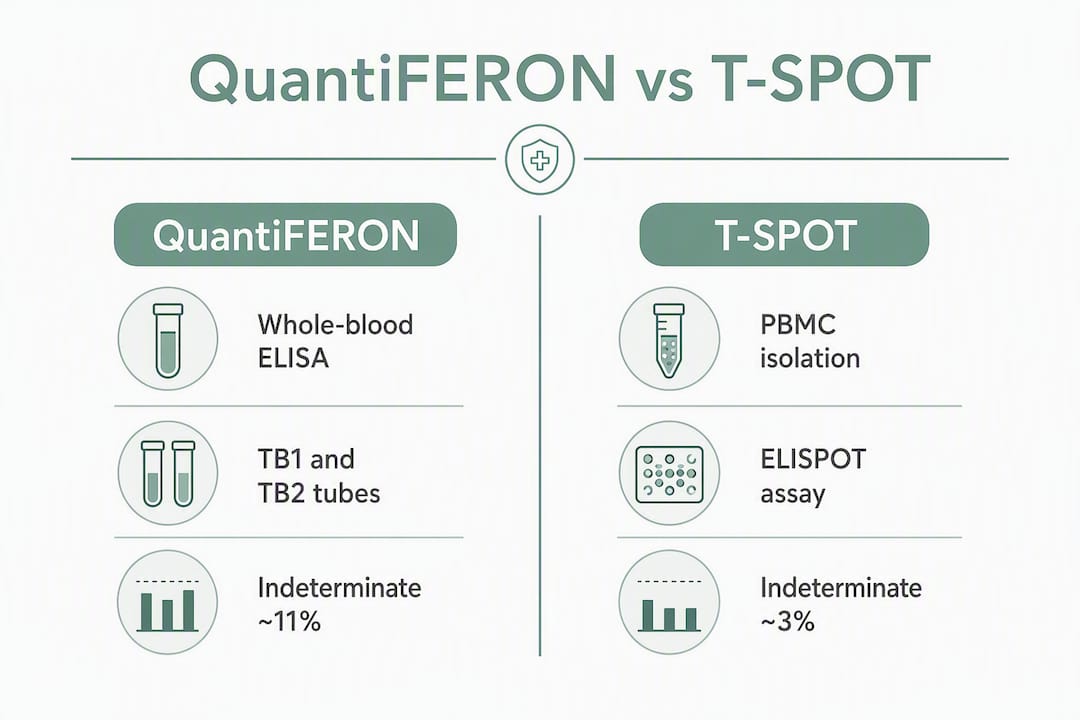
- Method: QFT-Plus measures interferon-gamma concentration in whole blood; T-SPOT.TB counts individual reactive immune cells after isolating them from a blood sample.
- Processing window: QFT-Plus tubes need to reach the lab within roughly 16 hours; T-SPOT.TB samples can typically be processed up to 32 hours after collection, giving remote clinics more flexibility.
- Indeterminate vs. borderline rates: QFT-Plus tends to produce more indeterminate results in immunosuppressed patients; T-SPOT.TB’s cell-counting method handles low-lymphocyte samples better.
Before your appointment, ask your provider two questions: “Which IGRA does your lab process?” and “What is your turnaround window for that test?” The answers will tell you more about which test you’ll actually get than any blanket recommendation.
Table of Contents
- What are QFT-Plus and T-SPOT.TB, and how do they work?
- QuantiFERON vs T-SPOT: head-to-head comparison
- How accurate are these tests, and who is at higher risk for a bad result?
- Why specimen handling can determine which test your clinic offers
- How results are reported and what to do next
- How do you choose between QFT-Plus and T-SPOT.TB?
- What to expect for TB testing during a U.S. immigration medical exam
- Key Takeaways
- Why the “better test” question misses the point
- TB testing for your immigration medical exam at Immigrationmedicalexams
- Authoritative sources and further reading
What are QFT-Plus and T-SPOT.TB, and how do they work?
Both tests belong to the IGRA family, meaning they measure how your immune system responds to TB-specific antigens rather than injecting anything under your skin. That is the key advantage over the older tuberculin skin test (TST): IGRAs are not thrown off by prior BCG vaccination, which is common in people born outside the United States.
QuantiFERON-TB Gold Plus draws whole blood directly into specialized tubes labeled TB1 and TB2. Those tubes contain antigens that stimulate both CD4+ and CD8+ T-cell responses. The lab then runs an ELISA to measure the concentration of interferon-gamma released into the blood. One blood draw, one set of tubes, processed as a unit.
T-SPOT.TB takes a different path. After the blood draw, a technician isolates peripheral blood mononuclear cells (PBMCs) from the sample, then places them on a plate coated with TB antigens. Instead of measuring cytokine concentration, the lab counts the number of “spots” left by individual cells that responded to the antigen. The result is a cell count, not a concentration.
| Feature | QFT-Plus | T-SPOT.TB |
|---|---|---|
| Method | Whole-blood ELISA | PBMC isolation + ELISPOT |
| Sample type | Whole blood (TB1/TB2 tubes) | Whole blood, then PBMC separation |
| What the result measures | IFN-γ concentration | Spot-forming cell count |
QuantiFERON vs T-SPOT: head-to-head comparison
The table below covers the dimensions that most directly affect U.S. patients, immigration applicants, and occupational health clinics.
| Dimension | QFT-Plus | T-SPOT.TB |
|---|---|---|
| How it works | Whole-blood ELISA; TB1/TB2 tubes stimulate CD4+ and CD8+ responses | PBMC isolation; counts IFN-γ–producing spot-forming cells |
| Result categories | Positive / Negative / Indeterminate | Positive / Negative / Borderline / Invalid |
| Processing window | Typically within ~16 hours of collection | Commonly up to ~32 hours for PBMC processing |
| Typical turnaround | 1–3 business days (lab-dependent) | 1–3 business days (lab-dependent) |
| Indeterminate/borderline tendency | Higher rates in immunosuppressed patients | Lower rates in low-lymphocyte samples |
| FDA approval | Yes | Yes |
| CDC/USCIS acceptance | Yes | Yes |
| Cost | Varies by lab and region | Varies by lab and region |
Both QFT-Plus and T-SPOT.TB are FDA-approved IGRAs accepted by USCIS for immigration medical exams and referenced in CDC clinical guidance on TB testing. Neither test is categorically preferred over the other for standard immigration screening — the choice depends on patient characteristics and clinic capability.
Cost varies meaningfully by lab, region, and insurance coverage. Published cost-effectiveness analyses show substantial variability between the two tests and across settings, so confirm pricing directly with the clinic before your appointment.
How accurate are these tests, and who is at higher risk for a bad result?
Across most meta-analyses and systematic reviews, QFT-Plus and T-SPOT.TB show broadly similar diagnostic performance. No consistent, clinically meaningful gap in sensitivity or specificity separates them in healthy adults. Some comparative studies in febrile or active-TB cohorts report occasional slight sensitivity advantages for T-SPOT.TB in small samples, but those findings are not consistent enough to drive a blanket recommendation.
Where the two tests diverge noticeably is in patients with weakened immune systems.
- Immunosuppressed patients (HIV, organ transplant, chemotherapy): T-SPOT.TB’s cell-counting approach can produce fewer indeterminate results because it normalizes for the number of viable cells in the sample. QFT-Plus measures total cytokine concentration, which can fall below the detection threshold when lymphocyte counts are low, triggering an indeterminate result.
- Children under five: Both tests have higher indeterminate rates in young children. Studies evaluating QFT-Plus in pediatric populations show the test performs reasonably well, but indeterminate rates remain a known limitation in this age group.
- Poor sample handling: Delays in processing, temperature excursions during transport, or improper tube mixing can produce indeterminate or invalid results regardless of which test is used.
One prospective clinical study published in The Lancet reported indeterminate rates of 11% for QuantiFERON versus 3% for T-SPOT.TB in a clinical cohort that included immunosuppressed patients. That gap matters in an immigration context because an indeterminate result means repeating the test, which delays your I-693 timeline.
T-SPOT.TB’s cell-counting method can reduce indeterminate outcomes in immunocompromised patients, but not all studies show consistent superiority. Clinicians should individualize test selection rather than applying a single rule.
Pro Tip: If you or a family member is immunosuppressed, tell the clinic before the blood draw. Ask specifically whether they can order T-SPOT.TB and confirm the lab’s processing window. A proactive conversation at scheduling can prevent a second appointment.
Why specimen handling can determine which test your clinic offers
Processing constraints are the most underappreciated factor in the QFT-Plus vs. T-SPOT.TB decision, and they often have nothing to do with clinical preference.

QFT-Plus whole-blood tubes must typically be processed within about 16 hours of collection; T-SPOT.TB samples commonly allow a processing window of up to 32 hours. That 16-hour gap is the reason many community clinics default to QFT-Plus: it fits a same-day courier run to a regional lab. T-SPOT.TB’s wider window is an advantage for clinics in rural areas or those doing weekend draws, where a courier pickup may not happen until the following morning.
| Test | Processing window | Typical lab turnaround |
|---|---|---|
| QFT-Plus | Within ~16 hours of collection | 1–3 business days |
| T-SPOT.TB | Within ~8–32 hours (blood cells) | 1–3 business days |
Statistic callout: The difference between a ~16-hour and a ~32-hour processing window is not just a logistics footnote. For a clinic that draws blood on a Friday afternoon, a 16-hour window may expire before Monday’s courier run, making QFT-Plus effectively unavailable for weekend appointments without same-day transport. T-SPOT.TB’s wider window is what makes weekend or after-hours draws feasible at many sites.
Clinics mitigate these constraints through on-site processing equipment, dedicated courier contracts, or by scheduling blood draws only on days when same-day transport is guaranteed. If your clinic cannot process QFT-Plus within the window, they will either use T-SPOT.TB or ask you to return on a different day.
How results are reported and what to do next
The two tests use different terminology for non-standard results, and that difference affects how clinicians manage them.
QFT-Plus reports three outcomes: positive, negative, or indeterminate. An indeterminate result typically reflects an insufficient mitogen control response or high background noise in the sample, not necessarily TB infection.
T-SPOT.TB reports four outcomes: positive, negative, borderline, or invalid. A borderline result means the spot count fell near the cutoff threshold. That is a different clinical situation from an indeterminate QFT-Plus, and the management path differs accordingly.
If your result is positive:
- A positive IGRA does not diagnose active TB disease. Neither test can distinguish latent TB infection from active disease on its own.
- The civil surgeon or your treating physician will order a chest X-ray.
- Based on the X-ray and clinical assessment, sputum testing or additional imaging may follow.
- If latent TB infection is confirmed, a treatment course (typically isoniazid or rifampin-based) is discussed before or alongside I-693 completion.
If your result is negative after recent exposure:
The immune response to TB infection takes time to develop. The CDC notes it can take 2–8 weeks after infection for a detectable response to appear, and a negative result too soon after exposure may not be reliable. Retesting 8–10 weeks after the exposure event is the standard recommendation.
If your result is indeterminate or borderline:
- The civil surgeon documents the result and typically orders a repeat test.
- Confirm with the clinic whether they will switch assays (e.g., from QFT-Plus to T-SPOT.TB) or repeat the same test.
- If the repeat is also indeterminate, the civil surgeon may use clinical judgment, chest X-ray findings, and symptom history to complete the I-693 evaluation.
- Build extra time into your immigration timeline. A single repeat test adds at least one to two weeks.
How do you choose between QFT-Plus and T-SPOT.TB?
The honest answer is that most patients do not choose, because the clinic’s lab capability decides for them. But knowing the criteria helps you ask the right questions.
Patient-centered factors:
- Immunosuppression: If you are on immunosuppressive therapy, have HIV, or have a low lymphocyte count, ask about T-SPOT.TB specifically.
- Prior BCG vaccination: This does not affect either test. Both IGRAs are unaffected by BCG, unlike the TST. CDC guidance explicitly notes this advantage.
- Recent exposure: If you may have been exposed to TB within the last eight weeks, discuss timing with your provider before testing.
- Age: For young children, discuss indeterminate-rate risks with the ordering physician.
- Timeline pressure: If your USCIS interview is in three weeks, an indeterminate result is a serious problem. Ask the clinic what their indeterminate rate looks like and what their protocol is.
Clinic-centered factors:
- Does the clinic have on-site processing, or does it rely on a courier to a reference lab?
- What is the lab’s courier schedule? Does it run on weekends?
- Can the clinic order both tests, or only one?
- What is the cost difference, and does your insurance cover either?
Questions to ask before you schedule:
“Which IGRA do you use?” / “What is your processing window for that test?” / “What happens if my result is indeterminate, and how quickly can you repeat it?”
What to expect for TB testing during a U.S. immigration medical exam
TB testing is a required component of the USCIS immigration medical exam, and the civil surgeon who completes your Form I-693 is responsible for ordering, collecting, and documenting the IGRA result.
At Immigrationmedicalexams, the TB testing workflow is built into the exam appointment. The blood draw happens on-site, and the clinic coordinates directly with the processing lab to meet the required handling window. Clients do not need to arrange a separate lab visit.
What to bring and expect:
- Bring a government-issued photo ID and any prior TB test records (TST results, prior IGRA results, or documentation of prior TB treatment).
- The blood draw takes a few minutes. Results typically return within one to three business days.
- If the result is positive, the clinic will refer you for a chest X-ray and coordinate the clinical evaluation needed to complete the I-693.
- If the result is indeterminate or borderline, the clinic will advise on repeat testing and document the process for USCIS.
- The sealed I-693 form is delivered within the clinic’s guaranteed turnaround window, currently two to three business days for standard processing.
Immigrationmedicalexams offers same-day and weekend appointments at clinics in Southern California, including Orange County and Los Angeles, with multilingual staff available. For applicants with specific medical conditions that may affect test results, the step-by-step exam process page covers what to expect from start to sealed form.
Key Takeaways
Both QFT-Plus and T-SPOT.TB are FDA-approved, CDC-referenced IGRAs accepted by USCIS, and the choice between them depends primarily on immunosuppression status and the clinic’s lab processing capability.
| Point | Details |
|---|---|
| Standard screening default | QFT-Plus is more widely available at U.S. labs and suits most healthy immigration and occupational screening applicants. |
| Immunosuppressed patients | T-SPOT.TB’s cell-counting method tends to produce fewer indeterminate results when lymphocyte counts are low. |
| Processing window matters | QFT-Plus requires processing within ~16 hours; T-SPOT.TB allows up to ~32 hours, affecting weekend and remote-clinic feasibility. |
| Positive result next steps | A positive IGRA requires a chest X-ray and clinical evaluation; it does not confirm active TB disease on its own. |
| Immigrationmedicalexams | Handles IGRA ordering, on-site blood draws, and sealed I-693 delivery within 2–3 business days at Southern California clinics. |
Why the “better test” question misses the point
The debate over which IGRA is superior tends to focus on sensitivity and specificity numbers, but for most immigration applicants, those numbers are nearly identical across healthy populations. The real variable is operational: which test can your clinic actually process correctly, within the required window, on the day you show up?
That framing matters because an indeterminate result caused by a missed processing window is not a clinical failure. It is a logistics failure, and it is entirely preventable. Clinics that have on-site processing or locked-in courier schedules eliminate that risk before the needle goes in. Clinics that send samples to a reference lab two counties away on a shared courier run are one traffic delay away from an indeterminate result that costs you two weeks.
The second thing people underestimate is the BCG factor. A significant share of immigration applicants were vaccinated with BCG as children, and many arrive at clinics having been told their TST was “always positive.” Both IGRAs cut through that noise cleanly. The test comparison question is almost always less important than the question of whether the clinic is using an IGRA at all instead of a TST.
For immunosuppressed applicants, the calculus does shift. The published indeterminate rate difference between QFT-Plus and T-SPOT.TB in those populations is large enough to matter clinically, and asking for T-SPOT.TB by name is worth the extra conversation with your provider.
TB testing for your immigration medical exam at Immigrationmedicalexams
Immigration applicants in Southern California who need a completed, sealed I-693 form without the back-and-forth of a general medical practice will find a more direct path at Immigrationmedicalexams. The clinic handles IGRA ordering, on-site blood draws, lab coordination, and I-693 documentation under one roof, with a guaranteed 2–3 business day turnaround on sealed forms.

Appointments are available same-day and on weekends at clinics across Orange County and Los Angeles. Multilingual staff support applicants throughout the process, and the flat-fee pricing covers the exam, lab work, and I-693 completion with no surprise add-ons. If your IGRA result comes back positive or indeterminate, the clinic coordinates the follow-up steps, including chest X-ray referral, so your timeline does not stall.
For applicants with specific health considerations, the immigration medical exam services page covers what is included and how to schedule. To book an appointment or confirm availability at a location near you, visit Immigrationmedicalexams.com.
Authoritative sources and further reading
- CDC: Clinical Testing Guidance for Tuberculosis — Interferon Gamma Release Assay — Primary U.S. clinical guidance on IGRA use, result interpretation, and retesting recommendations.
- Comparing QuantiFERON-TB Gold Plus with Other Tests To Diagnose Mycobacterium tuberculosis Infection (PMC) — Agreement study comparing QFT-Plus with QFT-GIT, T-SPOT.TB, and TST.
- Comparison of QFT-Plus and T-SPOT.TB in HIV-infected adults (PMC) — Prospective study examining indeterminate rates and performance in immunosuppressed patients.
- Immigrationmedicalexams: TB Testing for Immigration Medical Exams — Clinic-specific guidance on IGRA use in the I-693 process.
- Immigrationmedicalexams: Complete Guide to Immigration Medical Exam Lab Tests — Overview of all lab tests required for USCIS immigration medical exams.
This article provides general information about TB testing options and is not a substitute for professional medical advice. Confirm current USCIS requirements and your specific test options with a licensed civil surgeon or qualified healthcare provider.
Recommended
- Understanding TB Testing for Immigration: QuantiFERON Gold Explained | ImmigrationMedicalExams.com
- QuantiFERON-TB Gold Test for the Immigration Medical Exam | Immigration Medical Exams
- TB Testing for Immigration Medical Exams — QuantiFERON & More | ImmigrationMedicalExams.com
- Titer Testing for Immigration Vaccines — What You Need to Know | Immigration Medical Exams