Immigration Medical Exam for Couples: How It Works

If you and your spouse are both applying for a green card, each of you needs your own immigration medical exam and your own Form I-693. There is no joint or couples exam. You can book back-to-back appointments, bring your records together and file at the same time, but each of you is examined, documented and sealed in an envelope separately.
This guide walks through what that means in practice: who needs an exam, how to schedule two people efficiently, what each spouse should bring, what happens when one of you needs a vaccine or follow-up, and how to file both forms.
TL;DR
- Each spouse applying for a green card needs a separate exam and a separate sealed Form I-693. USCIS requires a separate form for each applicant.
- You can usually book two appointments in the same visit window, which saves a trip. Each person still gets an individual exam, lab work and vaccine review.
- Bring both sets of vaccination records and any medical records to the first appointment. Missing records are the most common cause of a second visit.
- The civil surgeon gives each of you a sealed envelope. Do not open it unless you are filing online and USCIS instructs you to.
- A form stays valid for two years from the civil surgeon’s signature, so plan the exam around your filing date.
Table of Contents
- Does each spouse need a separate immigration medical exam?
- Can couples schedule and attend the exam together?
- What each spouse should bring
- What the exam covers for each of you
- What if one spouse needs a vaccine or follow-up?
- How the completed forms are delivered and filed
- What does the exam cost for two people?
- Our perspective: treat it as two exams and plan as one project
- Booking your couple’s exams
- Mistakes couples make, and how to avoid them
- FAQ
- Sources
Does each spouse need a separate immigration medical exam?
Yes. The USCIS instructions for Form I-693 state that a separate Form I-693 must be submitted for each applicant. That applies whether you are the principal applicant, a derivative spouse, or a spouse of a U.S. citizen filing your own Form I-485.
The exam is also individual in substance. The civil surgeon reviews your medical history, performs a physical exam, orders the required tests and checks your vaccination record. Then they do the same for your spouse, using that person’s age, history and records. Two people can have very different exams. One spouse may be done in a single visit while the other needs a vaccine dose or a follow-up test.
Who in the family needs one
Most people filing to adjust status must submit Form I-693 completed by a designated civil surgeon, per the same instructions. In a typical household that means:
- The spouse who is the principal applicant.
- The other spouse, if they are also filing for a green card, either as a derivative applicant or on their own petition.
- Each child who is filing, with the exam adjusted for the child’s age.
If only one of you is applying for permanent residency, only that person needs the exam. A U.S. citizen petitioning for a spouse does not take an immigration medical exam.
A note for K visa holders
If you entered on a K-1, K-2, K-3 or K-4 visa and had a medical exam overseas no more than one year before filing to adjust status, you may not need a new full exam. USCIS says that if your vaccination record was not properly completed and included, you must submit a partial Form I-693. Check this on the USCIS page for your situation, and ask an immigration attorney if you are unsure which part applies to you.
Can couples schedule and attend the exam together?
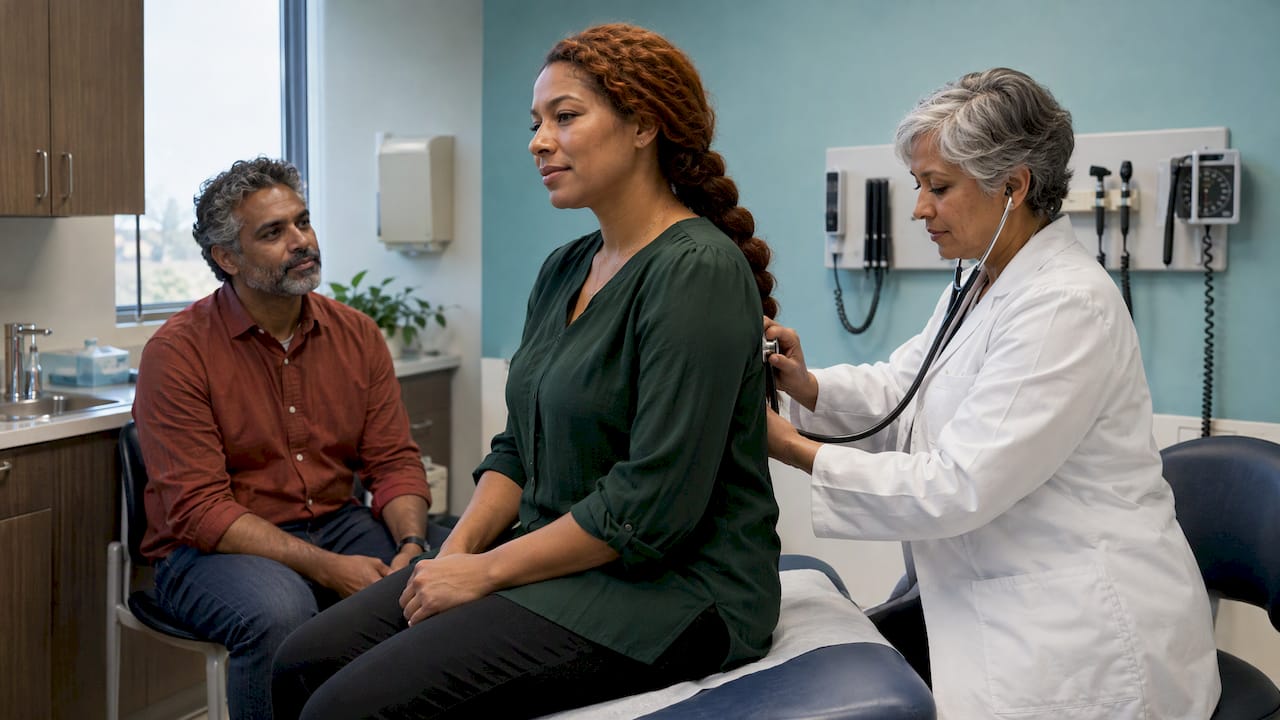
In practice, yes, as separate appointments that you place next to each other. Nothing in the USCIS instructions requires spouses to be examined at different times or places, and nothing makes a joint appointment a different kind of exam. Each person is examined individually and receives their own form.
Here is how to make it work smoothly:
- Book both appointments in the same booking session. Choose adjacent time slots so you only take one day off work.
- Plan for individual privacy. The history and physical are one-on-one. Your spouse may wait for you, but the conversation about your medical history is between you and the doctor.
- Decide who goes first if you have children or one of you has to leave early.
- Pick the processing speed together. If you are filing at the same time, you probably want both forms ready on the same day.
At our practice, we offer family and group exams and online scheduling around the clock, so you can book both spouses without calling during office hours. Standard turnaround is about three days, with a two-day expedited option.
What each spouse should bring
The USCIS instructions tell applicants to bring any medical records, including vaccination records, to the first appointment. Each spouse should bring their own set:
- Government-issued photo ID, such as a passport, driver’s license or state ID.
- Vaccination records, in any format you have: a yellow card, a clinic printout, school or military records, or a record from a previous country.
- Records of past medical conditions or treatments, especially anything related to tuberculosis, a mental health diagnosis with harmful behavior, or substance-related issues.
- A list of current medications.
- A copy of any prior Form I-693 or overseas exam, if you had one.
- Your Form I-485 receipt notice or case details, if you have already filed.
Our I-693 checklist lists everything in one place, and it works well as a shared checklist for two people. Hand each spouse a separate folder. Records get mixed up quickly when two people’s papers sit in one bag.
Vaccination records are the usual stumbling block
Couples often discover during the visit that one spouse has complete records and the other has none. That is common and fixable. Depending on age and history, the civil surgeon may accept documented doses, order blood tests that show immunity, or give the missing vaccines. We cover the details in our guides to USCIS vaccination requirements, adult vaccines for the I-693 and vaccine titers.
What the exam covers for each of you
The requirements are the same for both spouses, with some tests depending on age. According to the Form I-693 instructions, the exam includes:
- Testing for tuberculosis, syphilis and gonorrhea.
- Evaluation for other sexually transmitted diseases and for Hansen’s disease.
- Review of the required vaccination record.
- A physical exam and review of your medical history.
The instructions also explain the tuberculosis steps. Everyone two years of age and older must have an initial TB screening test. If it is positive, a chest X-ray is needed. If the X-ray looks abnormal and suggestive of TB, the civil surgeon must refer you to the health department.
The age bands for syphilis and gonorrhea testing differ. CDC technical instructions for civil surgeons, as summarized in this overview of civil surgeon requirements, call for syphilis testing for applicants aged 18 to 44 and gonorrhea testing for applicants aged 18 to 24. So if you and your spouse are a few years apart in age, your lab orders may not match. That is normal and says nothing about either person’s health.
What if one spouse needs a vaccine or follow-up?
This is where couples most often end up on different timelines. The USCIS instructions are clear on one point: if the civil surgeon refers you for further evaluation or treatment, the civil surgeon cannot finalize your Form I-693 until you have met all the health-related follow-up requirements.
Here is what that looks like in common cases:
| Situation | What usually happens | Effect on your spouse |
|---|---|---|
| Missing vaccine doses | The civil surgeon documents what you have and gives or orders what is missing | None. Your spouse’s form can be finished on its own schedule |
| Positive TB screening test | Chest X-ray, and possibly health department referral | None on the form itself. Only your own form waits |
| Records in another language or incomplete | You bring better documentation, or the civil surgeon fills gaps with testing or vaccines | None |
| Condition needing treatment | The form is finalized only after the required follow-up is complete | Your spouse’s form is a separate document |
Does one spouse’s result affect the other’s application?
Each Form I-693 documents one person’s health findings, and USCIS asks for a separate form for each applicant. The medical results are therefore recorded and evaluated per person. A delay in one spouse’s form does not change the content of the other’s form.
There is a practical effect on timing, though. If you want to file together, one incomplete form can hold up a joint filing. In that case, many couples file each spouse’s application as soon as each is ready, if their situation allows it. Ask your immigration attorney whether filing separately makes sense for your case. For specific health findings, such as a Class A condition that may make an applicant inadmissible, a waiver is a separate legal process, and you should talk to an attorney about it before you decide anything.
The more useful point: vaccines and follow-up are far easier to handle at the first appointment than after you have filed. Do not wait until the week before your interview.

How the completed forms are delivered and filed
The civil surgeon gives each applicant the completed Form I-693 in a sealed envelope. USCIS explains that applicants filing Form I-485 must submit the form with that application. If you file online, you open the envelope, upload the form and then keep both the original and the envelope until USCIS makes a final decision.
For paper filers, the rule is stricter. The instructions state that USCIS will return a form that is not in a sealed envelope, or whose envelope has been opened or altered in any way. With two spouses, make sure the envelopes do not get swapped. Write each person’s initials on the outside of your folder, not on the envelope itself.
Timing: before filing, with filing or at the interview
Since December 2, 2024, USCIS has required certain applicants filing Form I-485 to submit Form I-693, or a partial form such as the vaccination record, with their application, or the application may be rejected. Because rules on timing keep changing, confirm the current requirement for your category on USCIS before you pick a date.
If your situation lets you choose, our guide to getting the medical exam before your interview explains the trade-offs. Our guide to civil surgeon signature rules covers what to check on the form itself.
Validity: the two-year clock
A Form I-693 remains valid for two years from the date of the civil surgeon’s signature. If your spouse’s exam finishes months after yours because of follow-up, the two forms will have different signature dates and different expiration dates. Keep track of each date, especially if your case could take a long time to process.
What does the exam cost for two people?
Fees are set by each civil surgeon, and the exam is paid directly to the doctor. Because every person needs a full exam, a couple should expect to pay twice, plus any extra vaccines or tests each person needs. The USCIS filing fee for Form I-693 itself is separate from the doctor’s fee.
We use a flat-package approach designed to reduce surprise charges. Vaccines, titer tests, replacement envelopes and record copies are listed on our pricing page. If you book and miss an appointment, we charge a $210 missed appointment deposit, so reschedule early if plans change. Insurance generally does not pay for immigration exams, so confirm with your plan before you assume otherwise.
Our perspective: treat it as two exams and plan as one project
We have done nothing but immigration medical exams since 2007. No primary care, no urgent care, no sick visits. After that many years, we see the same pattern with couples: the exam itself is rarely the problem. The problem is that two people’s records, ages and vaccine histories are different, and nobody checks until the appointment.
Our advice is to treat each spouse as an individual case and the filing as one project. Gather both sets of records before you book. Book both appointments in one session. Let the civil surgeon review the vaccination record first, because the vaccine review is where most delays begin.
We also meet many applicants who come to us after a bad experience elsewhere: a form completed with missing vaccine documentation, an exam done by a doctor who does not do immigration work regularly, or an error found at the last minute. Our internal quality review before a form leaves our office exists so the I-693 is right the first time, and so a couple does not have to come back for a correction.
The labs, the vaccines and the form preparation all happen in one place, which means that when one spouse needs a dose or a titer test, we can handle it there instead of sending you across town.
ImmigrationMedicalExams Medical Team
Booking your couple’s exams
If you live in Los Angeles, Orange, Riverside, San Diego or San Bernardino County, you can book both of your exams in one session. Our USCIS immigration medical exam covers the civil surgeon exam, required lab testing, vaccination review and any vaccines you need, and preparation of the sealed Form I-693. Choose the standard 3-day exam if your filing date is flexible, or the 2-day expedited option if you are close to a deadline.

Scheduling is online and available 24/7, so you can book both spouses at the same time. Bring your photo IDs and every vaccination record you can find.
Mistakes couples make, and how to avoid them
These are the problems we see most often:
- Assuming one spouse’s records cover the other. Each person’s vaccination history is separate.
- Waiting until the interview. If a vaccine series needs more than one visit, you need time.
- Opening the envelope. A paper filing with a broken seal is returned by USCIS.
- Ignoring the expiration date. The two-year validity runs from the signature date, and your spouse’s date may differ from yours.
- Going to a doctor who is not a designated civil surgeon. Only a USCIS-designated civil surgeon can perform the exam, with limited exceptions for military and health department blanket-designated civil surgeons.
- Skipping a legal check. A recent USCIS policy lets officers deny a filing that lacks required initial evidence, so ask your attorney whether your packet is complete before you send it.
FAQ
Do both spouses have to go to the same civil surgeon?
No rule requires it, but it is usually easier. One office can review both vaccination records, order the right labs for each age and have both forms ready on the same schedule. Each spouse still receives an individual exam and sealed form.
Can my spouse sit in the room during my exam?
Your spouse can come to the appointment and wait with you for the paperwork, but the medical history and physical exam are done one-on-one. The civil surgeon needs your own answers, in your own words, since the form records your health history.
If my spouse has a problem on the exam, does my I-693 change?
No. USCIS asks for a separate form for each applicant, and each form records only that person’s findings. A delay in one spouse’s form can affect when you file together, so talk with your immigration attorney about timing.
How long does a couple’s exam take?
Each person is examined individually, so plan for two appointments in a row. If both of you have complete vaccination records, the visits are shorter. Missing records, TB follow-up or vaccine doses can add time. With us, standard processing is about three days, and an expedited two-day option is available.
Do we need to file the forms on the same day?
Not necessarily. Each spouse’s Form I-693 goes with that spouse’s application. If both of you file together, both forms should be ready. If one is delayed, ask your attorney whether to file separately.
Sources
- Form I-693 Instructions, USCIS
- Report of Immigration Medical Examination and Vaccination Record, USCIS
- USCIS alert on the Form I-693 submission requirement with Form I-485
- Civil surgeon technical instructions overview