
Adult Vaccines for I-693: What Green Card Applicants Need
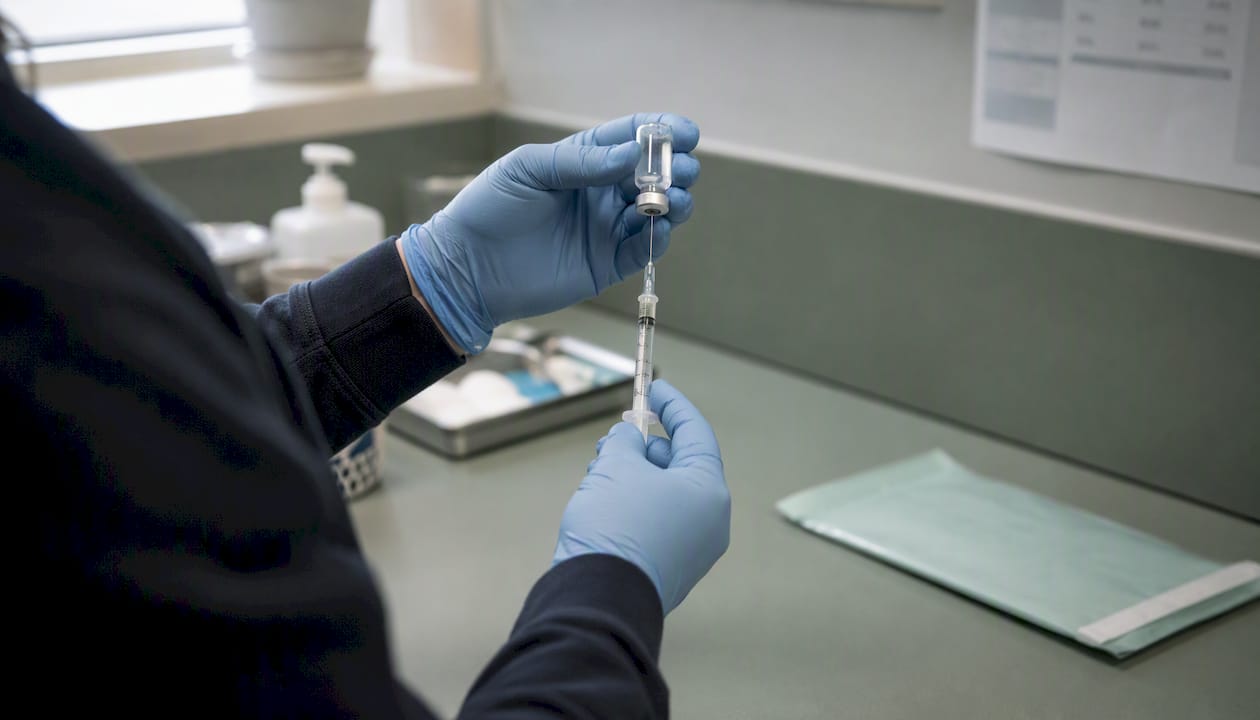
For most adults, the vaccines a civil surgeon will check on Form I-693 include Tdap or Td, MMR (measles-mumps-rubella), varicella, hepatitis B (for those under 60 or otherwise age-appropriate), influenza during flu season, polio/IPV if indicated, meningococcal vaccine when age-appropriate, and COVID-19 when required. USCIS and the CDC Technical Instructions govern this list, and missing any age-appropriate vaccine without an accepted waiver can create a Class A medical condition that makes you inadmissible.
The controlling authority here is 42 C.F.R. § 34.3, which binds civil surgeons to the CDC Technical Instructions as the operative clinical standard. That means the civil surgeon, not your personal doctor, makes the final call on which vaccines apply to you.
Your immediate next step: gather every official vaccination record you have, with exact dates, and schedule an appointment with a USCIS-designated civil surgeon. Do not get vaccines on your own before that appointment.
- Tdap or Td (tetanus, diphtheria, pertussis)
- MMR (measles, mumps, rubella)
- Varicella (chickenpox)
- Hepatitis B (age-appropriate, typically for certain age groups)
- Influenza (required during flu season, generally from early fall through early spring)
- Polio/IPV (if indicated by age or history)
- Meningococcal (if age-appropriate according to CDC guidelines)
- COVID-19 (when required per current policy)
Pro Tip: Do not get non-COVID vaccines before your civil surgeon appointment. The civil surgeon must evaluate which vaccines are medically appropriate for you first. COVID-19 is the one exception: completing that series before your exam can actually speed up processing.
Key Takeaways
The most critical fact for any adult applicant: missing a required age-appropriate vaccine without a documented “not medically appropriate” finding or approved waiver creates a Class A condition that can block your green card application.
| Point | Details |
|---|---|
| Core adult vaccines required | Tdap/Td, MMR, varicella, hepatitis B (age-appropriate), influenza (flu season), and COVID-19 are the most common requirements for adult I-693 applicants. |
| Single-dose rule at the exam | Civil surgeons administer at least one missing dose at the appointment; multi-dose series like hepatitis B can be completed afterward. |
| Concurrent I-693 filing | As of December 2, 2024, Form I-693 must be submitted with Form I-485, not brought to the interview later. |
| Official records only | Vaccination records must show month, day, and year; foreign-language records require certified translation; self-reported histories are not accepted. |
| Immigrationmedicalexams | Offers on-site vaccines, titers, sealed I-693 completion, and a three-business-day turnaround at Southern California clinics. |
Table of Contents
- Which adult vaccines does the I-693 vaccination chart require?
- How does a civil surgeon decide which vaccines you actually need?
- What happens at the exam when you’re missing doses?
- When can a vaccine be skipped? Medical waivers and contraindications explained
- Recent rule changes that affect your I-693 appointment
- What the civil surgeon records on Form I-693 and how to avoid costly errors
- How to prepare for your civil surgeon appointment: a practical checklist
- A note from an immigration medical exam provider
- How Immigrationmedicalexams simplifies meeting your I-693 vaccine requirements
- Sources
Which adult vaccines does the I-693 vaccination chart require?
The CDC Technical Instructions for Civil Surgeons define the vaccination chart that civil surgeons complete on Part 10 of Form I-693. Each row corresponds to a vaccine-preventable disease, and the civil surgeon marks whether you have documentation, need a dose, or qualify for a “not medically appropriate” notation. Here is how the major rows apply to adult applicants.
| Vaccine | Typical Adult Applicability | Notes |
|---|---|---|
| MMR (measles, mumps, rubella) | All adults without documented immunity | Two doses required; titers accepted if documented |
| Varicella | Adults without documented immunity or prior disease | Two doses or positive titer accepted |
| Tdap / Td | All adults | One Tdap dose, then Td booster every 10 years |
| Hepatitis B | Adults under 60; case-by-case above 60 | Three-dose series; titer may confirm immunity |
| Polio (IPV) | Adults with incomplete or no prior series | Age and history determine applicability |
| Influenza | All age-appropriate adults during flu season (Oct 1–Mar 31) | Seasonal; required if exam falls in that window |
| Meningococcal | Age-appropriate adults (typically 11–18 or high-risk groups) | MenACWY and/or MenB depending on age/risk |
| Hepatitis A | Age-eligible adults per CDC schedule | Two-dose series |
| Pneumococcal | Adults 65+ or with qualifying conditions | PCV15/PCV20 or PPSV23 per CDC schedule |
| Hib (Haemophilus influenzae type b) | Generally not required for adults | Rarely age-appropriate for adult applicants |
| Rotavirus | Not applicable to adults | Age cutoff makes this inapplicable |
How “age-appropriate” is determined. The civil surgeon uses your age on the exam date and cross-references CDC Table 1 in the Technical Instructions. If a vaccine is not recommended for your age group by the CDC immunization schedule, the civil surgeon marks it “not age-appropriate” and moves on. Hib and rotavirus, for example, almost never apply to adult applicants because the CDC schedule does not recommend them past early childhood.
What documentation counts. Official written records showing the month, day, and year of each dose are required. A printout from a pharmacy system, a yellow WHO card, or a government-issued vaccination booklet all qualify, provided the dates are complete and legible. Records not in English require a certified translation. Self-reported histories, where you simply tell the civil surgeon what you received, are not acceptable.
Flu season timing matters more than most applicants realize. If your exam falls between October 1 and March 31, the influenza vaccine row becomes active for all age-appropriate adults. Schedule accordingly, or expect to receive a flu shot at the appointment.
How does a civil surgeon decide which vaccines you actually need?
The process follows a clear sequence, and understanding it helps you walk in prepared rather than surprised.
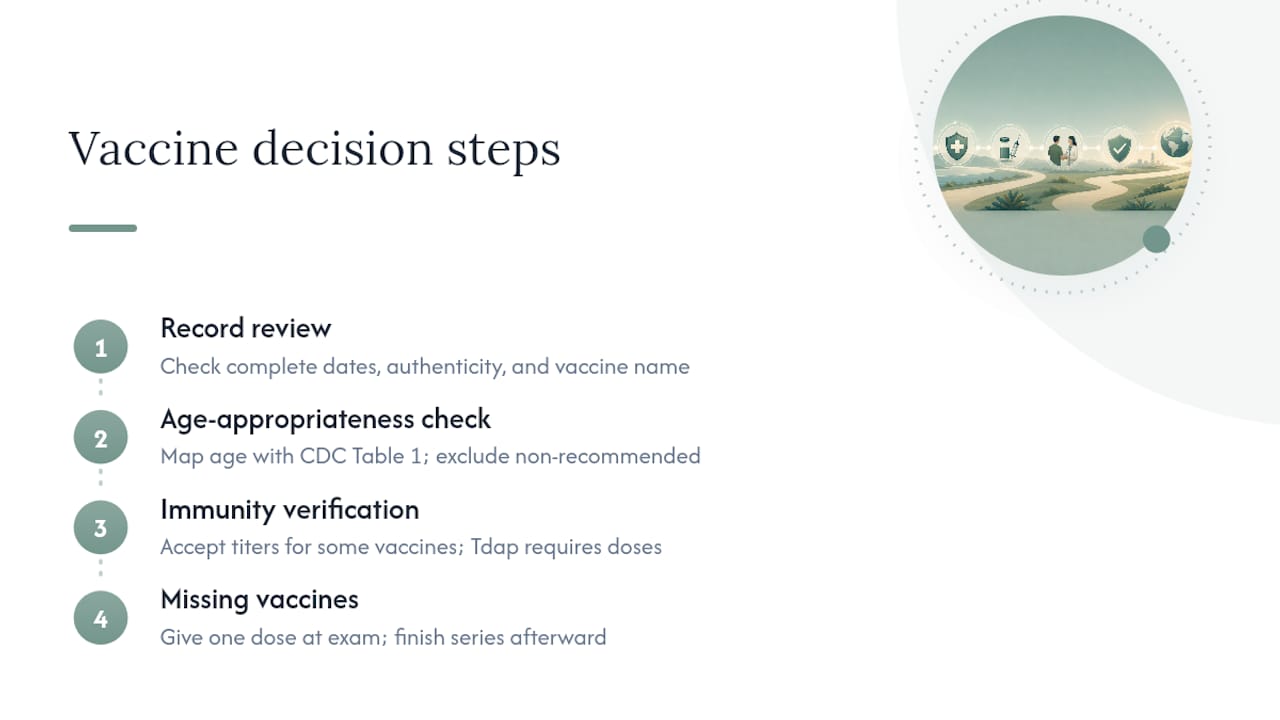
Step 1: Record review. The civil surgeon examines your written vaccination records first. They check that each dose has a complete date (month, day, and year), that the record appears authentic, and that the vaccine name matches a recognized formulation. Foreign records are evaluated for format and apparent authenticity; if they are not in English, a certified translation must accompany them.
Step 2: Age-appropriateness check. Using CDC Table 1, the civil surgeon maps your age to each vaccine row. Vaccines not recommended for your age group are marked accordingly and require no further action.
Step 3: Immunity verification. For some vaccines, laboratory confirmation of immunity (a titer test) is an accepted alternative to documented doses. A positive MMR titer, for instance, can satisfy that row without additional vaccination. However, titers do not replace vaccine doses in every situation. For Tdap, there is no titer that substitutes for the vaccine; you need documented doses. The civil surgeon decides when titers are appropriate based on the CDC Technical Instructions.
Step 4: Missing vaccines. If a required vaccine has no documentation and no accepted titer, the civil surgeon will generally administer at least one dose at the exam. This satisfies the I-693 requirement for that row while allowing you to complete any multi-dose series afterward.
Pro Tip: Bring your original vaccination records, not photocopies, to the appointment. If your records are in another language, have a certified translation ready before you arrive. The civil surgeon cannot accept your verbal account of what vaccines you received, no matter how certain you are.
Foreign-issued records are common among adult applicants. When vaccines were given abroad, civil surgeons evaluate the format and apparent authenticity of those records. Clinics that specialize in immigration medical exams often help applicants identify which records need translation before the appointment, saving a return visit.
What happens at the exam when you’re missing doses?
The single-dose-at-exam rule is one of the most misunderstood parts of the I-693 process. Civil surgeons are not required to complete an entire vaccine series before certifying the form. They document at least one dose of each missing age-appropriate vaccine, which allows the I-693 to be completed and sealed while you finish the series afterward.

This matters most for hepatitis B, which follows a three-dose schedule typically spread over six months (dose one at day zero, dose two at one month, dose three at six months). Completing the full series before your exam is rarely practical. The civil surgeon gives you the first dose, records it on Part 10, and counsels you to complete the remaining doses with your primary care provider or at a follow-up visit.
Appointment flow, step by step:
- Arrive with all vaccination records, government-issued ID, and passport.
- The civil surgeon reviews your records and determines which vaccine rows need attention.
- Any missing age-appropriate vaccines are administered on-site; you wait briefly for observation after each injection.
- The civil surgeon completes Part 10 of Form I-693 with dates and lot numbers for any vaccines given.
- The form is placed in a sealed envelope and given to you for submission with Form I-485.
- You receive a copy of the vaccination record and instructions for completing any multi-dose series.
Pro Tip: Ask the civil surgeon’s office for a written schedule showing which follow-up doses you need and when. If USCIS later requests updated vaccination documentation, you will need that schedule and proof of completion from a licensed provider, returned to the civil surgeon to update Part 10.
For the hepatitis B series specifically, detailed timing guidance is available at Immigrationmedicalexams, which walks through the schedule and what to do if you started a series abroad.
When can a vaccine be skipped? Medical waivers and contraindications explained
Not every adult applicant will receive every vaccine on the chart. The Form I-693 instructions define specific HHS-recognized reasons a civil surgeon can mark a vaccine “not medically appropriate,” which is distinct from a formal waiver application.
HHS-defined “not medically appropriate” reasons include:
- Age: The vaccine is not recommended for the applicant’s age group per the CDC schedule.
- Contraindication or precaution: A documented allergy, immune condition, or other medical factor makes the vaccine unsafe.
- Inability to complete the series in a reasonable time: Relevant for multi-dose vaccines when the applicant’s timeline makes completion impractical.
- Availability: For influenza and COVID-19, documented unavailability at the time of the exam can be noted.
When a civil surgeon marks a row “not medically appropriate” for one of these reasons, that notation on Part 10 is generally sufficient. A separate waiver application to USCIS is not always required.
Religious and moral objection waivers are a separate, more complicated path. An applicant who objects to vaccination on religious or moral grounds must file a formal waiver request. The civil surgeon’s role is limited to documenting the objection on the form; the waiver decision belongs to USCIS. If USCIS denies the waiver, the missing vaccine becomes a Class A condition, which can result in inadmissibility. This is not a theoretical risk.
What a blanket waiver is. USCIS can grant a blanket waiver for specific vaccines in specific circumstances, typically when a vaccine is unavailable nationwide or when HHS has issued guidance removing a requirement. These are rare and not something an individual applicant applies for; they apply automatically when USCIS announces them.
The clearest warning here: missing a required age-appropriate vaccine without a documented “not medically appropriate” finding or an approved waiver creates a Class A medical condition. That finding can block your green card application entirely until resolved.
Recent rule changes that affect your I-693 appointment
Three specific updates from 2024 onward are directly relevant to adult applicants preparing for the I-693 exam.
Effective December 2, 2024, USCIS requires applicants to submit Form I-693 (or at minimum the vaccination record portion) concurrently with Form I-485. Previously, some applicants submitted the I-485 and brought the I-693 to their interview. That option is gone. USCIS now requires concurrent submission, which means your civil surgeon appointment must happen before you file, not after.
This change has a practical consequence most applicants underestimate: you cannot file your I-485 and then schedule the medical exam. The exam, the sealed I-693, and the I-485 must all be ready at the same time.
COVID-19 vaccination policy. COVID-19 was added to the required vaccine list for immigration in 2021. Civil surgeons document COVID-19 vaccination status on Part 10. The specific requirements, including which vaccines are accepted and how boosters are handled, have been updated periodically. As of the current CDC Technical Instructions, completing your COVID-19 series before the exam is encouraged because it is the one vaccine where pre-exam completion speeds processing rather than creating a problem. Civil surgeons can note a waiver for COVID-19 when the vaccine is medically contraindicated or unavailable.
Polio/IPV update (May 2024). A policy update in May 2024 affected how civil surgeons assess polio vaccination for certain applicants, particularly those whose prior vaccination history involves oral polio vaccine (OPV) received abroad. If your vaccination history includes OPV doses, the civil surgeon will evaluate whether additional IPV doses are required based on the updated CDC guidance. Adults who received a complete OPV series in childhood may still need one IPV dose under the updated rules, depending on their age and history.
The CDC vaccination page for civil surgeons and the USCIS I-693 page are the authoritative sources for current policy. Both pages update when rules change, so check them close to your appointment date.
What the civil surgeon records on Form I-693 and how to avoid costly errors
Form I-693 has two sections most relevant to vaccination: Part 8 (the Civil Surgeon Worksheet, which covers the overall medical examination findings) and Part 10 (the Vaccination Record). Part 10 is where every vaccine row gets documented, and it is the section USCIS officers scrutinize most carefully for completeness.
For each vaccine row on Part 10, the civil surgeon must enter one of the following: the date(s) of documented doses, a titer result with date, or a “not medically appropriate” notation with the applicable reason. A blank row for an age-appropriate vaccine is the most common reason USCIS returns a Form I-693 or issues a Request for Evidence (RFE).
The sealed envelope is not optional. The civil surgeon places the completed I-693 in an envelope, signs across the seal, and gives it to you. USCIS will not accept an unsealed form. If you are filing online, you open the seal to scan and upload the form, but retain the original in case it is needed at an interview.
Common mistakes that cause USCIS to return the form:
- Vaccine entries with incomplete dates (year only, or month and year without the day)
- Illegible handwriting on vaccine lot numbers or dates
- A blank row for a vaccine that is age-appropriate for the applicant
- Missing civil surgeon signature or stamp on Part 10
- Submitting the I-693 without the sealed envelope intact (for paper filings)
- Failing to include the vaccination record when submitting a partial I-693 with the I-485
Pro Tip: Before you leave the civil surgeon’s office, ask to confirm that every age-appropriate vaccine row on Part 10 has an entry, that all dates are written in month/day/year format, and that the envelope is properly sealed and signed. Do not open it. Keep a photocopy of the completed form for your own records before sealing, if the office allows it.
A complete guide to Form I-693 covers the full set of parts and common adjudication issues in more detail.
How to prepare for your civil surgeon appointment: a practical checklist
Preparation before the appointment is where most delays are prevented. The checklist below is organized by timing.
Before your appointment:
- Locate all official vaccination records with complete dates (month, day, year) for every dose you have received.
- If any records are in a language other than English, arrange certified translations before the appointment.
- Do not get non-COVID vaccines from another provider before the civil surgeon evaluates you. Getting vaccinated elsewhere without the civil surgeon’s knowledge creates a documentation problem: those doses will not appear on Part 10 unless you return to the civil surgeon with proof.
- If you have documented allergies or medical contraindications to any vaccine, gather supporting medical records.
- Confirm your appointment requirements with the civil surgeon’s office, including whether they offer on-site vaccines and titers.
- Bring your insurance information if you plan to use it, though many civil surgeon offices charge flat fees that do not bill insurance.
At the appointment:
- Present government-issued photo ID and your passport.
- Hand over all vaccination records and certified translations.
- Expect the civil surgeon to review records, possibly order a titer test, and administer any missing age-appropriate vaccines on-site.
- Wait for the post-vaccination observation period before leaving.
- Confirm that Part 10 is complete and that the sealed envelope is properly signed before you leave.
After the appointment:
- Obtain receipts or records for any vaccines administered at the exam.
- Schedule follow-up doses for any multi-dose series that was started (hepatitis B is the most common).
- Retain the sealed I-693 envelope unopened until you are ready to file your I-485 (or open it only to scan for online filing, per USCIS instructions).
- File Form I-693 concurrently with Form I-485, as required since December 2, 2024.
Pro Tip: Adults who received vaccines in another country and are unsure whether their records meet U.S. documentation standards should call the civil surgeon’s office before the appointment. Many clinics, including those in Southern California, offer pre-appointment consultations to review foreign records and identify gaps.
For adults navigating Medicare transitions alongside immigration paperwork, documentation of adult vaccination history also intersects with coverage transitions in Southern California, particularly for applicants over 65 managing multiple health coverage changes at once.
A note from an immigration medical exam provider
The two documentation problems we see most often are foreign vaccination records without certified translations and records that list only a year, or a month and year, without the specific day. Both cause the civil surgeon to treat the dose as undocumented, which means the applicant receives an additional vaccine they may not have needed. Bringing complete, translated records eliminates that scenario almost entirely.
At Immigrationmedicalexams, every appointment is structured around a checklist-driven review of Part 10 before the envelope is sealed. Vaccines are administered on-site, titers are drawn in the same visit when needed, and the completed I-693 is ready within three business days. Multilingual staff handle record review for applicants whose documents are in Spanish, Vietnamese, Korean, or other languages common in Southern California, which reduces the back-and-forth that slows down other clinics.
One question adult applicants frequently ask is whether the vaccines given at the civil surgeon appointment are safe. They are the same CDC-recommended formulations used throughout the U.S. healthcare system. If an adverse reaction occurs, the civil surgeon documents it and provides appropriate follow-up guidance. Serious reactions are rare, and the observation period after each injection is specifically designed to catch and manage immediate responses.
How Immigrationmedicalexams simplifies meeting your I-693 vaccine requirements
Completing the vaccination requirements for Form I-693 is straightforward when you have an experienced civil surgeon and the right infrastructure in one place. Immigrationmedicalexams offers exactly that for green card and adjustment-of-status applicants across Southern California.
Every appointment includes a civil surgeon examination, on-site vaccine administration, titer/lab testing when needed, and sealed I-693 completion with a guaranteed three-business-day turnaround. If your records are in another language, the team helps identify what needs certified translation before your visit. Same-day and weekend appointments are available at clinics in Orange County and Los Angeles, so you are not waiting weeks to get started.
For older applicants with more complex vaccine histories, the immigration medical exam guide for seniors covers age-specific vaccine considerations in detail. For applicants ready to book, the civil surgeon exam and services page walks through what to expect and how to schedule.
Sources
The rules governing adult vaccines for the I-693 exam come from a small set of primary sources. These are the ones worth bookmarking, because they update when policy changes.
- Chapter 9 - Vaccination Requirement | USCIS
- Vaccination | Technical Instructions for Civil Surgeons | CDC
- 42 C.F.R. § 34.3 — Authority and applicability (eCFR)
Official pages change when policy changes. Check the CDC Technical Instructions and the USCIS I-693 page close to your appointment date for the most current version of the age-appropriate vaccine table.
This article provides general information about USCIS and CDC vaccination requirements for Form I-693. It is not a substitute for advice from a licensed civil surgeon or immigration attorney. Confirm current requirements with the official sources listed above or a qualified professional before your appointment.
Recommended
- What Vaccines Are Required for Immigration? | Immigration Medical Exams
- The Complete Guide to USCIS Form I-693 — ImmigrationMedicalExams.com
- Vaccine Requirements for Immigration Explained | ImmigrationMedicalExams.com
- Titer Testing for Immigration Vaccines — What You Need to Know | Immigration Medical Exams