Minor Consent for I-693 Vaccines: What Parents Need to Know

If your child needs a green card medical exam, a parent or legal guardian handles the consent, the paperwork and the decisions about vaccines. The child does not sign anything if they are under 14. The civil surgeon reviews the vaccine record, gives only the age-appropriate vaccines that are still missing, and records everything on Form I-693. If you object to vaccines, a waiver exists, but it is narrow.
This guide covers consent for minors in practice: who signs, what the civil surgeon can and cannot do without you, what happens when parents disagree or refuse, and how to arrive prepared.
TL;DR
- For applicants under 14, a parent or legal guardian may sign Form I-693 on the child’s behalf.
- A civil surgeon only needs to give one dose of each age-appropriate required vaccine the child is not up to date on. You do not have to finish a whole series first.
- The flu vaccine is required during flu season, October 1 through March 31, for applicants 6 months and older. The COVID-19 vaccine is no longer required.
- Refusing vaccines without a granted waiver can lead to a denial. Medical reasons, such as a contraindication or a vaccine not being age-appropriate, are handled by the civil surgeon on the form.
- Bring every vaccination record you have. Good records often mean fewer shots.
Table of Contents
- Who consents for a child at the I-693 exam
- What the civil surgeon actually does with vaccines
- When you decline a vaccine
- How to prepare your child’s records
- Our perspective: consent should be informed, not rushed
- Booking a child’s or family’s exam with us
- FAQ
- Sources
Who consents for a child at the I-693 exam
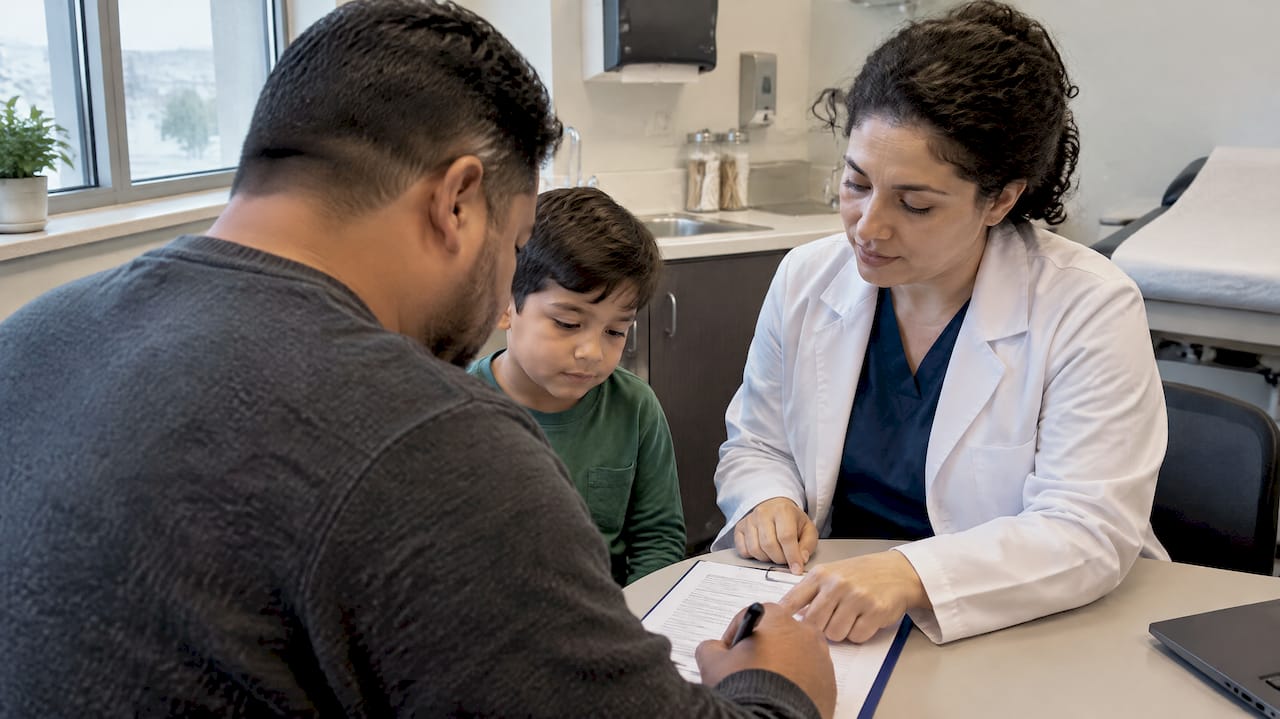
A minor cannot legally consent to medical care in most situations, so the adult responsible for the child does it. In practice that means a parent or legal guardian comes to the appointment, confirms the child’s history, signs the exam paperwork and agrees to any vaccines given that day.
The form itself follows the same logic. USCIS policy says that for applicants under 14, either a parent or legal guardian may sign on the applicant’s behalf. Older teenagers sign for themselves on the form, but we still want a parent or guardian involved in the vaccine conversation for anyone who is a minor under state law.
Two practical points:
- Bring someone with legal authority. A grandparent, aunt or family friend dropping a child off is the most common reason for a rescheduled visit. If someone other than a parent brings the child, check with the clinic first about what written authorization it needs.
- Every child needs their own I-693. Each family member in the application has an individual form, even infants.
The exam is not mainly about your consent being a legal formality. It is about the civil surgeon being able to give you accurate information so you can make a real decision. CDC’s technical instructions for civil surgeons call for counseling on the importance of vaccines, including when a vaccine is not needed that day.
If the question is really who has legal parentage, for example in a contested custody or paternity situation, that is a family law matter outside the exam room. For background on how consent works for testing a minor, this explainer on court-compelled paternity testing may help. Talk to a family law or immigration attorney before the appointment so the clinic is not caught in the middle.
What the civil surgeon actually does with vaccines
Parents often assume the visit means a long list of shots. It usually does not. The process works like this:
- The civil surgeon asks for your child’s vaccination records.
- CDC’s rules say the surgeon must review the records presented and, if they appear valid, record the history on Form I-693.
- The surgeon compares that history against the required vaccines for your child’s age, using CDC’s table of requirements by age.
- For each required, age-appropriate vaccine your child is not up to date on, the surgeon offers a dose.
That last step is where consent matters. The vaccine is never given without the parent’s or guardian’s agreement. If you decline, the surgeon documents it and the waiver rules below apply.
One dose is enough to complete the exam
Multi-dose series scare families, especially with toddlers. The requirement is lighter than it sounds. USCIS says that one dose of an age-appropriate required vaccine is enough when the applicant is not currently up to date. Your child can be mid-series when the form is completed. The pediatrician can continue the schedule afterward.

Which vaccines come up for children
The list depends on age, and CDC updates it. Depending on age and history, common items include MMR, varicella, Tdap or Td, polio, hepatitis B, and others on CDC’s age table. We have written separate guides on several of them:
- MMR clearance in one visit
- Tdap requirements and avoiding delays
- Menactra versus Menveo rules
- Why Shingrix will not replace Varivax
Use CDC’s age table as the authority for exactly what your child needs on the day of the exam, since it changes from time to time.
Flu and COVID-19
The flu vaccine is the one parents most often overlook. USCIS requires it only during the flu season it defines as October 1 through March 31, and it applies from 6 months of age. As of today, October 17, we are inside that window, so a child examined now will be asked about it. Outside the season it is not required.
COVID-19 is different. USCIS waived the COVID-19 requirement for adjustment of status applicants in January 2025, and the vaccine is no longer part of the I-693 vaccine requirements. Older online articles still say otherwise, so check the date on anything you read.

When you decline a vaccine
Parents have three different situations, and they are handled differently.
| Situation | What happens | Action needed from you |
|---|---|---|
| The vaccine is not age-appropriate or is outside the flu season | The civil surgeon notes it on the form and USCIS treats the requirement as waived | Usually none |
| A medical contraindication exists | The surgeon annotates the form accordingly | Bring documentation if you have it |
| You object on religious or moral grounds | An individual waiver may be available | Tell the civil surgeon and follow USCIS waiver procedure |
Blanket waivers are not exceptions
The term “blanket waiver” sounds like something you apply for. It is not. When a vaccine is not medically appropriate, the civil surgeon records that on Form I-693 and USCIS then waives the requirement. No separate request or fee is needed. It happens during the exam.
Individual waivers for religious or moral objections
This route is real but narrow. USCIS explains that a waiver may be available only if you oppose all vaccinations in any form. An objection to one vaccine, to one manufacturer, or to a single ingredient does not meet that standard. The sincerity of the belief also has to be shown. The legal test is set out in the USCIS Policy Manual’s waiver chapter.
The stakes are high. Refusing required vaccines without a granted waiver can result in a denied green card application. Tell the civil surgeon plainly what you object to and why, and speak with your immigration attorney before the exam, not after. The civil surgeon documents your position but does not decide the waiver.
If the parents disagree
People search this question a lot, and it deserves an honest answer: the USCIS and CDC pages we reviewed do not lay out a rule for parents who disagree. Clinics follow their own consent policies and state law on who can authorize care for a minor. If one parent wants the vaccine and the other does not, resolve it before the appointment. If there is a custody order or a guardianship document, bring it. An immigration attorney or a family law attorney is the right person to ask, since the answer depends on your state and your custody arrangement.
How to prepare your child’s records
The single most useful thing you can do is gather records. Fewer gaps on paper means fewer doses in the arm. The I-693 instructions tell applicants to take any medical records, including vaccination records, to the first appointment.
Where to look:
- Pediatrician or school. California schools and daycares keep immunization records, and pediatric offices can print a full history.
- State immunization registry. Many states let parents request a record.
- Records from abroad. Panel physician or foreign clinic records are sometimes incomplete, but civil surgeons review what you bring. Bring all of it, including old yellow cards and translations.
- Blood tests. If records are missing, antibody titers can sometimes show immunity. See our guide on vaccine titers and records for I-693 for how this works.
Other items to bring: a government ID for the parent, the child’s passport or other ID, your filing information if you have it, and any guardianship or custody paperwork. For a walkthrough of the visit, read what happens at an immigration medical exam.
Spanish-speaking families may also find our guide on what consent means on the I-693 useful. It is written in Spanish.
Our perspective: consent should be informed, not rushed
We have performed only immigration medical exams since 2007, and children’s visits are where we see the most avoidable trouble. Most of it comes from three things: the wrong adult at the appointment, records left at home, and a misunderstanding about what “required” means.
We frequently see families who come to us after an exam elsewhere went wrong. Typical examples are a vaccine chart with empty rows, a missing vaccine record, or a form that USCIS questioned. Fixing those costs time that a first visit done correctly would have saved.
What we tell parents:
- Ask questions. A civil surgeon is required to counsel you, and you should leave understanding why each vaccine is or is not being given.
- Do not assume your child needs every shot. A complete record often needs none.
- Do not assume a waiver is easy. If your objection covers all vaccines, talk to your attorney first.
- If your child is mid-series, one dose satisfies the exam. Your pediatrician can finish the schedule.
We do not provide primary care, urgent care or sick visits. Our practice exists to complete the I-693 correctly the first time, with an internal quality review before the form is sealed.
— ImmigrationMedicalExams Medical Team
Booking a child’s or family’s exam with us
We examine children, seniors and whole families, and attorneys and employers send us their clients too. Everything needed for the I-693 is in one location: the civil surgeon exam, lab testing, vaccine review and any required vaccines, and preparation of the form. Standard processing takes about 3 days, with a 2-day expedited option. You can book online at any hour.
Start with our immigration medical exam page, compare the standard 3-day and 2-day expedited options, or see family and children’s exams. Fees for extras such as titer testing and additional vaccinations are on our pricing page, which also lists the $210 missed appointment deposit.
FAQ
Does my child have to sign Form I-693?
Not if the child is under 14. USCIS policy lets either a parent or legal guardian sign on the child’s behalf. The civil surgeon still completes and signs their own section.
Can I refuse certain vaccines for my child?
You can decline, but it has consequences. A waiver is available only if you oppose all vaccinations in any form, and refusing without a granted waiver can lead to denial. Discuss it with your immigration attorney before the exam.
Does my child need a flu shot for the I-693?
If the exam happens during flu season, October 1 through March 31, and the child is 6 months or older, yes, unless it is medically inappropriate. Outside those dates it is not required.
Does my child need the COVID-19 vaccine?
No. USCIS no longer requires it for the I-693. Ignore older articles that say otherwise.
Does my child need to finish a whole vaccine series first?
No. The civil surgeon needs to give one dose of each age-appropriate required vaccine your child is not up to date on. Your pediatrician can complete the rest later.
Sources
- USCIS Policy Manual, Volume 8, Part B, Chapter 4: Review of Medical Examination Documentation
- USCIS Policy Manual, Volume 8, Part B, Chapter 9: Vaccination Requirement
- USCIS Policy Manual, Volume 9, Part D, Chapter 3: Waiver of Immigrant Vaccination Requirement
- USCIS: Vaccination Requirements
- USCIS: COVID-19 vaccination requirement waived for adjustment of status applicants
- Form I-693 instructions
- CDC: Vaccination Technical Instructions for Civil Surgeons
- CDC: Vaccination Technical Instructions FAQs
- CDC: Vaccine requirements by applicant age