

28-Day Live Vaccine Rule That Can Delay Your I-693

The live vaccine waiting period is generally at least four weeks between two injectable or intranasal live vaccines not given on the same day. Same-day administration is always the preferred option because it avoids the interval question entirely. The main exceptions are live oral vaccines like rotavirus and Ty21a typhoid, which carry no spacing requirement at all. When a civil surgeon sees a live vaccine given too recently on Form I-693, the standard practice is to document “insufficient time interval” rather than delay the exam.
TL;DR:
- The 28-day spacing rule applies only to injectable or intranasal live vaccines, excluding oral vaccines like rotavirus and Ty21a typhoid, which have no interval requirement.
- Giving two live vaccines fewer than 28 days apart makes the second dose invalid, requiring it to be repeated at least 28 days after the initial dose.
- Combining vaccines like MMRV simplifies scheduling by removing the need for separate timing, but the rule still applies for individual vaccines not given on the same day.
- The four-day grace period does not override the 28-day rule, and doses administered within that period are still considered invalid and need repeating.
- Using serologic testing to confirm immunity is a faster alternative to repeating doses when vaccination records are incomplete or timing issues arise.
Table of Contents
- Which Vaccines Fall Under the Live Vaccine Waiting Period
- The 28-Day Rule: What CDC Guidance Actually Says and Why
- Exceptions and the Points Where People Get Confused
- What Happens If the Doses Were Given Too Close Together
- Live Vaccines, TB Testing, and Pregnancy: Special Timing Rules
- Why Live Vaccine Spacing Matters for the I-693 Exam
- Clinic Perspective: Common Scheduling Pitfalls and Practical Tips
- Getting Your I-693 Right Even When Vaccine Timing Is Complicated
- Sources
- FAQ
Which Vaccines Fall Under the Live Vaccine Waiting Period
Not every vaccine on the immunization schedule is subject to spacing rules. The interval only applies to vaccines that use a weakened, live version of a virus given by injection or nasal spray. Here’s what that group actually includes:
- MMR (measles, mumps, rubella)
- Varicella (chickenpox)
- MMRV (the combined measles, mumps, rubella, and varicella shot)
- LAIV (live attenuated influenza vaccine, brand name FluMist, given as a nasal spray)
- Certain other live vaccines like yellow fever and zoster (shingles), when relevant to an applicant’s age and history
These vaccines work by triggering a mild, controlled infection so the immune system builds lasting protection. That’s exactly why timing matters: give a second live vaccine too soon, and the immune response from the first can interfere with how well the second one takes.
Two categories sit outside this rule entirely. Live oral vaccines, specifically rotavirus and the oral Ty21a typhoid vaccine, don’t trigger the same interference pattern and can be given at any interval relative to injectable or intranasal live vaccines, according to the CDC Pink Book’s general best practice guidance. The oral route produces a localized immune response in the gut rather than the kind of systemic antibody surge that interferes with a second injected vaccine.
And inactivated vaccines, think flu shots (the injectable kind), Tdap, hepatitis A and B, and most others, don’t interact with live vaccines at all. You can get an inactivated vaccine and a live vaccine on the same day, or any number of days apart, without any effect on how well either one works. If you’re trying to figure out what’s required for your own immigration medical exam vaccinations, the live/inactivated distinction is usually the first thing to sort out before worrying about spacing at all.
The 28-Day Rule: What CDC Guidance Actually Says and Why
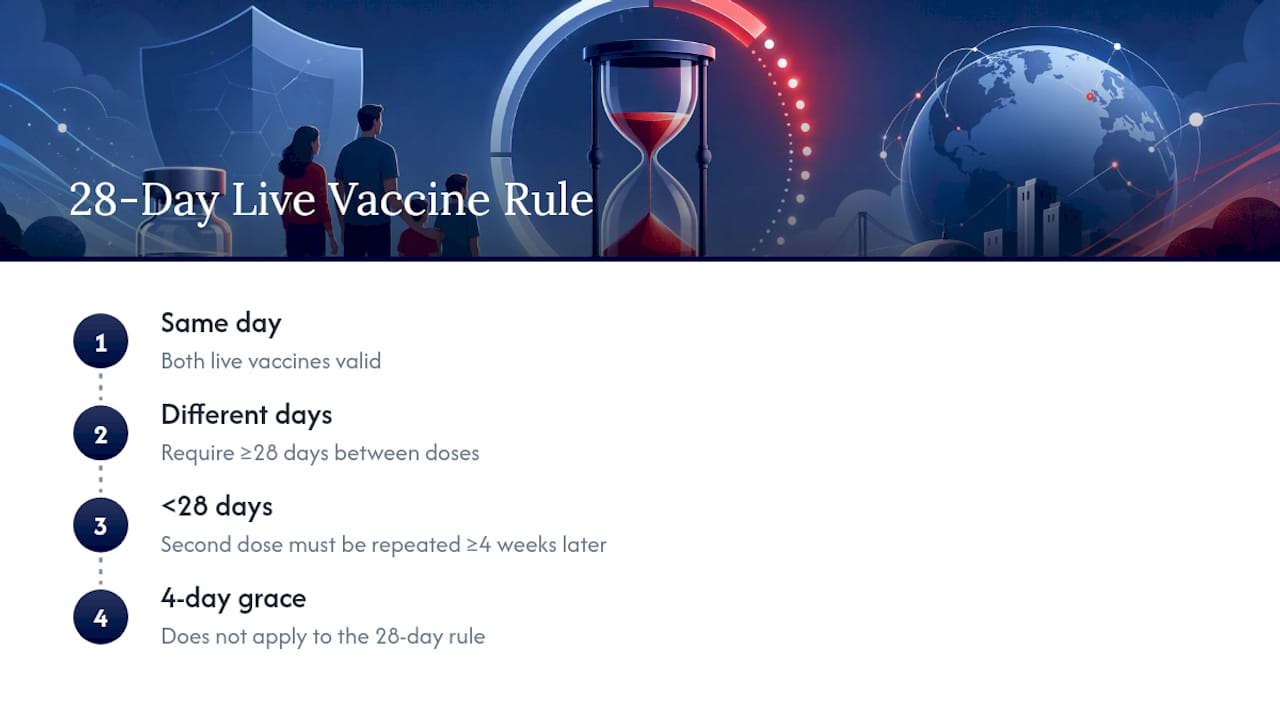
If two injectable or intranasal live vaccines aren’t given on the same day, the CDC Pink Book recommends spacing them at least 28 days apart. That’s the entire rule. There is no shorter “acceptable” window, no rounding down from 27 days, and no partial credit for getting close.
The minimum interval exists because of immune interference, not general caution. A live vaccine given first can trigger an antibody and interferon response strong enough to blunt how well a second live vaccine replicates in the body, and a vaccine that doesn’t replicate properly may not build durable immunity.
The Pink Book is explicit that vaccines separated by fewer than 4 weeks should have the second dose repeated at least 4 weeks after that invalid dose. This is where a lot of confusion creeps in: many vaccine schedules allow a “4-day grace period,” meaning a dose given up to 4 days before the minimum recommended age or interval still counts as valid. That grace period does not apply here. The CDC’s timing and spacing guidance treats the 4-day grace period and the 28-day live vaccine interval as two separate concepts entirely, and mixing them up is one of the most common scheduling errors clinics see.
A couple of concrete timelines make this easier to picture. Say a patient gets MMR on March 1. If varicella is also needed, the clinic can give it that same day with no interval required. But if varicella wasn’t given until March 15, that’s only 14 days later, well short of 28, so that varicella dose would need to be repeated no earlier than March 29 (28 days after the March 1 MMR dose, using the later date as the anchor). If instead varicella had been delayed until March 29 or later, the interval would be valid and no repeat dose would be needed.
Exceptions and the Points Where People Get Confused
Three situations account for most of the confusion around live vaccine spacing, and each one has a clean answer once you separate it from the general rule.
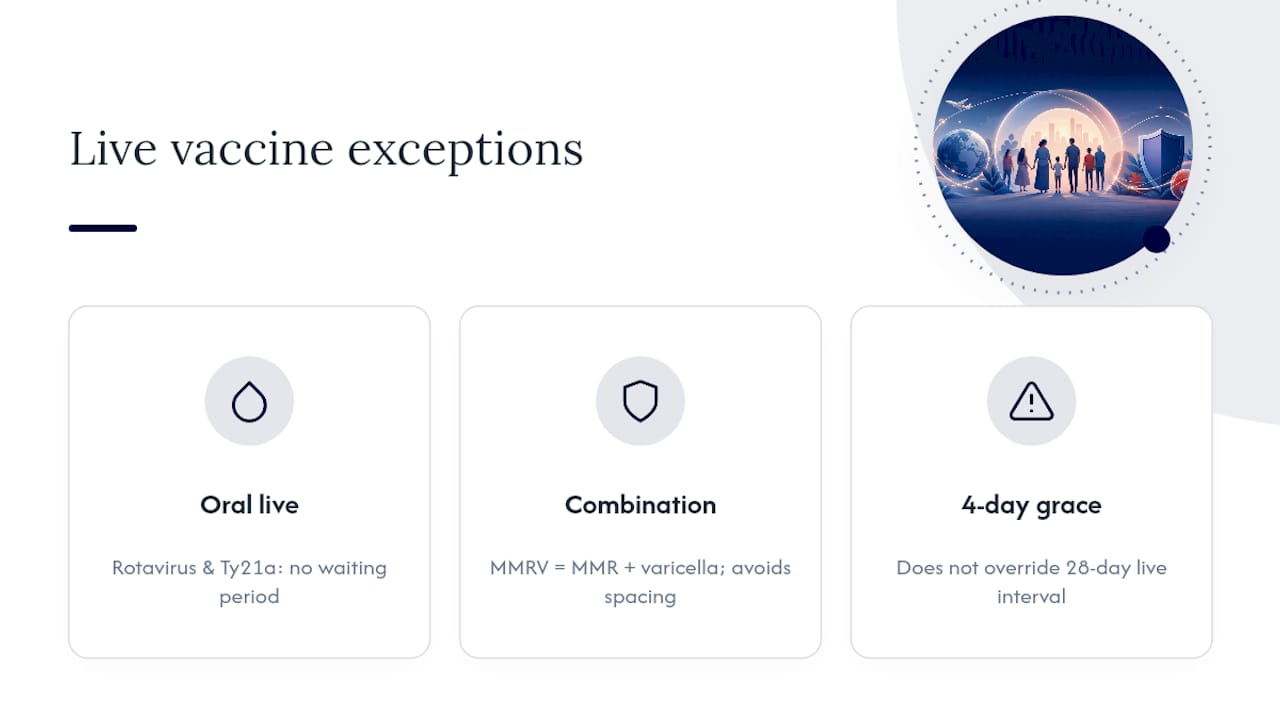
Live oral vaccines are the cleanest exception. Rotavirus and oral Ty21a typhoid can be given before, after, or alongside any injectable or intranasal live vaccine with no waiting period at all, per the CDC Pink Book. If a parent is told a rotavirus dose needs to wait 28 days after an MMR shot, that’s simply incorrect guidance.
Combination vaccines simplify the calendar. MMRV bundles measles, mumps, rubella, and varicella into a single shot, which sidesteps the spacing question entirely for those four diseases in one visit. Some clinics prefer separate MMR and varicella shots for younger children due to a slightly different fever risk profile, but from a scheduling standpoint, MMRV is the simplest path when it’s appropriate for the patient’s age.
The 4-day grace period never overrides the 28-day live vaccine interval. The grace period is designed for minimum-age and minimum-interval rules on the broader immunization schedule, not for spacing between two live vaccines. If a live vaccine was given 24 or 25 days after another, that’s still short of 28, and the grace period doesn’t rescue it.
Pro Tip: If you’re not sure whether a vaccine on your record is “live,” ask your provider directly rather than guessing from the vaccine name. MMRV, LAIV, and the standalone MMR and varicella vaccines are the ones that trigger the 28-day clock; everything else on a typical adult or pediatric schedule usually doesn’t.
What Happens If the Doses Were Given Too Close Together
A second injectable or intranasal live vaccine given fewer than 28 days after another live vaccine doesn’t count. Full stop. That dose is considered invalid, and it needs to be addressed before it can be relied on for immunity documentation, including on immigration paperwork.
Here’s how that typically gets resolved:
- Confirm the exact dates. Pull the vaccination record and calculate the interval precisely. A 26-day gap and a 30-day gap look similar but are treated completely differently.
- Repeat the invalid dose. The standard fix is giving the second vaccine again, at least 28 days after the date it was originally (invalidly) administered, per ACIP general recommendations.
- Consider serologic testing where appropriate. For some vaccines, particularly MMR, a blood test for measles IgG antibodies can confirm existing immunity and avoid an unnecessary repeat dose if titers come back positive.
- Ask your provider to document the invalid dose clearly. A well-documented record prevents the same confusion from happening again at a future appointment or exam.
If you’re working through this ahead of an immigration medical exam, the smartest move is bringing every vaccination record you have to the appointment, even ones from years ago or from a different country. Gaps in documentation are one of the most common reasons civil surgeons end up ordering repeat vaccines that may not have actually been necessary.
Live Vaccines, TB Testing, and Pregnancy: Special Timing Rules
A few populations and testing scenarios add extra timing considerations on top of the standard 28-day rule.
TB testing (TST or IGRA) interacts with live vaccines. The CDC’s best practices guidance recommends giving a tuberculin skin test or interferon gamma release assay either on the same day as a live vaccine or waiting a full 28 days after the vaccine before testing. Live vaccines can temporarily suppress the skin reaction that TST relies on, which risks a false negative if the test is done too soon afterward. Testing first and vaccinating a day or more later is generally fine; it’s live vaccine first, then TB test, that requires the 28-day wait.
Pregnancy generally rules out live vaccines. MMR, varicella, and LAIV are typically contraindicated during pregnancy because of theoretical risk to the fetus. The standard approach is to defer these vaccines until after delivery and document the deferral clearly on any medical exam paperwork. Anyone navigating both pregnancy and an immigration exam should look closely at how pregnancy affects vaccine timing and deferrals before their appointment.
Immunocompromised patients need individualized guidance. Many live vaccines carry contraindications for people with significant immune suppression, whether from medication, transplant history, or an underlying condition. This isn’t a situation to navigate through general web research; it calls for a conversation with a treating specialist, with the outcome documented for whatever exam or form requires it.
Why Live Vaccine Spacing Matters for the I-693 Exam
Civil surgeons who complete Form I-693 apply the same CDC vaccination standards used everywhere else in U.S. medicine, and the 28-day live vaccine rule is no exception. When an applicant shows up having received a live vaccine within the past 28 days that conflicts with another required dose, the civil surgeon doesn’t need to stall the whole exam. The standard notation is “insufficient time interval,” which lets the exam proceed while the remaining dose gets scheduled properly.
That said, applicants who arrive with a clean, complete vaccination history and no timing conflicts almost always move through the process faster. A few practical options help avoid the issue altogether: titer testing to confirm existing immunity instead of an unnecessary repeat dose, scheduling any required live vaccines with the 28-day window in mind before the exam date, or using titer testing services when serology is a faster path than a repeat shot. Vaccine review, on-site vaccinations, and lab work handled at a single visit are exactly the kind of coordination that keeps a 3-day standard turnaround realistic instead of theoretical.
Clinic Perspective: Common Scheduling Pitfalls and Practical Tips
The most common problem isn’t the 28-day rule itself. It’s applicants showing up without complete records, especially when a live vaccine was given at a pharmacy, a school clinic, or in another country, and nobody connects the dots until exam day. That single missing date can turn a straightforward appointment into a delay.
The fix is almost always simpler than people expect. Bring every immunization record you can find, even partial ones, and mention any vaccine given in the last month specifically. If timing looks tight, ask about titer testing before assuming a repeat dose is required. And if a spacing conflict does turn up, it’s resolvable: a documented “insufficient time interval,” a scheduled follow-up dose, or a same-day serology result usually keeps the process moving rather than stopping it cold.
— ImmigrationMedicalExams Medical Team
Getting Your I-693 Right Even When Vaccine Timing Is Complicated
Vaccine spacing conflicts are one of the most common reasons an immigration medical exam stalls, and they’re also one of the easiest to prevent when a clinic handles vaccine review, on-site vaccination, and lab testing under one roof instead of sending you elsewhere first. The clinic focuses exclusively on Form I-693 exams, with no primary care or urgent care visits diluting that focus, which means every appointment is built around getting the form right the first time.

If a live vaccine was given too recently, our team can document “insufficient time interval” correctly, order titer testing when it’s the faster path to confirmed immunity, and schedule any repeat dose without derailing your timeline. Standard processing runs about 3 days, and a 2-day expedited option is available when your case is time-sensitive. Every exam follows a package pricing approach designed to avoid surprise charges, and appointments can be booked online any time. Start by scheduling your USCIS immigration medical exam and bring whatever vaccination records you have, even incomplete ones. We’ll sort out the rest.
FAQ
Why wait 28 days between live vaccines?
The wait prevents immune interference: the first live vaccine can trigger an antibody response strong enough to blunt how well the second vaccine replicates and builds immunity. The CDC Pink Book sets 28 days as the minimum interval when two injectable or intranasal live vaccines aren’t given the same day.
What is the current live vaccine schedule rule in the US?
Same-day administration of live vaccines is always acceptable and preferred. If they’re not given the same day, they need at least 28 days apart, while live oral vaccines like rotavirus and Ty21a typhoid have no such requirement at all.
Is it safe to delay the MMR vaccine until 24 months old?
MMR is typically recommended starting in early childhood with a second dose several years later, and delaying the first dose doesn’t create a safety issue on its own. The bigger concern with delay is extended vulnerability to measles, mumps, and rubella during the wait, which is a separate question from vaccine spacing.
Can you get a live and a non-live vaccine at the same time?
Yes. Inactivated vaccines can be given simultaneously with a live vaccine, or before or after it at any interval, without any effect on either vaccine’s effectiveness, according to CDC timing and spacing guidance. The 28-day rule only applies between two live vaccines, not between a live and an inactivated one.
What if my immigration medical exam shows a live vaccine given too recently?
The civil surgeon will typically document “insufficient time interval” on Form I-693, which lets your exam proceed while the repeat dose or titer test gets scheduled. Immigrationmedicalexams handles this documentation, along with titer testing and any needed follow-up vaccination, as part of its standard I-693 process.