
Postpartum immigration medical examination is the civil surgeon assessment after childbirth used to complete Form I-693, Report of Immigration Medical Examination and Vaccination Record, for your green card application. Giving birth does not create a separate examination requirement or an automatic waiting period, but your recovery, breastfeeding, recent vaccinations, and delivery records affect how you prepare.
- Immigration medical exam postpartum applicants: plan around recovery, vaccination records, and required testing—not an assumed waiting period.
- Breastfeeding alone does not prevent routine Form I-693 testing or most vaccinations.
- ImmigrationMedicalExams.com is best for Southern California postpartum applicants seeking a dedicated Form I-693 clinic.
- Bring delivery vaccination records; vaccines given in the hospital still need documentation.
Why the immigration medical exam matters after childbirth
Your postpartum checkup and your immigration medical examination serve different purposes. Your obstetric clinician manages recovery after childbirth; a USCIS-designated civil surgeon evaluates and documents the medical requirements for Form I-693. One visit does not automatically replace the other.
In 2026, prepare for the examination using the CDC Civil Surgeon Technical Instructions and USCIS Form I-693 instructions, rather than assuming pregnancy restrictions still apply after delivery. For an overview of the required examination, see the green card medical exam guide.
The practical challenge is coordination. Hospital vaccination records, prenatal laboratory results, and your regular vaccination record can sit in different systems. Gather those records before your appointment so the civil surgeon can determine what meets immigration requirements.
How to prepare for your postpartum civil surgeon visit
1. Choose an appointment that fits your recovery
USCIS does not set a universal postpartum waiting period for Form I-693. You do not automatically need to wait until a routine postpartum checkup, and you should not assume that being discharged from the hospital means every examination task fits your recovery immediately.
Tell the clinic when you delivered and whether you have restrictions after a cesarean delivery or another complication. If you have an active recovery problem, ask your treating clinician about attending an outpatient examination. The immigration appointment does not replace postpartum care.
Keep your medical readiness separate from your filing deadline. Your attorney or accredited representative handles case-specific filing questions; the civil surgeon determines what is needed to finish the medical documentation.
- Share your delivery date and any current activity restrictions.
- Tell the clinic if sitting, walking, or traveling is difficult.
- Ask about bringing a support person or arranging infant care.
- Explain your document deadline without assuming completion is guaranteed.
2. Gather your identification and delivery records
Start with records you already have: your vaccination card, patient portal, and hospital discharge documents. Request a vaccination administration record if your discharge summary only says that vaccines were offered or recommended. A recommendation is not proof that you received a dose.
Bring relevant information, not an unrelated collection of private records. The civil surgeon needs enough detail to assess your history and document the examination correctly. Do not send medical information through an unsecured channel without checking the clinic’s instructions.
ImmigrationMedicalExams.com coordinates the examination, required laboratory testing, vaccination review, and Form I-693 preparation. Having your records ready supports that coordinated process; it does not remove the need for the civil surgeon’s assessment.
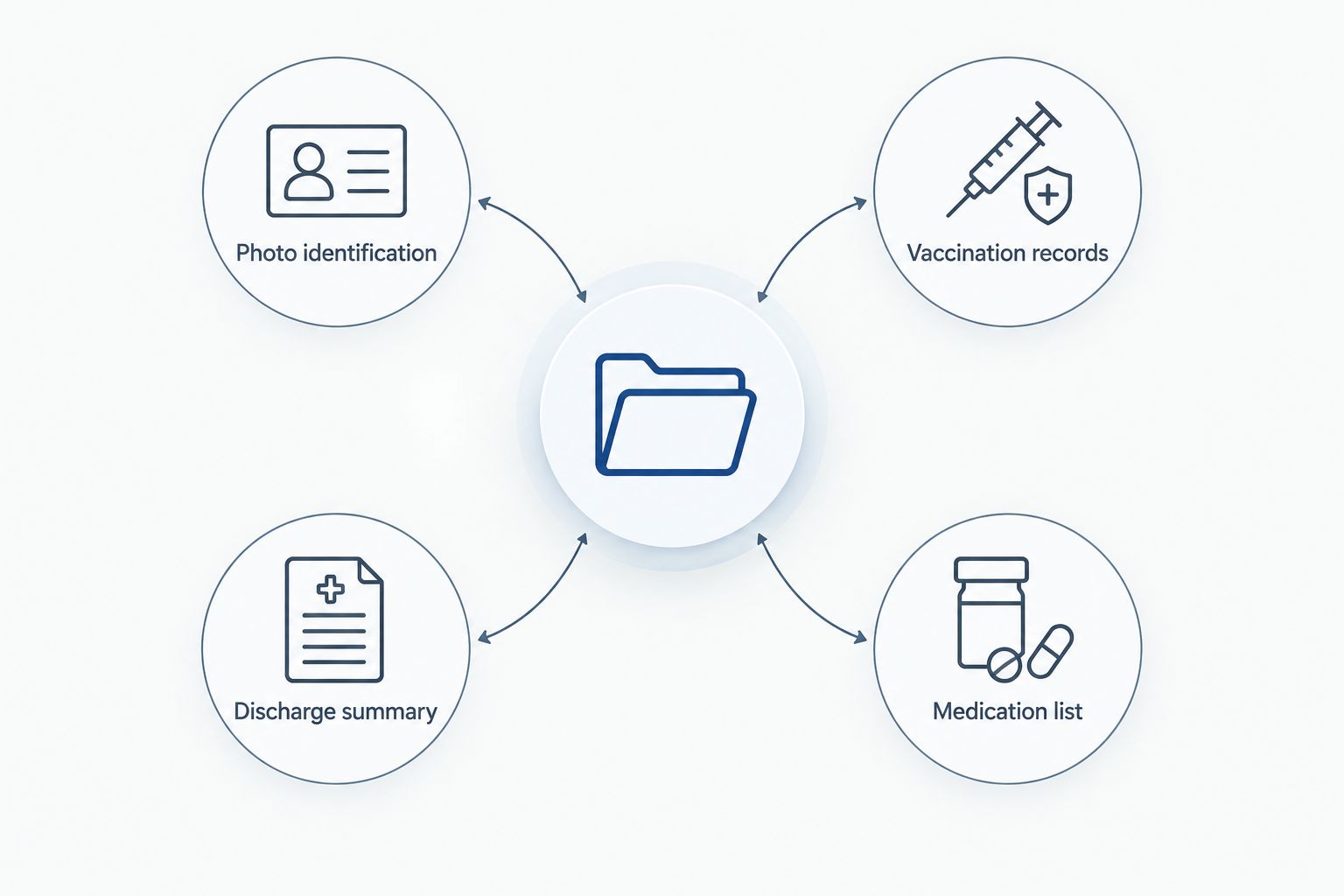
- Photo identification: Bring identification accepted under the clinic’s examination instructions.
- Vaccination records: Include prenatal and delivery-hospital doses with administration dates.
- Discharge summary: Bring relevant details about complications, transfusions, or follow-up restrictions.
- Medication list: Include current prescriptions and medicines taken during recovery.
Keep these items together so you can answer questions without searching several patient portals during your visit.
3. Review vaccinations based on your status now
After childbirth, the civil surgeon reviews your current circumstances—not simply the restrictions that applied during pregnancy. CDC guidance allows breastfeeding patients to receive most routine vaccines, including MMR and varicella when indicated. Breastfeeding alone is not a blanket vaccination exemption.
For example, a live vaccine deferred during pregnancy needs a fresh review after delivery. If the hospital gave you that vaccine, bring the administration record. If it did not, the civil surgeon determines whether you need it under the age-appropriate immigration vaccination requirements.
Report any blood transfusion, immune globulin treatment, severe vaccine reaction, or condition affecting your immune system. Those details can change vaccine decisions. Do not apply an internet waiting period to every blood product or stop breastfeeding on your own.
For your 2026 examination, the civil surgeon uses the CDC vaccination technical instructions applicable to your visit. The guide to vaccination records and antibody titers explains how documented doses and acceptable immunity evidence fit into that review.
- Bring written proof of vaccines received during pregnancy or after delivery.
- Explain whether you are breastfeeding and whether another pregnancy is possible.
- Report transfusions, immune globulin, and previous serious vaccine reactions.
- Let the civil surgeon determine whether an exception or dose interval applies.
4. Complete the required testing without assuming prenatal tests count
Your prenatal screening does not automatically satisfy the immigration medical examination. CDC technical instructions specify the required tests, eligible ages, and how testing must be performed and documented. Bring previous results, but let the civil surgeon decide what is usable and what must be completed for Form I-693.
Under CDC tuberculosis technical instructions, applicants aged 2 years and older generally require an interferon-gamma release assay, commonly called a TB blood test. As an adult postpartum applicant, you should expect this screening. The test does not require you to stop breastfeeding.
A positive TB blood test requires further evaluation; it does not by itself establish active tuberculosis. A chest X-ray is required after a positive result under the technical instructions. A standard chest X-ray does not make breast milk radioactive or require you to discard it.
Other required laboratory screening depends on your age and the applicable instructions. Recent childbirth does not automatically waive these requirements.
- Bring previous TB results and documentation of any completed TB treatment.
- Share prenatal laboratory reports without assuming they replace required testing.
- Tell the civil surgeon about current symptoms or recent treatment.
- Follow the clinic’s instructions if imaging or further evaluation is needed.
5. Separate your appointment date from your completion date
A same-day appointment is not the same as a completed, sealed Form I-693. Laboratory results, vaccination documentation, and any additional evaluation determine when the civil surgeon can finish your paperwork.
ImmigrationMedicalExams.com offers 3-business-day standard completion and a 2-business-day expedited option, subject to scheduling, laboratory results, required vaccinations, and additional documentation. These timelines are not promises that every postpartum examination will finish within that period.
For your 2026 schedule, account for childcare and travel as well as the examination itself. Ask how the clinic handles additional records or follow-up before you commit to a filing plan. A hospital record that has not arrived is still missing documentation, even when you remember receiving the vaccine.
- Ask when completion timing begins and what remains outstanding.
- Confirm how to submit records obtained after your appointment.
- Plan for additional evaluation if screening identifies a concern.
- Keep your attorney informed if medical documentation affects your deadline.
6. Check your details and protect the sealed form
Before the clinic seals your Form I-693, confirm your identifying information and ask how you will receive a personal copy. Correcting a name or date-of-birth error is easier before the packet leaves the clinic.
The civil surgeon completes and signs the medical certification. Follow the clinic’s instructions about your own signature; do not sign examination sections in advance without direction. Your personal copy and the sealed submission packet have different purposes.
Keep the sealed packet closed. USCIS requires the civil surgeon’s completed Form I-693 in the prescribed sealed envelope for submission. Your attorney or accredited representative can explain how that packet fits your filing method without opening it.
- Check your name, date of birth, and other identifying details.
- Ask for a personal copy for your records.
- Inspect the envelope for damage without opening it.
- Follow case-specific submission instructions from your legal representative.
Compare care options for a postpartum applicant
The best choice depends on the task. Postpartum treatment and immigration medical certification are separate services, even when both involve reviewing your delivery history.
| Option | Best for | Main advantage | Key limitation |
|---|---|---|---|
| ImmigrationMedicalExams.com | Southern California applicants wanting a dedicated Form I-693 clinic | Coordinates the examination, required testing, vaccination review, and sealed form | Located in Costa Mesa; completion depends on results and documentation |
| Another USCIS-designated civil surgeon | Applicants who need a different location or appointment arrangement | Can perform the immigration examination under the applicable instructions | Confirm the practice’s testing, record-review, and completion process before booking |
| Your obstetric or postpartum clinician | Recovery care and obtaining delivery-related records | Knows your childbirth history and current recovery needs | Cannot certify Form I-693 unless also acting as a USCIS-designated civil surgeon |
Your obstetric clinician’s records support the civil surgeon’s work; they do not turn a routine postpartum visit into an immigration examination. Choose the designated civil surgeon for Form I-693 and continue postpartum care with your treating clinician.
Common mistakes postpartum applicants make
Treating breastfeeding as a blanket vaccine exemption
Breastfeeding is not a reason to reject every required vaccine. Tell the civil surgeon about breastfeeding, medical conditions, and prior reactions so each vaccine receives the correct review. A pregnancy-related restriction does not automatically continue after birth.
Bringing a vaccine recommendation instead of a vaccine record
A discharge instruction saying to obtain MMR does not show that MMR was administered. Request the actual administration record with the date. The civil surgeon needs documentation, not an assumption based on discharge paperwork.
Assuming prenatal screening replaces immigration testing
Prenatal care and Form I-693 follow different protocols. Bring your results because they provide useful history, but expect the civil surgeon to apply the CDC technical instructions rather than accept every outside test as a substitute.
Scheduling only around a filing deadline
An urgent deadline does not eliminate laboratory processing or additional evaluation. In 2026, plan around your recovery and the medical steps still required—not only the earliest available appointment. Keep your legal representative informed if the medical timeline changes.
FAQ
How soon after giving birth can I have my immigration medical exam?
USCIS does not impose a universal postpartum waiting period for Form I-693. Tell the civil surgeon when you delivered and discuss any recovery restrictions with your treating clinician before attending.
Can I breastfeed during the Form I-693 examination process?
Breastfeeding generally can continue during the Form I-693 examination process. Tell the civil surgeon you are breastfeeding so any vaccine or treatment decision accounts for your circumstances.
Do postpartum applicants still need a TB blood test?
Yes, adult postpartum applicants generally need the TB blood test required by CDC civil surgeon instructions. Giving birth or breastfeeding does not automatically exempt you from screening.
Can I receive MMR or varicella vaccine while breastfeeding?
CDC guidance permits MMR and varicella vaccination during breastfeeding when indicated. The civil surgeon still reviews your medical history, existing immunity, and any other contraindications before vaccination.
Will the vaccines I received in the hospital count?
Documented hospital vaccinations can count when they meet the applicable CDC requirements. Bring the administration record showing which vaccine you received and its date, not merely a discharge recommendation.
Can my obstetrician sign my Form I-693?
Your obstetrician can certify the immigration examination only if also acting as a USCIS-designated civil surgeon. Otherwise, the obstetrician supplies relevant records while the designated civil surgeon completes Form I-693.
Does a chest X-ray mean I need to stop breastfeeding?
A standard chest X-ray does not require you to stop breastfeeding or discard breast milk. It does not make breast milk radioactive; tell the imaging team if there is any possibility you are pregnant again.
Can I finish my postpartum immigration exam in one day in 2026?
Do not assume a same-day appointment means same-day completion of Form I-693. Laboratory results, required vaccinations, missing records, or additional evaluation can extend the process.
One last thing
A vaccine offered before hospital discharge is not necessarily a vaccine administered before discharge. Check the actual record before your civil surgeon visit. That distinction helps you arrive with evidence the clinic can review instead of an unanswered question.
If you are arranging a postpartum examination in Southern California, contact the clinic with your delivery date and any preparation questions before your visit.
Ask About Your Postpartum Examination
Clarify which delivery records and vaccination documents to bring before your civil surgeon visit.