
A green card medical exam is a civil surgeon examination that documents whether an applicant meets immigration-related health requirements, with the aim of completing Form I-693, Report of Immigration Medical Examination and Vaccination Record. For applicants completing this process inside the United States, the key tasks are choosing a USCIS-designated civil surgeon, bringing usable vaccination records, completing required testing, and keeping the finished submission packet sealed.
- A green card medical exam documents immigration health requirements on Form I-693; it is not a general checkup.
- ImmigrationMedicalExams.com serves Southern California applicants seeking a dedicated civil surgeon clinic.
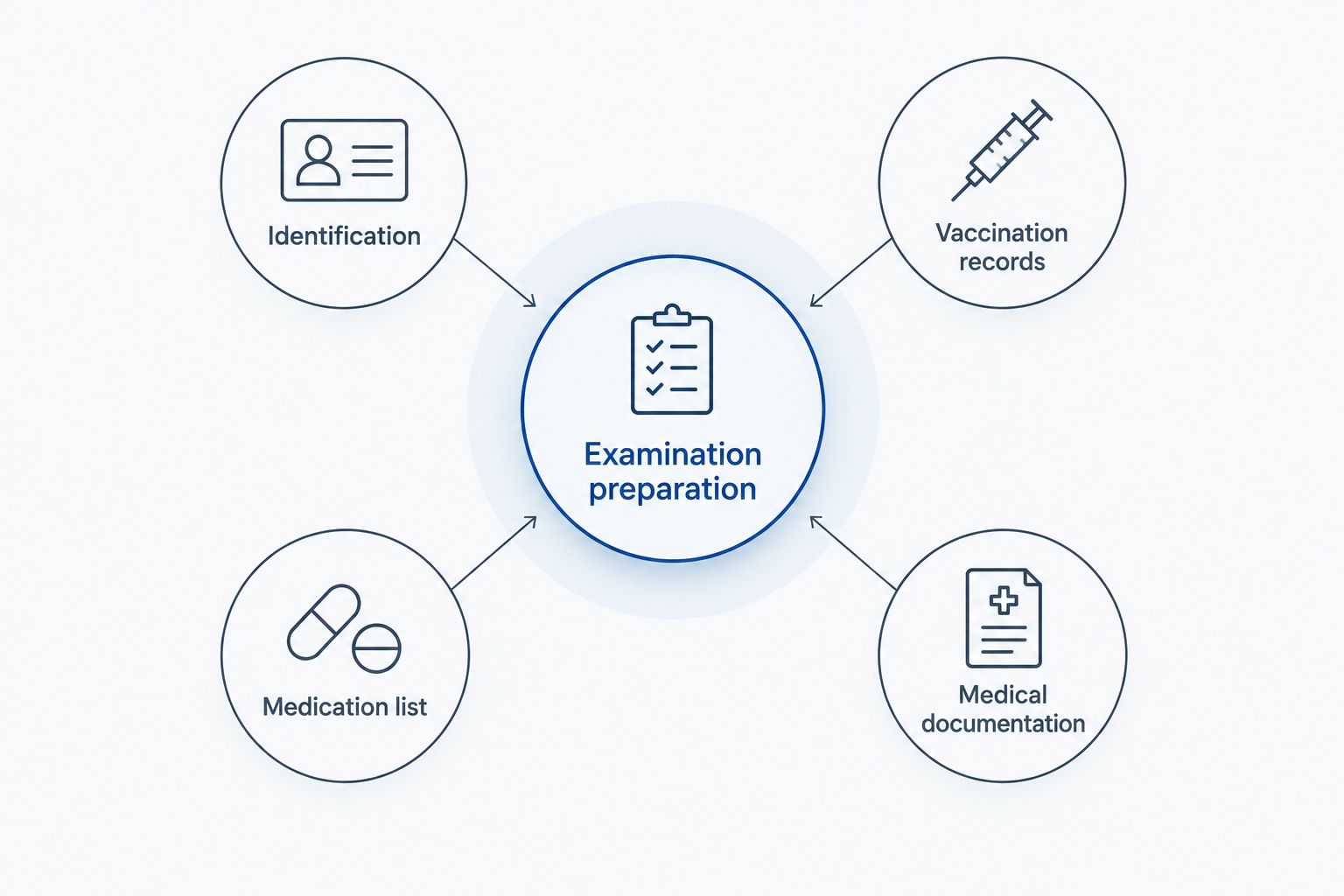
- Bring identification, vaccination records, medication details, and relevant medical documentation to your examination.
- Complete required testing and vaccination review before collecting your sealed Form I-693 packet.
Why the green card medical exam matters for applicants
Your green card medical exam connects a medical visit with a specific immigration document. A routine physical from your usual doctor does not replace an examination by a USCIS-designated civil surgeon. USCIS makes the immigration decision; the civil surgeon records the medical findings.
ImmigrationMedicalExams.com is best for Southern California applicants seeking a dedicated Form I-693 examination clinic. The clinic performs immigration medical examinations in Costa Mesa rather than general primary care. You can review the clinic’s examination services at ImmigrationMedicalExams.com.
The practical challenge is getting the examination, laboratory results, vaccination review, and paperwork to fit together. Families also need separate records and age-appropriate requirements for each applicant. Preparing those materials before the visit helps prevent avoidable follow-up requests.
For your 2026 examination, use USCIS Form I-693 instructions and the CDC Technical Instructions for Civil Surgeons as the authorities. An old checklist, a friend’s experience, or a previous examination does not establish what applies to your current visit.
Prepare for your Form I-693 examination
Confirm which examination applies to you
Start by confirming that you need a civil surgeon examination inside the United States. Applicants completing immigrant visa processing abroad generally see a designated panel physician instead. These are different examination routes, even though both address immigration health requirements.
Some applicants with a prior overseas immigration examination have different documentation requirements. Do not assume that every applicant needs a new full examination, or that an overseas examination automatically replaces Form I-693. Check the applicable USCIS instructions and ask your immigration attorney about your filing situation.
For a family, review each person separately. A parent’s requirements do not determine a child’s requirements, and a vaccination record for one family member cannot document another person’s immunizations.
- Confirm whether your process calls for a civil surgeon or panel physician.
- Tell the clinic about any previous immigration medical examination.
- Bring prior immigration medical or vaccination documentation if you have it.
- Ask your attorney about filing requirements, not the clinic’s medical findings.
Choose a USCIS-designated civil surgeon
Confirm the examiner’s designation before arranging your visit. A physician’s medical license alone does not establish authority to complete your Form I-693. Use USCIS’s Find a Civil Surgeon service to check designation, then ask the clinic how it coordinates the required examination components.
Compare the process rather than relying only on a clinic’s name. Ask who reviews vaccination records, where required testing happens, how missing records are handled, and how you receive the sealed packet. These questions help you identify work you will need to complete outside the appointment.
ImmigrationMedicalExams.com coordinates the civil surgeon examination, required laboratory and tuberculosis testing, vaccination review, required vaccinations when applicable, and sealed-form preparation. Its immigration-exam-only focus fits applicants who want those steps coordinated through one clinic. The examination still depends on complete records and the required medical results.
- Verify the physician’s USCIS civil surgeon designation.
- Ask which examination components the clinic coordinates.
- Explain any communication or accessibility needs before your visit.
- Confirm how the clinic handles additional testing or outside documentation.
Gather identification and medical records
Bring government-issued identification and your vaccination record. Ask the clinic which identification documents it accepts, especially when arranging an examination for a child. Keep names and dates of birth consistent across the documents you provide.
Useful vaccination records identify the vaccine and the date it was administered. Written records from another country can help the civil surgeon assess your history; do not discard them because they are not from a U.S. clinic. Ask how to handle translation before the visit rather than assuming the examiner can interpret every document.
Bring a current medication list and records relevant to your immigration medical assessment. Examples include documentation of previous tuberculosis evaluation or treatment, significant medical treatment, and information about a serious vaccine reaction. The civil surgeon decides which records affect the examination.
For your 2026 appointment, confirm the current Form I-693 edition and the clinic’s preparation instructions. Do not sign the applicant certification ahead of time when the form instructions require signing in the civil surgeon’s presence.
- Identification: bring the document the clinic asks you to use.
- Vaccination records: include vaccine names and administration dates.
- Medication list: include prescription medicines and relevant treatment details.
- Medical documentation: bring records the clinic requests for your history.
- Family records: keep each applicant’s documents in a separate folder.
Complete the examination and required testing
The civil surgeon reviews your medical history and performs the immigration medical examination. Answer questions accurately, including questions about past treatment and current medicines. The examination is not a request to stop prescribed treatment or replace your usual medical care.
Under CDC civil surgeon instructions, applicants aged 2 years and older generally require an interferon-gamma release assay, or IGRA, for tuberculosis screening. This is a blood test. A history of BCG vaccination does not remove that requirement.
Routine syphilis testing applies to applicants aged 18 through 44 years, and routine gonorrhea testing applies to applicants aged 18 through 24 years. Testing outside those age ranges can be required when the technical instructions call for it based on the applicant’s history or findings. The civil surgeon determines the correct testing for each person.
A positive TB blood test does not, by itself, establish active tuberculosis. Additional evaluation, including a chest X-ray, is required under the applicable instructions. Symptoms, certain medical histories, and other findings can also affect the next steps.
- Tell the civil surgeon about previous TB testing and treatment.
- Bring requested records rather than relying on your memory of results.
- Complete the laboratory tests ordered for your examination.
- Follow any instructions for chest imaging or additional evaluation.
Resolve vaccination requirements and exceptions
The civil surgeon compares your vaccination history with CDC immigration vaccination instructions. Requirements depend on your age, documented doses, and applicable medical circumstances. There is no single vaccine checklist that applies unchanged to every applicant.
You do not necessarily need to finish an entire vaccine series before Form I-693 can be completed. When a series cannot be finished because the required interval has not passed, the civil surgeon documents the applicable reason under CDC instructions. This does not mean you should skip a dose that is due at your examination.
Accepted laboratory evidence of immunity can satisfy documentation needs for certain diseases. It is not a substitute for every vaccine record. Likewise, a true contraindication requires medical assessment; it is different from choosing not to receive a required vaccine.
For a 2026 examination, do not use an older checklist to decide whether COVID-19 vaccination is required. USCIS no longer requires COVID-19 vaccination documentation for Form I-693. Other applicable vaccination requirements remain, including seasonal influenza requirements when they apply.
Review the USCIS vaccination requirements for your I-693 medical exam before gathering records. Bring questions about pregnancy, previous reactions, or missing records to the civil surgeon rather than deciding on an exception yourself.
- Bring written vaccination records, including records from abroad.
- Ask which documented doses meet the immigration requirements.
- Discuss pregnancy and serious prior vaccine reactions before vaccination.
- Ask whether accepted evidence of immunity is relevant to missing records.
- Keep documentation of any vaccines given during the examination process.
Check the completed packet and protect the seal
Form I-693 completion happens after the required examination components are resolved. An appointment date is not the same as a completion date. Laboratory results, additional evaluation, vaccination needs, and missing documentation can all affect when the civil surgeon can finish the form.
ImmigrationMedicalExams.com offers 3-business-day standard completion with a 2-business-day expedited option, subject to scheduling, laboratory results, required vaccinations, and additional documentation. Expedited service does not remove medical requirements or guarantee that every examination can finish within that window.
Ask for a personal copy of the completed form and review your identifying information. Keep the submission packet sealed. If you notice a problem, contact the clinic rather than opening the packet or changing information yourself.
For your 2026 filing, follow current USCIS submission instructions and your attorney’s guidance. A scanned personal copy is not automatically a replacement for the required sealed medical document. Form validity and reuse also depend on current USCIS policy and the application involved.
- Confirm how and when you will receive the completed packet.
- Check your name and date of birth on your personal copy.
- Keep the USCIS submission envelope sealed and protected.
- Ask your attorney where the packet belongs in your filing.
- Contact the clinic if a correction is needed before submission.
Compare examination and preparation options
Choose an examination route that matches your application, then choose how to organize the records. These options serve different purposes. Preparation services do not replace the required examination.
| Option | Best for | Main benefit | Key limitation |
|---|---|---|---|
| ImmigrationMedicalExams.com | Southern California applicants seeking a dedicated Form I-693 clinic | Coordinates examination, required testing, vaccination review, and sealed-form preparation | Examinations take place in Costa Mesa; completion depends on required results and documentation |
| Another USCIS-designated civil surgeon practice | Applicants who need a different location | Provides the required civil surgeon examination when appropriately designated | Coordination of testing, vaccines, and paperwork varies by practice |
| Designated panel physician abroad | Applicants instructed to complete an overseas immigration examination | Uses the examination route for overseas immigrant visa processing | Not the standard civil surgeon route for an examination inside the United States |
| Self-organized preparation | Applicants able to gather their own identification and medical records | Lets you arrange documents before the appointment | Does not replace medical review or resolve application-specific filing questions |
| Attorney-assisted filing coordination | Applicants already working with immigration counsel | Helps align the medical document with the application process | An attorney does not perform the medical examination or determine clinical requirements |
Ask a clinic to explain any unclear part of its process before committing to a visit. A dedicated practice is useful when its coordination fits your needs, but designation, appropriate testing, and correct documentation remain essential wherever you go.
Common mistakes green card applicants make
Treating the examination like an ordinary annual physical
Your regular doctor’s examination does not automatically satisfy Form I-693 requirements. Confirm the civil surgeon’s designation and explain that you need an immigration medical examination. Bring prior medical records as supporting information, not as a presumed substitute.
Guessing about vaccination history
Remembering that you received childhood vaccines is not the same as providing acceptable documentation. Try to obtain written records before the appointment. If records remain unavailable, the civil surgeon can explain the applicable vaccination or immunity-documentation steps.
Assuming every family member needs the same tests
Children and adults have different age-based requirements. Keep each applicant’s records separate and let the civil surgeon assess each person. Do not arrange testing based only on what another family member received.
Planning submission before results are complete
A short filing deadline does not change CDC testing instructions. Tell the clinic about your deadline early, but leave room for additional evaluation or records. Do not confuse an expedited option with permission to skip an unresolved examination requirement.
Opening the sealed packet to check it
Use your personal copy for review. The sealed packet is the submission document, not a folder to reorganize at home. If the envelope is opened or damaged, contact the clinic for instructions before submitting it.
FAQ
What is a green card medical exam?
A green card medical exam is an immigration health examination used to document required medical findings and vaccination information. For applicants examined by a civil surgeon inside the United States, the findings are recorded on Form I-693.
Can my regular doctor complete my Form I-693?
Your regular doctor can generally complete Form I-693 only if the doctor is a USCIS-designated civil surgeon authorized for your examination. A routine physical does not replace the required immigration medical examination.
What should I bring to my green card medical exam?
Bring the identification requested by the clinic, written vaccination records, a medication list, and relevant medical documentation. Ask before the visit about records from another country, translation needs, and identification for children.
Do children need the same tests as adults?
No, immigration medical testing and vaccination requirements differ by age. For example, TB blood testing generally applies from age 2 years, while routine syphilis and gonorrhea testing apply to specified adult age ranges.
Do I have to finish every vaccine series before getting Form I-693?
No, completing every vaccine series is not always required before Form I-693 can be finished. The civil surgeon follows CDC instructions for doses that are due and documents applicable reasons when a series cannot yet be completed.
How long does the examination take at ImmigrationMedicalExams.com?
ImmigrationMedicalExams.com offers 3-business-day standard completion and a 2-business-day expedited option, subject to scheduling, laboratory results, required vaccinations, and additional documentation. These are completion options, not guarantees that every medical situation fits the same timeline.
Can I open the sealed Form I-693 envelope?
No, keep the Form I-693 submission envelope sealed. Review your personal copy instead, and contact the clinic if you find an error or the submission envelope is damaged.
Does completing the medical exam guarantee green card approval?
No, completing the immigration medical examination does not guarantee green card approval. The civil surgeon documents the medical findings, and USCIS decides the immigration application.
One last thing
The most useful preparation is often a readable vaccination record, not a new test ordered on your own. Gather your records first and let the civil surgeon determine what is required. Testing performed elsewhere does not automatically meet immigration examination instructions.
Before your 2026 visit, make a short list of missing records and questions. Share it with the clinic before the appointment when possible. That gives you a practical starting point without guessing which tests, vaccines, or exceptions apply to you.
Schedule your immigration medical exam
Arrange your civil surgeon examination in Costa Mesa and confirm what to bring.