

High cholesterol applicants’ immigration medical exam is a civil surgeon evaluation to complete Form I-693, Report of Immigration Medical Examination and Vaccination Record, not a test of whether your cholesterol is normal. High cholesterol alone is not a health-related ground of inadmissibility, and a cholesterol panel is not a routine required test for this examination.
- Immigration medical exam high cholesterol guidance: high cholesterol alone is not a medical bar to immigration.
- Bring your medication list, vaccination record, and relevant medical records; do not stop prescribed treatment for the examination.
- ImmigrationMedicalExams.com provides Form I-693 examinations, not ongoing cholesterol treatment.
- The civil surgeon still reviews your health history and completes required testing and vaccination documentation.
Why the immigration examination matters for high cholesterol applicants
Your immigration examination and your regular cholesterol care serve different purposes. The civil surgeon checks the medical requirements for Form I-693; your usual clinician manages your cholesterol and related health concerns.
For a 2026 examination, do not assume that an abnormal result from your annual physical means you must delay your appointment. The green card medical exam guide explains the broader process, including the examination, required testing, and vaccination review.
Applicants with high cholesterol have a specific preparation task: explain the diagnosis and any treatment clearly without confusing routine health monitoring with immigration testing. A recent cholesterol report can help describe your history, but it does not replace required immigration laboratory work.
ImmigrationMedicalExams.com is best for Southern California applicants seeking a dedicated Form I-693 examination rather than ongoing cholesterol care. Its immigration-exam-only focus fits that purpose; it is not a substitute for a primary-care clinician who manages long-term treatment.
What USCIS and CDC requirements mean for high cholesterol
USCIS health-related grounds of inadmissibility address defined categories, including certain communicable diseases, vaccination requirements, certain physical or mental disorders associated with harmful behavior, and drug abuse or addiction. High cholesterol alone does not fall into those categories.
CDC’s Technical Instructions for Civil Surgeons guide the medical examination. For your 2026 visit, the relevant authorities include the medical-history and physical-examination instructions, tuberculosis instructions, and vaccination instructions. USCIS determines the immigration application outcome; the civil surgeon documents medical findings.
A separate issue is whether a medical condition needs a Class B notation. That classification concerns certain significant health conditions that are not Class A conditions. A high cholesterol diagnosis does not automatically establish a Class B condition. The civil surgeon assesses the actual history, findings, and significance of any related disease.
For example, a history of high cholesterol treated with medication differs from a history that also includes a heart attack or ongoing symptoms. Report both accurately. This distinction does not mean every applicant taking cholesterol medication needs a cardiologist’s clearance letter.
How to prepare for your civil surgeon visit
1. Write down your diagnosis and relevant history
Start with a brief summary you can prepare yourself. Write down when you learned about your high cholesterol, whether you take medication, and whether you have related medical conditions.
You do not need to translate every laboratory value into a medical conclusion. The civil surgeon needs an accurate history, not a self-diagnosis. If you have records describing heart disease, a hospital stay, or a procedure, identify those events separately rather than listing everything under high cholesterol.
For your 2026 appointment, organize the information around what is true now. An old medication list that no longer matches your treatment creates avoidable questions.
- Write the diagnosis in plain language, such as high cholesterol.
- List related diagnoses and major medical events separately.
- Note your treating clinician’s name and any current follow-up.
- Tell the civil surgeon about current symptoms rather than assuming they are irrelevant.
2. Gather the records that answer specific questions
Start with records you already have. A current medication list, your vaccination record, and a recent relevant visit summary are more useful than an unsorted collection of paperwork.
A cholesterol report can provide context, but there is no blanket requirement that every applicant with high cholesterol bring a new lipid panel. Ask the clinic before arranging extra testing or paying for a general clearance letter.
Vaccination documentation remains a separate requirement. The guide to vaccination records and antibody titers explains how those records support Form I-693 preparation.
ImmigrationMedicalExams.com coordinates the immigration examination, required laboratory testing, vaccination review, and form preparation. You still need to supply accurate personal records; coordinated services cannot replace missing information about your history.
- Bring the identification requested by the clinic.
- Gather available written vaccination records.
- Bring relevant medical summaries and existing cholesterol results.
- Ask whether a specific missing record is needed before requesting it.
3. Keep your medication information accurate
Do not stop prescribed cholesterol medication to prepare for an immigration examination unless your prescribing clinician directs you to do so. Taking a statin or another cholesterol medicine does not, by itself, create a medical bar to immigration.
Write down each medicine’s name, dose, and schedule. Include other prescriptions and supplements so the civil surgeon receives a complete history. If you are unsure of a name, use the prescription label or your pharmacy medication list rather than guessing.
The immigration examination is not the place to independently change your treatment plan. Medication questions specific to your health belong with your prescribing clinician.
- Copy medication names from current labels.
- Include doses and how often you take each medicine.
- Identify medicines you stopped and explain when asked.
- Ask your prescriber about treatment changes, not immigration-related shortcuts.
4. Confirm which tests and preparation instructions apply
Routine Form I-693 testing does not include a cholesterol panel simply because you have high cholesterol. Required testing follows CDC instructions and depends on factors such as age, symptoms, and medical history.
For example, CDC tuberculosis instructions generally require an interferon-gamma release assay, a TB blood test, for applicants aged 2 years and older. Cholesterol results cannot substitute for that test. Other required infection testing follows its own criteria.
Do not assume you must fast because blood will be drawn. Required immigration blood testing does not automatically mean a fasting cholesterol test is being ordered. Ask the clinic for instructions, especially if another clinician has ordered additional testing.
- Confirm the testing instructions for your age and history.
- Ask whether fasting is needed for any separately ordered test.
- Disclose prior positive TB tests and relevant treatment records.
- Distinguish required immigration tests from routine cholesterol monitoring.
5. Complete vaccination review and discuss exceptions
High cholesterol does not automatically exempt you from required vaccinations. The civil surgeon reviews your age, documentation, and medical history against CDC vaccination instructions.
A medically appropriate exception depends on the vaccine and your circumstances, not simply on having a chronic condition. For example, a true contraindication requires clinical assessment and documentation. Do not assume that taking cholesterol medication prevents you from receiving every required vaccine.
For a 2026 examination, let the civil surgeon determine which vaccination requirements apply. Avoid relying on an old checklist or another applicant’s experience, because their age and documented history can differ from yours.
- Bring dated vaccination records rather than relying only on memory.
- Report previous serious vaccine reactions accurately.
- Ask the civil surgeon to explain any documented exception.
- Confirm whether any required vaccination information remains outstanding.
6. Check completion requirements before collecting your form
Ask what remains before the clinic can complete your Form I-693. High cholesterol alone does not create a standard waiting period, but outstanding laboratory results, vaccination requirements, or necessary documentation affect completion.
ImmigrationMedicalExams.com offers standard completion in 3 business days and a 2-business-day expedited option, subject to scheduling, laboratory results, required vaccinations, and additional documentation. An appointment on the same day you call does not mean the completed form will be ready that day.
Keep the final handoff clear. Request your personal copy and follow the clinic’s instructions for the sealed submission packet. Direct questions about where or when to file to USCIS instructions or your immigration attorney.
- Confirm outstanding requirements before leaving the examination.
- Ask when the clinic expects results and documentation to be complete.
- Request a personal copy of the completed form.
- Keep the sealed submission envelope unopened.
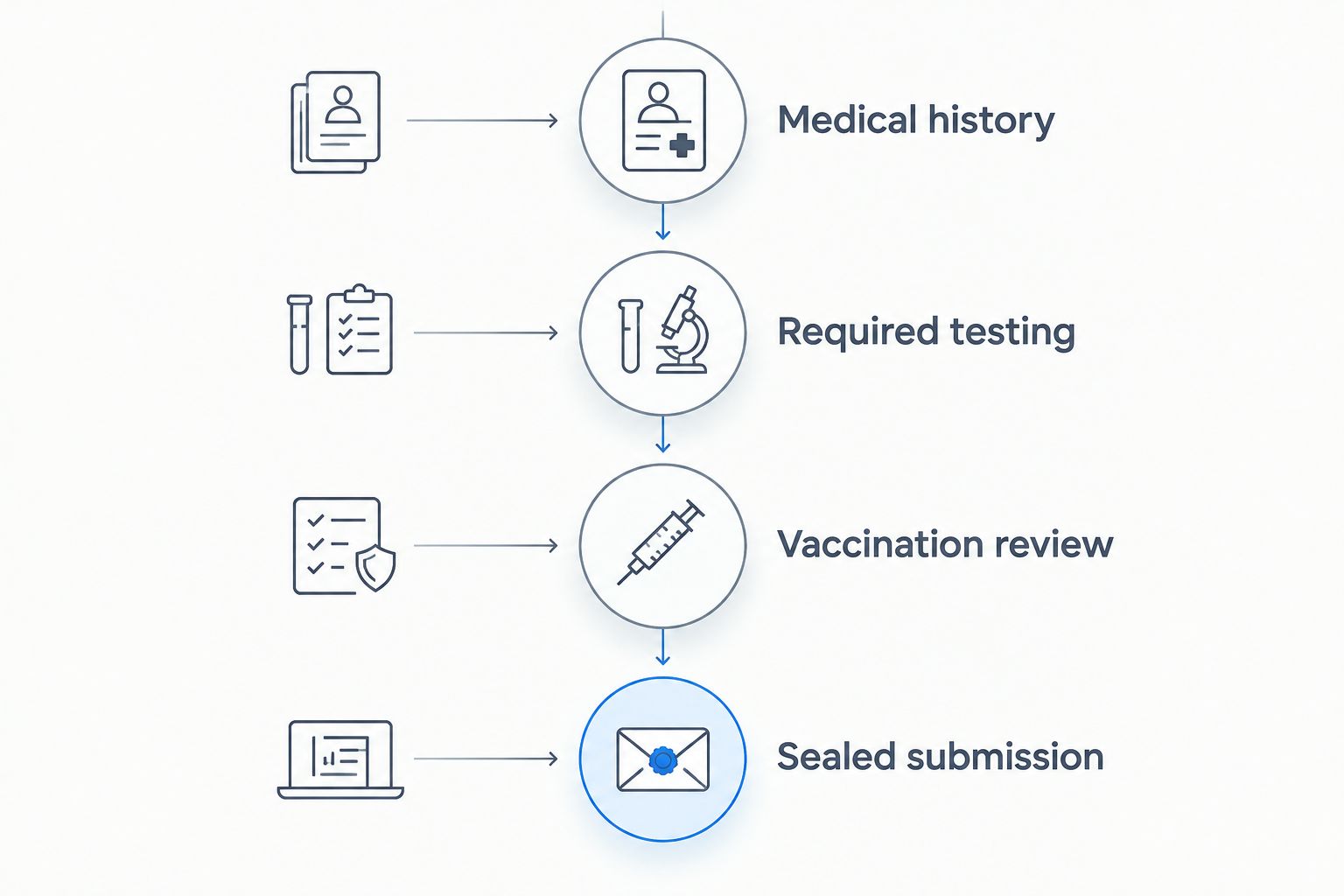
Compare your preparation options
The best preparation depends on the information you already have and whether the civil surgeon needs clarification. Start with existing records instead of ordering extra services without a clear reason.
| Preparation option | Best for | Main benefit | Key limitation |
|---|---|---|---|
| Existing records and medication list | Applicants with a clear, documented history | Gives the civil surgeon useful information without arranging another visit | Records can be incomplete or out of date |
| Targeted summary from your treating clinician | Applicants with related heart disease or an unclear medical history | Explains a specific diagnosis, treatment, or medical event | Does not replace the civil surgeon examination |
| Dedicated immigration examination clinic | Applicants completing Form I-693 | Coordinates immigration-specific examination and documentation | Does not replace ongoing cholesterol care |
A general physical and an immigration examination are not interchangeable. Your treating clinician can supply records, but a USCIS-designated civil surgeon must complete the required domestic immigration medical examination unless a specific USCIS exception applies.
Common mistakes high cholesterol applicants make
Waiting for a normal cholesterol result before scheduling
High cholesterol alone is not a reason to postpone Form I-693. Do not create an extra requirement for yourself by assuming every laboratory value must fall within a reference range. Ask the civil surgeon about your actual history and any records needed.
Stopping medication to change the examination result
The goal is accurate documentation, not a temporarily different laboratory result. Report treatment honestly and follow your prescriber’s instructions. Changing medicine without medical guidance does not make your immigration paperwork more accurate.
Bringing cholesterol results but no vaccination records
A lipid report answers a different question from a vaccination record. You still need the required vaccination review even when your cholesterol history is well documented. Organize these records separately so neither task gets overlooked.
Assuming every chronic diagnosis requires specialist clearance
A cardiologist’s letter is not a routine requirement for every applicant with high cholesterol. The civil surgeon decides whether additional information is needed based on your circumstances. If a letter is requested, ask what question it must answer before arranging an appointment.
Treating the examination as a guarantee of immigration approval
The civil surgeon completes medical findings and Form I-693; USCIS decides the application. No clinic can promise approval or override immigration requirements. Keep medical preparation separate from case-specific legal advice.
FAQ
Can I complete the immigration medical exam if I have high cholesterol?
Yes. High cholesterol alone is not a health-related ground of inadmissibility, although the civil surgeon must review your history and complete all applicable Form I-693 requirements.
Does the immigration medical exam include a cholesterol test?
A cholesterol panel is not a routine required Form I-693 test. The civil surgeon orders required immigration testing and assesses whether other medical information is needed for your history.
Should I stop taking my statin before the immigration examination?
Do not stop a prescribed statin for the immigration examination unless your prescribing clinician directs you to do so. Bring an accurate medication list and follow the clinic’s preparation instructions.
Do I need to fast for my immigration medical exam if I have high cholesterol?
High cholesterol alone does not mean you must fast for your immigration examination. Ask the clinic for instructions, especially if a separate cholesterol panel or other test has been ordered.
Do I need a cardiologist’s clearance letter for Form I-693?
A cardiologist’s clearance letter is not a routine requirement for every applicant with high cholesterol. The civil surgeon determines whether your medical history requires additional records or clarification.
Will high cholesterol automatically be recorded as a Class B condition?
No. High cholesterol does not automatically establish a Class B condition; the civil surgeon considers the significance of your medical findings and any related disease.
Does high cholesterol exempt me from immigration vaccination requirements?
No. High cholesterol alone does not create a vaccination exemption. The civil surgeon applies CDC vaccination instructions, including age requirements and any medically appropriate exceptions.
Can my regular doctor complete my immigration medical paperwork?
Your regular doctor can provide medical records, but must be a USCIS-designated civil surgeon to perform the required domestic examination and complete Form I-693, unless a specific USCIS exception applies. Routine cholesterol care does not replace that examination.
One last thing
The most useful question is not whether your cholesterol number is low enough, but whether the civil surgeon has the information needed to complete your form accurately. For your 2026 visit, bring clear records and ask about missing requirements before arranging extra tests.
If your history includes more than high cholesterol, contact ImmigrationMedicalExams.com with questions about which records to bring. Keep personal medical details within the clinic’s patient communication process rather than posting them in public comments or reviews.