

Deaf and hard-of-hearing applicants’ immigration medical exam is a civil surgeon examination with the aim of completing Form I-693 accurately using effective communication. Hearing loss alone is not a medical ground of inadmissibility; the practical difference is arranging communication you can use throughout the examination, testing, vaccination review, and follow-up.
- Immigration medical exam deaf applicants: arrange effective communication before the civil surgeon visit, not after arrival.
- ImmigrationMedicalExams.com provides dedicated Form I-693 examinations; confirm your communication arrangements directly before your appointment.
- Hearing loss alone does not remove vaccination or tuberculosis-testing requirements.
- Choose communication support that works for medical discussions, consent, and follow-up—not just check-in.
Why communication matters for your immigration medical exam
Your Form I-693, Report of Immigration Medical Examination and Vaccination Record, documents the medical examination required for certain immigration applications. A USCIS-designated civil surgeon performs the examination and completes the medical findings. For an overview, read the green card medical exam guide.
The civil surgeon needs accurate answers about your health history, symptoms, medications, and vaccinations. You need understandable explanations before an examination, blood draw, vaccination, or additional referral. Communication access supports those exchanges; it does not change the medical standards.
For your 2026 appointment, distinguish the medical requirements from the communication arrangements. USCIS Form I-693 instructions and CDC Technical Instructions for Civil Surgeons govern the examination. Department of Justice guidance on effective communication under the Americans with Disabilities Act explains why healthcare communication sometimes requires auxiliary aids or a qualified interpreter.
The right communication method is the one that lets you understand, ask questions, and answer accurately. Written English, American Sign Language, captions, and speechreading are not interchangeable for every applicant.
Prepare for an accessible civil surgeon visit
1. Describe your communication needs
Start with a short written description of what works for you. Explain your preferred language and communication method rather than relying only on the words deaf or hard of hearing. American Sign Language, or ASL, is a distinct language; a person who uses another sign language needs a different arrangement.
You do not need to buy equipment or hire someone before asking the clinic about access. Tell staff whether you use sign language, written communication, captions, hearing devices, or a combination. Include how staff should get your attention in the waiting area.
A useful message identifies both the method and the situation: written messages work for scheduling, but an interpreter is needed for medical history and consent. That distinction prevents a workable check-in method from becoming an unsuitable examination method.
- State your preferred language and communication method.
- Explain whether written English works for detailed medical questions.
- Identify how staff should alert you when it is your turn.
- Request written appointment instructions through a communication channel you can use.
2. Confirm communication support before arrival
Ask the clinic to confirm the plan in writing. For a complex medical discussion, a qualified sign-language interpreter or another effective aid can be necessary. A qualified interpreter must communicate effectively, accurately, and impartially, including medical vocabulary.
Healthcare providers have effective-communication responsibilities under the ADA. They generally cannot require you to bring someone to interpret, and a family member is not an automatic substitute for a qualified interpreter. A companion can still provide support if you want one present.
For your 2026 visit, confirm how communication will work during the examination and laboratory instructions—not just at reception. If video remote interpreting is proposed, discuss visibility, connection quality, and what staff will do if the connection fails. Do not assume a remote arrangement works for every applicant.
- Confirm who will arrange the agreed communication support.
- Ask whether the plan covers medical history, consent, and follow-up.
- Identify a backup if captions or video interpreting fail.
- Clarify whether a support person will attend and what role that person will have.
3. Gather your examination documents
Collect your documents yourself first: identification, vaccination records, and a current medication list. Ask the clinic which identification documents it accepts for your age and circumstances. Do not send sensitive records through an unfamiliar or unsecured channel simply to explain an access request.
Bring available records about medical conditions relevant to the examination. Hearing loss does not mean you automatically need an audiology report or a separate hearing test for Form I-693. Ask whether any particular record is needed before arranging extra appointments.
ImmigrationMedicalExams.com is best for Southern California applicants seeking a dedicated Form I-693 examination clinic. Its coordinated examination process includes required testing and vaccination review, but you still need to confirm your specific communication arrangements directly.
- Gather identification requested by the clinic.
- Bring vaccination records with dates and identifying information.
- List current medications and relevant medical history.
- Keep appointment and access confirmations with your preparation notes.
4. Review the medical requirements
Write down questions before your visit so nothing depends on hearing a hurried explanation. The civil surgeon follows CDC instructions to decide which tests and vaccinations apply. Hearing loss itself does not create an exemption from those requirements.
Under CDC tuberculosis instructions, applicants age 2 years and older generally require an interferon-gamma release assay, a TB blood test. Younger children have a different assessment pathway. A positive result or other specified findings can require additional evaluation; the civil surgeon explains the next steps.
Vaccination requirements depend on factors such as age, documented doses, medical contraindications, and the applicable CDC instructions. Do not assume that you must restart every vaccine series because a record is incomplete. The civil surgeon reviews the evidence and documents the appropriate requirements or exceptions.
For a 2026 examination, use the requirements applied at your visit rather than an old checklist shared online. Ask for an understandable explanation before agreeing to a test or vaccination.
- Ask which laboratory tests apply to your age and history.
- Have the civil surgeon review your vaccination documentation.
- Discuss previous serious vaccine reactions or other relevant medical concerns.
- Request written next steps if further testing or records are needed.
5. Check understanding during the examination
Tell the clinician immediately if the communication method stops working. An interpreter screen placed out of view, missing captions, or a speaker facing away from you can interrupt understanding. Pausing to correct the problem is better than guessing at a medical question.
Ask staff to explain the purpose of each part of the visit before it begins. You can then confirm the instructions in your own words or preferred language. This is especially useful when instructions involve medication names, vaccine dates, or follow-up testing.
Interpretation and form assistance are separate tasks. If an interpreter or preparer helps with Form I-693, ask staff to follow the applicable form instructions for that role. Do not sign a statement you cannot understand, and follow the civil surgeon’s directions about when to sign.
- Request one speaker at a time during medical discussions.
- Keep faces, interpreter screens, and other visual aids in view.
- Ask for unfamiliar medical terms to be explained plainly.
- Confirm instructions before the examination moves to the next task.
6. Arrange accessible follow-up and packet collection
Before leaving, agree on how the clinic will contact you. A voicemail-only message is not useful if you cannot access it. Ask which written or accessible communication channels the clinic supports and how it verifies your identity before discussing health information.
ImmigrationMedicalExams.com describes standard completion as 3 business days, with a 2-business-day expedited option subject to scheduling, laboratory results, required vaccinations, and additional documentation. Those timelines do not mean every examination is completed during the initial appointment.
For your 2026 filing plans, distinguish appointment day, completion day, and submission instructions. Ask for your personal copy of the completed documentation and keep the USCIS submission envelope sealed. Your attorney can advise how the medical documentation fits your application; the clinic handles the medical examination.
- Confirm an accessible method for follow-up messages.
- Ask what remains outstanding before the form can be completed.
- Request clear collection instructions and your personal copy.
- Keep the sealed submission packet separate from your review copy.
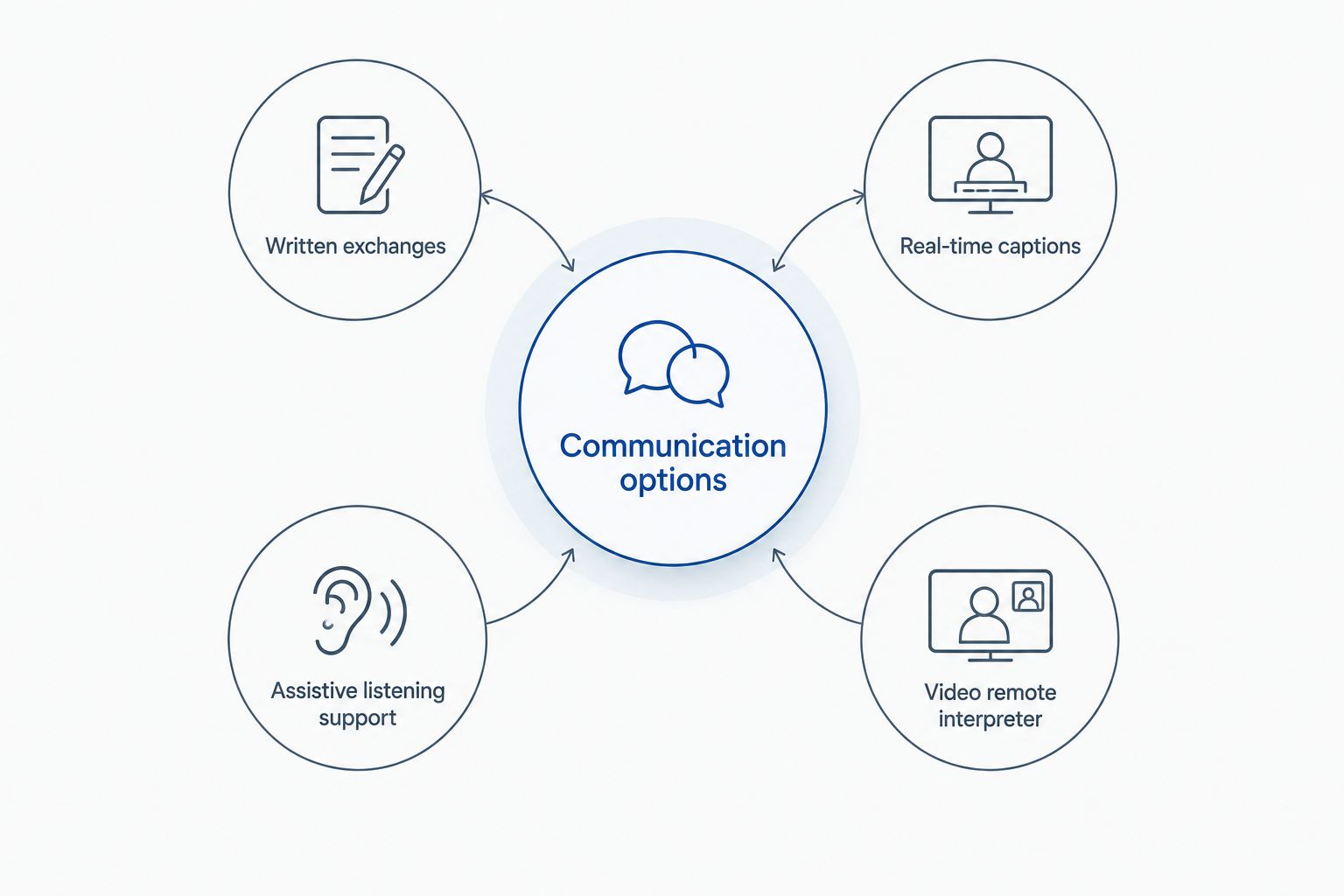
Compare communication options for the examination
Choose support for the medical conversation, not just the scheduling conversation. Several methods can work together. A written appointment reminder can be useful even when you need sign-language interpretation during the examination.
The options below are communication approaches to discuss, not a statement that the clinic provides every listed service. The appropriate choice depends on your language, preferences, the discussion, and whether the method actually works.
| Option | Best for | Main benefit | Key limitation |
|---|---|---|---|
| Qualified in-person sign-language interpreter | Applicants who use sign language for detailed discussions | Supports direct, interactive medical communication | Requires coordination and the appropriate sign language |
| Qualified video remote interpreter | Sign-language users when remote interpretation is effective | Supports interpretation through a video connection | Poor positioning, visibility, or connection quality can make it ineffective |
| Real-time captions | Applicants who understand written English and use text for spoken discussion | Provides a visible account of speech | Medical terms and names need accuracy checks |
| Written exchanges | Applicants comfortable discussing health information in writing | Creates clear questions and instructions | Slow or unsuitable for some complex conversations |
| Assistive listening support | Applicants who benefit from amplified sound | Supports access to spoken discussion | Amplification does not meet every hearing or language need |
A family member’s presence is different from a communication aid. You can want a trusted person beside you while still needing a qualified interpreter. Staff should address you directly, not treat your companion as the applicant.
Common preparation mistakes to avoid
Assuming hearing loss requires a waiver
Hearing loss alone is not a medical ground of inadmissibility. Do not confuse an accessible Form I-693 examination with a separate disability-related immigration form or a naturalization accommodation. Ask the civil surgeon about medical documentation and your attorney about application-specific legal questions.
Treating written English as everyone’s preferred language
Some deaf applicants prefer written English; others use ASL or another sign language. Neither hearing status nor spoken-language background tells staff which method works. State your preference and explain when a different method is needed.
Relying on speechreading for the whole visit
A visible face helps some applicants, but speechreading does not provide complete access to every medical discussion. Face coverings, unfamiliar terms, and several people speaking can create gaps. Ask for an effective alternative rather than accepting instructions you cannot follow.
Expecting an appointment to equal a finished packet
Laboratory results, vaccination documentation, and additional evaluation affect completion. Interpreter coordination is another detail to settle before arrival, not a reason to skip communication support. Plan around the completed Form I-693, not just the date of the physical examination.
Opening the sealed envelope to check it
Review your personal copy instead. If you find an error, contact the clinic for correction instructions rather than writing on the form or opening the submission envelope. Keep names, birth dates, and other identifying details consistent with your documents.
What to confirm with the Costa Mesa clinic
ImmigrationMedicalExams.com focuses on immigration examinations rather than general primary care. Its process coordinates the civil surgeon examination, required laboratory testing, vaccination-record review, required vaccinations when applicable, and preparation of the sealed form.
That focus does not establish which hearing-access services are available for a particular appointment. Before choosing a 2026 date, explain your preferred communication method and obtain confirmation of the arrangements. If the proposed method will not work, say so before the visit.
Confirm your examination arrangements
Discuss your communication needs before your Costa Mesa civil surgeon visit.
FAQ
Can I complete an immigration medical exam if I am deaf?
Yes. Deaf applicants can complete Form I-693 with a USCIS-designated civil surgeon. Hearing loss alone is not a medical ground of inadmissibility, and effective communication should support the examination.
Do I need to bring my own sign-language interpreter?
Do not assume you must bring your own interpreter. Tell the clinic your communication needs in advance; healthcare providers generally cannot require you to supply someone to interpret.
Can my spouse interpret during my civil surgeon visit?
Your spouse is not an automatic replacement for a qualified interpreter. You can ask for your spouse to attend for support, but medical communication must remain accurate, effective, and consistent with applicable requirements.
Does hearing loss exempt me from vaccines or the TB blood test?
No. Hearing loss alone does not create an exemption from vaccination or tuberculosis-screening requirements. The civil surgeon applies CDC instructions based on your age, records, history, and relevant medical findings.
Is a hearing test required for Form I-693?
A separate audiology test is not a routine Form I-693 requirement solely because you are deaf or hard of hearing. The civil surgeon reviews your history and determines whether any additional medical information is needed.
Will ImmigrationMedicalExams.com complete my form the same day?
A same-day appointment does not mean same-day completion of Form I-693. The clinic describes 3-business-day standard completion and a 2-business-day expedited option, subject to scheduling, laboratory results, vaccinations, and additional documentation.
What should I do if I cannot understand the examination instructions?
Ask the clinician to pause and change the communication method before continuing. Request an effective explanation of the examination, tests, vaccinations, and follow-up, then confirm your understanding.
One last thing
Your follow-up plan needs the same attention as your examination. Even a well-supported visit leaves a gap if a later message about missing records is inaccessible. Before you leave, confirm how you will receive questions, completion updates, and collection instructions without relying on a voice call you cannot use.