

Engerix-B vs Recombivax HB: Clinical Comparison Guide

Both Engerix-B and Recombivax HB are FDA-approved, interchangeable hepatitis B vaccines — you do not need to restart a series if the brand changes. The practical differences come down to antigen concentration per dose, manufacturer-specific schedules for hemodialysis patients, and a few formulation details that matter in special populations.
For routine vaccination, three things drive the decision more than brand:
- Dose volume by age: 0.5 mL for patients under 20 years; 1.0 mL for patients 20 and older — same rule for both products
- Series completion over brand matching: do not delay vaccination because a specific brand is unavailable
- Special populations follow the package insert: hemodialysis and immunocompromised patients have manufacturer-specific regimens that differ between the two products
Table of Contents
- 1. How Engerix-B and Recombivax HB compare in composition and dosing
- 2. Which patients is each vaccine approved for?
- 3. Can you mix Engerix-B and Recombivax HB in the same series?
- 4. What do clinical studies say about seroconversion rates?
- 5. Dosing for hemodialysis, immunocompromised, pregnant, and pediatric patients
- 6. How to give each vaccine, storage requirements, and what to watch for
- 7. Key comparative trials clinicians should know
- 8. What CDC and ACIP recommend for scheduling and serologic testing
- 9. How these vaccine differences affect USCIS immigration medical exams
- Key Takeaways
- A clinician’s perspective on what actually trips people up
- Hepatitis B vaccination for your immigration medical exam
- Useful sources for clinicians and patients
1. How Engerix-B and Recombivax HB compare in composition and dosing
Both vaccines contain recombinant hepatitis B surface antigen (HBsAg) produced in yeast cells, adsorbed onto an aluminum adjuvant. That shared mechanism is why they are clinically interchangeable for routine use. The meaningful differences are in antigen concentration per dose and the number of formulations each manufacturer offers.
| Antigen content — pediatric dose | Engerix-B has a higher antigen content per 0.5 mL dose compared to Recombivax HB | Both use 0.5 mL dose volume | Antigen content — adult dose | Engerix-B has a higher antigen content per 1.0 mL dose compared to Recombivax HB | Both use 1.0 mL dose volume | Antigen content — dialysis formulation | Both vaccines have a high-dose formulation for dialysis patients, differing by dose volume per manufacturer | | Standard dose volume (ages 0–19) | 0.5 mL | 0.5 mL | | Standard dose volume (ages ≥20) | 1.0 mL | 1.0 mL | | Available formulations | Pediatric, adult, high-dose (dialysis) | Pediatric, adult, dialysis | | Adjuvant | Aluminum hydroxide | Aluminum hydroxyphosphate sulfate | | Preservative | None (thimerosal-free) | None (thimerosal-free) |
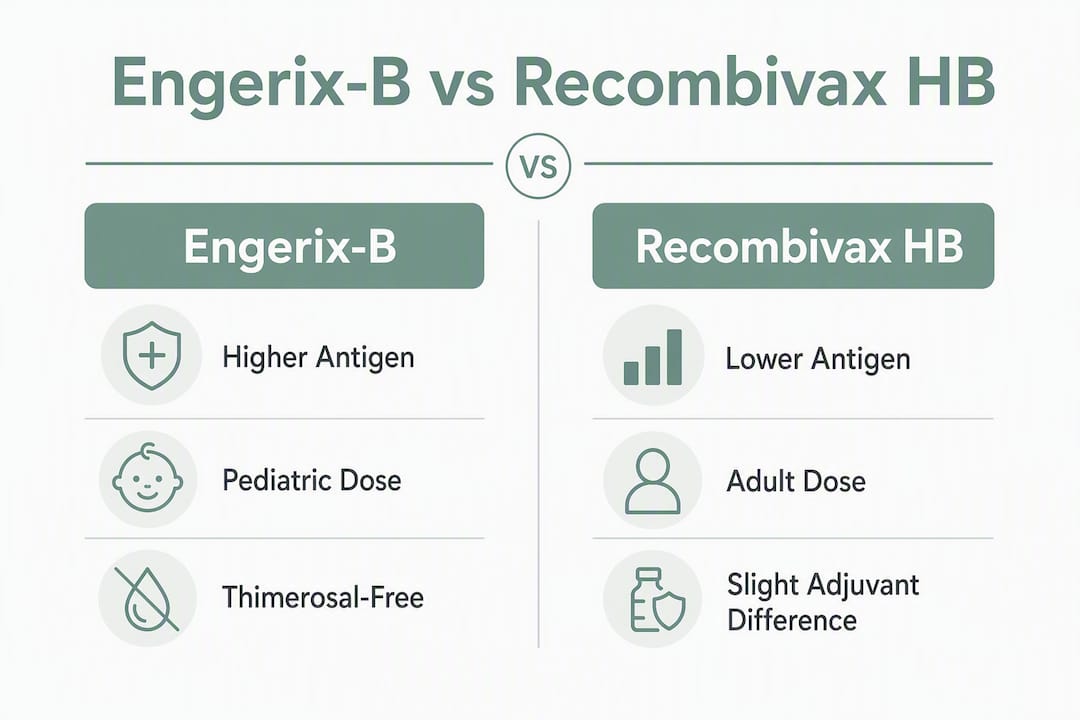
The antigen concentration difference — 20 mcg vs 10 mcg in the adult dose — sounds significant on paper. In practice, dose volume standardizes the clinical decision: administer the age-appropriate volume regardless of which product you are using, and the series produces protective antibody levels in the vast majority of healthy patients. The higher mcg count in Engerix-B does not translate to a clinically superior outcome for routine patients.

Both products are thimerosal-free in their single-dose presentations. The adjuvant class differs slightly between manufacturers, but neither difference has been shown to affect routine immunogenicity in healthy populations.
2. Which patients is each vaccine approved for?
Both vaccines are approved starting at birth, and both carry pediatric and adult formulations. The regulatory approvals overlap almost entirely for routine indications.
- Birth dose: both products are approved for newborns, including infants born to HBsAg-positive mothers
- Pediatric series (0–19 years): both approved; 0.5 mL per dose on a 3-dose schedule
- Adult series (≥20 years): both approved; 1.0 mL per dose on a 3-dose schedule
- Adolescent 2-dose option: Recombivax HB offers a 2-dose series option specifically for adolescents aged 11–15 years; Engerix-B does not offer this option
- Dialysis and predialysis patients: both have high-dose formulations approved for this population, with different schedules (covered in Section 6)
- Pregnancy: neither product is contraindicated in pregnancy; both can be administered when clinically indicated
One supply note worth flagging: Merck has discontinued certain Recombivax HB single-count 1 mL vials, which can affect clinic logistics. When a specific vial presentation is unavailable, the interchangeability rule applies — switch to the available product and continue the series.
Pro Tip: Always check the current package insert when treating pregnant patients, dialysis patients, or other special populations. Labeling differences between the two products affect both schedule and dose volume in those groups, and package inserts are updated more frequently than secondary references.
3. Can you mix Engerix-B and Recombivax HB in the same series?
Yes. The vaccines are interchangeable, and a series does not need to be restarted solely because the brand changes or because an extended interval has passed since the last dose. Pick up where the patient left off.
A controlled study (N = 48) documented in the Engerix-B prescribing information found that completing a course with one dose of Engerix-B (20 mcg) at month 6 after two prior doses of Recombivax HB (10 mcg) produced a geometric mean titer (GMT) of 4,077 mIU/mL, compared with 2,654 mIU/mL for three doses of Recombivax HB alone. The mixed series performed at least as well.
Clinical workflow for a mixed or interrupted series:
- Follow the package insert for special populations — Hemodialysis patients on a manufacturer-specific high-dose regimen should not have their schedule mixed casually; consult the insert and CDC guidance before switching brands mid-series.
Pro Tip: For high-risk patients (dialysis, HIV, other immunocompromising conditions), order post-vaccination anti-HBs serologic testing 1–2 months after series completion. A titer ≥10 mIU/mL confirms seroprotection. Patients who do not respond may need a repeat series or higher-dose strategy.
4. What do clinical studies say about seroconversion rates?
For healthy adults and children, both vaccines produce protective antibody levels after a completed 3-dose series. The headline finding from the comparative literature is that observed differences in seroconversion rates have no public-health significance for routine populations.
Key points from the evidence:
- Mixed-series immunogenicity: — the controlled study cited in the Engerix-B FDA label showed the mixed series (2 doses Recombivax HB + 1 dose Engerix-B) produced a GMT of 4,077 mIU/mL vs 2,654 mIU/mL for Recombivax HB alone — the mixed series was not inferior
- End-stage renal disease: studies in dialysis patients reported different seroconversion rates between the two products, with Engerix-B showing higher responses in some analyses; researchers attributed much of this difference to schedule variation rather than inherent product superiority
Clinical bottom line: Seroconversion differences between Engerix-B and Recombivax HB are real in some study populations but have not changed population-level vaccination recommendations. Series completion and correct dose volume by age matter far more than brand selection for routine patients.
Both vaccines are preventative — they generate an antibody response to HBsAg and do not treat active hepatitis B infection. A patient who is already HBsAg-positive or anti-HBc-positive will not benefit from vaccination.
5. Dosing for hemodialysis, immunocompromised, pregnant, and pediatric patients
Special populations are where the two products diverge most clearly, and where reading the package insert is non-negotiable.
Hemodialysis patients
CDC recommends high-dose regimens for dialysis and predialysis patients:
- Recombivax HB dialysis formulation: high-dose at specified intervals on a 3-dose schedule
- Engerix-B high-dose regimen: higher volume dose at specified intervals on a 4-dose schedule
These schedules are not interchangeable in the same way routine doses are. If a dialysis patient started on one product’s high-dose regimen, consult the package insert before switching brands mid-series.
Immunocompromised patients
- Standard-dose regimens may produce lower seroconversion rates in HIV-positive patients, transplant recipients, and others on immunosuppressive therapy
- Higher-dose strategies and post-vaccination anti-HBs testing are appropriate; re-vaccination or booster doses may be needed if the initial series fails to produce a protective titer
- Both products can be used; the choice often comes down to availability and the specific regimen the clinician selects
Pregnant patients
Hepatitis B vaccination is recommended during pregnancy when the patient is at risk and has not been previously vaccinated. Both Engerix-B and Recombivax HB can be administered. Neither contains live virus, and neither is contraindicated in pregnancy. For immigration medical exam purposes, the pregnancy-specific guidance from USCIS and CDC applies to timing and documentation.
Infants and adolescents
- Newborns receive 0.5 mL at birth, 1–2 months, and 6 months
- Adolescents aged 11–15 years have the option of a 2-dose Recombivax HB series (10 mcg at 0 and 4–6 months) — this option does not exist for Engerix-B
- Pediatric immigration exams follow the same age-based volume rules: 0.5 mL for patients under 20
Pro Tip: For dialysis patients, document the specific formulation used (dialysis vs standard) and the dose volume in mcg, not just mL. A 1.0 mL dose means something different for Recombivax HB dialysis formulation (40 mcg) than for standard adult Recombivax HB (10 mcg). Ambiguous records create real problems at follow-up.
6. How to give each vaccine, storage requirements, and what to watch for
Administration
Both vaccines are given intramuscularly. The preferred site is the deltoid muscle in adults and older children; the anterolateral thigh is preferred for infants and young children. Never administer in the gluteal region — reduced immunogenicity has been documented with gluteal injection.
- Adults and patients ≥20 years: 1.0 mL IM
- Patients aged 0–19 years: 0.5 mL IM
- Dialysis formulations: follow the specific volume in the package insert (1.0 mL for Recombivax HB dialysis; 2.0 mL for Engerix-B high-dose)
Storage and handling
- Both products require refrigeration at 2°C–8°C (36°F–46°F)
- Do not freeze either vaccine — freezing destroys potency and the product must be discarded
- Shake well before use; the suspension should appear slightly opaque and white
- Single-dose vials should be used promptly after opening; multi-dose vials follow the manufacturer’s open-vial policy
Note that Merck has discontinued certain Recombivax HB single-count 1 mL vials, so clinics should verify current vial presentations when ordering to avoid workflow disruptions.
Common adverse events
- Local reactions: injection-site soreness, redness, and swelling are the most frequently reported events — typically mild and resolving within 1–2 days
- Systemic reactions: low-grade fever, fatigue, and headache occur in a minority of patients
- Serious adverse events are rare; anaphylaxis has been reported and is the primary contraindication
Pre-vaccination screening checklist
- Confirm no prior severe allergic reaction to a hepatitis B vaccine component (yeast protein, aluminum)
- Screen for current moderate or severe acute illness — defer vaccination until the patient has recovered
- Verify prior vaccination history to avoid unnecessary doses
- Document lot number, brand, dose volume, injection site, and date for every administered dose
- Report serious adverse events to VAERS (Vaccine Adverse Event Reporting System)
7. Key comparative trials clinicians should know
The comparative literature on Engerix-B vs Recombivax HB spans healthy adults, healthcare workers, and dialysis populations. A few studies stand out.
End-stage renal disease (PubMed, 2005)
A study published on PubMed examining antibody response in end-stage renal disease compared seroconversion rates between the two vaccines in dialysis patients. Engerix-B showed higher antibody responses in some analyses. The authors noted that schedule differences — Engerix-B’s 4-dose regimen vs Recombivax HB’s 3-dose regimen — likely contributed to the observed difference, making direct product comparisons difficult.
Mixed-series controlled study (FDA label data)
The Engerix-B prescribing information includes a controlled study (N = 48) showing that completing a series with one Engerix-B dose after two Recombivax HB doses produced a GMT of 4,077 mIU/mL versus 2,654 mIU/mL for three Recombivax HB doses. This is the primary evidence base for interchangeability.
Public-health significance assessment
“The difference in antibody response rate between Engerix-B and Recombivax HB has no public health significance.” This conclusion, published in Infection Control and Hospital Epidemiology, reflects the consensus that small serologic differences observed in trials have not altered population-level vaccination policy or recommendations.
Source: Cambridge Core — Infection Control and Hospital Epidemiology
Methodologic caveat
When interpreting any comparative trial, check whether the two products were given on identical schedules and to comparable populations. Studies that used Engerix-B on a 4-dose schedule and Recombivax HB on a 3-dose schedule cannot attribute GMT differences to product alone. Schedule confounding is the most common methodologic issue in this literature.
8. What CDC and ACIP recommend for scheduling and serologic testing
The CDC and ACIP hepatitis B vaccination guidance applies to both products and does not express a preference between them for routine use.
Standard schedules
- 3-dose series at 0, 1–2, and 6 months for both products (routine adult and pediatric)
- Adolescent 2-dose option: Recombivax HB only, at 0 and 4–6 months for ages 11–15
- Minimum intervals: dose 2 at least 4 weeks after dose 1; dose 3 at least 8 weeks after dose 2 and at least 16 weeks after dose 1
Serologic testing before vaccination
- Testing for prior infection (HBsAg, anti-HBc, anti-HBs) is recommended before vaccinating adults in certain high-risk groups to avoid vaccinating someone who is already infected or immune
- A positive HBsAg result means the patient is infected — vaccination will not help and the patient needs clinical management
- A positive anti-HBs result (≥10 mIU/mL) indicates prior immunity — vaccination is not needed
- A positive anti-HBc with negative HBsAg and negative anti-HBs may indicate resolved infection or a false positive; clinical judgment applies
Mixing brands and interrupted series
CDC guidance is explicit: the vaccines are interchangeable, and an interrupted series should be continued from the last valid dose without restarting. This applies to both routine and catch-up vaccination.
Post-vaccination serologic testing
Post-vaccination anti-HBs testing 1–2 months after series completion is recommended for:
- Infants born to HBsAg-positive mothers
- Healthcare workers and others at ongoing occupational risk
- Hemodialysis patients
- HIV-positive individuals and other immunocompromised patients
- Sex partners of HBsAg-positive persons
For routine healthy adults, post-vaccination testing is not generally recommended.
Key figure: The protective anti-HBs threshold is ≥10 mIU/mL. Patients who do not reach this level after a primary series are candidates for re-vaccination.
9. How these vaccine differences affect USCIS immigration medical exams
For immigration medical exam purposes, the USCIS vaccination requirements focus on series completion and valid documentation — not on which brand was used. That said, the clinical details covered above translate directly into I-693 documentation requirements.
What matters for I-693 vaccine documentation
- A completed hepatitis B series with valid intervals qualifies, regardless of brand
- Dose volume must be age-appropriate: 0.5 mL for patients under 20; 1.0 mL for adults
- Dates, lot numbers, and brand must be recorded for each dose administered or verified
When the prior brand is unknown
If a patient brings incomplete records or cannot identify the brand used for prior doses, the civil surgeon should:
- Accept documented doses with valid dates and intervals as valid, regardless of brand
- Administer remaining doses using the available product
- Document the brand and lot number for every dose given at the clinic visit
- Not restart the series solely because the prior brand is unidentified
Clinic workflow for immigration exams
The hepatitis B vaccination requirements for immigration are part of the standard I-693 vaccine checklist. At a well-run immigration medical exam clinic, the workflow looks like this:
- Review prior vaccine records at intake
- Identify any missing or invalid doses
- Administer missing doses on-site during the exam visit when possible
- Document all administered doses with brand, lot number, date, and injection site
- Provide the patient with a clear schedule for any remaining follow-up doses
- Seal and submit the I-693 only after all required documentation is complete
Pro Tip: Bring every prior vaccine record to the immigration medical exam, even if the records are partial or from another country. A civil surgeon can often use partial records to avoid repeat doses. Missing documentation is the single most common cause of delays in I-693 processing.
Key Takeaways
Both Engerix-B and Recombivax HB are FDA-approved, interchangeable hepatitis B vaccines — series completion and correct dose volume by age matter more than brand selection for routine patients.
| Point | Details |
|---|---|
| Interchangeability | Both vaccines are interchangeable; never restart a series solely because the brand changes. |
| Dose volume by age | Administer 0.5 mL for patients aged 0–19 and 1.0 mL for adults 20 and older, regardless of brand. |
| Special populations | Hemodialysis patients follow manufacturer-specific high-dose regimens: 3-dose 40 mcg for Recombivax HB; 4-dose 40 mcg for Engerix-B. |
| Series completion priority | Minimum intervals are 4 weeks (dose 1 to 2), 8 weeks (dose 2 to 3), and 16 weeks (dose 1 to 3). |
| Immigration exam documentation | Immigrationmedicalexams verifies prior doses, administers missing vaccines on-site, and documents brand, lot number, and dates for I-693 compliance. |
A clinician’s perspective on what actually trips people up
The Engerix-B vs Recombivax HB question comes up constantly in immigration medical exam settings, and the answer is almost always the same: the brand is not the problem. The problem is documentation.
Patients arrive with vaccine cards from three different countries, handwritten records in two languages, and occasionally nothing at all. The clinical question is never “which brand is better” — it is “how many valid doses does this person actually have, and what do I need to give today?” That reframe changes everything about how you approach the intake process.
The interchangeability rule is genuinely useful here. Once a clinician understands that a mixed series is not just acceptable but well-supported by the FDA label data, the anxiety about brand-matching disappears. You use what you have, you document it properly, and you give the patient clear instructions for any remaining doses.
Where things go wrong is in the special-population cases. A dialysis patient who received two doses of Engerix-B on a standard schedule is not halfway through a high-dose regimen — those are different protocols, and conflating them creates real clinical risk. The package insert is not optional reading for those patients. Neither is post-vaccination serologic testing.
For routine healthy adults navigating an immigration medical exam, the practical message is simple: bring your records, complete the series, and do not let brand availability delay your appointment. The vaccine works. The paperwork is what needs attention.
Hepatitis B vaccination for your immigration medical exam
Hepatitis B is a required vaccine for most green card applicants, and incomplete or poorly documented series are one of the most common reasons I-693 forms get delayed. Immigrationmedicalexams handles the entire process in one visit: reviewing your prior vaccine records, administering any missing doses on-site, documenting brand, lot number, and dates for every dose, and processing your sealed I-693 form within 3 business days.

Clinics operate across Southern California, including Orange County and Los Angeles, with same-day and weekend appointments available. Whether you need a single catch-up dose or a full series, the clinic’s civil surgeons follow current CDC and USCIS guidance to keep your application on track.
Bring your prior vaccine records to your appointment. Book your immigration medical exam and get your I-693 moving.
Useful sources for clinicians and patients
Primary references for verifying dosing, schedules, and labeling details:
- CDC — Hepatitis B Vaccine Administration: the primary U.S. public-health reference for schedules, interchangeability, and special-population guidance; updated regularly by ACIP
- DailyMed — Engerix-B full prescribing information: the FDA-approved label with exact dosing tables, contraindications, and the mixed-series controlled study data
- FDA — Engerix-B product summary: includes the controlled interchangeability study (N = 48) with GMT data for mixed and single-brand series
- Immunize.org — Ask the Experts: Hepatitis B: expert Q&A on minimum intervals, interrupted series, and dose volume rules; highly practical for clinical decision-making
- PubMed — Antibody response in end-stage renal disease: comparative study of Engerix-B and Recombivax HB in dialysis patients; useful for understanding schedule-driven seroconversion differences
- Cambridge Core — Public-health significance of antibody response differences: the key publication concluding that serologic differences between the two products do not affect population-level recommendations
- ASHP — Recombivax HB drug shortage detail: current supply and packaging information; check before ordering to anticipate vial presentation changes
- Mayo Clinic — Hepatitis B vaccine (intramuscular route): patient-facing overview of the vaccine’s preventative mechanism and safety profile
- Immigrationmedicalexams — Hepatitis B vaccine for immigration: explains USCIS documentation requirements and how hepatitis B fits into the I-693 vaccine checklist
This article provides general clinical information and is not a substitute for professional medical advice. Always consult current package inserts, CDC/ACIP guidance, and a qualified clinician for final dosing and scheduling decisions.
Recommended
- Vaccinations & Laboratory Testing for Immigration | ImmigrationMedicalExams.com
- Is the Hepatitis B Vaccine Required for Immigration? | Immigration Medical Exams
- Is the MMR Vaccine Required for Immigration? | Immigration Medical Exams
- QuantiFERON-TB Gold Test for the Immigration Medical Exam | Immigration Medical Exams