
Yes, you can generally bring your own interpreter to an immigration medical exam, but confirm the arrangement with the clinic before your visit. The interpreter must help you understand the questions and interpret your answers accurately; if the interpreter assists with Form I-693, the form includes an interpreter certification and signature section. A friend or relative is not automatically the right choice, especially when you need to discuss private medical information.
- Can I bring my own interpreter to immigration medical exam appointments? Generally yes; confirm the clinic’s arrangements first.
- USCIS Form I-693 includes an interpreter certification when someone interprets the form for you.
- Choose someone fluent in English and your language who will interpret completely, without answering for you.
- ImmigrationMedicalExams.com provides dedicated Form I-693 examinations; discuss your language needs before your visit.
Can I bring my own interpreter to my medical exam?
You can generally arrange your own interpreter, but do not arrive assuming the clinic has approved every part of that arrangement. Tell the clinic your language, dialect, and whether your interpreter will attend in person. Ask what information the interpreter should bring and whether the proposed arrangement works for the examination and paperwork.
For a broader look at what happens during the appointment, see the green card medical exam guide.
USCIS Form I-693, Report of Immigration Medical Examination and Vaccination Record, includes a section for an interpreter’s contact information, certification, and signature. That section matters when someone interprets the form and its instructions for you. It is separate from the civil surgeon’s medical findings and certification.
For your 2026 appointment, use the Form I-693 edition accepted by USCIS at the time of filing. Follow the civil surgeon’s instructions about completing and signing it rather than copying instructions from an older form.
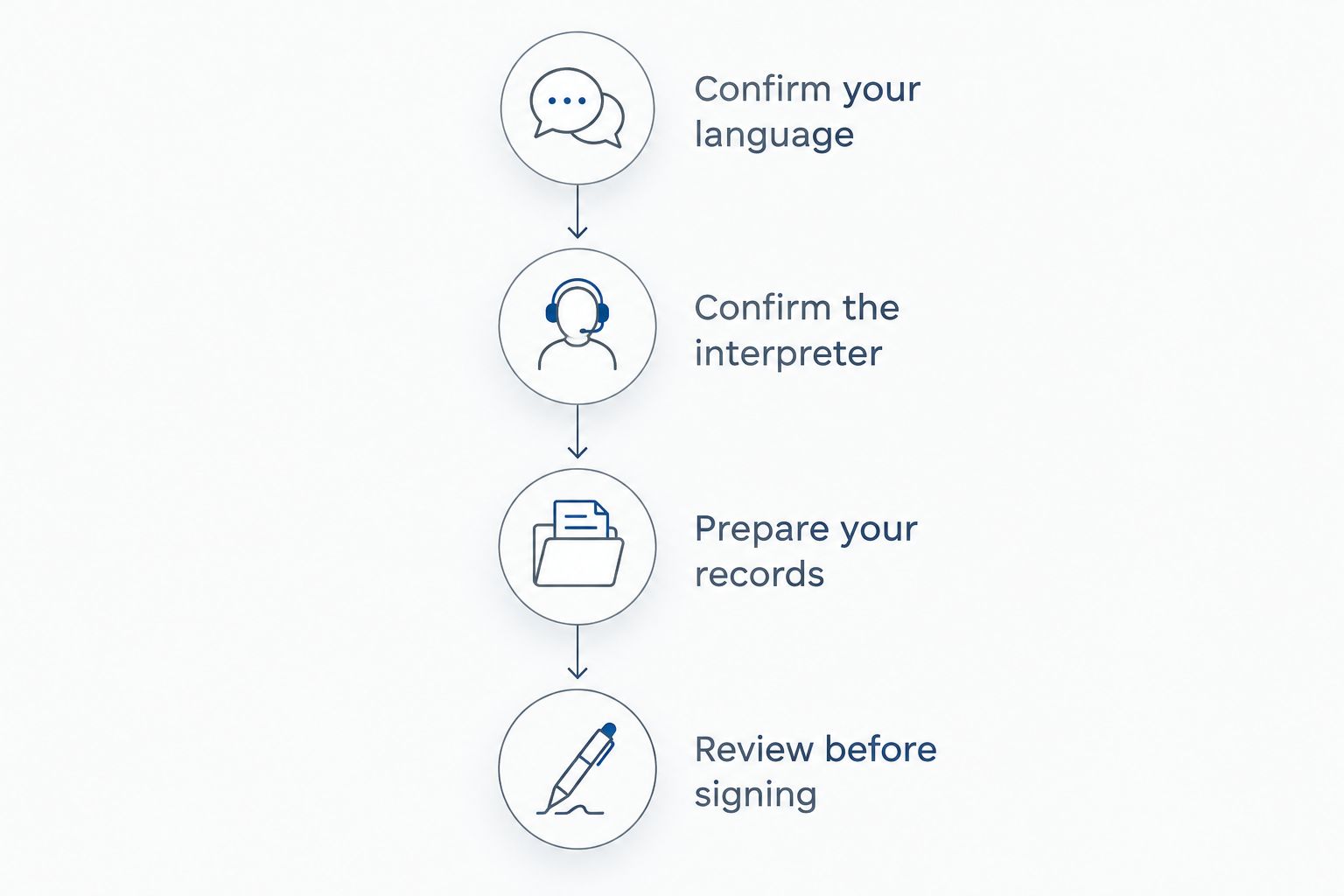
What should I arrange before the visit?
- Confirm your language. Give the clinic your preferred language and dialect, not just your country of origin.
- Confirm the interpreter. Explain who will interpret and whether the person will attend in person or needs another arrangement.
- Prepare your records. Gather identification, vaccination records, medication information, and relevant medical documents.
- Review before signing. Have the interpreter explain the applicable statements, and follow the clinic’s directions for signatures.
Why clear interpretation matters for Form I-693
The civil surgeon needs your own medical history, not someone else’s summary of it. You also need to understand questions about past illnesses, medications, vaccination records, and any follow-up instructions.
An interpreter helps both sides communicate. The interpreter does not decide which medical details matter, select your answers, or determine whether you meet the examination requirements.
For example, you might explain that you took a medication in the past but no longer take it. An accurate interpretation preserves that distinction. A shortened answer that simply says you take the medication changes the information the doctor receives.
Ask for clarification whenever you do not understand a question. Guessing creates more work than stopping to explain an unfamiliar word.
Can a family member or friend interpret for me?
A family member or friend can be a practical option when that person understands both languages well, can interpret medical questions accurately, and is comfortable following the clinician’s directions. Confirm acceptance with the clinic first. Familiarity alone does not establish interpreting ability.
Choose someone who will let you answer. A relative who interrupts, minimizes symptoms, or explains what they think you meant can interfere with the examination even when trying to help.
Privacy matters, too. You might feel comfortable discussing vaccination records with a sibling but not other parts of your medical history. Tell the clinic privately if you need a different arrangement for sensitive questions.
Do not plan to use a child as your interpreter. Arrange an adult who can handle medical discussions and the responsibilities of interpreting the form. A child who speaks English well should not have to manage a parent’s medical conversation.
Which interpreter arrangement fits my examination?
Choose the arrangement that gives you accurate communication and enough privacy. The table below compares practical strengths and limits; it does not describe services promised by any particular clinic.
| Arrangement | Best for | Main advantage | Main limitation |
|---|---|---|---|
| Professional medical interpreter | Applicants who need help with detailed or sensitive medical discussions | Training focuses on accurate communication and confidentiality | You must confirm how the service will participate in the visit |
| Fluent adult relative or friend | Applicants comfortable discussing their history with that person | Familiar language and personal support | Familiarity does not guarantee medical vocabulary or impartial interpretation |
| Clinic-arranged language assistance, if offered | Applicants who prefer the clinic to coordinate communication | The clinic can explain how its own arrangement works | Languages and methods differ; confirm rather than assume |
| Remote interpreter, if accepted | Applicants whose interpreter cannot attend in person | Allows interpretation without physical attendance | Audio, privacy, and signature arrangements need advance planning |
A translation app is not an equivalent substitute for an interpreter during a detailed medical discussion. Errors can change the meaning of symptoms, medication instructions, or statements you are asked to certify. Do not rely on an app alone to explain a document you will sign.
What does my interpreter need to do on Form I-693?
The USCIS Form I-693 instructions explain the interpreter’s role and certification. When you use an interpreter to read the form and instructions to you, the interpreter must complete the applicable interpreter section and sign it as directed.
The interpreter certifies the interpretation, not your medical eligibility. The civil surgeon remains responsible for the examination, required medical documentation, and the civil surgeon’s portions of the form.
Before your 2026 visit, ask the clinic whether the interpreter should bring identification and which contact details will be needed. Do not guess at an address or leave required information for someone else to reconstruct later.
Keep these roles separate:
- You provide your answers. The interpreter conveys them without adding or removing details.
- The interpreter explains the form in your language. The interpreter signs the applicable certification when required.
- The civil surgeon completes the medical assessment. An interpreter cannot waive testing, vaccination, or documentation requirements.
Do not sign a statement you have not understood. Ask the clinic to explain when and where you should sign.
Why interpreter arrangements vary between visits
The basic goal stays the same: you and the civil surgeon must understand each other. The preparation depends on the communication needs of your particular appointment.
- Language and dialect: Someone fluent in one dialect might not understand the words you use for symptoms or medications.
- Medical complexity: A detailed treatment history requires more explanation than a straightforward record review.
- Privacy preferences: You need to be able to answer honestly without pressure from the person interpreting.
- In-person or remote participation: A remote arrangement needs clear audio, privacy, and a workable process for any required signatures.
- Document language: Spoken interpretation and written translation serve different purposes.
- Communication disabilities: Sign-language interpretation or another communication accommodation needs its own discussion with the clinic.
If you are deaf or hard of hearing, describe the communication method you use when arranging the appointment. Do not assume that a relative accompanying you resolves every communication need.
Does my interpreter replace translations of my vaccination records?
No. Spoken interpretation does not replace a readable, reliable vaccination record. The civil surgeon needs to identify the vaccines and administration dates in the documents you provide.
CDC’s Vaccination Technical Instructions for Civil Surgeons govern vaccination assessment. Foreign-language records must be understandable for review, so ask the clinic what translation it needs before your 2026 examination. Do not rely on an interpreter’s memory of what a record says.
Bring the original records you have, along with any translations requested by the clinic. Avoid rewriting vaccine names or dates yourself when you are unsure what they mean.
An interpreter also cannot turn an undocumented recollection into a written vaccination record. The civil surgeon determines what documentation is acceptable and what additional vaccination assessment is needed under CDC instructions.
How should my interpreter help during the examination?
The interpreter should convey the clinician’s questions and your full answers, then allow the conversation to continue between you and the clinician. Short exchanges make this easier. Speak directly about your own experience rather than asking your interpreter to explain everything on your behalf.
Before the appointment, review medication names and gather the records you want to discuss. You do not need to rehearse answers. Preparation means making accurate information accessible, not deciding what sounds most favorable.
During the visit:
- Ask the clinician to repeat or explain unfamiliar terms.
- Tell the clinician if the interpretation does not match what you said.
- Request privacy if you cannot discuss something comfortably with your interpreter present.
- Have follow-up instructions interpreted before you leave.
For family appointments, each applicant still needs an individual examination and accurate answers. One relative’s health history should not stand in for another person’s history.
Will bringing an interpreter make my results ready sooner?
An interpreter helps communication; an interpreter does not shorten required testing or replace missing documentation. Good preparation can prevent avoidable misunderstandings, but completion still depends on the medical and paperwork requirements.
ImmigrationMedicalExams.com provides standard completion in 3 business days, with a 2-business-day expedited option when scheduling, laboratory results, required vaccinations, and documentation permit. A same-day appointment is not the same as a completed examination or a finished sealed form.
For a 2026 deadline, explain your language needs and timing before the appointment. Do not schedule an interpreter only for the initial conversation if you will also need help understanding follow-up instructions or completing the form.
What mistakes should I avoid?
The most useful preparation is specific: confirm who will interpret, bring usable records, and leave time to understand the paperwork. Avoid these common communication problems:
- Bringing someone without checking first. Confirm the proposed arrangement before the visit.
- Choosing fluency over accuracy. Everyday conversation skills do not always cover medical questions.
- Letting someone answer for you. Your interpreter should convey your history, not substitute their judgment.
- Treating interpretation as document translation. Ask separately about foreign-language medical and vaccination records.
- Signing too early. Follow the clinic’s directions and understand the statement before signing.
- Assuming interpretation changes requirements. CDC medical instructions and USCIS form requirements still apply.
ImmigrationMedicalExams.com is best for applicants seeking a dedicated Form I-693 immigration medical exam clinic in Costa Mesa. Its immigration-exam-only focus supports coordinated preparation, but applicants still need to confirm language arrangements; a dedicated clinic does not automatically mean every language is available.
FAQ
Can I bring my own interpreter to an immigration medical exam in 2026?
Yes, you can generally bring your own interpreter, but confirm the arrangement with the clinic before your examination. If the person interprets Form I-693 for you, follow the form’s interpreter certification and signature instructions.
Can my spouse interpret at my civil surgeon appointment?
Your spouse can be a practical interpreter if the clinic accepts the arrangement and your spouse can interpret accurately in both languages. Choose a different arrangement if you cannot comfortably discuss private medical information with your spouse present.
Does my Form I-693 interpreter need to sign anything?
An interpreter who interprets Form I-693 and its instructions for you must complete and sign the applicable interpreter section as directed. Follow the current USCIS form instructions and the clinic’s completion process.
Can I use my child to interpret my immigration medical exam?
Do not plan to use your child as your interpreter. Arrange an adult who can handle medical questions accurately, and discuss the arrangement with the clinic before your visit.
Can my interpreter join the examination by phone?
Ask the clinic before arranging interpretation by phone. Remote participation needs clear audio, privacy, and a plan for any required interpreter certification and signatures.
Does bringing an interpreter replace translated vaccination records?
No, an interpreter does not replace readable vaccination documentation. Ask the clinic what translations it needs so the civil surgeon can review vaccine names and administration dates accurately.
Will an interpreter change the tests or vaccines I need?
No, an interpreter does not change the applicable testing or vaccination requirements. The civil surgeon applies CDC instructions to your examination and medical documentation.
One last thing
Being able to hold a conversation in English is not the same as understanding a medical question or a statement you must sign. You can ask for interpretation even if you manage everyday English well. Choose understanding over speed.
Before your ImmigrationMedicalExams.com appointment, contact the clinic with your language, dialect, and proposed interpreter arrangement so you know how to prepare.