
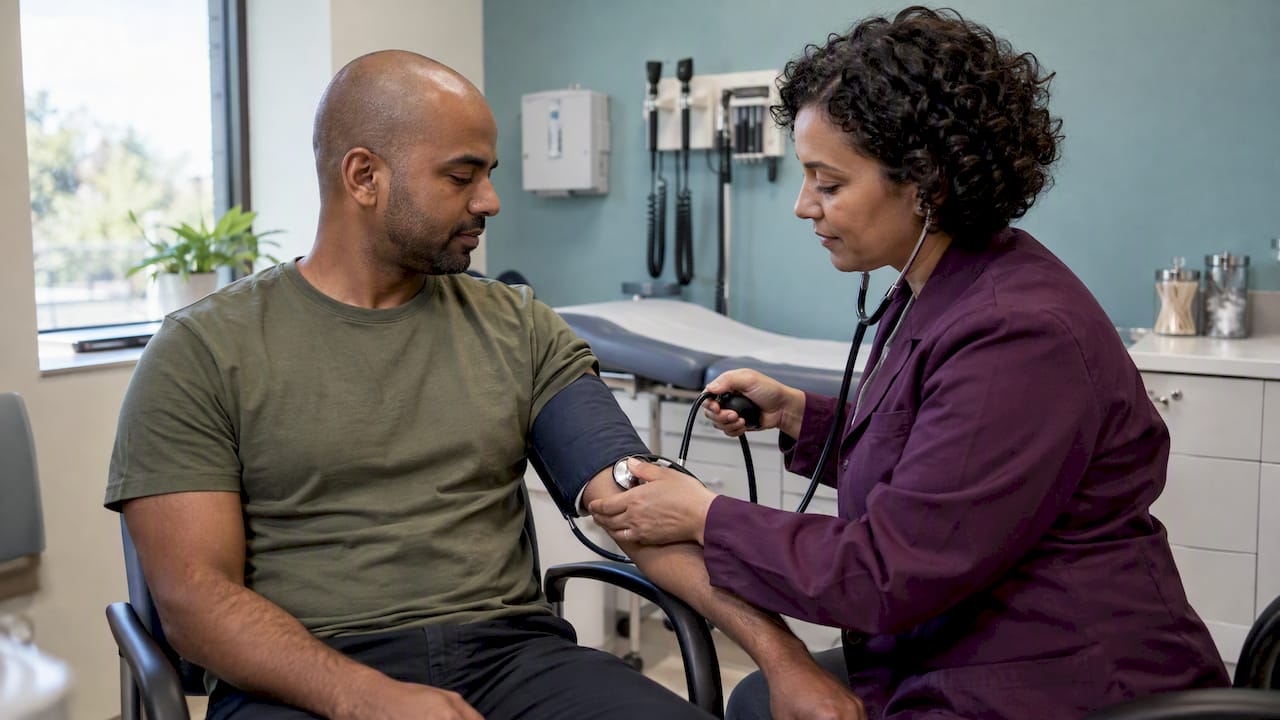
Blood Pressure and the I-693 Medical Exam: What to Expect

Yes, expect your blood pressure to be taken at your I-693 exam, but a high reading does not disqualify you from a green card. The CDC instructions that civil surgeons follow require a physical examination sufficient to identify Class A and Class B conditions. They do not set a pass/fail blood pressure number. Hypertension is, at most, a Class B condition, and USCIS says Class B conditions do not make an applicant inadmissible on health grounds.
Below, we explain what the civil surgeon is looking for, what happens if your reading is high, how medication fits in, and how to prepare. We have performed only immigration medical exams since 2007, so these are questions we hear every week.
TL;DR
- A civil surgeon performs a physical exam as part of Form I-693. The CDC’s instructions do not prescribe a standalone blood pressure cutoff for immigration purposes.
- Hypertension appears on Form I-693 only as an example under “Other Medical Conditions,” which is where Class B conditions are reported. It is not a Class A, inadmissibility-level condition.
- A very high reading can lead the civil surgeon to recommend treatment or evaluation first, and the form is signed only once the exam, including follow-up, is complete.
- Bring a list of your medications and any records of treatment, and keep taking prescribed medicine as your own doctor directs.
Table of Contents
- Is blood pressure checked during the I-693 exam?
- What the exam is really looking for
- Does high blood pressure make you ineligible for a green card?
- What happens if your blood pressure is high at the exam
- What a Class B hypertension report contains
- Can you take blood pressure medication before the exam?
- How to prepare for a calm, accurate reading
- Perspective: why a specialized practice matters for borderline readings
- Plan for timing if a follow-up is possible
- Book an I-693 exam with a flat-package approach
- FAQ
- Sources
Is blood pressure checked during the I-693 exam?
In practice, yes, because it is a basic part of any physical. The formal rule is broader than that. The CDC’s technical instructions for civil surgeons call for a medical history, a review of available medical records, a cardiovascular symptom review, and a physical examination sufficient to identify and assess Class A or Class B conditions. They leave the specifics of the physical to the physician’s judgment. They do not name a blood pressure number that triggers a failure.
The USCIS instructions for Form I-693 say the civil surgeon must follow HHS regulations and the CDC Technical Instructions. So the exam is not a general wellness checkup, and it is not designed to grade your cardiovascular health. Its purpose is to find conditions that matter for health-related inadmissibility, such as certain communicable diseases, and to document other significant conditions accurately.
If you want the full picture of the visit, from paperwork to vaccines, our step-by-step guide to the exam walks through it.
What the exam is really looking for
The I-693 sorts findings into two groups that matter for your case:
- Class A conditions. USCIS states that a Class A condition is conclusive evidence of health-related inadmissibility. On the form these are specified categories: communicable diseases of public health significance, certain physical or mental disorders tied to harmful behavior, and drug abuse or addiction.
- Class B conditions. Under the CDC definition, a Class B condition is a physical or mental disorder that represents a substantial departure from normal health or well-being. It may interfere with self-care, school or work, or require extensive treatment or institutionalization.
Blood pressure belongs to neither Class A category. The current Form I-693 lists hypertension as an example under “Other Medical Conditions,” separate from the Class A communicable disease, harmful-behavior and drug-abuse sections. That placement tells you how the government views it: a medical condition to be documented when it meets the Class B definition, not a barrier to entry.
Most people with well-controlled blood pressure will have nothing special written about it. The Class B reporting section is for conditions that meet the definition above.
Does high blood pressure make you ineligible for a green card?
No. USCIS policy says a Class B condition does not itself make an applicant inadmissible on health-related grounds. Its public-charge guidance repeats the point and adds one nuance: Class B conditions do not render someone inadmissible, although they may be relevant to a separate public-charge determination.
That nuance is worth understanding, because it is where applicants worry most:
- Health-related inadmissibility is the question the I-693 answers. Hypertension does not trigger it.
- Public charge is a broader review that weighs many factors together, such as age, income, assets, education and health. Health information can be one input, but even a Class B condition does not automatically bar adjustment.
- Who makes the medical judgment? USCIS instructs its officers not to make their own health diagnoses in a public-charge assessment and generally to defer to the civil surgeon’s report.
That last point is why an accurate, complete report matters. A clear note from the civil surgeon that your condition is treated and manageable is far more useful to your case than a vague or missing one. If you have a pending case with an attorney, ask them how health information fits into your specific public-charge analysis.
What happens if your blood pressure is high at the exam
A single high reading in an unfamiliar office is common. Stress, rushing to the appointment, caffeine and a lack of sleep all push numbers up. A careful civil surgeon will usually recheck after you have sat quietly for a few minutes and ask about your history before drawing any conclusion.
From there, the possible paths look like this:
| Situation | What typically happens |
|---|---|
| Mildly elevated, no history, no symptoms | The physician rechecks, asks questions, and may advise you to see your own doctor. The exam continues. |
| Known hypertension, treated and stable | The civil surgeon reviews your records and medications. If it meets the Class B definition, it is reported in the “Other Medical Conditions” section. |
| Severely high reading or symptoms | The physician may recommend treatment or evaluation before finishing the exam, for your safety. |
| Unclear diagnosis or unclear class | The civil surgeon refers you for further evaluation, and the consultant’s report goes with your medical report. |
The rules behind that table come from the CDC. If an acute illness makes it impossible to determine your medical status, the civil surgeon is told to have it treated and complete the exam after recovery. When the physician is uncertain about a diagnosis or whether something is Class A or Class B, the CDC requires a referral for evaluation sufficient to resolve the uncertainty. The civil surgeon should also advise applicants who need unrelated evaluation or treatment and recommend appropriate diagnostic evaluation.
If a referral is made, the USCIS instructions require the civil surgeon to identify the physician or public-health facility and specify the additional exam, tests or treatment. The receiving professional completes and signs the referral evaluation. You are also expected to attend the initial exam and all required follow-up exams.
Because USCIS policy lets the civil surgeon sign Form I-693 only after the entire exam is complete, including necessary follow-up, a referral can add time. That is the real cost of an uncontrolled reading: delay, not denial.
What a Class B hypertension report contains
When hypertension does need to be reported, USCIS expects substance, not a one-word label. In its training presentation on the exam, USCIS explains that the “Other Medical Conditions” section covers Class B conditions such as hypertension or diabetes. It calls for the diagnosis, whether the condition is manageable and how it is treated, and its likely effect on normal life activities or the need for extensive care or institutionalization.
The USCIS policy manual frames the Class B review in similar terms. The report should address the nature and extent of the abnormality, incapacity for normal physical activity, remediability, and the likelihood of extensive medical care or institutionalization.
For someone whose blood pressure is controlled with one daily medication and who works, drives and lives normally, the honest answer to those questions is reassuring. That is exactly why documentation helps you. A civil surgeon who has your prescription history and recent readings can describe the condition accurately instead of guessing.
Can you take blood pressure medication before the exam?

The exam rules do not ask you to stop or change your treatment, and we would never suggest you do. Take your medicines as your own prescribing doctor has directed, including on exam day. Skipping a dose to look healthier is a bad idea for two reasons: it can be unsafe, and an artificially high reading can create the very delay you are trying to avoid.
What to do instead:
- Bring the list. Write down each medication, the dose and how long you have taken it. A pharmacy printout works well.
- Bring records. The USCIS instructions tell you to bring available medical records, including vaccination records. For hypertension, recent office readings or a letter from your treating doctor help the civil surgeon document the condition.
- Tell us about it. Medication history is part of the medical history. Being open about it lets the physician describe your condition accurately.
- Ask your own doctor. Questions about timing or dosing are for the physician who prescribes your medication, not for an immigration exam.
If you were told by a doctor to monitor your pressure at home, bring those logs too.
How to prepare for a calm, accurate reading
A few simple habits make the reading more representative of your everyday numbers. These are general good practice for any blood pressure check, not USCIS requirements:
- Arrive 10 to 15 minutes early so you are not rushing from the parking lot.
- Go easy on caffeine and avoid smoking right before the appointment.
- Use the restroom before the exam.
- Wear a short-sleeved or loose-sleeved top so a cuff fits comfortably.
- Sit with your back supported and feet flat, and let the clinician know if you are anxious or in a hurry.
- If a first reading is high, ask for a recheck after a few quiet minutes.
Also arrive with the paperwork a normal I-693 visit requires. Our guide to what is included in Form I-693 lists the exam, labs and vaccines, and our article on I-693 blood tests covers the lab screens, which are separate from blood pressure and often confused with it.
Perspective: why a specialized practice matters for borderline readings
Blood pressure questions are rarely the real problem on an I-693. The real problem is an incomplete file: a missing medication list, a vague note, or a form signed before follow-up was finished.
We perform immigration medical exams only, and have since 2007. We do not run a primary care or urgent care clinic, so our time and our review process are built around one outcome: a Form I-693 that is complete and compliant the first time. Our team applies an internal quality review before a form is sealed, because errors are what cost applicants weeks.
We also see applicants who come to us after problems with exams done elsewhere, including unclear documentation or missing vaccination records. If your reading is high or you have a diagnosis of hypertension, our advice is simple: tell us early, bring your records, and let the physician document it accurately. With a clear history, an honest report is usually the strongest report.
ImmigrationMedicalExams Medical Team
Plan for timing if a follow-up is possible
If you are applying under a deadline, such as an upcoming interview, build in margin. A follow-up visit with your own doctor or a specialist can add days or weeks, and the civil surgeon cannot sign the form until the exam is complete. If your blood pressure has been poorly controlled, see your own physician before you book rather than after.
A few other timing notes help:
- The sealed envelope must reach USCIS as the instructions direct, so do not open it.
- If you need a document replaced or copied, ask the clinic what is available. We list replacement sealed envelopes and printed record copies on our pricing page.
- Costs and fees vary by clinic, so compare what each package includes. Our overview of how to evaluate I-693 clinics lays out what to ask.
Book an I-693 exam with a flat-package approach
We are a Southern California practice that performs the civil surgeon exam, required lab testing, vaccination review and required vaccinations when appropriate, and the preparation of Form I-693 in one location. Our flat-package approach is designed to minimize unexpected costs. Standard processing takes about 3 days, and a 2-day expedited option is available. You can schedule online at any hour.

If you already know you have hypertension, book the standard 3-day exam and bring your records. If your timeline is tight, look at the 2-day expedited exam. For the full service description, see our immigration medical exam page.
FAQ
Will I fail the I-693 exam if my blood pressure is high?
No. The CDC instructions for civil surgeons do not set a pass/fail blood pressure number, and hypertension is listed on the form only as an example of an other medical condition. A very high reading may lead to treatment or evaluation before the exam is completed, which can delay the signed form but is not a denial.
Is hypertension a Class A or Class B condition?
Hypertension is not a Class A condition. Form I-693 lists it as an example under “Other Medical Conditions,” where Class B conditions are reported if they meet the definition. USCIS says a Class B condition does not by itself make you inadmissible on health grounds.
Should I bring my blood pressure medication records?
Yes. USCIS instructs applicants to bring available medical records, and a medication list plus recent readings or a note from your treating doctor helps the civil surgeon document your condition accurately. Keep taking your medicine as your own doctor directs.
Can a civil surgeon refer me to another doctor?
Yes. If the civil surgeon is uncertain about a diagnosis or its class, the CDC requires a referral for evaluation, and the consultant’s report is included with your medical report. The civil surgeon can sign the form only after that follow-up is complete.
Can high blood pressure affect a public-charge review?
Possibly as one factor among many. USCIS says Class B conditions may be relevant to a separate public-charge determination, but they do not automatically bar adjustment. Talk to an immigration attorney about how your own facts fit.
Sources
- CDC: Medical History and Physical Examination, Technical Instructions
- USCIS: Instructions for Form I-693
- USCIS: Form I-693
- USCIS Policy Manual, Volume 9, Part D, Chapter 1
- USCIS Policy Manual, Volume 8, Part G, Chapter 5
- USCIS Policy Manual, Volume 8, Part B
- USCIS Policy Manual, Volume 8, Part B, Chapter 4
- USCIS: Medical Exams and Form I-693 presentation