Biometrics vs. Medical Exam: What Each Green Card Step Is

A biometrics appointment and an immigration medical exam are two different steps in a green card case. Biometrics is a USCIS appointment to collect your fingerprints, photo or signature so the agency can confirm who you are and run background checks. The medical exam is a health screening by a USCIS-designated civil surgeon, who records the results on Form I-693. Different people run them, in different places, for different reasons. Only one of them (the medical exam) is something you schedule yourself.
TL;DR
- Biometrics is scheduled by USCIS, takes place at an Application Support Center, and is about identity and background checks.
- The medical exam is booked by you with a civil surgeon, and it covers health-related admissibility, including required vaccines.
- Most adjustment-of-status applicants must submit a completed Form I-693 with their Form I-485, so the exam usually comes before biometrics, not after.
- Do not bring your sealed I-693 envelope to biometrics unless your notice says to. Keep the envelope sealed unless you are uploading it for an online filing.
- A sealed I-693 stays valid for two years from the civil surgeon’s signature.
Table of Contents
- The two appointments side by side
- What biometrics actually involves
- What the immigration medical exam involves
- Which one comes first?
- What to bring to each appointment
- Cost and insurance: the difference people notice
- Our perspective: where applicants lose time
- Getting your exam done in Southern California
- Common mix-ups to avoid
- FAQ
- Sources
The two appointments side by side
| Biometrics appointment | Immigration medical exam | |
|---|---|---|
| Purpose | Confirm identity, run background and security checks | Determine health-related admissibility |
| Who schedules it | USCIS, by notice | You, with a civil surgeon |
| Where | Application Support Center named on your notice | A USCIS-designated civil surgeon’s office |
| What happens | Fingerprints, photo, possibly a signature | Medical history review, physical exam, lab tests, vaccine review |
| What you bring | Appointment notice (Form I-797C) and valid photo ID | Photo ID, vaccination records, medical history; see the checklist below |
| What you get | Nothing to carry away; USCIS records the data | A completed Form I-693 in a sealed envelope |
| Who chooses the provider | USCIS assigns the location | You choose, from designated civil surgeons |
The most common confusion is the assumption that both happen at the same place, or that one appointment replaces the other. They do not.
What biometrics actually involves
After you file, USCIS decides whether it needs your biometrics. If it does, it sends an appointment. According to USCIS, biometrics may include fingerprints, a photograph, or a signature, and the agency uses them to confirm your identity and run the required background and security checks.
You do not choose the date or the building. The appointment takes place at the Application Support Center listed on your notice, Form I-797C. USCIS tells applicants to bring that notice and valid photo identification. Without them, you risk being turned away and having to reschedule.
There is also a security rule worth knowing before you leave the house. Federal law prohibits firearms, knives, pepper spray and ammunition at USCIS facilities, and violators may face fines or imprisonment. Leave anything like that at home, including a small knife on a keychain or pepper spray in a purse.
Biometrics is not a medical event. Nobody at the Application Support Center examines you, reviews vaccines, or collects health paperwork. If a relative tells you to bring your medical exam there, they are likely mixing up the two steps.
What the immigration medical exam involves
The medical exam exists to establish that you are not inadmissible on health-related grounds. For applicants who file Form I-485, USCIS says they typically must undergo an immigration medical examination and receive vaccinations against vaccine-preventable diseases.
The exam must be done by a USCIS-designated civil surgeon, with limited military and health department exceptions. Your regular family doctor generally cannot do it unless that doctor happens to hold the designation. We cover that distinction in more detail in our guide to civil surgeons versus general doctors, which is written in Spanish.
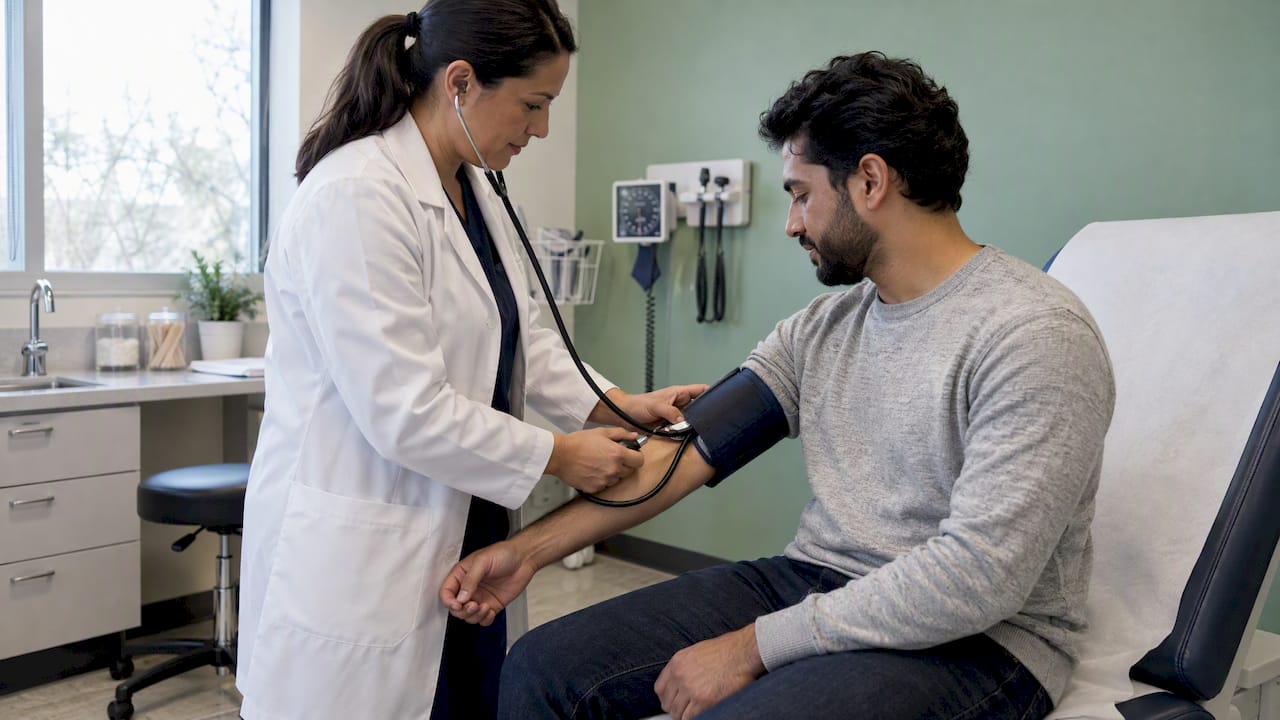
According to USCIS training material, the civil surgeon reviews your medical history and other records, assesses Class A and Class B conditions through a review of systems and a physical examination, and uses Form I-693 to report the findings. In practice that means a conversation about your health history, a physical exam, required lab work, and a review of your vaccination record.
Vaccines are part of the exam
This is the piece applicants most often underestimate. The CDC lists the vaccines that can be required: diphtheria, tetanus, pertussis, polio, measles, mumps, rubella, rotavirus, Hib, hepatitis A, hepatitis B, meningococcal disease, varicella, pneumococcal disease and influenza. Which ones apply to you depends on your age and your vaccination history.
The civil surgeon must review your existing records and administer any required vaccine for which you are not up to date under current ACIP recommendations. So bring every vaccination record you have, even old ones from another country. If you started a series years ago and paused, CDC guidance says an extended gap between doses does not mean starting the series over; the examiner gives the next required dose.
The sealed envelope
When the exam is complete, the civil surgeon gives you the finished Form I-693 in a sealed envelope to submit to USCIS. USCIS will return it if the envelope has been opened or altered. Online filers are the exception: for I-485 cases filed online, you open the envelope to upload the form, then keep the original form and envelope until USCIS makes a final decision.

Which one comes first?
For most adjustment-of-status applicants, the medical exam comes first. USCIS now says that certain applicants filing Form I-485 must submit Form I-693 with the I-485. The agency explained the change as a way to cut down on Requests for Evidence before it decides the case. The form instructions confirm that most adjustment applicants must submit it to show they are not inadmissible on health grounds.
That gives you a typical order:
- Get your medical exam and sealed Form I-693 from a civil surgeon.
- File your Form I-485 with the I-693.
- Receive a receipt notice.
- If USCIS needs your biometrics, receive an appointment notice and attend.
- Respond to any other notices, then attend an interview if one is scheduled.
Biometrics happens after filing, because USCIS cannot schedule it until it has your application. The medical exam can happen before filing, which is why the two feel out of sequence to many people.
Not every benefit works this way. USCIS’s policy manual explains that requirements vary: immigrant-visa applicants processed through the Department of State generally use an overseas panel physician, adjustment applicants generally use a U.S. civil surgeon, and many nonimmigrant and asylum applicants do not need an immigration medical exam unless an exception or specific concern applies. Your category decides whether you need the exam at all. If you are not sure, ask your attorney or check the I-693 instructions for your filing basis.
Do I bring my medical exam to biometrics?
No. One answer ranking for this very question is blunt on the point: the medical exam is not something you take to a biometrics appointment. Your I-693 goes to USCIS with your application, or in response to a USCIS request. Biometrics is a separate identity step. The only items to bring are the ones on your notice: the I-797C and valid photo ID.
How long is the exam good for?
USCIS removed the old 60-day rule. A signed Form I-693 keeps its evidentiary value for two years from the civil surgeon’s signature. USCIS made the change because stakeholders said the old rule was confusing and caused Requests for Evidence on otherwise valid forms. Practically, this gives you room: you can do the exam when you are ready to file without racing a short clock. It does not mean you can ignore the form’s edition or the vaccines it records; see our note on checking the I-693 edition, vaccines and seal.
What to bring to each appointment
Biometrics
- Your appointment notice (Form I-797C)
- Valid photo identification
- Nothing prohibited under the federal weapons rule above
Medical exam
- Government-issued photo ID
- Every vaccination record you can find, including foreign records
- A list of current medications and any relevant medical history
- Any prior test or treatment records for conditions you have been told about
- Payment method; the fee is set by the clinic
On your own checklist, add the filing basis. If you are an F2B adult child, an Amerasian immigrant or a K-1 fiancé(e), details can differ. We have separate guides for F2B adult children, Amerasian immigrants and who needs an immigration medical exam.
Cost and insurance: the difference people notice
Biometrics has no clinic bill. The medical exam does, and it is priced by the provider. USCIS does not regulate medical exam fees, and its guidance notes that fees vary, many civil surgeons do not accept insurance, and insurance may not cover many parts of the exam. It encourages you to compare local civil surgeons.
When you compare, ask what the quote includes. Some offices quote the exam alone and then add lab work, vaccines, the sealed envelope or a copy of your records. A flat package is easier to compare than an itemized list. Ask specifically about:
- The civil surgeon’s exam and Form I-693 preparation
- Required blood and other lab tests
- Vaccines you will need, if any
- Turnaround time for the sealed form
- Fees for missed appointments or replacement envelopes
Our own pricing page lists the extras separately, such as titer testing, additional vaccinations and replacement envelopes, plus a $210 missed appointment deposit.
Our perspective: where applicants lose time
We have done nothing but immigration medical exams since 2007. The pattern we see most is not a medical problem. It is a paperwork problem, and it often traces back to confusing the two appointments.
Some applicants wait for their biometrics notice before thinking about the medical exam. When the rules ask for the I-693 at filing, that leaves the case missing a required piece. Others show up at biometrics with a sealed envelope, or open the envelope at home to check it, which can invalidate it. Still others arrive at an exam with a single vaccine card and no record of anything else, and leave needing repeat visits.

We frequently see applicants who come to us after delays, errors, incomplete vaccination documentation or an exam done elsewhere. Our approach is to treat the I-693 as a document that has to be right the first time: an internal quality review before it is sealed, a check that the vaccine section matches the records, and a clear explanation of what to do with the envelope. We do no primary care, urgent care or sick visits, so everything in the office is built around this one form.
If you remember only one thing: the exam is yours to schedule and the sealed envelope is yours to protect. Biometrics will come when USCIS calls for it.
— ImmigrationMedicalExams Medical Team
Getting your exam done in Southern California
If you need a civil surgeon in Los Angeles, Orange, Riverside, San Diego or San Bernardino County, we handle the exam, lab testing, vaccine review and required vaccines, and Form I-693 preparation in one place. You can choose the standard 3-day exam or the 2-day expedited option when your filing date is close. Online scheduling is open 24/7. See the full I-693 immigration medical exam page for what is included.

Attorneys and families can also use our group, children’s, senior and attorney exam services. For more on how we handle turnaround, read about sealed I-693 forms in 2–3 days.
Common mix-ups to avoid
- Treating biometrics as the medical step. No health information is collected at the Application Support Center.
- Opening the envelope. USCIS returns an opened or altered envelope. Only online filers open it, for upload.
- Skipping vaccine records. The civil surgeon has to review them and give required doses you are missing.
- Using the wrong type of doctor. A general practitioner who is not a designated civil surgeon cannot complete the form.
- Assuming you need the exam at all. Many nonimmigrant and asylum applicants do not, so confirm your category.
- Forgetting that results are not private from public health authorities in every case. Exam results are confidential, but when the law requires it the civil surgeon may share them with public health authorities.
Lawyers and consultants who need a quick summary for clients can also point them to our practical guide to I-693 for attorneys, written in Spanish.
FAQ
Do I do biometrics or the medical exam first?
For most adjustment-of-status applicants, the medical exam comes first, because Form I-693 is generally submitted with the I-485. USCIS schedules biometrics only after it receives your application, and only if it needs them. Check your filing instructions for your category.
Is the medical exam done at the biometrics appointment?
No. Biometrics is held at a USCIS Application Support Center and covers fingerprints, a photo or a signature. The medical exam happens at a civil surgeon’s office, and you book it yourself.
Do I bring my I-693 to my biometrics appointment?
No, unless your notice says otherwise. USCIS asks you to bring the I-797C notice and valid photo ID. Keep your sealed I-693 envelope unopened, and submit it as your filing instructions direct.
What vaccines will I need for the green card medical exam?
The list that can apply is set by the CDC and includes MMR, Tdap, polio, varicella, hepatitis A and B, and influenza, among others. Which ones you actually need depends on your age and records. The civil surgeon reviews your history and gives what is missing.
Does insurance pay for the immigration medical exam?
Often it does not. USCIS notes that many civil surgeons do not accept insurance and that coverage may not extend to many parts of the exam. Ask for a written quote that shows what is included before you book.
Sources
- Finding a Medical Doctor, USCIS
- Preparing for Your Biometric Services Appointment, USCIS
- Policy Manual, Volume 8, Part B, Chapter 3, USCIS
- Medical Exams and Form I-693, USCIS presentation
- Form I-693 Instructions, USCIS
- USCIS Now Requires Report of Immigration Medical Examination and Vaccination Record
- Forms Available to File Online, USCIS
- Removal of the 60-Day Rule, USCIS policy manual update
- Vaccination, Technical Instructions for Civil Surgeons, CDC
- Vaccination Technical Instructions FAQs, CDC