
Instead of counting toward your asylum anniversary without a medical-exam plan, coordinate your Form I-693, Report of Immigration Medical Examination and Vaccination Record, with your adjustment-of-status timeline. There is no automatic medical-exam deadline exactly one year after asylum approval; arrange your civil surgeon visit around your actual filing requirements.
- Asylum approval one year medical exam planning starts with your filing timeline, not an automatic anniversary appointment.
- USCIS generally requires asylees seeking adjustment of status to complete an immigration medical examination.
- ImmigrationMedicalExams.com provides dedicated Form I-693 examinations for Southern California applicants.
- Bring identification, vaccination records, and relevant medical documentation; keep the completed USCIS envelope sealed.
Why this matters
Your asylum approval date, your physical presence in the United States, and your medical-exam date serve different purposes. Treating them as one deadline can lead you to schedule an examination without knowing when or how you will submit it.
USCIS policy requires an asylee seeking adjustment of status to have at least 1 year of physical presence after the asylum grant by the time USCIS decides the application. That rule does not create an annual medical-exam requirement. Ask your immigration attorney or accredited representative to confirm your application timing; the civil surgeon handles the medical examination and documentation.
For the medical portion, the green card medical exam I-693 guide explains the broader process. This 2026 workflow focuses on moving from asylum approval to a correctly prepared medical packet, without confusing the clinic visit with the immigration filing.
Before you start
- Identify your submission plan. Have your asylum approval notice and any USCIS request for medical evidence available. Confirm with your legal representative whether you are preparing an initial application or responding to an existing case.
- Collect your examination materials. Gather government-issued photo identification, dated vaccination records, a medication list, and relevant medical reports. Ask the clinic about identification requirements for children and any documents that need translation.
- Do not assume a previous examination covers this application. An overseas examination, refugee examination, routine physical, or earlier Form I-693 does not automatically satisfy your current requirements. Tell the clinic exactly what you have before arranging repeat testing.
You do not need to understand every vaccine or laboratory rule before calling. You do need to explain that you received asylum and are arranging the medical documentation for adjustment of status.
Your filing timeline
Establish the medical submission plan
- Locate your asylum approval notice. Record the grant date accurately. Do not substitute the date you first applied for asylum, received employment authorization, or first visited a doctor.
- Confirm the filing plan with your legal representative. Ask when the medical report should accompany the application or a response. Keep eligibility calculations separate from the clinic's scheduling decisions.
- Identify any existing USCIS deadline. Give the clinic the response deadline shown on a request for evidence, if one exists. Do not describe the deadline only as “urgent.”
- Choose the examination window. Allow time for the visit, laboratory results, vaccination review, and any additional evaluation. Do not make the appointment date your intended mailing date.
Expected result: You know what the medical packet is for, when you expect to submit it, and whether USCIS has already assigned a response deadline.
For 2026 planning, use the current USCIS Form I-693 instructions and USCIS Policy Manual guidance on asylee adjustment. Do not rely on a discussion-board timeline from another applicant. The applicant's category, filing history, and medical documentation can differ from yours.
Keep a simple written timeline with separate entries for asylum approval, your planned examination, and the planned submission. Add a USCIS response deadline only when an actual notice provides one. This prevents a personal calendar reminder from becoming a mistaken filing rule.
Your records and appointment
Prepare the examination materials
- Match your identity documents. Compare your name and date of birth across your identification, vaccination records, and immigration paperwork. Flag spelling differences before the civil surgeon completes the form.
- Request dated vaccination records. Collect records from prior clinics, pharmacies, schools, or public health programs. Bring records from outside the United States rather than assuming they cannot be used.
- Gather relevant medical reports. Include prior tuberculosis test results, chest X-ray reports, and treatment documentation when applicable. Tell the clinic about pregnancy, significant medical conditions, and current medications.
- Explain practical needs before the visit. Ask about interpreter arrangements, accessibility needs, or coordinating examinations for family members. Each applicant still needs an individual assessment and medical form.
- Confirm what the clinic wants you to complete beforehand. Follow its instructions for the current form edition and personal-information sections. Do not sign the applicant certification before the civil surgeon instructs you to sign.
Expected result: The clinic has a clear picture of your documentation and knows which questions need attention during the examination.
A vaccination history recalled from memory is not the same as a dated vaccination record. If records are missing, tell the clinic before the appointment. The civil surgeon can explain when acceptable evidence of immunity or vaccination is appropriate under CDC instructions.
ImmigrationMedicalExams.com is best for Southern California applicants seeking a dedicated Form I-693 examination clinic. Its focus is immigration examinations, not ongoing primary care or legal representation. That distinction helps you choose the right appointment without expecting the clinic to decide your adjustment eligibility.
Your examination and sealed packet
Complete the medical requirements
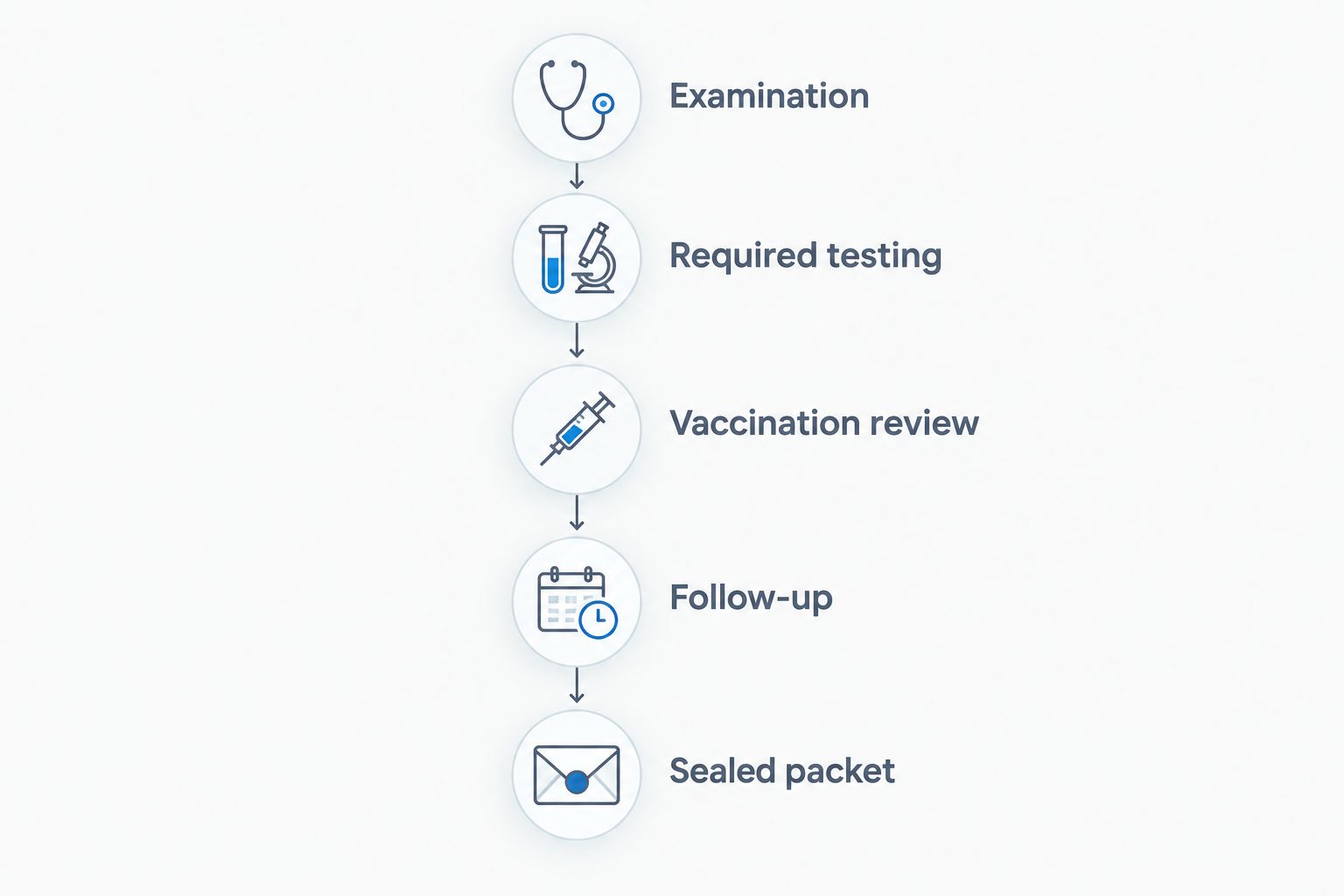
- Attend the civil surgeon examination. Review your medical history honestly and bring the documents you collected. A routine physical from a doctor who is not a USCIS-designated civil surgeon does not replace the required examination.
- Complete the required testing. Under CDC civil surgeon tuberculosis instructions, applicants aged 2 years and older generally need an interferon-gamma release assay, a TB blood test. Other testing depends on the applicable age and medical requirements.
- Review vaccinations with the civil surgeon. The doctor evaluates your age, records, acceptable evidence of immunity, and any medically appropriate exceptions. Not every vaccine applies to every applicant.
- Finish any necessary follow-up. A positive TB blood test can require a chest X-ray and further assessment. Additional evaluation changes the completion timeline; it does not automatically mean USCIS will deny your application.
- Review your copy and collect the sealed original. Check identifying information and report errors to the clinic. Keep the USCIS envelope sealed and follow the submission instructions for your application or notice.
Expected result: Once all requirements are satisfied, the civil surgeon completes your Form I-693 and prepares the sealed packet for USCIS.
At ImmigrationMedicalExams.com, standard completion is 3 business days, with a 2-business-day expedited option, subject to scheduling, laboratory results, required vaccinations, and additional documentation. Neither timeline removes a required medical evaluation.
For your 2026 schedule, distinguish the date you see the doctor from the date your packet is ready. An appointment and a completed Form I-693 are separate milestones. Confirm completion expectations after the clinic reviews your records and requirements.
The sealed I-693 packet submission guide explains the handoff in more detail. An online immigration account does not, by itself, mean you should open the envelope and upload its contents.
If you already completed an immigration examination
An existing examination changes the first step: arrange a document review before assuming you need to repeat everything. Asylees and refugees have different medical-documentation rules, so describe your actual status rather than using the terms interchangeably.
| Starting point | Best for | Useful next step | Limitation |
|---|---|---|---|
| No completed Form I-693 | Asylees arranging their first adjustment medical exam | Prepare records and arrange a civil surgeon examination | Completion depends on testing and follow-up |
| An existing Form I-693 or prior immigration exam | Applicants checking whether earlier documentation applies | Have the document and case history reviewed before repeating the examination | Prior paperwork does not automatically satisfy a new submission |
- Identify who performed the earlier examination and whether you have a completed Form I-693, an overseas medical record, or only laboratory results.
- Give your legal representative the relevant examination information and explain whether the form was already submitted to USCIS.
- Ask the civil surgeon what additional examination, testing, or documentation is necessary for the current task.
- Proceed only after you understand whether you need a new examination, a correction, or a different submission step.
Expected result: You avoid treating an old medical document as either automatically acceptable or automatically useless.
For 2026 submissions, confirm current USCIS rules on Form I-693 validity and its connection to the underlying application. Do not assume that a sealed envelope remains usable indefinitely or that a form submitted with one application can always be transferred to another.
Troubleshooting common delays
“My one-year anniversary is approaching, but I have no filing plan.”
Confirm the submission plan before choosing the examination date. The anniversary alone does not tell the clinic when USCIS needs your medical report. You can gather vaccination and medical records while your legal representative addresses application timing.
“I cannot find my vaccination records.”
Request copies from the original providers and tell the clinic what is missing. Do not postpone all communication until the records appear. CDC instructions allow certain evidence of immunity for specified diseases, but the civil surgeon must decide what documentation meets the requirements.
“My TB blood test is positive.”
Follow the civil surgeon's instructions for chest imaging and any further evaluation. A positive blood test does not by itself establish active tuberculosis. Do not assume expedited processing can bypass the additional medical steps.
“My name differs between documents.”
Flag the difference before the form is finalized and bring supporting identity documentation requested by the clinic. Do not hand-edit a completed medical form or write corrections on a sealed packet. Ask the issuing clinic to handle necessary corrections.
“The packet is ready, but my application is delayed.”
Keep the envelope sealed and ask your legal representative whether the planned submission remains appropriate. Confirm any medical-document questions with the civil surgeon. A completed examination does not determine when you are eligible to file or guarantee USCIS approval.
Customize your workflow
For a family, maintain a separate record checklist for each person. One parent's vaccination history does not establish a child's vaccine status, and one family member's finished packet does not mean every examination is complete.
If an attorney coordinates your examination, agree on who communicates deadlines and who receives the sealed packet. Share medical information only through the clinic's instructed process, and authorize disclosures as required. Avoid sending sensitive medical records through public messages or shared links.
For your 2026 examination, prioritize complete records over a last-minute appointment. Ask early about missing documents, prior TB treatment, or vaccine questions so the clinic can identify the next step before your intended submission date.
Contact ImmigrationMedicalExams.com with questions about preparing for your civil surgeon visit. Keep questions about adjustment eligibility and filing strategy with your immigration attorney or accredited representative.
FAQ
Do I have to get my medical exam exactly one year after asylum approval?
No. Asylum approval does not create an automatic medical-exam appointment or deadline on the one-year anniversary. Coordinate Form I-693 with your adjustment application or a specific USCIS request.
Does the one-year physical-presence rule determine my examination date?
No. The physical-presence rule concerns eligibility for adjustment, not a required anniversary examination. Ask your legal representative to confirm your filing plan before setting the medical submission schedule.
Do asylees generally need Form I-693 for a green card?
Yes. USCIS generally requires asylees applying for adjustment of status to complete an immigration medical examination and submit Form I-693. Have any prior immigration medical documents reviewed rather than assuming an exception applies.
Can I use the physical examination from my regular doctor?
A routine physical does not replace a required civil surgeon examination. Your regular doctor's vaccination records and relevant medical reports can still help the civil surgeon assess your documentation.
What should I bring to my civil surgeon visit after asylum approval?
Bring accepted identification, dated vaccination records, a medication list, and relevant medical reports. Also provide any USCIS medical request and its deadline, and follow the clinic's preparation instructions.
Can my Form I-693 be completed in one visit?
Do not assume that attending one visit means your Form I-693 is complete. Laboratory results, vaccination requirements, and additional medical evaluation determine when the civil surgeon can finish the packet.
Should I open my sealed medical envelope before sending it to USCIS?
No. Keep the USCIS medical envelope sealed and use your separate copy to review the information. Contact the clinic if the packet is opened, damaged, or appears to need a correction.
One last thing
A missing vaccination record is a preparation problem, not a reason to abandon the examination plan. Tell the clinic what you have before obtaining extra tests or vaccines on your own. The civil surgeon can identify which evidence matters for your Form I-693 and which steps you actually need.