

RPR vs VDRL: Which Syphilis Test Do You Need?

Both RPR (rapid plasma reagin) and VDRL (venereal disease research laboratory) are nontreponemal screening tests for syphilis, meaning they detect reagin antibodies rather than antibodies specific to Treponema pallidum itself. RPR is the workhorse for blood screening and runs on automated platforms in most U.S. labs today; VDRL is the only validated nontreponemal test for cerebrospinal fluid (CSF) and remains the standard for diagnosing neurosyphilis. A reactive result on either test is not a diagnosis on its own. Per CDC guidance, every reactive screen requires confirmation with a treponemal-specific test such as TP-PA or FTA-ABS, plus clinical correlation.
Quick orientation:
- RPR: Blood/serum/plasma; widely automated; used for routine screening and treatment monitoring
- VDRL: Blood or CSF; manual slide test; the only validated nontreponemal test for neurosyphilis workup
- Reactive result on either: Order a treponemal confirmatory test before drawing any clinical conclusions
- Serial monitoring: Always use the same test at the same lab; RPR and VDRL titers are not interchangeable
Table of Contents
- How do RPR and VDRL differ technically?
- How accurate are these tests, and what causes false results?
- How do you read and use quantitative titers?
- What testing algorithms do U.S. labs use?
- How do results change in pregnancy, neurosyphilis, and HIV?
- What should you expect when your clinician orders one of these tests?
- RPR testing and the USCIS immigration medical exam
- Key Takeaways
- Why a reactive screen is not the end of the story
- On-site syphilis screening for your immigration medical exam
- Authoritative sources and further reading
How do RPR and VDRL differ technically?
The two tests share the same underlying principle — flocculation — but diverge in reagent, specimen, and workflow in ways that matter clinically.
Specimen and validated use
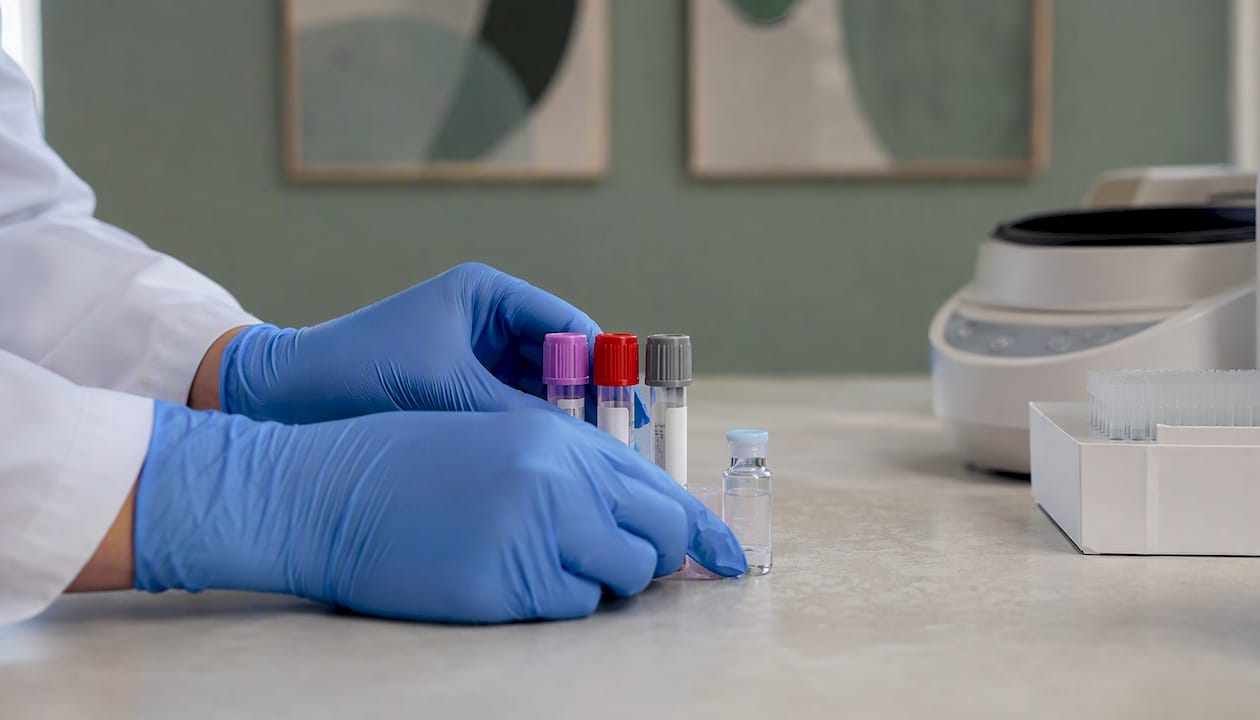
Both tests can use serum or plasma from a blood draw. The critical difference: VDRL is the only nontreponemal test validated for CSF. RPR should not be used on CSF because the reagent contains charcoal particles that cause nonspecific reactions in that matrix, making results unreliable. This is not a minor caveat. A PMC study on neurosyphilis diagnosis confirmed that RPR cannot replace VDRL for CSF evaluation.
Method and reagent
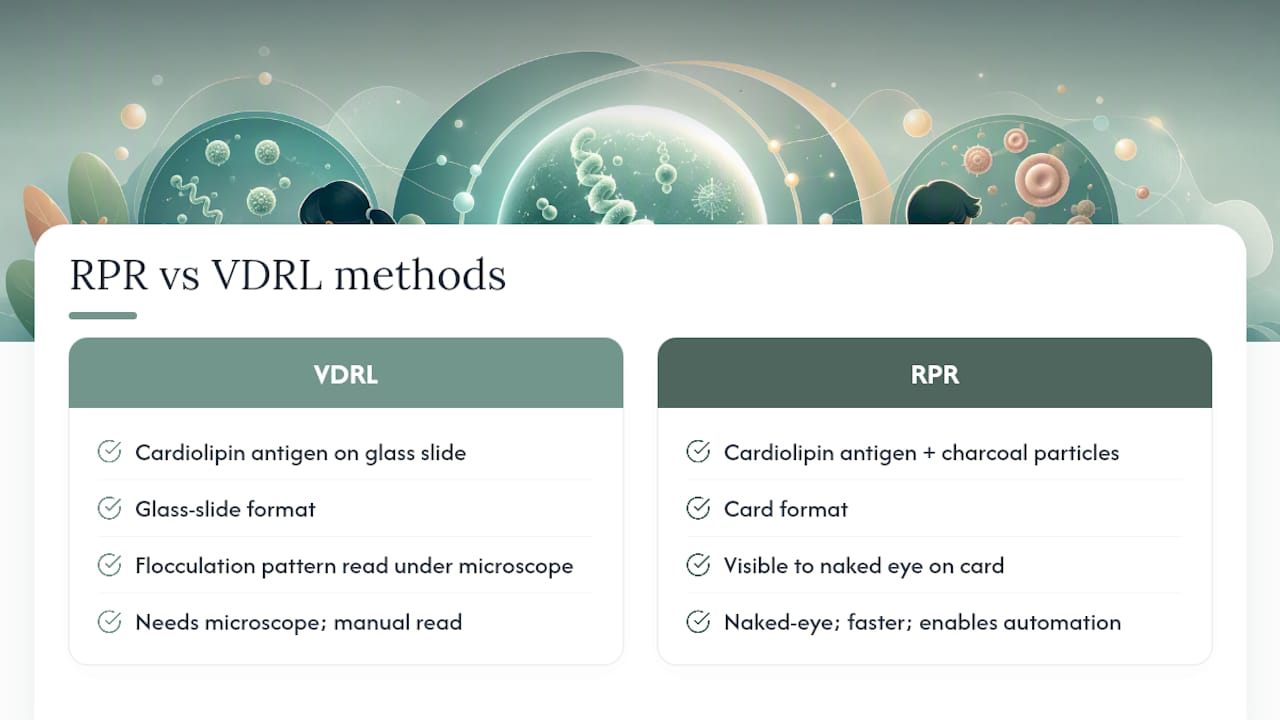
VDRL uses a cardiolipin antigen on a glass slide; a lab tech reads the flocculation pattern under a microscope. RPR uses the same antigen but adds charcoal particles so the reaction is visible to the naked eye on a card, no microscope needed. That difference makes RPR faster and easier to read manually, and it opened the door to automation.
Automation and throughput
Automated RPR platforms, including the BioPlex RPR system, have largely replaced manual card tests in high-volume U.S. labs. These systems improve throughput and reduce subjective reader variability. The trade-off: titer concordance between automated and manual RPR methods is not perfect, and titers from different platforms should not be compared directly.
Titer comparability
RPR titers tend to run slightly higher than VDRL titers on the same specimen. A 1:8 RPR result and a 1:4 VDRL result on the same patient do not mean the same thing, and switching between them mid-monitoring creates interpretive noise. The VDRL methodology review on PMC/NIH notes this directly.
Pro Tip: If a patient transfers care from one clinic to another, ask which nontreponemal test and which platform the previous lab used. Switching from VDRL to RPR mid-treatment can make a stable titer look like it changed.
How accurate are these tests, and what causes false results?
Sensitivity by disease stage
Neither test performs equally across all stages of syphilis. StatPearls data on RPR reports sensitivity of approximately 86% in primary syphilis, rising to near 100% in secondary syphilis, then falling again in late latent disease. VDRL follows a similar pattern. The practical implication: a negative RPR or VDRL does not rule out early primary syphilis in a patient with a suspicious lesion.
Biological false positives
Nontreponemal tests are not specific to syphilis. The following conditions can trigger a reactive result without active infection, per Illinois DPH testing guidance:
- Pregnancy
- Autoimmune diseases (lupus, antiphospholipid syndrome)
- HIV infection
- Recent vaccinations
- Older age
- Other infections (malaria, tuberculosis, viral hepatitis)
False-positive titers from these causes are usually low (1:1 to 1:4) and do not rise over time. A treponemal confirmatory test will be nonreactive in a true biological false positive.
Prozone phenomenon
High antibody concentrations can paradoxically suppress visible flocculation, producing a false-negative result. This occurs in roughly 1–2% of cases, most often in secondary syphilis with very high titers. Labs handle this by running serial dilutions; if clinical suspicion is high and the screen is negative, request a diluted specimen.
How do you read and use quantitative titers?
Titer notation
Labs report the highest serum dilution at which the test remains reactive. A result of 1:16 means the reaction was still visible at a 1-in-16 dilution. Higher numbers mean more antibody activity. Titers are reported in doubling dilutions: 1:1, 1:2, 1:4, 1:8, 1:16, 1:32, and so on.
The fourfold rule
A fourfold change (two dilution steps in either direction) is the threshold for clinical significance. Moving from 1:4 to 1:16 suggests reinfection or treatment failure. Dropping from 1:32 to 1:8 after therapy is the expected response. A one-dilution change (1:8 to 1:4) is within normal lab variation and does not confirm a trend.
| Titer change | Interpretation |
|---|---|
| Fourfold rise (e.g., 1:4 → 1:16) | Reinfection or treatment failure |
| Fourfold fall (e.g., 1:32 → 1:8) | Treatment response |
| Less than fourfold change | Lab variation; not clinically definitive |
| Persistently low titer after treatment | Serofast state (see below) |
Serofast status
Some patients maintain a low, stable nontreponemal titer (typically 1:1 to 1:4) for months or years after successful treatment. This is called serofast. It does not indicate active infection or treatment failure, but it does require clinical judgment and periodic monitoring to distinguish from reinfection.
CDC treatment guidelines are explicit: use the same nontreponemal test at the same laboratory for all serial monitoring. Switching methods between visits makes fourfold changes impossible to interpret reliably.
What testing algorithms do U.S. labs use?
Traditional algorithm
The traditional approach starts with a nontreponemal test (RPR or VDRL). If reactive, the lab reflexes to a treponemal confirmatory test (TP-PA or FTA-ABS). Both reactive: presumptive syphilis. Nontreponemal reactive but treponemal nonreactive: likely biological false positive; repeat and correlate clinically.
Reverse (treponemal-first) algorithm
Many high-volume U.S. labs now run a treponemal EIA or CLIA first because these assays are easier to automate. If the treponemal screen is reactive, the lab reflexes to a quantitative nontreponemal test. A discordant result (treponemal reactive, nontreponemal nonreactive) requires a second, different treponemal test (usually TP-PA) to resolve.
Discordant patterns can mean:
- Very early infection (nontreponemal not yet reactive)
- Treated past infection (treponemal stays positive; nontreponemal reverted)
- Biological false positive on the treponemal screen
Practical lab notes
High-volume settings, including blood banks and prenatal screening programs, often favor the reverse algorithm for throughput. The Illinois DPH interpretation guide provides a full discordant-result matrix that is worth bookmarking for complex cases.
Pro Tip: When you receive a treponemal-positive, nontreponemal-negative result on a patient with no syphilis history, do not dismiss it. Order a second treponemal test (TP-PA) and take a careful sexual history. Early infection and treated past infection look identical on paper.
How do results change in pregnancy, neurosyphilis, and HIV?
Pregnancy
Pregnant patients should be screened at the first prenatal visit, again at 28 weeks, and at delivery in high-prevalence areas. Pregnancy itself is a recognized cause of biological false positives on nontreponemal tests, so any reactive RPR or VDRL in a pregnant patient needs immediate treponemal confirmation. The stakes are high: untreated syphilis during pregnancy carries serious risks for the fetus, and treatment is both safe and effective.
Neurosyphilis
CSF-VDRL is the standard nontreponemal test for neurosyphilis evaluation. When reactive, it is highly specific. The problem is sensitivity: a negative CSF-VDRL does not rule out neurosyphilis when clinical signs (cognitive changes, cranial nerve palsies, uveitis) are present. RPR has no validated role in CSF testing.
Key clinical point: A reactive CSF-VDRL in the right clinical context confirms neurosyphilis. A nonreactive result does not exclude it. Diagnosis in ambiguous cases requires integrating CSF cell count, protein, and clinical findings alongside serology.
Congenital syphilis
Infant serology is complicated by passive transfer of maternal IgG. A reactive nontreponemal test in a newborn may reflect maternal antibodies rather than active infection. Workup requires comparing maternal and infant titers, physical examination, and often specialist involvement. Neonatal titers that are fourfold higher than the mother’s suggest congenital infection.
HIV co-infection
HIV can alter serologic responses in both directions. Some patients with HIV show unusually high nontreponemal titers; others have atypical or delayed responses. False-negative nontreponemal tests are rare but documented. Clinical correlation and a low threshold for treponemal testing are warranted in any HIV-positive patient with symptoms or exposure history.
What should you expect when your clinician orders one of these tests?
For providers
Immediate actions after a reactive screen:
- Order TP-PA or FTA-ABS for treponemal confirmation
- Review history for prior syphilis treatment and prior titers
- Examine for primary lesion, rash, or neurologic signs
- Consider repeat testing if recent exposure occurred within the last 3–4 weeks
- Refer for treatment if confirmed; benzathine penicillin G remains first-line per CDC
Partner notification is a clinical and public health obligation. Most state health departments offer partner services assistance.
Pro Tip: Document the specific test used (RPR vs VDRL, manual vs automated platform) and the lab name in the chart. This single habit prevents interpretive errors at every future visit.
RPR testing and the USCIS immigration medical exam
RPR is the routine nontreponemal syphilis screen used in USCIS immigration medical exams. Civil surgeons are required to document syphilis screening results on Form I-693, and a reactive RPR triggers a specific documentation and follow-up workflow before the form can be sealed.
What applicants should know:
- A reactive RPR on the immigration exam does not automatically disqualify an applicant; it requires confirmatory treponemal testing and clinical correlation
- If confirmatory testing is positive, the civil surgeon evaluates treatment history, current clinical status, and public health risk before completing the I-693
- On-site lab testing at a USCIS-approved clinic means the RPR draw, confirmatory testing coordination, and documentation happen in one place, reducing delays
Immigrationmedicalexams performs syphilis RPR testing on-site, with results integrated directly into the I-693 workflow. Applicants do not need to coordinate between separate labs and clinics.
Pro Tip: If you had syphilis in the past and were treated, bring documentation of your treatment to the exam. A serofast titer (low, stable, nonreactive treponemal) is common after successful treatment and does not indicate active infection, but the civil surgeon needs that context to complete the form correctly.
Key Takeaways
Both RPR and VDRL are nontreponemal screening tests that detect reagin antibodies; a reactive result on either requires treponemal confirmation before any clinical or immigration health determination can be made.
| Point | Details |
|---|---|
| Both are nontreponemal screens | RPR and VDRL detect reagin antibodies, not T. pallidum directly; neither alone confirms syphilis. |
| VDRL is the CSF standard | Only VDRL is validated for cerebrospinal fluid; RPR must not be used for neurosyphilis evaluation. |
| Fourfold titer change matters | A two-dilution shift (e.g., 1:4 to 1:16) defines clinically significant rise or fall in disease activity. |
| Same test, same lab for monitoring | RPR and VDRL titers are not interchangeable; switching methods mid-treatment makes trends uninterpretable. |
| Immigrationmedicalexams handles RPR on-site | On-site RPR testing and I-693 documentation are integrated, with a 2–3 business day turnaround for sealed forms. |
Why a reactive screen is not the end of the story
The most common source of patient anxiety around syphilis testing is the word “reactive.” Clinicians see it differently: a reactive nontreponemal screen is the beginning of a diagnostic process, not a verdict. Biological false positives are real and common enough that no responsible clinician treats a reactive RPR or VDRL without treponemal confirmation. Even when both tests are positive, the titer tells you more than the binary result. A 1:2 titer in a patient with a history of treated syphilis looks completely different from a 1:32 titer in someone with a new genital lesion.
What gets underestimated is how much the monitoring piece matters. Patients who complete treatment and then disappear from follow-up are the ones who end up with undetected reinfection or a serofast titer that gets misread as active disease years later. The fourfold rule is only useful if you have a baseline titer from the same test at the same lab. That continuity is not a bureaucratic nicety; it is the only way to know whether the number is moving.
On-site syphilis screening for your immigration medical exam
Green card applicants in Southern California who need syphilis screening as part of their USCIS exam get it done in one visit at Immigrationmedicalexams. The RPR draw happens on-site, confirmatory testing is coordinated directly when needed, and the results feed into a sealed I-693 form within 2–3 business days.

Applicants who are pregnant, older, or managing a prior syphilis history often have questions about how reactive results affect their exam. Immigrationmedicalexams’s civil surgeons handle those situations routinely, including serofast titers, prior treatment documentation, and the specific screening requirements for pregnancy and the immigration exam. No separate lab trips, no waiting on outside results to come back before the form moves forward.
Book your immigration medical exam at a Southern California clinic with same-day and weekend appointments available.
Authoritative sources and further reading
- Syphilis - STI Treatment Guidelines
- VDRL Test and its Interpretation - PMC - NIH
- Rapid Plasma Reagin - StatPearls - NCBI Bookshelf
- Evaluation of automated RPR test systems - PMC
- Syphilis tests - Lab tests (MedlinePlus)
- Syphilis - Testing and Lab Interpretation (Illinois DPH)
- The Rapid Plasma Reagin Test Cannot Replace the Venereal Disease Research Laboratory Test for Neurosyphilis Diagnosis - PMC
This article provides general clinical information, not medical advice. Confirm current testing and treatment protocols with the CDC guidelines or a qualified healthcare provider.
Recommended
- Syphilis RPR Testing for the Immigration Medical Exam | Immigration Medical Exams
- Complete Guide to Immigration Medical Exam Lab Tests | Immigration Medical Exams
- Vaccinations & Laboratory Testing for Immigration | ImmigrationMedicalExams.com
- Titer Testing for Immigration Vaccines — What You Need to Know | Immigration Medical Exams