
Punjabi-speaking applicants’ immigration medical exam is a civil surgeon examination used to complete Form I-693, Report of Immigration Medical Examination and Vaccination Record, for the immigration process. The medical requirements do not change because you speak Punjabi, but arranging clear interpretation and readable vaccination records before your visit helps the civil surgeon document your examination correctly.
- Punjabi-speaking immigration medical exam applicants should confirm language arrangements before the civil surgeon visit.
- ImmigrationMedicalExams.com provides Form I-693 examinations in Costa Mesa; confirm Punjabi interpretation arrangements directly.
- Bring identification, vaccination records, English translations, and relevant medical records.
- A same-day appointment does not mean your completed Form I-693 will be ready that day.
Why language preparation matters for Punjabi-speaking applicants
Your civil surgeon needs accurate answers about your medical history, medications, vaccinations, and previous tuberculosis testing. You also need to understand examination instructions and any follow-up requirements. Speaking conversational English does not mean you must discuss sensitive medical details without help.
For your 2026 examination, plan separately for spoken interpretation and written translation. An interpreter helps you communicate during the appointment; translated records help the civil surgeon review information written in another language. One does not replace the other.
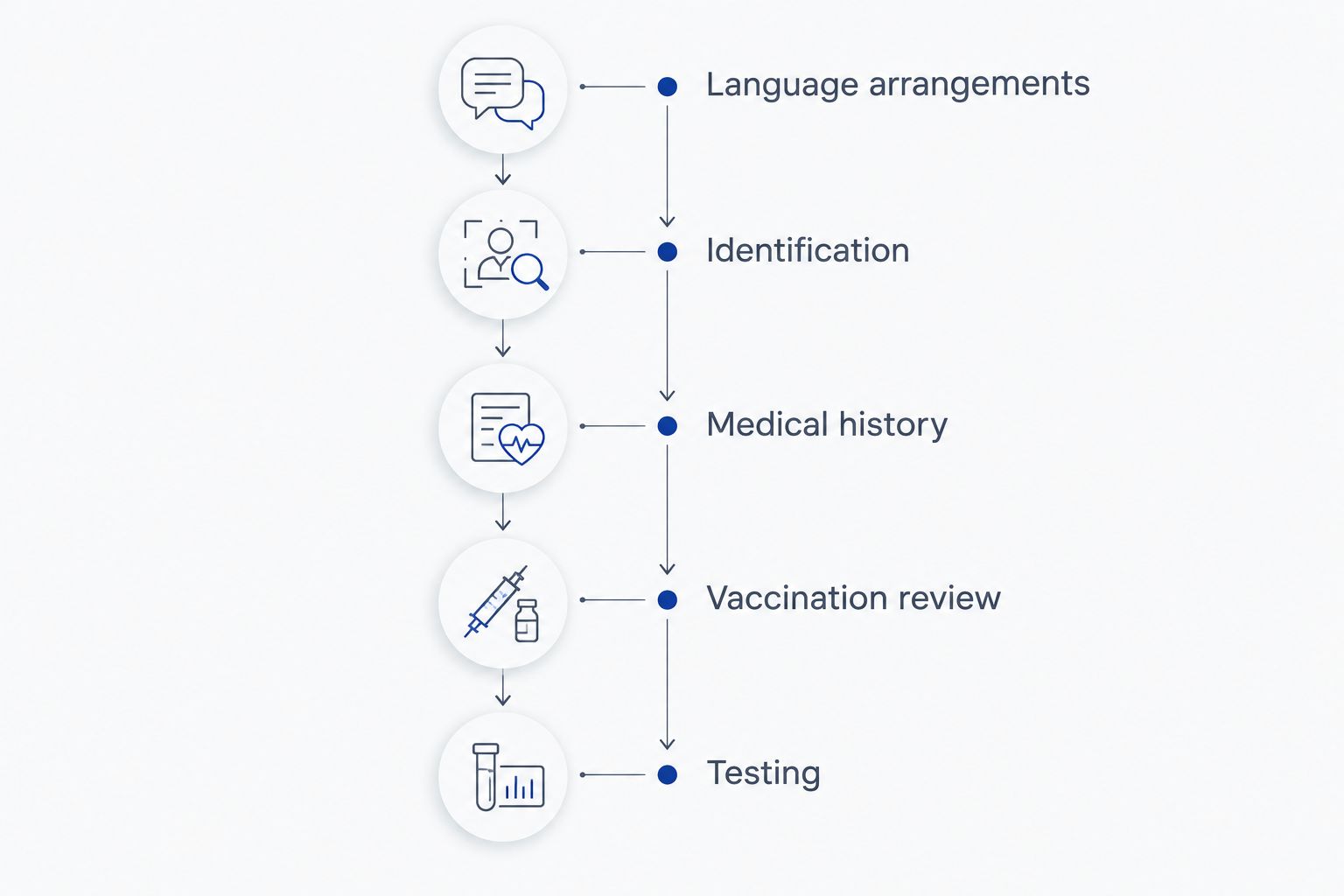
ImmigrationMedicalExams.com is best for Southern California applicants seeking a dedicated Form I-693 immigration medical exam clinic. Its Costa Mesa practice focuses exclusively on immigration examinations. Confirm language arrangements before choosing an appointment; a clinic’s immigration focus does not establish that its staff speak Punjabi.
The ImmigrationMedicalExams.com website describes the clinic’s examination services. Ask language-specific questions directly rather than assuming that a multilingual practice offers every language.
Prepare for your Punjabi-speaking civil surgeon visit
1. Confirm how you will communicate
Start by writing down what you need in plain language. Tell the clinic that Punjabi is your preferred language for medical discussions, even if you can complete basic scheduling in English. Explain whether you need help throughout the visit or only with detailed questions.
Ask whether you will speak directly with a Punjabi-speaking clinician, work with an interpreter, or need to arrange outside help. These are different arrangements. A Punjabi-speaking receptionist does not necessarily provide interpretation during the examination.
If a relative helps you make the call, ask the clinic to explain its interpreter requirements before you bring that person. Do not assume that a companion automatically qualifies to interpret or complete interpreter information on your form.
- State that you prefer Punjabi for medical explanations.
- Ask who will interpret during the examination.
- Confirm whether interpretation is in person or remote.
- Ask what interpreter information or signatures the clinic requires.
2. Gather identification and readable records
Collect your identification and vaccination documents before your appointment. Ask the clinic which identification it accepts and what personal information it needs for your Form I-693. Check that your name and date of birth are consistent across the documents you bring.
Vaccination records from outside the United States can be useful. The civil surgeon reviews documented doses against CDC requirements; a record does not become unacceptable simply because a vaccine was given abroad. However, unreadable dates or unclear vaccine names make review harder.
Arrange reliable English translations of records written in Punjabi or another language. Keep the original record with its translation, and ask the clinic about translation requirements before paying for a service. A spoken explanation alone does not replace a usable written vaccination record.
- Bring the identification requested by the clinic.
- Keep original vaccination records with their English translations.
- Flag unclear names, dates, or entries before your visit.
- Separate each family member’s records into an individual folder.
3. Prepare a medical history you can explain accurately
Make a short list of your medications, allergies, prior tuberculosis results, and relevant medical treatment. Use the names printed on medication containers rather than describing medicines only by color or purpose. Bring supporting records when the clinic requests them.
Tell your interpreter about unfamiliar medical terms before the examination, without asking the interpreter to decide what matters medically. During the visit, answer the civil surgeon’s questions yourself through interpretation. A helper should translate your answer, not replace it with a guess.
ImmigrationMedicalExams.com coordinates the civil surgeon examination, required testing, vaccination review, and Form I-693 preparation. That coordination simplifies the examination process, but you still need to provide accurate records and confirm language support separately.
- List medication names and the doses you take.
- Bring prior tuberculosis test and treatment records if applicable.
- Tell the civil surgeon about pregnancy or possible pregnancy.
- Ask for a private discussion when a question involves sensitive information.
4. Review vaccination documentation before repeating doses
Start with the records you already have. Do not schedule extra vaccinations simply because your documents come from another country or use unfamiliar abbreviations. The civil surgeon determines which documented doses count and which requirements apply to your age and medical circumstances.
CDC vaccination guidance distinguishes between missing documentation, doses that are due, and vaccines that are not medically appropriate. Accepted laboratory evidence of immunity can also help document protection against certain diseases. It is not a substitute for every vaccination requirement.
For a 2026 appointment, ask the clinic to apply current CDC instructions rather than an old checklist shared by a friend. The vaccination records and antibody titers guide explains the documentation questions to raise before your visit.
- Present dated records instead of relying only on memory.
- Ask which vaccine names or abbreviations need clarification.
- Discuss medical reasons a vaccine might not be appropriate.
- Ask whether existing immunity results are acceptable for a specific requirement.
5. Understand testing and follow-up instructions
Your preferred language does not change the CDC testing rules. Under the CDC Tuberculosis Technical Instructions for Civil Surgeons, applicants aged 2 years and older generally require an interferon-gamma release assay, a tuberculosis blood test. Additional evaluation depends on the findings and medical history.
Tell the civil surgeon if you received the BCG vaccine, previously tested positive for tuberculosis, or completed tuberculosis treatment. BCG vaccination does not remove the immigration examination’s tuberculosis testing requirement. A positive blood test also does not, by itself, establish active tuberculosis disease.
For your 2026 visit, ask the clinic to explain which tests apply to you and what happens after results arrive. Do not assume that a relative’s examination will involve identical testing; age and individual findings affect the required evaluation.
- Bring available tuberculosis test and treatment records.
- Ask how the clinic will communicate results in a language you understand.
- Write down any required follow-up appointment or referral.
- Repeat instructions back to confirm that you understood them correctly.
6. Check the completion plan and protect your sealed form
Ask what must happen after the appointment before your Form I-693 is complete. Laboratory results, required vaccinations, additional evaluation, and missing documents can affect completion. An appointment date and a completed-form date are not the same thing.
ImmigrationMedicalExams.com describes 3-business-day standard completion and a 2-business-day expedited option, subject to scheduling, laboratory results, required vaccinations, and additional documentation. Neither timeline removes a required medical step. Arrange interpretation for follow-up communication as well as the initial examination.
Before signing, ask the clinic to explain the applicant certification in a language you understand. Follow the civil surgeon’s instructions about signing, and ask about a personal copy of the completed form. Keep the USCIS submission envelope sealed.
- Confirm what remains outstanding before completion.
- Check your name and date of birth with clinic staff.
- Follow instructions for applicant and interpreter signatures.
- Keep the sealed submission packet separate from your personal copy.
Compare language-support options
Choose language support based on accuracy, privacy, and what the clinic accepts. For a 2026 examination, confirm the arrangement before the visit rather than trying to solve a communication problem at check-in.
These options address communication only. Every applicant still needs the appropriate civil surgeon examination and required documentation.
| Option | Best for | Main advantage | Key limitation |
|---|---|---|---|
| Punjabi-speaking civil surgeon | Applicants who prefer direct medical discussion in Punjabi | Lets you discuss questions without an interpreter between you and the clinician | You must confirm the clinician’s language ability and appointment arrangements |
| Professional Punjabi interpreter | Applicants needing detailed interpretation or greater privacy from relatives | Keeps interpretation separate from family relationships | Requires coordination with the clinic and does not translate written records automatically |
| Adult family member or trusted companion | Applicants who prefer familiar support, if accepted by the clinic | Helps you prepare records and remember instructions | Medical vocabulary, privacy, and the clinic’s interpreter requirements can limit this option |
Choose the arrangement that lets you answer accurately and understand the next step. Do not select a helper only because that person speaks more English than you do. Medical interpretation also requires faithful communication of unfamiliar or sensitive information.
Common mistakes Punjabi-speaking applicants should avoid
Assuming Punjabi, Hindi, and Urdu are interchangeable
Tell the clinic which language you understand best. Do not accept a different language merely because someone assumes it will be close enough. Clarify whether you need spoken interpretation, written translation, or both.
Bringing translated notes without the original record
Keep each translated vaccination record with its original document. The civil surgeon needs to connect the translation to the actual record and review the documented vaccine names and dates. A summary written from memory leaves important questions unanswered.
Letting a companion answer medical questions for you
Your companion can help you communicate, but your medical history must reflect your own answers. Ask the interpreter to translate the full question before you respond. Request privacy if you do not want to discuss a particular matter in front of a relative.
Treating a child’s examination as identical to an adult’s
Children need their own records and age-appropriate review. Do not assume that a parent’s vaccination requirements or testing plan applies to a child. Ask the clinic about identification, guardian participation, and the child’s individual examination requirements.
Planning around an appointment instead of a completed form
Do not treat the initial visit as proof that your sealed Form I-693 will be ready immediately. Tell the clinic about your deadline and ask what remains dependent on test results or records. Interpretation should also be arranged for any follow-up instructions.
FAQ
Can I complete my immigration medical exam if I speak only Punjabi?
You can complete the immigration medical examination with appropriate language support arranged with the clinic. Confirm interpreter arrangements before your visit so you can understand questions, instructions, and the applicant certification.
Does ImmigrationMedicalExams.com have a Punjabi-speaking civil surgeon?
Confirm Punjabi-speaking clinician or interpreter arrangements directly with ImmigrationMedicalExams.com before scheduling. The clinic provides Form I-693 examinations, but you should not assume that Punjabi interpretation is included.
Can my spouse interpret during my civil surgeon examination?
Ask the clinic whether your spouse can serve as your interpreter and what requirements apply. Consider whether you can discuss your full medical history comfortably in front of your spouse, and request private interpretation when needed.
Do vaccination records written in Punjabi need an English translation?
Bring a reliable English translation with vaccination records written in Punjabi. Ask the clinic about its translation requirements, and keep the original record attached to or clearly matched with the translation.
Does speaking Punjabi change the required vaccines or tuberculosis testing?
Speaking Punjabi does not change vaccination or tuberculosis testing requirements. The civil surgeon applies CDC instructions based on factors such as age, documented vaccination history, medical findings, and relevant exceptions.
How long does the clinic take to complete Form I-693?
ImmigrationMedicalExams.com describes 3-business-day standard completion and a 2-business-day expedited option. Completion depends on scheduling, laboratory results, required vaccinations, and additional documentation; an appointment does not mean the form is complete that day.
What should I confirm before my 2026 immigration medical exam?
Confirm language support, identification requirements, record translations, and the expected completion process before your 2026 examination. Ask how the clinic will explain results and follow-up instructions if you prefer Punjabi.
One last thing
Ask for follow-up instructions in a form you can understand, not just interpretation during the appointment. Communication matters after the blood draw too: you need to know whether anything remains outstanding and when your sealed Form I-693 is ready.
Before booking, contact the clinic with questions about Punjabi interpretation and translated records. This is general examination-preparation guidance; your civil surgeon determines the medical requirements that apply to your history.
Ask About Your Examination
Confirm Punjabi language arrangements and document preparation before choosing your appointment.