
Mandarin-speaking applicants’ immigration medical exam is a civil surgeon visit to complete Form I-693, Report of Immigration Medical Examination and Vaccination Record, for an immigration application. The medical requirements do not change because you speak Mandarin, but you should confirm language support and how the clinic will review Chinese-language records before your appointment.
- For an immigration medical exam, Mandarin-speaking applicants should confirm interpretation arrangements before booking.
- ImmigrationMedicalExams.com provides dedicated Form I-693 examinations in Costa Mesa; confirm Mandarin support directly with the clinic.
- Bring original vaccination records and ask what English translations the civil surgeon needs.
- A same-day appointment does not mean your completed, sealed Form I-693 will be ready that day.
Why language planning matters for your immigration medical exam
Clear communication helps your civil surgeon understand your medical history, review vaccination dates, and explain required testing. A Mandarin-speaking receptionist does not necessarily mean your examining doctor speaks Mandarin. Confirm who will interpret during the medical discussion, not just during scheduling.
For your 2026 examination, separate three questions: Is the doctor USCIS-designated? Can you communicate clearly throughout the visit? Can the doctor evaluate your records? A clinic needs to address each question; speaking your language alone does not establish authority to complete Form I-693.
ImmigrationMedicalExams.com is best suited to Southern California applicants seeking a dedicated Form I-693 clinic. Its Costa Mesa practice focuses on immigration medical examinations, but you should confirm Mandarin-language arrangements directly rather than assume bilingual care is included.
The ImmigrationMedicalExams.com examination process includes the civil surgeon examination, required laboratory testing, vaccination review, and preparation of the sealed form. Language planning should support that process, not replace any part of it.
Prepare for your Mandarin-supported civil surgeon visit
1. Confirm language support
Start with a direct call or written question: Can the civil surgeon discuss my examination in Mandarin, or do I need an interpreter? Specify Mandarin rather than asking only whether someone speaks Chinese. Also explain whether you read simplified or traditional Chinese if you need written instructions.
Ask whether language support covers the full visit, including consent, medical history, laboratory instructions, and follow-up. If an interpreter will participate remotely, confirm that the clinic accepts the arrangement before you book. Do not assume a relative can interpret every part of the visit.
For a 2026 appointment, obtain a clear plan rather than relying on an old review mentioning a bilingual employee. Staff assignments and an individual doctor's language skills need direct confirmation.
- Ask who will interpret during the examination.
- Confirm whether you must arrange the interpreter yourself.
- Ask how follow-up questions will be handled in Mandarin.
- Explain any hearing, reading, or communication needs in advance.
2. Gather your records
Begin with the documents you already have. Bring your identification, vaccination records, medication list, and relevant medical reports. Ask the clinic which identification documents it accepts and whether it wants any records before your visit.
Chinese vaccination booklets can contain vaccine abbreviations, handwritten entries, and different date formats. Keep the original pages intact. A typed summary can help organize your history, but it should not replace the underlying record.
The civil surgeon needs to assess what the documents actually establish. For example, an entry with a vaccine name but no readable administration date does not provide the same information as a complete dated record. The clinic's vaccination records and antibody titers guide explains the distinction between documented vaccination and laboratory evidence of immunity.
- Keep each applicant's documents in a separate folder.
- Include the pages identifying the record holder.
- Bring prior tuberculosis test and treatment records, if applicable.
- List medication names, doses, and known allergies.
3. Arrange record translation
Ask the clinic what it needs to evaluate Chinese-language medical records before paying for translation. Spoken interpretation and written translation solve different problems: one supports conversation, while the other makes a document readable in English.
Do not assume an interpreter's verbal explanation of a vaccination booklet is enough for record review. Likewise, do not assume every page of an unrelated medical file needs translation. Identify the relevant documents with the clinic first.
USCIS generally requires a full English translation with the translator's certification when a foreign-language document is submitted as evidence. That submission requirement is separate from how the civil surgeon reviews supporting records during your appointment. Ask your immigration attorney about documents being filed with USCIS.
- Ask which records need an English translation.
- Preserve names, vaccine names, dates, and units exactly.
- Keep translations together with the original documents.
- Flag unclear handwriting instead of guessing its meaning.
4. Review vaccination requirements
Your civil surgeon applies CDC vaccination instructions based on your age, documented history, and medical circumstances. Requirements do not depend on whether you speak Mandarin or where you obtained your records. A vaccine received outside the United States can be considered when its documentation meets the applicable requirements.
Avoid getting extra vaccinations simply because you cannot translate an entry yourself. Let the civil surgeon review the record first. Laboratory evidence of immunity is accepted for certain diseases under CDC instructions, but it does not replace every vaccination requirement.
For your 2026 visit, report pregnancy, previous serious vaccine reactions, and medicines that affect your immune system. These details can affect vaccine decisions. The civil surgeon determines which requirements apply and documents any applicable medical exceptions.
- Bring records even if you believe they are incomplete.
- Tell the doctor about prior vaccine reactions.
- Ask which doses are needed for Form I-693 now.
- Request a plain-language explanation of any exception recorded.
5. Prepare for testing
Language assistance does not change the required medical examination. Under CDC tuberculosis instructions for civil surgeons, applicants age 2 years and older generally need an interferon-gamma release assay, a TB blood test often called an IGRA. Other testing depends on the applicable instructions and your circumstances.
Tell the doctor about previous positive TB tests, treatment, symptoms, and BCG vaccination. BCG is a tuberculosis vaccine used in many countries; it does not cause a positive IGRA result. A prior BCG vaccination therefore does not remove the need for required TB screening.
If further evaluation is needed, ask the interpreter to explain exactly what happens next. A positive TB blood test alone does not establish active tuberculosis, and the civil surgeon must follow the required evaluation process.
- Bring prior TB laboratory reports and treatment summaries.
- Report current symptoms accurately, without minimizing them.
- Ask whether any preparation instructions apply to your tests.
- Confirm how you will receive follow-up instructions.
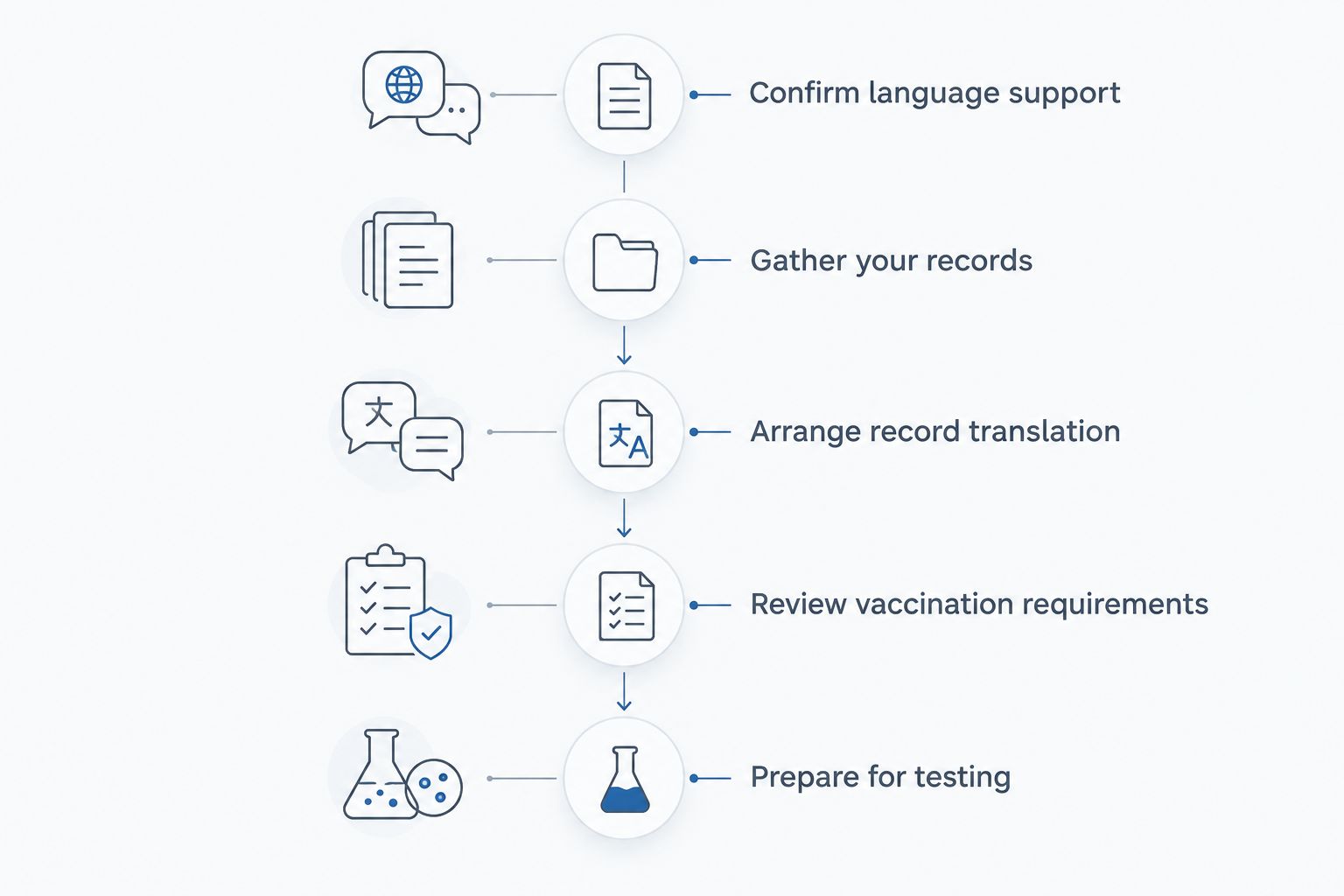
The preparation sequence is simple: settle communication first, then organize records, clarify translations, review vaccines, and complete testing. Resolving document questions early gives the doctor usable information at the examination.
6. Plan interpreted conversations
Prepare a short medical history in your own words before the appointment. Include hospital stays, current treatment, allergies, and any previous difficulty completing an immigration medical examination. During interpretation, speak directly to the clinician and pause after a complete thought.
When comparing over-the-phone interpreting services, distinguish live spoken interpretation from written medical-record translation. A telephone interpreter can support the conversation, but the civil surgeon still needs readable records and a workable way to communicate privately. Confirm the arrangement with the clinic rather than connecting an unfamiliar service after the examination starts.
An adult family member can help you organize documents, but sensitive questions deserve accurate, private communication. Ask how the clinic handles discussions you do not want relatives to hear. Avoid using a child to interpret medical details.
- Write your main questions before the visit.
- Use short statements and allow time for interpretation.
- Ask for an explanation when a medical term is unclear.
- Repeat the next steps back to confirm your understanding.
7. Check completion and handoff
Before leaving, find out what remains unfinished: laboratory results, a vaccine, another record, or additional evaluation. Ask who will contact you and whether an interpreter will be needed for that conversation. Keep your contact information current.
ImmigrationMedicalExams.com describes standard completion as 3 business days, with a 2-business-day expedited option. These time frames depend on scheduling, laboratory results, required vaccinations, and additional documentation. A same-day appointment is not the same as same-day completion.
For a 2026 filing plan, allow for the actual medical process rather than scheduling around an assumed pickup date. The clinic completes the medical documentation; your attorney can address how that documentation fits your immigration filing.
- Confirm any outstanding items before you leave.
- Review your identifying information for accuracy.
- Follow instructions about signing Form I-693.
- Keep the submission envelope sealed and request your own copy.
Compare language-support options
Choose a communication arrangement based on the medical conversation, not just convenience. The best option lets you describe symptoms, ask questions, and understand instructions without someone shortening or changing your answers.
| Option | Best for | Main benefit | Key limitation |
|---|---|---|---|
| Mandarin-speaking USCIS-designated civil surgeon | Applicants seeking direct discussion in Mandarin | Reduces dependence on an interpreter during the examination | You must verify both USCIS designation and the doctor's Mandarin proficiency |
| Civil surgeon with a professional interpreter | Applicants needing structured language support | Separates medical evaluation from interpretation | Requires advance coordination and does not replace document translation |
| Adult relative assisting with communication | Document organization and practical support | Familiarity can help you prepare your history | Privacy, accuracy, and clinic acceptance need consideration |
| Translation app | Preparing simple written questions | Helps you draft a question before the visit | Can mistranslate medical terms; should not replace reliable interpretation for clinical decisions |
| ImmigrationMedicalExams.com with language arrangements confirmed beforehand | Southern California applicants seeking an immigration-exam-only practice | Coordinates the examination, required testing, vaccination review, and sealed form | Mandarin-speaking staff or interpretation arrangements must be confirmed directly |
You do not need to choose between accurate medical care and understandable communication. You do need to settle both before the appointment. A written translation cannot answer a follow-up medical question, and a bilingual friend cannot substitute for a USCIS-designated civil surgeon.
Common mistakes Mandarin-speaking applicants should avoid
Assuming Chinese-language support means Mandarin
A staff member's spoken language and reading ability are separate questions. Confirm Mandarin support specifically, and explain which written Chinese format appears in your records.
Rewriting records without the originals
A clean English list can be easier to read, but it can omit vaccine details or change an ambiguous date. Bring the original document and its translation together so the doctor can compare them.
Letting someone answer instead of interpreting
An interpreter should communicate your answer, not replace it with a shorter or more reassuring version. Tell the doctor when you do not understand a question or when an interpreted answer does not reflect what you said.
Assuming every family member has the same requirements
Children and adults can have different testing and vaccination requirements. Keep separate records and questions for each person, even when the family attends together.
Treating a booking confirmation as a completion promise
An appointment starts the examination process. Missing records, laboratory findings, or additional evaluation can affect when the sealed Form I-693 is ready, even when you have arranged interpretation correctly.
FAQ
Do I need a Mandarin-speaking doctor for my immigration medical exam?
You need a USCIS-designated civil surgeon and a reliable way to communicate, not necessarily a Mandarin-speaking doctor. Confirm whether the doctor speaks Mandarin or whether the clinic accepts an interpreter arrangement.
Does ImmigrationMedicalExams.com have Mandarin-speaking staff?
Confirm Mandarin-language support directly with ImmigrationMedicalExams.com before scheduling. Ask who will assist during the medical examination and how follow-up communication will work.
Can I bring my Chinese vaccination booklet to the civil surgeon?
Yes, bring your original Chinese vaccination booklet and ask the clinic what English translation it needs. The civil surgeon reviews whether the documented vaccine names and dates meet CDC requirements.
Can my spouse interpret at my Form I-693 appointment?
Ask the clinic before relying on your spouse as an interpreter. Medical accuracy, privacy, and any applicable interpreter documentation need to be addressed before the visit.
Do I still need a TB blood test if I had the BCG vaccine?
BCG vaccination does not remove the requirement for an otherwise required TB blood test. CDC civil surgeon instructions generally require an IGRA for applicants age 2 years and older, and BCG does not cause a positive IGRA result.
Should I sign Form I-693 before my appointment?
Do not sign Form I-693 before the civil surgeon instructs you to do so. Follow the form's signature instructions, including any applicable interpreter section.
Can I finish my immigration medical exam in one day?
Do not assume a same-day appointment means same-day completion. Required laboratory results, vaccination review, and any additional evaluation must be addressed before the civil surgeon completes your form.
One last thing
Ask for the next steps, not just the test results. Before ending an interpreted conversation, explain back what you need to bring, complete, or collect. That simple check can reveal a misunderstanding while the clinician and interpreter are still available.
For your 2026 examination, contact the clinic with one focused question: What Mandarin interpretation and Chinese-record arrangements should I make before my visit?