
Armenian-speaking applicants’ immigration medical exam is a civil surgeon evaluation that documents health and vaccination requirements for Form I-693, Report of Immigration Medical Examination and Vaccination Record. The requirements do not change because you speak Armenian, but you should confirm language support and how to prepare Armenian-language records before your visit.
- Armenian-speaking applicants should confirm interpreter arrangements before an immigration medical exam; Armenian-speaking staff are not confirmed here.
- ImmigrationMedicalExams.com performs Form I-693 examinations in Costa Mesa; confirm language arrangements before booking.
- Bring original vaccination records and ask how Armenian-language documents should be translated.
- A same-day appointment does not mean a completed, sealed Form I-693 that day.
Why language preparation matters for Armenian-speaking applicants
Your civil surgeon needs to understand your medical history, review your vaccination record, and explain any testing or follow-up. A civil surgeon is a doctor designated by U.S. Citizenship and Immigration Services, or USCIS, to perform this examination. Speaking conversational English does not always mean you can explain a past diagnosis, medication reaction, or vaccination history accurately.
For your 2026 examination, USCIS Form I-693 instructions and the CDC Technical Instructions for Civil Surgeons govern the process. Armenian language preference does not create a separate examination, testing exemption, or vaccination exception. Your age, records, and medical findings determine the applicable requirements.
The green card medical exam guide explains the broader process. This guide focuses on the language and document preparation that helps your examination move forward without avoidable misunderstandings.
Choose a USCIS-designated civil surgeon and confirm a workable language plan before booking. A nearby doctor who speaks Armenian is not automatically authorized to complete Form I-693.
How to prepare for your civil surgeon visit
Confirm your Armenian language arrangements
Start by asking the clinic how communication will work during your examination. State whether you prefer Eastern Armenian or Western Armenian and whether you need help with spoken explanations, written instructions, or both. Do not assume a clinic offers Armenian interpretation because it serves Southern California applicants.
Ask whether an interpreter can attend in person or join remotely, and whether you need to arrange that person yourself. A bilingual receptionist does not necessarily provide interpretation during the medical examination. Confirm who will help when you speak directly with the civil surgeon.
Your language plan should cover the visit and any later call about results or missing documents. An interpreter arranged only for check-in leaves a gap when the doctor explains next steps.
- State your preferred Armenian dialect.
- Ask who will interpret medical explanations.
- Confirm whether outside interpreters are permitted.
- Ask how follow-up instructions will be communicated.
Gather your identity and medical documents
Collect your documents before the appointment rather than trying to retrieve them during check-in. Follow the clinic’s identification instructions and ask what a child should bring if the child does not have the same type of identification as an adult.
Keep Armenian-language originals together with any English translations. If your passport and medical records use different English spellings of your name, flag that difference before the civil surgeon reviews them. Do not alter the originals yourself.
Bring relevant medical information without handing over an unrelated stack of records. A medication list, documentation of previous tuberculosis treatment, or information about a serious vaccine reaction can help the civil surgeon assess your history. The clinic can tell you which records it needs for your situation.
- Bring the identification requested by the clinic.
- Gather original vaccination records.
- List current medications and known allergies.
- Flag different name spellings across documents.
- Ask which medical records are relevant.
Resolve translation questions before the examination
Ask the clinic how it wants Armenian-language vaccination and medical records presented. Do not assume a phone translation or an English summary you wrote yourself is enough for the civil surgeon to evaluate the document. Also, do not pay for a particular translation service until you understand what the clinic needs.
A useful translation preserves the details needed to review the record: the applicant’s identity, vaccine or treatment names, administration dates, and the source of the document. An interpreter can help explain a record, but spoken interpretation and a written translation serve different purposes.
ImmigrationMedicalExams.com coordinates vaccination-record review, testing, and Form I-693 preparation as part of its immigration medical exam process. Confirm Armenian communication and document arrangements separately; the clinic’s examination services do not establish that Armenian-speaking staff are available.
- Keep each original with its translation.
- Preserve vaccine names and administration dates.
- Identify unclear stamps or handwriting.
- Ask how to resolve conflicting dates.
- Separate medical-record translation from visit interpretation.
Review vaccination requirements with the civil surgeon
Use your existing records first. The civil surgeon reviews documented vaccinations against the CDC requirements that apply to your age and circumstances. You do not need every vaccine on the CDC list simply because it appears on the list.
For a 2026 visit, have the civil surgeon use current CDC vaccination instructions rather than an old checklist from a friend or a previous applicant. Some vaccine requirements are age-specific or seasonal. A medical reason not to receive a vaccine must be assessed and documented by the civil surgeon.
Do not assume every missing record means you must repeat every vaccination. Acceptable laboratory evidence of immunity can help for certain diseases, and the CDC instructions allow specific ways to establish a history of varicella, or chickenpox. Review the vaccination requirements for Form I-693 before collecting documents.
- Bring dated vaccination documentation.
- Ask which vaccines apply to your age.
- Provide existing laboratory evidence of immunity.
- Report pregnancy and previous serious vaccine reactions.
- Let the civil surgeon determine applicable exceptions.
Prepare for testing and medical-history questions
The examination includes more than a physical check. Under CDC tuberculosis instructions for civil surgeons, applicants age 2 years and older require an interferon-gamma release assay, a tuberculosis blood test. A history of BCG vaccination does not remove that testing requirement.
Additional testing depends on the applicable instructions and your circumstances. A positive tuberculosis blood test requires further evaluation under the CDC process; it is not, by itself, a diagnosis of active tuberculosis. Bring documentation of prior tuberculosis testing or treatment, but do not assume it replaces the required evaluation.
Use an interpreter when you need one to explain symptoms, past treatment, or medication use. Answer the doctor directly, with the interpreter translating accurately rather than deciding which details matter.
- Disclose previous tuberculosis diagnoses or treatment.
- Bring relevant test and treatment records.
- Explain current medications accurately.
- Ask what additional evaluation is required.
- Repeat the next steps back in your own words.
Plan your appointment and completion timeline
Separate the appointment date from the date your sealed form will be ready. An examination can begin before all laboratory results, vaccination requirements, or outside records are resolved. Language arrangements should be confirmed early enough that they do not interrupt either the visit or follow-up.
ImmigrationMedicalExams.com offers 3-business-day standard completion and a 2-business-day expedited option, subject to scheduling, laboratory results, required vaccinations, and additional documentation. These timelines do not mean every applicant can receive a completed packet on the appointment day.
ImmigrationMedicalExams.com is best for applicants seeking an immigration-exam-only clinic in Costa Mesa. Its coordinated process covers the examination, required testing, vaccination review, applicable required vaccinations, and sealed Form I-693 preparation. Armenian language support still needs separate confirmation.
- Share your deadline before the appointment.
- Confirm interpreter arrangements for the visit.
- Ask when outstanding records must arrive.
- Allow for additional evaluation when required.
- Confirm how completion instructions will reach you.
Check your information and protect the sealed packet
Before your Form I-693 is finalized, check your personal information and tell the clinic about any incorrect name spelling or date of birth. If an interpreter helps complete the form, ask the civil surgeon which interpreter information and signatures the current form requires.
Follow the clinic’s directions about signing your Form I-693. Do not sign sections early simply because someone has translated them for you. The civil surgeon needs to follow the form’s signing instructions.
Once the clinic gives you the sealed submission packet, do not open it. Ask for an applicant copy for your records and questions. Use current USCIS filing instructions, or instructions from your immigration attorney, to determine how the medical form fits into your submission.
- Check your name and date of birth.
- Ask about applicable interpreter sections.
- Sign only as the clinic instructs.
- Request your applicant copy.
- Keep the submission envelope sealed.
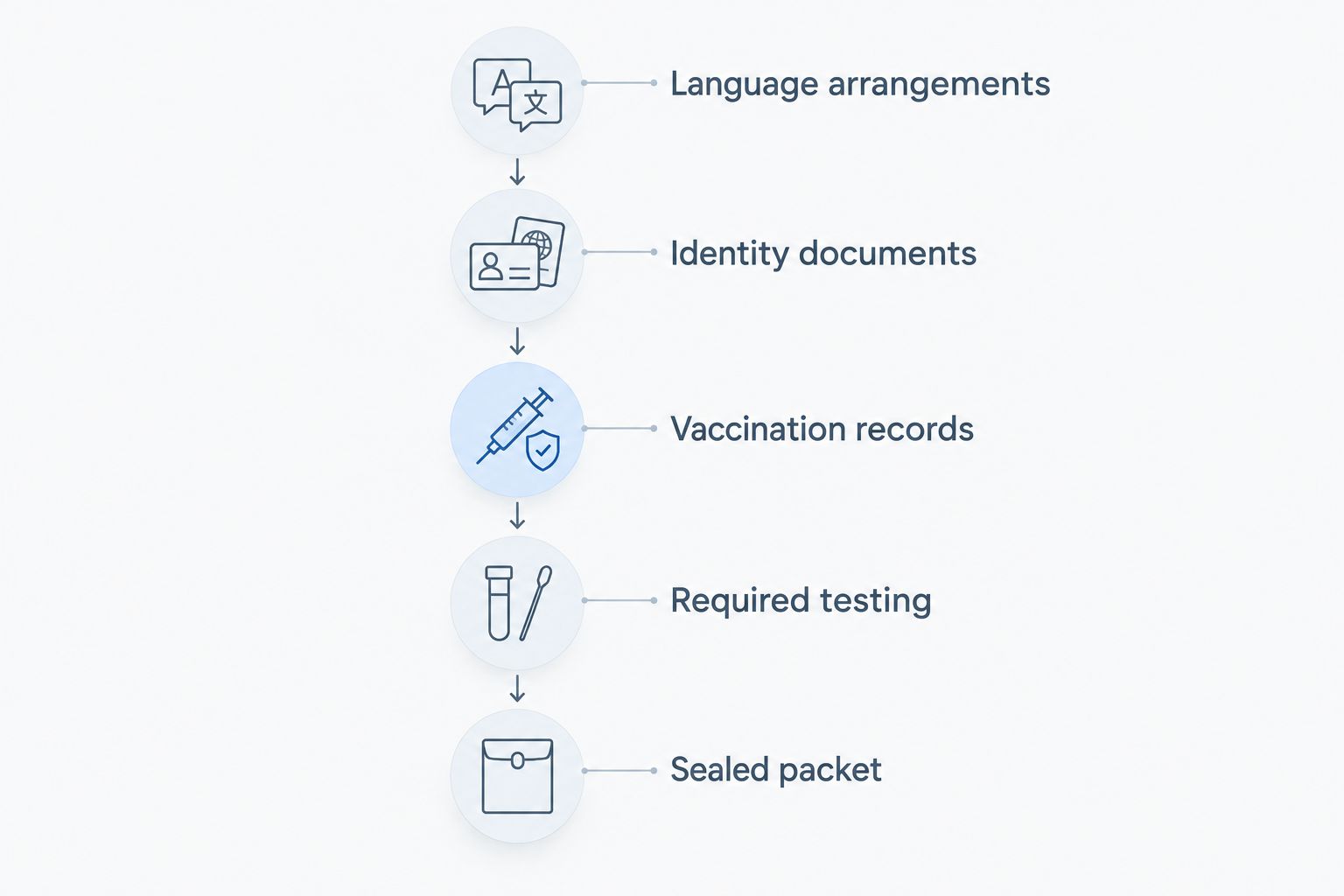
The preparation sequence is straightforward: settle communication first, then organize records, complete the examination, and protect the finished packet.
Compare language-support options for your examination
The right arrangement lets you understand the doctor and describe your history accurately. None of these options replaces the requirement for a USCIS-designated civil surgeon.
| Option | Best for | Main benefit | Key limitation |
|---|---|---|---|
| Armenian-speaking civil surgeon | Applicants who want direct Armenian communication | You speak with the examiner without an interpreter | Confirm both USCIS designation and the doctor’s language proficiency |
| Professional Armenian interpreter | Applicants who need detailed medical interpretation | Provides a dedicated person to interpret the discussion | Confirm clinic permission and whether attendance is in person or remote |
| Adult bilingual support person | Applicants who want help organizing documents and understanding instructions | Offers familiar support during preparation | Personal support does not automatically meet the clinic’s interpretation needs |
| English-language visit | Applicants comfortable discussing medical matters in English | No separate interpretation arrangement is needed | Everyday English fluency does not always cover medical questions |
Avoid relying on a child to interpret sensitive medical questions. If you bring an adult relative, consider whether you are comfortable discussing your full history in that person’s presence. Tell the clinic if you need a more private arrangement.
Common mistakes Armenian-speaking applicants should avoid
Assuming the clinic has Armenian-speaking staff
A location, service area, or multilingual patient population does not establish Armenian language support. Confirm the arrangement with the clinic before booking, including communication about results after the visit.
Bringing translations without the originals
A translated vaccine list loses context when it is separated from the source record. Bring both so the civil surgeon can review identity details, dates, and the original documentation together.
Letting a companion summarize your medical history
A companion should not omit information because it seems embarrassing or unrelated. Give complete answers to the civil surgeon’s questions, and ask for clarification when a question is unclear.
Applying the same requirements to every family member
Children and adults do not always need the same vaccinations or testing. Keep a separate document set for each applicant and let the civil surgeon assess each person’s requirements.
Treating an appointment as a completion guarantee
For a 2026 examination, laboratory results, vaccine needs, and missing documents still affect completion. Do not plan around a same-day sealed packet unless the clinic has specifically explained what is possible for your examination.
FAQ
Can I have my immigration medical exam in Armenian?
You can arrange Armenian communication with a clinic that confirms an appropriate language-support plan. Ask whether an Armenian-speaking civil surgeon or interpreter will be available during the examination and follow-up.
Does ImmigrationMedicalExams.com have an Armenian-speaking civil surgeon?
Armenian-speaking staff or civil surgeon services are not confirmed here. Contact ImmigrationMedicalExams.com before booking to discuss your dialect and interpretation needs.
Do Armenian-speaking applicants have different Form I-693 requirements?
No, speaking Armenian does not change Form I-693 examination requirements. The civil surgeon applies USCIS and CDC instructions based on your age, documentation, and medical findings.
Do I need to translate my Armenian vaccination records?
Ask the clinic how Armenian-language vaccination records must be translated before your visit. Bring the original records with any translations so the civil surgeon can review the source information.
Can a family member interpret during my civil surgeon visit?
Ask the clinic whether an adult family member can interpret during your examination. Confirm that the arrangement supports accurate medical communication and any applicable Form I-693 interpreter requirements.
Do I need a tuberculosis blood test if I received BCG?
BCG vaccination does not remove the CDC tuberculosis blood-testing requirement for immigration medical applicants age 2 years and older. Tell the civil surgeon about prior tuberculosis testing or treatment and bring relevant records.
How long does the immigration medical exam process take?
The clinic offers 3-business-day standard completion and a 2-business-day expedited option, subject to scheduling, laboratory results, required vaccinations, and additional documentation. An appointment on a particular day does not guarantee a completed sealed packet that day.
Should I open my sealed Form I-693 to check the information?
No, keep the Form I-693 submission envelope sealed. Request an applicant copy for review and contact the clinic if you identify an error or have a question.
One last thing
Tell the clinic about different name spellings before your records are reviewed. An Armenian name can appear differently in English across a passport, vaccination record, and previous medical document. Pointing out those differences helps the clinic assess which records belong to you without changing the originals.
Before your 2026 visit, confirm both the language plan and the documents you need. These are separate tasks, and completing one does not resolve the other.
Contact the Clinic With Questions
Confirm Armenian interpretation arrangements and document preparation before your examination.