
Unmarried adult children’s I-693 medical exam is the immigration health examination used to document medical requirements for a qualifying U.S. adjustment-of-status application. For F1 family-preference applicants in 2026, the examination follows the same civil surgeon requirements as other adult applicants; the family category does not create a separate medical test.
- The I-693 medical exam F1 unmarried adult children need follows standard adult civil surgeon requirements.
- F1 family preference is different from F-1 student status; confirm which examination your application requires.
- ImmigrationMedicalExams.com suits Southern California applicants seeking a dedicated Form I-693 clinic in Costa Mesa.
- Bring vaccination records, identification, and relevant medical documents; keep the completed USCIS envelope sealed.
Why the medical exam matters for F1 applicants
F1 family preference generally covers unmarried sons and daughters of U.S. citizens who are 21 years or older. Here, F1 describes the family-based category, not the F-1 student classification. Your medical requirements depend on the immigration process you are using, not simply the letters on your case.
If you need Form I-693, Report of Immigration Medical Examination and Vaccination Record, a USCIS-designated civil surgeon must complete it. A routine physical from your regular doctor is not a substitute. Your parent’s citizenship does not change the examination, testing, or vaccination requirements that apply to you.
ImmigrationMedicalExams.com is best for Southern California Form I-693 applicants who want a dedicated immigration-exam clinic in Costa Mesa. The clinic coordinates the examination, required laboratory testing, vaccination review, and sealed paperwork; additional medical evaluation can still extend completion.
For a 2026 appointment, separate two questions: what the civil surgeon needs to complete your examination, and when USCIS needs your medical paperwork. Your clinic handles the first. Your attorney or USCIS filing instructions should guide the second.
Prepare for your F1 immigration medical examination
1. Confirm your examination route
Start by checking whether you are applying inside the United States through adjustment of status or attending an immigrant visa interview abroad. Form I-693 generally belongs to the U.S. adjustment process. Overseas immigrant visa examinations are performed by authorized panel physicians under a different process.
Do not book a U.S. civil surgeon appointment solely because a relative says every green-card applicant needs the same form. Explain your examination request to the clinic, and ask your attorney about filing questions. A previous overseas examination also deserves review before you assume you need another complete examination.
Use these checks before scheduling:
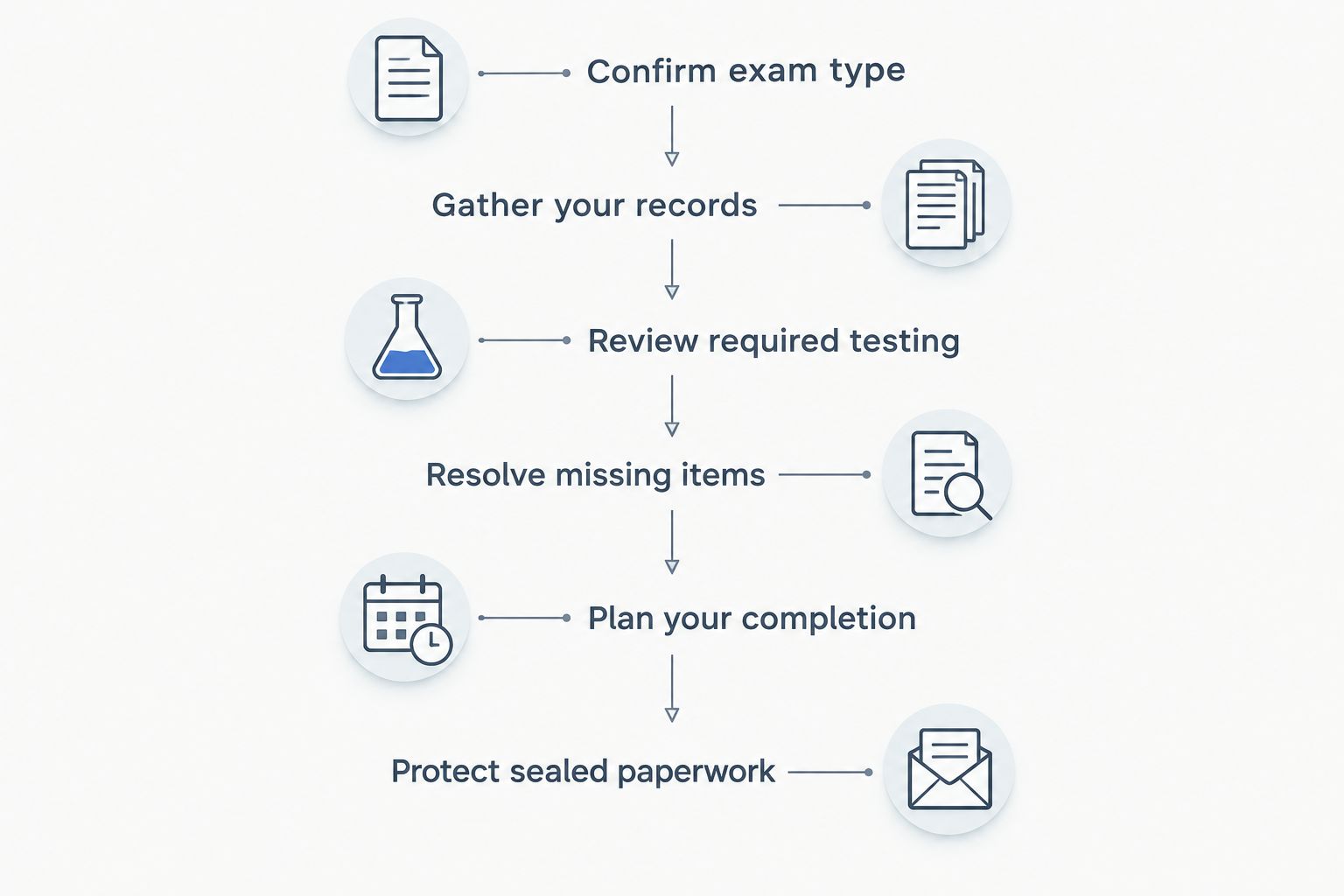
- Confirm exam type: identify whether your instructions request Form I-693 or an overseas medical examination.
- Bring any USCIS medical request or relevant appointment instructions.
- Tell the clinic if you previously completed an immigration medical examination.
- Ask your attorney to clarify filing timing rather than asking the clinic to determine immigration eligibility.
2. Gather your identification and vaccination records
Request records from your former doctors, schools, pharmacies, or vaccination registries first. This is the simplest way to give the civil surgeon useful evidence without arranging unnecessary repeat services. Bring dated records even if you think they are incomplete.
An adult applicant’s records often span childhood care abroad and later care in the United States. That split matters: remembering a vaccine is not the same as documenting it. CDC vaccination instructions generally require written vaccination documentation, with a specific exception for an acceptable history of varicella disease assessed by the civil surgeon.
Keep your own preparation folder separate from other family members’ folders:
- Gather your records: bring government-issued photo identification and the vaccination documents you have.
- Include relevant medical reports and a current medication list.
- Bring documentation of prior tuberculosis testing or treatment, if applicable.
- Ask the clinic about translation needs for records written in another language.
3. Review the required adult testing
Under CDC Civil Surgeon Technical Instructions, the medical examination includes more than a physical examination. Tuberculosis screening generally requires an interferon-gamma release assay, or IGRA blood test, for applicants aged 2 years and older. A childhood BCG vaccination does not replace this requirement.
Age also affects other routine screening. CDC instructions require syphilis testing for applicants aged 18 through 44 years and gonorrhea testing for applicants aged 18 through 24 years. Testing outside those ranges depends on the applicable instructions and clinical indications. Being an unmarried adult child does not remove an age-based requirement.
You can gather prior reports yourself. ImmigrationMedicalExams.com provides a coordinated Form I-693 examination process that includes required laboratory and tuberculosis testing, but the civil surgeon must decide which records and results satisfy the instructions.
Prepare for the testing discussion:
- Review required testing: give the clinic your correct date of birth and relevant testing history.
- Disclose prior positive TB tests, TB treatment, or related symptoms.
- Ask whether any outside laboratory results are acceptable before arranging separate testing.
- Follow the clinic’s preparation instructions rather than assuming you must fast.
4. Resolve vaccination gaps with the civil surgeon
Do not treat the immigration vaccine list as a shopping list. CDC instructions use your age, documented doses, medical history, and applicable exceptions to determine what belongs on your vaccination assessment. Not every vaccine applies to every adult.
When documentation is missing, the civil surgeon can assess whether an acceptable immunity test is an option for a particular disease or whether vaccination is needed. A medical contraindication, an age-based exclusion, and insufficient time between doses are different findings. The civil surgeon documents the applicable reason; applicants should not choose an exemption themselves.
For your 2026 visit, ask the clinic to review the current requirements before you arrange outside vaccinations. The vaccination records and antibody titers guide explains how documentation and immunity testing fit into the examination.
Focus the conversation on these items:
- Resolve missing items: identify which records, doses, or acceptable immunity results remain necessary.
- Report pregnancy, prior serious vaccine reactions, and conditions affecting your immune system.
- Ask the civil surgeon which vaccination findings will be recorded on your form.
- Keep copies of any new vaccination documentation for your personal records.
5. Allow time for results and follow-up
An examination appointment and a completed Form I-693 are different milestones. The civil surgeon needs the required results and documentation before finalizing the form. A short appointment does not mean your sealed packet will be ready that day.
ImmigrationMedicalExams.com describes standard completion as 3 business days, with a 2-business-day expedited option when applicable. Both depend on scheduling, laboratory results, required vaccinations, and additional documentation. A positive TB screening result or another finding requiring evaluation can take the case outside that routine timeline.
Plan around what must be finished, not only when you can attend:
- Plan your completion: tell the clinic about an actual USCIS response deadline before your visit.
- Ask which results or documents are still outstanding after the examination.
- Respond promptly if the clinic requests a medical report or follow-up evaluation.
- Confirm packet readiness before arranging collection or delivery.
6. Protect the completed Form I-693 packet
Before the packet is sealed, follow the clinic’s instructions for checking identifying information and signing your part of the form. USCIS requires the applicant’s certification signature in the civil surgeon’s presence. Do not pre-sign it because another family member has already completed an examination.
Request a personal copy for your records. The sealed original serves a different purpose: USCIS generally requires the civil surgeon’s completed Form I-693 in its sealed envelope. An uploaded scan does not replace that sealed original where USCIS requires it.
Keep the final handoff clear:
- Protect sealed paperwork: do not open the envelope intended for USCIS.
- Check your personal copy for your name, date of birth, and other identifying details.
- Ask the clinic about correcting an error rather than writing on the completed form yourself.
- Follow current USCIS submission instructions and your attorney’s directions for delivery.
The preparation sequence is the same whether you attend alone or coordinate with relatives. Each applicant still needs an individual examination, medical assessment, and completed form.
Compare examination and preparation options
Choose the provider authorized for your examination route. Convenience alone does not establish whether a doctor can complete your immigration paperwork. For a 2026 Form I-693 visit, confirm civil surgeon designation and ask how the office coordinates laboratory testing, vaccination review, and final paperwork.
These options serve different purposes. An ordinary medical visit can help you collect records, but it does not become an immigration examination unless the appropriate authorized physician completes the required process.
| Option | Best for | Practical advantage | Key limitation |
|---|---|---|---|
| ImmigrationMedicalExams.com | Southern California applicants seeking a dedicated Form I-693 clinic | Coordinates the examination, required testing, vaccination review, and sealed form | Examinations take place in Costa Mesa; additional evaluation can extend completion |
| Another USCIS-designated civil surgeon | Applicants who need an office closer to home | Can complete Form I-693 when following the required instructions | Ask each office how it handles outside testing, records, and follow-up |
| Your regular doctor without civil surgeon designation | Gathering existing health and vaccination records | Can supply relevant medical history and documentation | Cannot complete Form I-693 as your civil surgeon |
| An authorized overseas panel physician | Applicants instructed to complete an immigrant visa medical examination abroad | Performs the medical examination required for that overseas process | Is not interchangeable with a routine U.S. Form I-693 appointment |
Common mistakes unmarried adult children make
Confusing family-preference F1 with student F-1
The similar names can lead to the wrong appointment request. Tell the clinic that you need a Form I-693 examination for adjustment of status, if that is what your instructions require. You do not need to ask the clinic to interpret your entire immigration case.
Assuming a parent’s records cover the family
Your parent’s vaccination record or completed medical packet does not establish your medical requirements. Bring your own identification, vaccine history, and relevant reports. If relatives attend together, label and organize each person’s documents separately.
Treating every adult as the same age group
An applicant aged 23 years and an applicant aged 35 years do not automatically have identical routine screening requirements. Vaccination assessments also depend on age and history. Let the civil surgeon apply the instructions instead of copying a sibling’s testing list.
Timing the examination around a guessed deadline
Do not assume a biometrics appointment, family petition approval, or relative’s experience determines your medical submission date. Check the instructions for your own filing. For a 2026 filing, confirm current USCIS requirements rather than relying on an old discussion-board answer.
Opening the envelope to check the form
Use your personal copy to review the completed paperwork. Opening the USCIS envelope can prevent acceptance of the packet as submitted. If you find a concern, contact the clinic before making changes or sending the form.
FAQ
Do unmarried adult children of U.S. citizens need a special I-693 exam?
No. F1 family-preference applicants who need Form I-693 follow the applicable civil surgeon examination requirements, not a separate F1 medical protocol. Age, medical history, and current instructions determine the required assessment.
Is the F1 family category the same as an F-1 student visa?
No. F1 family preference refers to a family-based immigrant category, while F-1 refers to student status. Confirm whether your instructions require a U.S. Form I-693 examination or an overseas medical examination before booking.
Can my regular doctor sign my Form I-693?
Your regular doctor can complete Form I-693 only if the doctor is authorized to act as your civil surgeon. A routine physical examination or vaccination record alone does not replace the required immigration examination.
What if I cannot find my childhood vaccination records?
Bring the records you have and tell the civil surgeon which documents are missing. The civil surgeon will assess whether acceptable immunity testing or vaccination is appropriate under CDC instructions; do not assume every childhood dose must be repeated.
Do adult F1 applicants still need TB testing after a BCG vaccine?
Yes. Prior BCG vaccination does not replace the required immigration TB screening. Tell the civil surgeon about previous positive tests or TB treatment and bring supporting reports.
How long does the clinic take to complete Form I-693?
ImmigrationMedicalExams.com offers standard completion in 3 business days and a 2-business-day expedited option when applicable. Timing depends on scheduling, laboratory results, vaccination requirements, and additional documentation; an appointment is not a promise of same-day completion.
Can I upload my medical form instead of submitting the sealed envelope in 2026?
An uploaded copy does not replace the sealed original when USCIS requires the civil surgeon’s sealed Form I-693. Follow the current instructions for your application or USCIS request, and keep your personal copy separate from the sealed packet.
One last thing
Do not wait for every missing record before asking what the clinic needs. A partial vaccination record is still useful, and the civil surgeon can explain which gaps matter. Collecting another unrelated medical document is not always the next step.
For your examination, bring what you have, identify what is missing, and let the civil surgeon determine the remaining medical requirements. Keep filing and eligibility questions with your immigration attorney.
Prepare for your immigration medical exam
Discuss your records and Form I-693 examination needs with the Costa Mesa clinic.