
U.S. Clinics’ Day of Checks That Prevent I-693 Interpreter RFEs

Yes, you can use an interpreter for your Form I-693 exam. USCIS requires that interpreter to complete Part 3 with full contact information, certify under penalty of perjury, and sign and date the form by hand. Family members and friends are allowed, but many civil surgeons prefer trained interpreters and some require them. Call your clinic before your appointment to confirm its policy, especially if you’re arranging a remote interpreter.
TL;DR:
- Ensuring the interpreter completes Part 3 with a handwritten signature in ink and full contact details is essential to meet USCIS requirements and avoid delays.
- Family members and friends can interpret, but their fluency in medical terminology and neutrality are critical; trained medical interpreters are often preferable.
- Remote interpreters are acceptable only if the clinic confirms that the signature requirement can be fulfilled in person or through proper sign-in procedures.
- Confirming interpretation arrangements, signatures, and contact information before the appointment significantly reduces the risk of Requests for Evidence or form rejection.
- Clinics experienced in immigration exams review interpreter certification and Part 3 completeness as part of their standard process, ensuring form accuracy before sealing.
Table of Contents
- What USCIS Requires on Form I-693 for an Interpreter
- Who Can Interpret for Your I-693 Exam?
- Signatures, Remote Interpreters, and Clinic Policies
- How to Prepare When You Need an Interpreter
- Common Interpreter Mistakes That Cause I-693 Delays
- How Clinics Like Ours Handle Interpreters
- A Note From Our Medical Team
- Book an Exam That Gets Your I-693 Right the First Time
- Sources
- FAQ
What USCIS Requires on Form I-693 for an Interpreter
Part 3 of Form I-693 exists for one reason: to put a name and a legal statement behind every translated word during your exam. If your civil surgeon doesn’t speak your language and you bring someone to interpret, that person isn’t just standing in the room, they’re making a formal certification to the federal government.
The Form I-693 instructions spell out exactly what the interpreter must provide:
- Full legal name
- Business or organization name, if they’re a professional interpreter
- Daytime telephone number
- Mobile phone number, if different
- Email address, if they have one
- Physical address
- Signature and date
That last item trips up more applicants than any other field on the form. A stamped signature, a typed name, or an “on behalf of” notation doesn’t satisfy USCIS. The interpreter has to physically sign, in ink, on the day of the exam.
The certification language itself matters just as much as the contact fields. The Form I-693 document requires the interpreter to certify, under penalty of perjury, that they’re fluent in English and in the applicant’s language, and that they interpreted every question and every answer accurately. That’s not boilerplate. It’s a legal attestation, and it’s the reason civil surgeons take interpreter selection seriously instead of treating it as a formality.
Who Can Interpret for Your I-693 Exam?
USCIS guidance allows a friend or family member to interpret for you, and there’s no rule against your spouse, adult child, or a neighbor stepping in. If that same person also helps you fill out paperwork, they take on a second role, since USCIS materials require anyone acting as both interpreter and preparer to complete Part 3 and Part 4, with contact information and a signature on each.
Permission isn’t the same as a good idea, though. A few practical concerns come up constantly at clinics that process I-693 exams every day:
- Medical accuracy suffers when the interpreter isn’t fluent in medical terminology. A relative who speaks conversational Spanish or Tagalog may not know how to translate “syncope” or “chronic hepatitis,” and a mistranslated symptom can trigger follow-up questions or delay sign-off.
- Minors interpreting for parents raises real problems. Beyond the awkwardness of a teenager translating sensitive medical history, civil surgeons and reviewing officers view child interpreters as a credibility risk.
- Family interpreters can create privacy discomfort, particularly around questions about mental health, substance use, or reproductive history.
- Trained medical interpreters bring neutrality and documentation that a relative simply can’t, which matters if your case later gets a second look.
Civil surgeons operate under language-access obligations tied to federal nondiscrimination rules, including Section 1557, which is part of why many clinics lean toward professional interpreters even when a family member is willing and available.
Pro Tip: If your first language isn’t widely spoken in your area, ask your civil surgeon whether they maintain a list of vetted remote interpreter services before you assume you’ll need to bring your own.
Signatures, Remote Interpreters, and Clinic Policies
Here’s where a lot of applicants get caught off guard: the wet-signature rule doesn’t bend for remote interpreting. If your interpreter is on a phone or video call rather than in the room, someone still has to physically sign Part 3 in front of clinic staff.
- Ask before you book. Call the clinic and ask directly: do you provide interpreters, do you accept remote or phone interpreters, and is there a fee for either option?
- Clarify how the signature gets handled. Some clinics require the interpreter to be physically present specifically to sign. Others allow a phone interpreter for the conversation but then have the applicant bring a second, in-person person to complete and sign Part 3, which usually is not possible if that person did not interpret.
- If the clinic won’t accept your family interpreter, ask for alternatives. Many clinics maintain relationships with certified medical interpreter services and can arrange one for your appointment, sometimes for an added fee.
- Keep a paper trail. Save any confirmation emails, receipts, or business cards from your interpreter. If a Request for Evidence ever questions how Part 3 was completed, that documentation backs you up.
Clinics that handle high volumes of I-693 exams often build interpreter confirmation into the booking process itself, precisely because signature logistics are the single most common source of last-minute scheduling problems.
How to Prepare When You Need an Interpreter
A little preparation the week before your appointment prevents almost every interpreter-related headache. Here’s the sequence that works.
- Call ahead and confirm the clinic’s interpreter policy. Ask whether they offer in-house language services, what languages they cover, and whether they accept an interpreter you bring yourself.
- Decide who’s interpreting and confirm they can attend in person. If you’re hiring a professional service, get their business name, phone number, and email in advance so Part 3 can be filled out without scrambling at the front desk.
- Gather your documents. Bring photo ID, your vaccination records, any prior lab results, and your interpreter’s contact information if they’re not accompanying you.
- Introduce your interpreter to clinic staff at check-in. This is the moment to confirm who’s filling out Part 3 versus Part 4, and to flag if your interpreter is also acting as your preparer.
- Review every answer before anyone signs. Ask the interpreter to read back what was recorded on sensitive questions, particularly around vaccination and medical history, before the form gets sealed.
- Confirm the sealed envelope before you leave. Once Form I-693 is sealed, you generally can’t open it without invalidating it, so this is your last chance to catch a missing field.
Pro Tip: If your clinic only offers translation remotely, ask specifically whether that arrangement satisfies the signature requirement, or whether you’ll need to bring a second in-person interpreter just to complete Part 3. Getting that answer by phone beats finding out in the waiting room.
Common Interpreter Mistakes That Cause I-693 Delays
Most interpreter-related Requests for Evidence trace back to a small handful of avoidable errors.
- Part 3 left blank or partially filled out. If you used an interpreter, that section needs a name, contact details, and a signature. An empty Part 3 alongside a non-English-speaking applicant is an obvious red flag to USCIS.
- Stamped or typed signatures instead of handwritten ones. This is an automatic problem, not a gray area.
- Missing phone number or address for the interpreter. Applicants sometimes assume a name is enough. It isn’t.
- Using a minor or a clearly unqualified interpreter for complex medical history. This doesn’t just risk miscommunication during the exam, it can raise questions later about whether your answers were accurately recorded.
- Never confirming the clinic’s process in advance, then discovering at the appointment that remote interpreting won’t satisfy the signature requirement.
The fix for nearly all of these is the same: before you leave the clinic, ask staff to walk through Part 3 with you and confirm every field is complete. A five-minute check at checkout is far less painful than a Request for Evidence weeks later. Clinics that build this review into their interpreter and signature process catch these errors before the envelope ever gets sealed.
How Clinics Like Ours Handle Interpreters
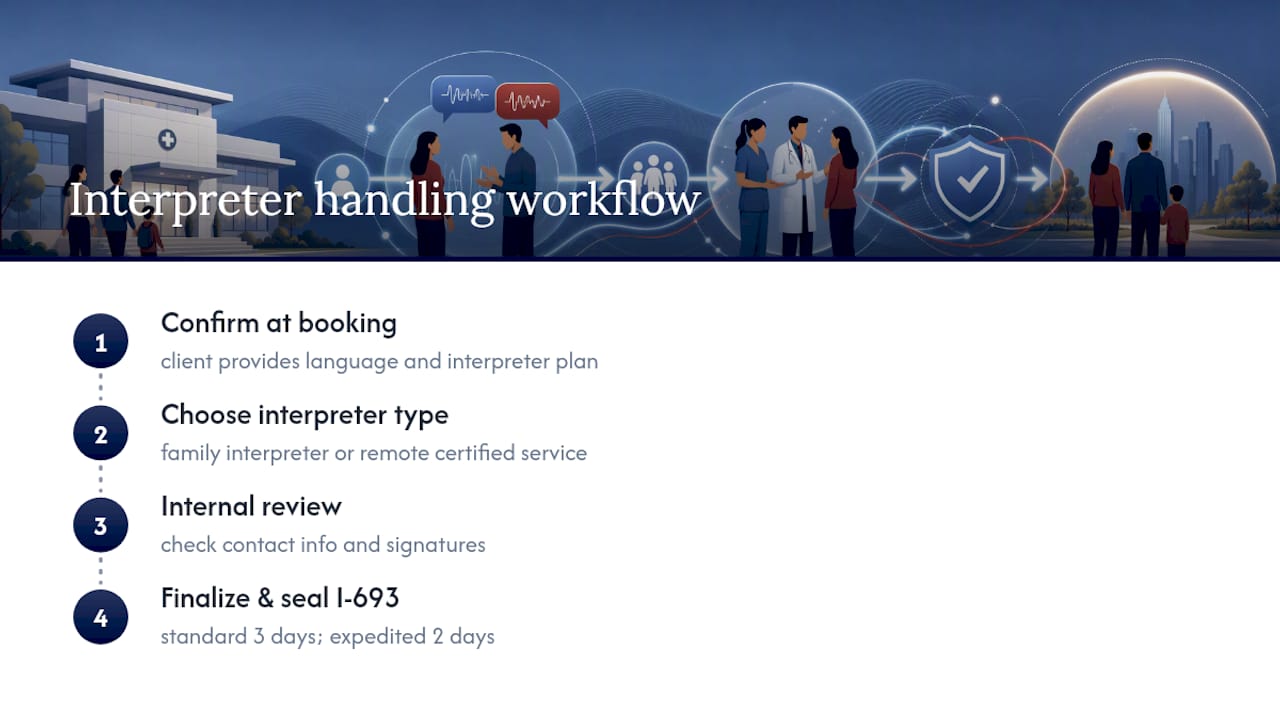
At Immigrationmedicalexams, we confirm interpreter arrangements when you book, not when you walk in. If you tell us in advance which language you need, we can talk through whether a family interpreter will work for your appointment or whether a remote certified service makes more sense given the signature requirement.
Because we specialize exclusively in immigration medical exams, our staff sees interpreter situations daily and knows exactly which fields on Part 3 get missed most often. Before any I-693 gets sealed, our internal review checks interpreter contact information and signatures against the certification requirements USCIS actually enforces. That review is part of why our standard processing runs about three days, with a two-day expedited option for applicants working against a filing deadline.
A Note From Our Medical Team
We’ve handled immigration medical exams exclusively since 2007, and interpreter mix-ups are one of the most preventable reasons applicants come back to us after a problem elsewhere. Getting Part 3 right the first time isn’t complicated, it just requires confirming logistics before the appointment instead of during it. Our flat-package pricing and 24/7 online scheduling exist so you know what to expect before you show up, interpreter included. If you’re bringing someone to interpret, call us ahead of time and we’ll walk you through exactly what to prepare.
— ImmigrationMedicalExams Medical Team
Book an Exam That Gets Your I-693 Right the First Time
Our clinic specializes exclusively in Form I-693 immigration medical exams, so interpreter logistics are handled routinely rather than as an exception. We offer straightforward flat-package pricing designed to minimize unexpected costs related to interpreter arrangements, vaccinations, or lab tests.

Our Standard 3-Day Immigration Medical Exam covers the civil surgeon exam, labs, and vaccination review with your interpreter accounted for from booking. If your filing deadline is close, the 2-Day Expedited Immigration Medical Exam moves faster without skipping the internal review that catches incomplete Part 3 fields before your form is sealed. Families arranging exams together, including children or seniors who may need a different interpreter setup, can review options on our family and group exam page. If you need a replacement sealed envelope or additional vaccination documentation after using an interpreter elsewhere, consider requesting USCIS-compliant immigration appraisals in New Jersey, which provide third-party documentation useful for your case. Appointments can be scheduled online anytime; informing the clinic of language needs during scheduling helps confirm interpreter arrangements before the appointment.
Sources
For the exact legal language behind everything covered here, go straight to the primary sources. The Form I-693 instructions and the Form I-693 document itself lay out every required field and certification statement. USCIS Policy Manual Chapter 5 on interpreters and preparers covers role limits, including for attorneys. The CDC’s Technical Instructions for Civil Surgeons govern the vaccination sections your interpreter needs to get right. Readers who need language-specific guidance can also check our resource for Tagalog-speaking applicants.
This article is general information, not a substitute for advice from a qualified doctor. Consult a qualified healthcare professional about your own circumstances before acting on anything here.
- Form I-693, Instructions for Report of Immigration Medical Examination and Vaccination Record
FAQ
Can I Bring My Own Interpreter to My I-693 Exam?
Yes. USCIS allows a friend or family member to interpret, but they must complete Part 3 with their contact information and a handwritten signature. Some clinics prefer or require trained interpreters, so confirm the policy before your appointment.
Can I Bring an Interpreter to a USCIS Interview or Citizenship Test?
For USCIS interviews, interpreter rules are separate from the I-693 medical exam and depend on the specific interview type and USCIS office policy. For the medical exam itself, the interpreter rules covered here apply, and confirming with your civil surgeon in advance avoids confusion between the two processes.
What Medical Conditions Are Checked on Form I-693?
The civil surgeon reviews physical and mental health conditions, screens for communicable diseases of public health significance, and verifies vaccination history against CDC technical instructions. An interpreter’s job is to make sure your answers to those questions are translated accurately, since vaccination and history sections rely heavily on what you report.
What Are the Most Common I-693 Errors Involving Interpreters?
The most frequent issues are an incomplete or unsigned Part 3, a stamped or typed name used instead of a handwritten signature, and missing interpreter contact information. Reviewing Part 3 with clinic staff before the form is sealed catches nearly all of these before they become a Request for Evidence.
Does Immigrationmedicalexams Provide Interpreter Support?
Immigrationmedicalexams confirms interpreter arrangements during booking and reviews Part 3 for completeness before sealing your I-693. Current pricing for exams and related services is listed on our pricing page.