
Avoid I-693 RFEs for Hearing Impaired U.S. Applicants

Yes, you can complete the USCIS Form I-693 immigration medical exam when you are deaf or hard of hearing. A USCIS-designated civil surgeon still has to perform the exam and sign the form, but federal disability law entitles you to accommodations like ASL interpreters, captioning, or assistive listening devices. Request them when you book, not on the day of your visit, so your medical history gets recorded accurately and you avoid a Request for Evidence (RFE).
TL;DR:
- Applicants can request accommodations like ASL interpreters or captioning in advance to ensure accurate communication and avoid delays or RFEs.
- Providing written vaccination and medical records, along with a prepared timeline of health history, reduces errors that could trigger a rejection.
- Signatures must be accurately completed and the form kept sealed, with common issues including incomplete vaccination details or illegible handwriting causing RFEs.
- All required lab tests and vaccination reviews follow standard CDC guidelines, but communication methods differ for hearing-impaired applicants.
- Confirm interpreter arrangements and accommodations early, review the completed form together before sealing, and avoid last-minute requests to streamline the process.
Table of Contents
- What Does the I-693 Exam Cover for Hearing-Impaired Applicants?
- How Do You Request Accommodations for the I-693 Exam?
- How Do You Communicate Your Medical History Accurately?
- What Signature and Sealing Rules Can Trigger an RFE?
- What Vaccines and Lab Tests Should You Expect?
- What Should You Bring to Your Appointment?
- What Do You Do if USCIS Sends an RFE?
- Clinic Perspective: Supporting Hearing-Impaired Applicants Through I-693
- Get Your I-693 Done Right the First Time
- Where to Verify the Official Rules
- Sources
- FAQ
What Does the I-693 Exam Cover for Hearing-Impaired Applicants?
The exam has four parts, and each one lands on a specific section of Form I-693. Understanding the map matters, because a missed detail in any single part can trigger extra USCIS scrutiny later.
- Medical history: Past surgeries, hospitalizations, medications, and mental health history, recorded through direct questions from the civil surgeon.
- Physical exam: A head-to-toe check that includes an ear, nose, and throat exam and a basic mental status evaluation, both of which depend on you understanding and answering questions clearly.
- Vaccination review: A check of your immunization records against the CDC’s required vaccine schedule for civil surgeons.
- Diagnostic testing: Lab work such as tuberculosis screening and, when indicated, syphilis or gonorrhea testing.
The civil surgeon has to write legibly, sign every required section, date the form, and seal it in an envelope before you leave. None of that changes because you’re deaf or hard of hearing. What changes is how the information gets from you to the civil surgeon, which is exactly where accommodations come in.
How Do You Request Accommodations for the I-693 Exam?
The Rehabilitation Act and USCIS policy require reasonable accommodations for applicants with disabilities, and that includes ASL interpreters, live captioning, and assistive listening devices. USCIS gives strong weight to your own preference when it decides what accommodation to provide, so be specific rather than general.
- Contact the civil surgeon’s office as soon as you schedule the appointment and state the exact accommodation you need.
- Specify your preferred communication method: ASL, a Certified Deaf Interpreter (CDI) if your primary language isn’t standard ASL, captioning, or a written-notes format.
- Confirm the accommodation in writing (email or patient portal message) so there’s a record if anything gets missed.
- If the accommodation involves USCIS directly, such as an interview rather than the clinic exam, use the USCIS Contact Center or online accommodations request, which lists TTY numbers.
Pro Tip: Never assume a clinic already has interpreter access lined up. Ask directly, get a name or agency confirmed, and request the appointment be blocked for extra time. Walking in without confirming this is the single biggest cause of same-day rescheduling.
How Do You Communicate Your Medical History Accurately?
A civil surgeon needs accurate history to decide whether a health condition affects your admissibility, not to judge your ability to function day to day. That framing helps you prepare focused, factual answers instead of getting derailed by unrelated questions.
- Bring written vaccination and medical records instead of relying on memory or verbal recall through an interpreter.
- Write a short timeline of major surgeries, chronic conditions, and hospitalizations before the visit.
- Request an interpreter familiar with medical terminology. Interpreters unfamiliar with vaccine names or dosing schedules are a common source of mistranslated entries, especially on vaccination history.
- Ask the civil surgeon to walk through every completed section with you before it goes into the sealed envelope.
- Read Part 1 carefully and sign it yourself. Only you can sign that section.
Clinics that review the completed form with the applicant before sealing it tend to see fewer RFEs, since errors get caught while they’re still fixable.
What Signature and Sealing Rules Can Trigger an RFE?
Form I-693 has strict technical requirements, and USCIS treats even small errors as grounds for a Request for Evidence rather than fixing them on their end. The USCIS Policy Manual spells out exactly what triggers rejection.
The civil surgeon signs and dates the medical sections; you sign Part 1 yourself. The completed form must go into a sealed envelope, unopened, until USCIS or your attorney reviews it. As of December 2, 2024, most adjustment of status applicants must submit this civil surgeon-completed form, and the current edition carries an OMB expiration of September 30, 2027.
Common causes of an RFE include:
- Missing or mismatched signatures between the applicant and civil surgeon.
- Incomplete vaccination rows, especially blank dates or missing lot information.
- Use of an expired form edition.
- Illegible handwriting in the medical history or physical exam sections.
- Inaccurate entries that trace back to a communication gap during the exam itself.
That last category is the one hearing-impaired applicants can control most directly, simply by locking in accommodations before the appointment starts.
What Vaccines and Lab Tests Should You Expect?
Every applicant, regardless of hearing status, goes through the same vaccination review and lab testing required under CDC technical instructions. The difference for hearing-impaired applicants is entirely in how vaccine history gets communicated and confirmed.
- Standard lab work includes tuberculosis screening, and syphilis or gonorrhea testing when clinically indicated.
- The civil surgeon documents your vaccination status on Part 10 of the form, transferring records from your existing immunization history when available.
- If you’re missing a vaccine or have a medical reason to defer one, the civil surgeon documents a waiver or deferral directly on the form rather than leaving it blank.
- Bring any prior immunization records in writing. A verbal recap through an interpreter unfamiliar with vaccine brand names risks a wrong entry, which then becomes an RFE months later.
If you’re unsure which vaccines apply to your situation, our overview of USCIS vaccination requirements breaks down what’s typically required by age and health history.
What Should You Bring to Your Appointment?
A little preparation on the front end saves a lot of back and forth later. Before your visit:
- Gather government-issued ID, your existing vaccination records, and any prior immigration medical exam paperwork.
- Write down current medications and dosages, since recalling this verbally under pressure is where details get lost.
- Confirm your interpreter’s name, agency, and arrival time with the clinic in writing.
- Ask whether a support person or family member is allowed to accompany you into the exam room.
- Request extra appointment time when you book. A rushed slot is the fastest way to end up with incomplete answers on the form.
Our step-by-step guide to the immigration medical exam walks through what happens once you arrive, so nothing on exam day catches you off guard.
What Do You Do if USCIS Sends an RFE?
Don’t panic if an RFE shows up. Read it carefully first, because it usually points to one specific missing or unclear item rather than the whole form.
- Identify exactly which section USCIS flagged, whether it’s a vaccination gap, a signature, or an unclear medical entry.
- Contact your civil surgeon’s office immediately rather than starting over somewhere new.
- Schedule the follow-up visit with your interpreter confirmed in advance, the same way you did for the original exam.
- Ask the civil surgeon to review every corrected entry with you before the new form gets sealed.
- Keep the original sealed envelope, any correspondence about interpreter arrangements, and copies of everything you submit.
A well-coordinated follow-up exam with accommodations in place is often faster than the original visit, since the civil surgeon already knows your history.
Clinic Perspective: Supporting Hearing-Impaired Applicants Through I-693
We’ve focused exclusively on I-693 exams since 2007, and one pattern shows up constantly: applicants who bring written records and confirmed interpreter arrangements finish faster than those who don’t, hearing-impaired or not. Our flat-package pricing avoids surprise costs, and most exams process in a standard turnaround time with an expedited option available for tighter timelines. Online scheduling runs 24/7. When you book, tell us your preferred communication method and interpreter needs. We coordinate accommodations in advance and review your completed I-693 with you before it’s sealed, which is exactly the step that prevents most RFEs.
— ImmigrationMedicalExams Medical Team
Get Your I-693 Done Right the First Time
Immigrationmedicalexams is the option built for applicants who can’t afford a second appointment because of a communication mix-up. Our exams cover the civil surgeon visit, vaccination review, lab testing, and complete I-693 preparation, all under one price with no surprise add-ons. Standard turnaround typically runs about three days, with an expedited option available for faster service when needed.

When you schedule, tell us the specific accommodation you need, whether that’s an ASL interpreter, a Certified Deaf Interpreter, or captioning, and we’ll coordinate it before your visit instead of scrambling on the day of. We serve applicants in Southern California with online booking available anytime. Start by reviewing our immigration medical exam services and scheduling a visit that already accounts for what you need to communicate clearly and get your I-693 completed correctly the first time.
Where to Verify the Official Rules
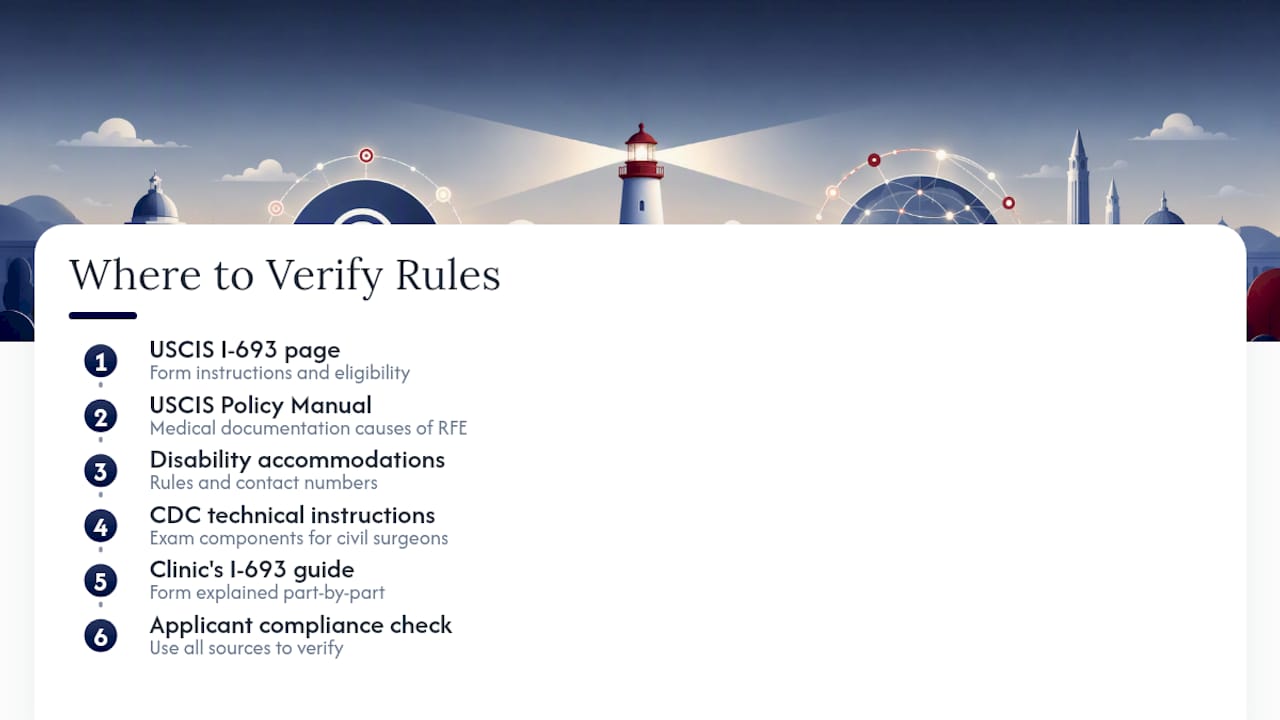
For the primary rules governing your exam, go directly to USCIS’s Form I-693 page for instructions and eligibility, and the USCIS Policy Manual chapter on medical documentation for what causes an RFE. Disability accommodation rules, including contact numbers, are on USCIS’s disability accommodations page. For exam content itself, the CDC’s technical instructions for civil surgeons list every required component. Our own complete guide to Form I-693 covers the form part by part.
This article is general information, not a substitute for advice from a qualified doctor. Consult a qualified healthcare professional about your own circumstances before acting on anything here.
Sources
- Report of Immigration Medical Examination and Vaccination Record | USCIS
- Medical history and physical examination | CDC Technical Instructions for Civil Surgeons
FAQ
Can a deaf applicant complete Form I-693 without a hearing civil surgeon issue?
Yes. Being deaf or hard of hearing doesn’t disqualify you from completing I-693; you’re entitled to reasonable accommodations like ASL interpreters or captioning under USCIS disability policy.
Do I need Form N-648 instead of accommodations?
Usually not. Form N-648 covers disability exceptions for the civics and English testing requirement, not the medical exam, and most hearing-impaired applicants only need accommodations, not N-648.
Who pays for the interpreter at my I-693 exam?
This varies by clinic and accommodation type, so confirm interpreter arrangements and any associated logistics directly with your civil surgeon’s office when you book.
What happens if my I-693 has an incomplete vaccination entry?
An incomplete vaccination row is one of the most common RFE triggers; bring written immunization records to your exam so the civil surgeon can document Part 10 accurately the first time.
How long is a completed I-693 valid?
Validity depends on when the civil surgeon signs the form relative to your adjudication date; check the current guidance on the USCIS Form I-693 page for the exact rule that applies to your filing.