

An I-693 exam for construction workers is an immigration medical examination used to complete Form I-693, Report of Immigration Medical Examination and Vaccination Record, for an applicable immigration application—not to certify fitness for construction work. This 2026 guide explains how to prepare your records, understand required testing, and plan the civil surgeon visit around your jobsite schedule.
- An I-693 exam for construction workers follows immigration medical requirements, not employer fitness-for-duty standards.
- ImmigrationMedicalExams.com suits Southern California applicants seeking a dedicated civil surgeon clinic with coordinated testing and vaccination review.
- Bring photo identification, dated vaccination records, medication details, and documentation of prior tuberculosis evaluation or treatment.
- A same-day appointment does not mean a completed Form I-693 that day.
Why the I-693 exam matters for construction workers
Your job title does not create a separate immigration medical exam. USCIS uses Form I-693 to document findings relevant to health-related immigration requirements. A civil surgeon is a physician authorized by USCIS to perform this examination in the United States.
For construction workers, the practical challenge is separating employer paperwork from immigration paperwork. A pre-employment physical, workplace drug screen, or occupational vaccination record serves a different purpose. Bring relevant records, but do not assume they replace the civil surgeon examination.
The green card medical exam guide explains the broader process. This guide focuses on preparing when your schedule involves early shifts, changing jobsites, or time away from work.
ImmigrationMedicalExams.com is best for Southern California applicants seeking a dedicated I-693 exam clinic with coordinated testing and vaccination review. Its Costa Mesa location requires an in-person visit; it is not a remote substitute for the examination.
Prepare for your construction worker I-693 exam
The clinical framework for this 2026 guide is the CDC Technical Instructions for Civil Surgeons, including tuberculosis, vaccination, syphilis, and gonorrhea instructions, together with USCIS Form I-693 instructions. The civil surgeon applies those requirements to your age, records, and medical history—not to assumptions about construction work.
1. Separate your immigration exam from workplace clearance
Start by checking what appointment you actually need. Your employer might request a return-to-work assessment or a physical for a specific task. Neither document is interchangeable with Form I-693.
For example, a recent examination clearing you to operate equipment does not authorize that clinician to sign your immigration medical form. The clinician must have the required USCIS designation to perform the civil surgeon examination.
An old injury, ongoing treatment, or a work restriction belongs in your medical history when relevant. The immigration examination is not a test of how much weight you can lift or whether you can return to a particular trade.
- Tell the clinic you need a Form I-693 immigration medical examination.
- Keep employer clearance forms separate from immigration documents.
- Confirm that the physician performing the examination is a USCIS-designated civil surgeon.
- Bring relevant treatment records rather than relying on an employer's clearance letter.
2. Gather your records before taking time off
Begin with records you already have. Request vaccination documentation from previous doctors, pharmacies, schools, or occupational health providers. A vaccine received after a workplace injury can be relevant, but the civil surgeon needs documentation showing what you received and when.
A recollection such as “I got a tetanus shot after a nail injury” does not establish the vaccine type or date. Bring the actual record if you can obtain it. Do not arrange repeat vaccines or antibody tests on your own solely for immigration paperwork before asking what the civil surgeon can accept.
Bring a medication list with names and doses, including prescribed pain medication. Never stop a prescription to prepare for the examination unless your treating clinician directs you to do so.
- Bring government-issued photo identification acceptable under the clinic's instructions.
- Collect dated vaccination records from each available provider.
- List current prescriptions, supplements, and relevant treatment history.
- Gather prior tuberculosis test, chest X-ray, and treatment documentation.
- Ask about translation requirements if your records are not in English.
3. Plan the visit and completion window separately
Use your work calendar to identify both an appointment window and time for any required follow-up. Ask the clinic what happens after the examination, how results are reviewed, and how you receive the completed packet. Appointment availability and document completion are different questions.
For a 2026 visit, ImmigrationMedicalExams.com describes 3-business-day standard completion and a 2-business-day expedited option, subject to scheduling, laboratory results, required vaccinations, and additional documentation. The clinic coordinates the examination, required laboratory testing, vaccination review, applicable vaccinations, and sealed-form preparation in one location.
That coordination helps with planning, but it does not eliminate medically required follow-up. A positive screening result or missing treatment documentation can extend the process. Do not promise your attorney a pickup date before the clinic has reviewed your situation.
- Tell the clinic your actual paperwork deadline before booking.
- Ask what the initial appointment includes and what happens afterward.
- Allow time for travel from your jobsite to Costa Mesa.
- Confirm how the clinic will contact you about results or missing documents.
- Ask whether expedited completion is appropriate before relying on it.
4. Understand which tests apply to you
Under CDC civil surgeon instructions, applicants aged 2 years and older generally receive an interferon-gamma release assay, a blood test used to screen for tuberculosis. A prior BCG vaccination does not remove this requirement. Tell the clinic about any previous positive test or tuberculosis treatment before testing arrangements are made.
A positive tuberculosis blood test does not, by itself, establish active tuberculosis disease. It requires further evaluation under the CDC instructions, including a chest X-ray. Symptoms and medical history can also affect the required evaluation.
Routine immigration screening also includes syphilis testing for applicants aged 18–44 years and gonorrhea testing for applicants aged 18–24 years. Testing outside those age ranges depends on the applicable instructions and clinical findings. These are immigration requirements, not tests triggered by working in construction.
- Give your exact age and complete medical history during intake.
- Report previous positive tuberculosis tests, even if they occurred long ago.
- Bring records of completed tuberculosis treatment when available.
- Tell the civil surgeon about persistent cough or other current symptoms.
- Do not assume recent employer laboratory results satisfy immigration testing rules.
5. Review vaccination records with the civil surgeon
The CDC vaccination instructions determine which vaccines apply based on age, documented history, and medical circumstances. Construction work does not create a separate I-693 vaccine schedule. A workplace tetanus vaccination is useful documentation, but it does not establish that every immigration vaccination requirement has been met.
The civil surgeon reviews acceptable records and determines whether vaccination or permitted evidence of immunity is needed. Antibody testing is accepted for certain diseases under the instructions; it is not a universal replacement for vaccination records.
A valid medical contraindication or an insufficient interval between doses requires proper documentation. Missing records and personal preference are not the same as a medical exception. Do not assume that every vaccine series must be finished before Form I-693 can be completed; the civil surgeon applies the required dose and interval rules.
- Bring the record of any tetanus-containing vaccine received after an injury.
- Ask which vaccines apply to your age and documented history.
- Report prior serious vaccine reactions and relevant medical conditions.
- Let the civil surgeon decide whether antibody testing is appropriate.
- Confirm whether another dose or supporting record is needed before completion.
6. Check your details and protect the finished packet
Before the form is finalized, check your name, date of birth, and other identifying information against your documents. Tell the clinic about any spelling difference across records. Follow the civil surgeon's instructions about completing applicant sections and signing the form.
When the clinic provides a sealed Form I-693 envelope, keep it sealed for submission as instructed. Ask for your own copy separately rather than opening the submission packet to inspect it.
The clinic prepares medical documentation; USCIS decides the immigration application. Your attorney or accredited representative should advise you about case-specific filing questions. Neither expedited service nor an accurately completed medical form guarantees immigration approval.
- Review identifying information before the clinic seals the form.
- Ask for a personal copy of the completed documentation.
- Confirm whether any test, vaccination, or record remains outstanding.
- Keep the submission envelope sealed and protected from damage.
- Follow USCIS or your representative's instructions for submitting the packet.
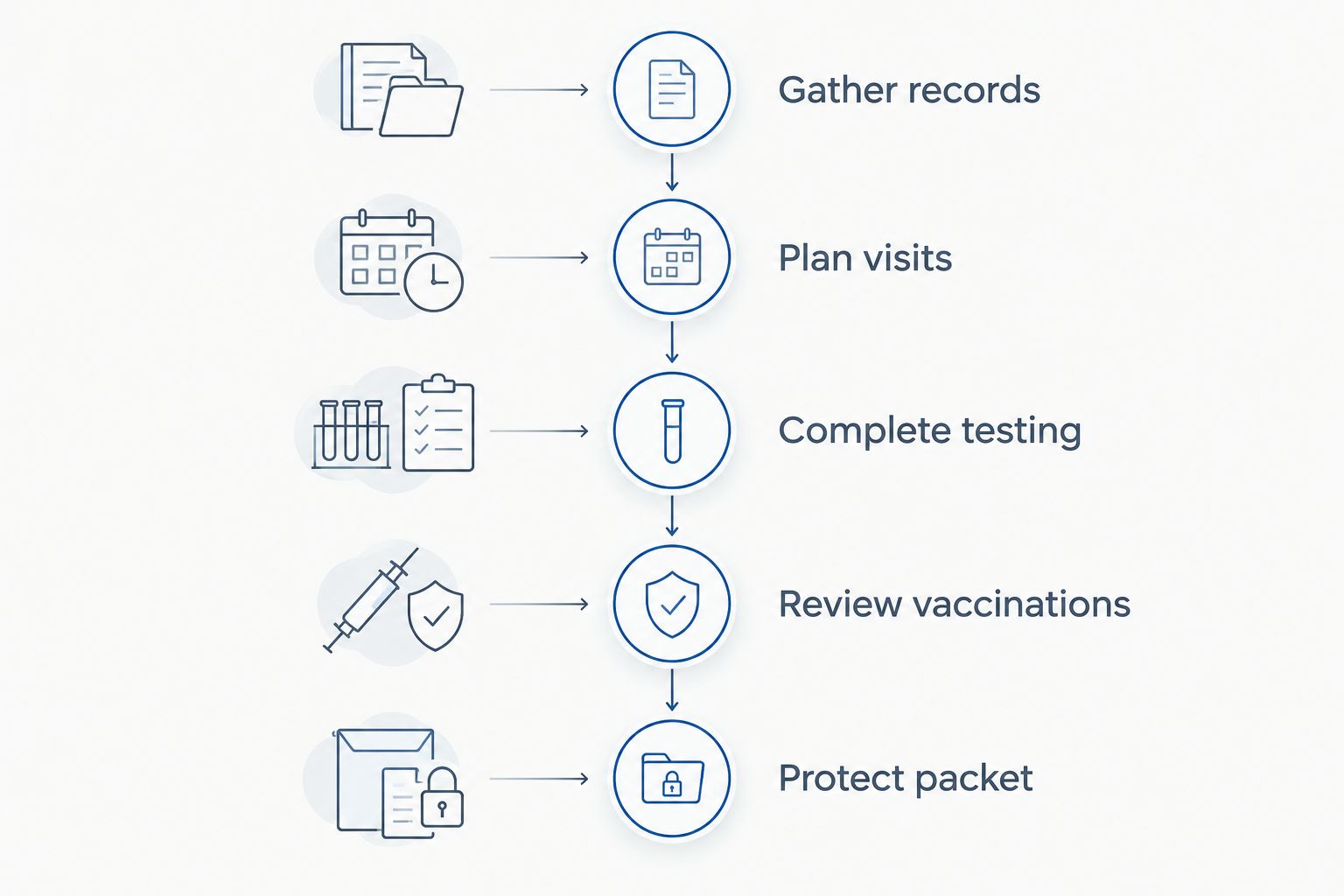
Compare preparation options around your work schedule
Choose a preparation approach based on the records you already have and how much coordination you need. For your 2026 examination, the deciding question is whether the provider can complete the required immigration process—not whether you recently passed a workplace physical.
| Option | Best for | Main benefit | Key limitation |
|---|---|---|---|
| Collect your own records before booking | Workers with accessible vaccination and treatment records | Gives the civil surgeon documentation to review | Gathering records does not replace the examination or required testing |
| ImmigrationMedicalExams.com coordinated I-693 examination | Southern California applicants seeking an immigration-exam-only clinic | Coordinates the examination, required testing, vaccination review, and form preparation | Requires a Costa Mesa visit; completion depends on results and documentation |
| An existing doctor who is also a USCIS-designated civil surgeon | Applicants whose current physician has the required designation | Offers the possibility of using an established clinical relationship | Being your regular doctor alone does not authorize Form I-693 completion |
| Employer or occupational health examination | Workers needing separate job-related clearance | Addresses the employer's stated purpose | Does not replace the immigration examination unless performed through the required civil surgeon process |
Best for reducing avoidable follow-up: gather records first, then confirm the clinic's process. Even a coordinated examination cannot supply a missing treatment history without your help.
Common mistakes construction workers make
Treating a workplace physical as an immigration exam
A clearance for lifting, driving, or returning to a jobsite answers an employment question. It does not automatically satisfy Form I-693 requirements. Verify the clinician's USCIS designation and the purpose of the appointment.
Assuming an injury-related tetanus shot covers everything
The vaccine given after an injury might be relevant, but the civil surgeon needs its documented type and date. Bring the record and let the clinician review the rest of your age-appropriate vaccination requirements.
Planning around the appointment instead of the completed form
A same-day appointment is not a same-day sealed packet. For a 2026 deadline, plan around laboratory review, vaccination needs, and any additional evaluation—not simply the first available appointment.
Leaving treatment records at home
Do not dismiss previous tuberculosis treatment or ongoing medical care as unrelated to construction work. Relevant records help the civil surgeon assess your history and identify what documentation is still needed. Share medical details with the clinic, not through an employer's scheduling message.
FAQ
Is an I-693 exam for construction workers different from other applicants' exams?
No. An I-693 exam for construction workers follows the same applicable USCIS and CDC requirements as other civil surgeon examinations. Your age, medical history, records, and findings determine the required evaluation—not your construction trade.
Can I use my pre-employment physical instead of an immigration medical exam?
A pre-employment physical does not automatically replace an immigration medical exam. Form I-693 requires the appropriate examination and documentation by a USCIS-designated civil surgeon.
Does construction work mean I need extra vaccines for Form I-693?
Construction work alone does not create extra Form I-693 vaccination requirements. The civil surgeon applies CDC vaccination instructions based on age, documented vaccination history, and medical circumstances.
Can I use the tetanus shot I received after a workplace injury?
A documented tetanus-containing vaccination can be reviewed for your immigration vaccination record. Bring the record showing the vaccine type and administration date; the civil surgeon determines how it applies.
Will a positive tuberculosis blood test automatically stop my Form I-693?
A positive tuberculosis blood test requires further evaluation, not an automatic conclusion that you have active tuberculosis disease. The civil surgeon follows CDC instructions, including chest X-ray requirements and any additional evaluation indicated by your history or findings.
How long should I plan for my immigration medical paperwork?
ImmigrationMedicalExams.com describes 3-business-day standard completion and a 2-business-day expedited option, subject to scheduling, laboratory results, required vaccinations, and additional documentation. A same-day appointment does not mean the completed form will be ready that day.
Should I stop taking prescribed pain medicine before my examination?
Do not stop prescribed medicine solely to prepare for your immigration examination unless your treating clinician instructs you to do so. Bring an accurate medication list and discuss your treatment history with the civil surgeon.
One last thing
The most useful document might be the vaccination record from your last workplace injury. Request it before your appointment rather than relying on memory. It can give the civil surgeon usable evidence, even though it cannot replace a complete vaccination review.
For a 2026 appointment, prepare your records first and confirm the completion process before arranging time away from the jobsite.
Prepare for your immigration examination
Arrange your civil surgeon visit in Costa Mesa and confirm what records to bring.