

How to Fix an I-693 Deficiency Notice for Your I-485

An I-693 deficiency notice means USCIS has found your Form I-693, Report of Immigration Medical Examination and Vaccination Record, technically invalid or incomplete, and your I-485 cannot move forward until you correct and resubmit it. Your first move: read the notice carefully, preserve every original document, and call your civil surgeon today.
Three authorities govern every decision here: USCIS (Form I-693), the USCIS Policy Manual Volume 8, Part B, Chapter 4, and the Form I-693 Instructions. Know them, or have your attorney know them.
- Preserve originals. Keep the deficiency notice, the returned I-693, and the original envelope.
- Read the notice. USCIS will specify the exact defect and the response deadline.
- Contact your civil surgeon and immigration attorney immediately.
Key Takeaways
An I-693 deficiency notice requires immediate action: preserve originals, identify the defect, and contact your civil surgeon before the USCIS deadline passes.
| Point | Details |
|---|---|
| Validity window | A completed I-693 is generally valid for two years from the civil surgeon’s signature date. |
| December 2024 policy change | Since December 2, 2024, missing the I-693 at I-485 filing typically results in rejection, not an RFE. |
| Fixable vs. new exam | Opened envelopes, missing signatures, and incomplete vaccines can often be corrected; expired exams require a full new exam. |
| Class A findings | A Class A condition requires lab documentation, civil surgeon coordination, and immediate consultation with an immigration attorney. |
| Immigrationmedicalexams | Offers USCIS-approved civil surgeon exams with a 2–3 business-day sealed I-693 turnaround in Southern California. |
Table of Contents
- Why USCIS issues an I-693 deficiency notice
- Exact steps to take after receiving the notice
- Deadlines, validity windows, and lockbox rejection scenarios
- What a Class A medical condition means for your case
- How to coordinate with your civil surgeon effectively
- What to do if USCIS returned or rejected your package
- Practical checklist and sample timeline to resolve the deficiency
- What avoidable mistakes actually cost applicants
- Resolve your I-693 deficiency with the right medical partner
- Sources
Why USCIS issues an I-693 deficiency notice
Common causes fall into two categories: defects a civil surgeon can fix without a new exam, and defects that require starting over.
Fixable by the civil surgeon:
- Opened or tampered envelope. The sealed envelope rule requires the civil surgeon to sign across the sealed flap. An opened envelope voids the I-693 unless USCIS itself opened it during processing.
- Missing civil surgeon signature or date. The surgeon must sign and date every required section.
- Missing applicant signature or photo. The applicant signs Part 11; a missing photo is a common oversight.
- Incomplete vaccination records. Missing required vaccines or undocumented vaccination dates trigger a deficiency. The surgeon can often administer missing vaccines and update the form.
Requires a new exam:
- Expired medical exam. USCIS considers a completed I-693 valid for two years after the civil surgeon’s signature. Past that window, a new exam is mandatory.
- Civil surgeon not USCIS-authorized. Only a currently designated civil surgeon can complete Form I-693. Verify authorization before every appointment.
- Class A medical condition requiring further evaluation. If the original exam flagged a communicable disease, drug abuse, or a physical or mental disorder with associated harmful behavior, additional medical evidence or treatment clearance is needed before the form can be finalized.
Exact steps to take after receiving the notice
- Read the deficiency notice in full. Note the stated defect, the response deadline, and the exact return address or upload instructions.
- Preserve all originals. Retain the deficiency notice, the returned I-693, the original envelope (even if opened), and any USPS or courier tracking receipts. These documents protect your original filing date.
- Contact your civil surgeon immediately. Ask whether the defect is correctable (reseal, missing signature, vaccination update) or requires a new exam. Get the answer in writing.
- Get the corrected I-693 properly sealed. If the surgeon can fix the issue, the corrected form must go into a new sealed envelope with the surgeon’s signature and stamp across the flap. A reseal without a fresh signature is not valid.
- Follow USCIS resubmission instructions exactly. The USCIS I-693 page specifies that online filers must open the sealed envelope and upload the I-693 electronically, then retain the original envelope. Mail filers submit the sealed envelope with their package. Include a copy of the deficiency notice if USCIS requests it.
- Coordinate with your attorney. If the notice involves a Class A finding or a waiver, your attorney needs to be involved before you resubmit anything.
Pro Tip: Online filers often make the mistake of keeping the I-693 sealed when uploading. Per Form I-485 instructions, you must break the seal to upload, but keep the original sealed envelope until a final decision is issued.
Deadlines, validity windows, and lockbox rejection scenarios
A completed Form I-693 is generally valid for a limited period from the date the civil surgeon signs it. File too early and the form may expire before USCIS adjudicates your case. File too late and you face the same problem from the other direction.
The stakes changed significantly on December 2, 2024. A USCIS newsroom alert announced that certain applicants must now submit Form I-693 with Form I-485 at the time of filing. Miss that requirement and USCIS may reject the entire package outright, rather than issuing a deficiency notice or RFE.
- Lockbox rejection vs. deficiency notice. A lockbox rejection happens before USCIS accepts the application. A deficiency notice comes after acceptance. They require different responses.
- Missed deadline consequences. Failing to respond by the stated deadline risks denial of the I-485 and loss of your original filing date.
- Refiling with an opened I-693. If USCIS returned your package with an opened I-693, you can often refile using that same form. Include the rejection notice with your new package. Check the USCIS I-485 checklist to confirm all required initial evidence is included.
Key date: The December 2, 2024 policy change means missing the I-693 at filing now typically results in rejection, not a second chance via RFE.
What a Class A medical condition means for your case
Class A conditions are health-related grounds of inadmissibility under U.S. immigration law. Finding one on your I-693 does not automatically end your case, but it does require immediate, careful action.
Class A conditions include:
- Communicable diseases of public health significance (tuberculosis, syphilis, gonorrhea, and others)
- Missing required vaccinations
- Physical or mental disorders with associated harmful behavior
- Drug abuse or addiction
When USCIS identifies a Class A condition, the likely outcome is a finding of inadmissibility, which may require a waiver, treatment, or additional medical documentation before your I-485 can be approved. The USCIS Policy Manual and the Form I-693 Instructions both spell out civil surgeon responsibilities and the consequences of incomplete or falsified findings.
Practical next steps:
- Ask the civil surgeon for copies of all lab reports and a written explanation of the finding.
- Consult an immigration attorney before responding to USCIS. A Class A finding often requires a waiver strategy, not just a corrected form.
- Preserve every document: lab results, vaccination records, clinic invoices, and any written communication with the surgeon.
Pro Tip: Falsifying or concealing information on Form I-693 can result in denial of your I-485 and potential criminal prosecution. The USCIS Policy Manual is explicit on this point. Never alter a form or omit a finding.
How to coordinate with your civil surgeon effectively
Walk into the civil surgeon’s office with a specific list of requests, not just a vague description of the problem.
Ask these questions directly:
- Are you currently a USCIS-authorized civil surgeon?
- Will you sign and stamp across the sealed envelope flap?
- Can you reseal and re-sign the form if a correction is needed?
- What is your expedited turnaround time?
Request these documents in writing:
- A completed, signed Form I-693 in a properly sealed envelope
- Copies of all vaccination records with dates administered
- Lab results for all required tests
- A clinic invoice with the date of service
Attorneys should also request a dated note of any conversation about the defect and its correction. That paper trail matters if USCIS questions the timeline later. For medical records and lab documentation, ask the clinic to provide copies before the sealed envelope is handed over.
Clinics that specialize in immigration medical exams can coordinate directly with attorneys on expedited processing and documentation. That said, the clinic’s role ends at the medical exam and I-693 completion. Legal strategy, waivers, and USCIS correspondence belong with your immigration attorney.
What to do if USCIS returned or rejected your package
- Retain everything. Keep the rejection notice, the returned package, the original I-693, and the original envelope, even if opened.
- Read the rejection notice carefully. USCIS will state whether you can refile with the original I-693 or must obtain a new one.
- Determine reuse eligibility. You can generally refile with the original opened I-693 if the form is still within its two-year validity window and the defect was an administrative error rather than a substantive medical issue. If the form has expired or a new exam is required, schedule one promptly.
- Refile with the rejection notice included. Attach a copy of the rejection notice to your new I-485 package. This supports any argument for preserving your original filing date.
- Confirm your filing method. Online refilers upload the I-693 and retain the envelope. Mail refilers submit the sealed envelope. See what happens if your I-693 is rejected for a detailed walkthrough.
Pro Tip: Document chain of custody from the moment you receive the returned package. Keep proof of delivery, tracking numbers, and clinic receipts together. If a filing-date dispute arises, this documentation is your evidence.
Practical checklist and sample timeline to resolve the deficiency
Checklist:
- [ ] Preserve deficiency notice, returned I-693, and original envelope
- [ ] Record the response deadline and return address
- [ ] Contact civil surgeon to confirm fix vs. new exam
- [ ] Obtain corrected I-693 in a properly sealed, signed envelope
- [ ] Gather supporting documents (lab results, vaccination records, clinic invoice)
- [ ] Confirm filing method (upload vs. mail) and follow USCIS instructions
- [ ] Include deficiency notice copy if USCIS requests it
- [ ] Coordinate with immigration attorney if Class A finding is involved
Sample timeline:
Speed-up options include clinics offering 2-day expedited processing, same-day on-site labs, and weekend appointments. Confirm your filing method before the corrected I-693 leaves the clinic.
What avoidable mistakes actually cost applicants
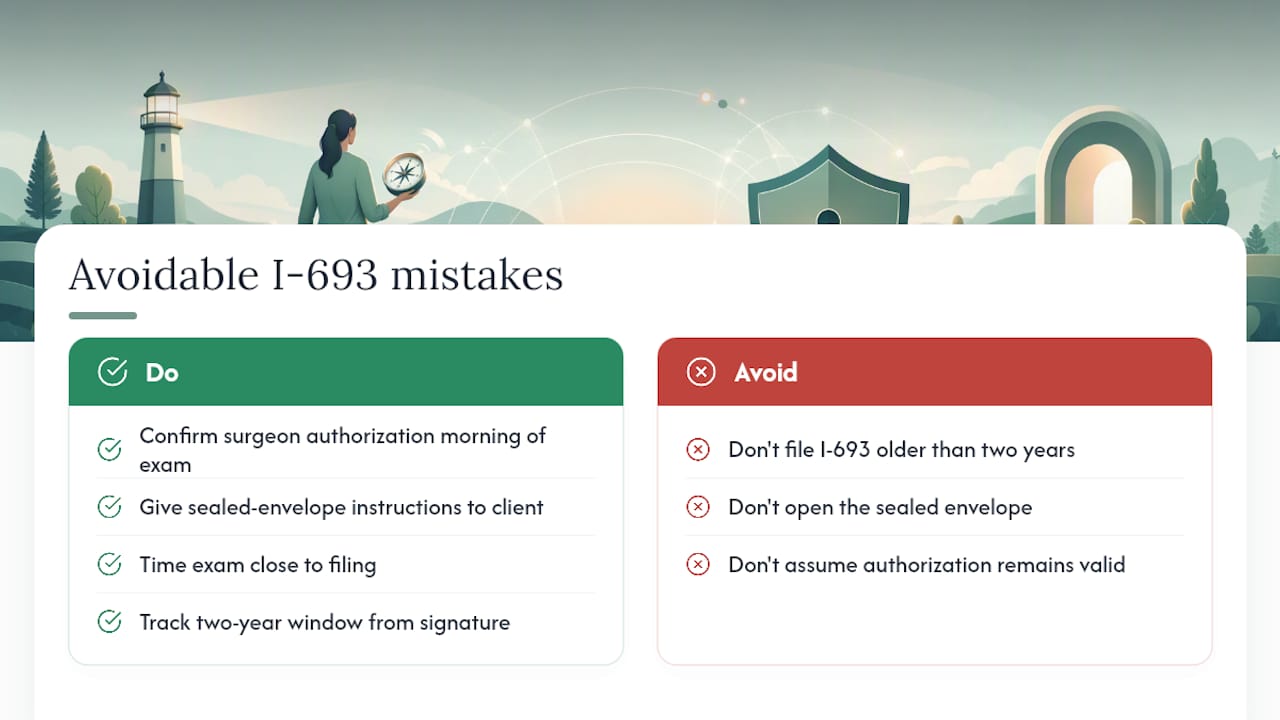
The most expensive errors in I-693 deficiency cases are not the ones that require a new exam. They are the ones that could have been prevented with a five-minute checklist.
Filing an I-485 without verifying the civil surgeon’s current USCIS authorization is the single most common avoidable mistake. Authorization lapses. A surgeon who was authorized when you first called may not be authorized on the day of your appointment. Confirm it the morning of the exam.
The second pattern: attorneys who assume the sealed envelope rule is obvious to clients. It is not. Applicants regularly open the envelope to “check” the form, or mail filers accidentally hand over an already-opened I-693 without realizing it voids the submission. A one-page instruction sheet given to the client at the time of the appointment prevents this entirely.
The third: filing too early. An I-693 signed more than two years before USCIS adjudicates the case is expired. Applicants who complete the exam well before filing, then experience delays, often discover the form has expired at the worst possible moment. Time the exam close to filing, and track the two-year window from the surgeon’s signature date.
The cost of these errors is concrete: a lost filing date, a refile fee, and months of additional waiting. For employer-sponsored applicants, that can mean losing a priority date. Prevention requires a checklist and a phone call.
Resolve your I-693 deficiency with the right medical partner
When a deficiency notice requires a corrected or new Form I-693 fast, the medical side of the fix needs to move without delay. Immigrationmedicalexams provides USCIS-approved civil surgeon exams exclusively for green card and adjustment-of-status applicants, with a guaranteed 2–3 business-day turnaround on sealed I-693 forms, on-site labs, and same-day vaccination administration at clinics in Southern California, including Orange County and Los Angeles.

Attorneys can coordinate directly with the clinic for expedited scheduling and documentation. Every exam includes a properly sealed envelope with the surgeon’s signature across the flap, copies of lab results and vaccination records, and a clinic invoice, giving you everything needed for resubmission. Immigrationmedicalexams handles the medical exam and I-693 completion only. For waiver strategy, legal filings, or USCIS correspondence, work with your immigration attorney.
Book your expedited immigration medical exam or review the step-by-step exam process to know exactly what to bring.
Sources
- USCIS Policy Manual, Volume 8, Part B, Chapter 4
- Reminder to submit all required initial evidence and supporting documentation, including Form I-693 | USCIS (archived)
- What Does an I-693 Deficiency Notice Mean? - LegalClarity
This article is general information, not a substitute for advice from a qualified doctor. Consult a qualified healthcare professional about your own circumstances before acting on anything here.