
You do not need to notarize I-693 exam paperwork for the standard USCIS submission: the civil surgeon completes and signs Form I-693, Report of Immigration Medical Examination and Vaccination Record, and gives you the original in a sealed envelope. Keep that envelope closed; a notarized photocopy does not replace the properly completed, sealed original.
- You do not need to notarize I-693 exam paperwork for the standard USCIS submission.
- USCIS requires the civil surgeon’s sealed original, not a notarized photocopy.
- Request a separate personal copy before leaving your civil surgeon’s office.
- ImmigrationMedicalExams.com focuses on Form I-693 examinations; ask the clinic about copies and documentation questions.
For handling and delivery instructions, see the guide to your sealed I-693 packet and online filing. The distinction matters: your personal copy is for review and recordkeeping, while the sealed packet is the examination document prepared for USCIS.
How do you notarize or certify copies of your I-693 exam paperwork?
For a standard Form I-693 submission in 2026, skip notarization and request a separate copy from the civil surgeon. USCIS Form I-693 Instructions require the civil surgeon to provide the completed form in a sealed envelope. They also instruct applicants not to accept the form unless it is sealed.
If someone separately asks for a certified copy, first identify the document and the recipient’s requirement. A request for your vaccination record, a copy of your examination, and the original Form I-693 are not interchangeable.
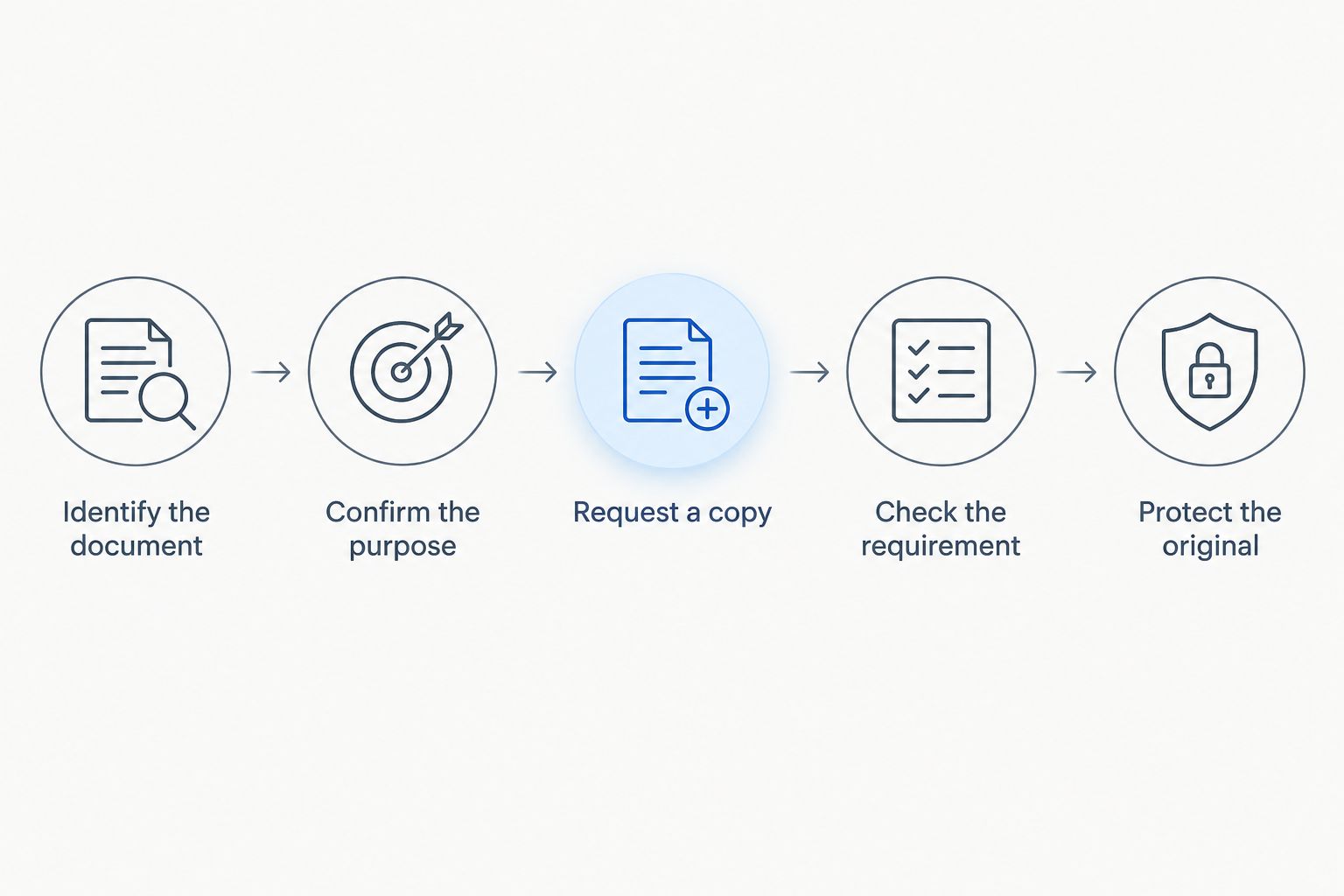
Use this sequence before arranging any notarization:
- Identify the document. Determine whether you need your completed Form I-693, a vaccination record, a laboratory report, or another medical record.
- Confirm the purpose. Ask whether the document is for USCIS submission, your own records, or a separate recipient.
- Request a copy. Contact the civil surgeon’s office for a separate patient copy. Do not open your sealed packet to make one.
- Check the requirement. If another recipient requests certification, ask what wording and certifying authority it accepts.
- Protect the original. Keep the sealed Form I-693 unchanged and follow the submission instructions that apply to your case.
Why this matters
Notarization addresses a particular signature or notarial act. It does not establish that an immigration medical examination meets USCIS requirements or that a clinician is a USCIS-designated civil surgeon.
For your 2026 examination, focus on the requirements that actually affect Form I-693: the proper examiner, required examination and testing, vaccination assessment, correct signatures, and sealed delivery. A stamp on a photocopy cannot correct a missing civil surgeon signature or an opened envelope.
The primary authorities are the USCIS Form I-693 Instructions for completing and handling the form, and CDC Technical Instructions for Civil Surgeons for the examination and vaccination assessment. Neither a notary nor an applicant can replace the civil surgeon’s medical findings with a separate declaration.
Which document should you keep, submit, or request?
Your examination produces documents with different purposes. Separate your submission packet from your personal records before you leave the clinic. That makes it easier to review your information without disturbing the original.
| Document | Best for | What it does | What it cannot replace |
|---|---|---|---|
| Sealed original Form I-693 | USCIS submission | Contains the civil surgeon’s completed examination documentation | It is not a packet you should open for personal review |
| Separate patient copy of Form I-693 | Your records and attorney review | Lets you review the completed information without opening the original | The sealed original required for standard submission |
| Vaccination record | Documenting vaccine history | Gives the civil surgeon evidence to assess vaccination requirements | The completed immigration medical examination |
| Laboratory report | Documenting a test result | Records a specific laboratory finding | The civil surgeon’s complete Form I-693 assessment |
A personal copy is useful, but it has a clear limit: it is not the submission original. A vaccination record is useful evidence, but it does not show that every part of your immigration medical examination is complete.
If you receive several documents at pickup, ask the office to identify which envelope must remain sealed and which pages you can read. For families, keep each applicant’s personal copies and submission packet together without mixing records between family members.
Does Form I-693 need a notary signature?
Form I-693 does not require a notary signature for the standard USCIS submission. The applicant signs the required certification in the civil surgeon’s presence, and the civil surgeon signs the examination certification as directed by the form instructions.
Do not sign the applicant certification ahead of the visit just because you want to finish the paperwork early. Follow the civil surgeon’s instructions about when to sign. A notary’s presence is not a substitute for signing in front of the civil surgeon where USCIS requires it.
For a child or an applicant who needs assistance signing, ask the clinic to follow the applicable USCIS signature instructions. Do not assume a family member can sign every section, and do not arrange notarization as a workaround.
Can a California notary certify a copy of Form I-693?
A California notary generally cannot certify an ordinary photocopy of medical paperwork as a true copy. California’s notary rules allow copy certification in limited situations, including copies of powers of attorney; that authority does not extend to general medical records such as Form I-693.
A notary can perform an authorized notarial act on a separate statement when the legal requirements are met. For example, a document holder might sign a statement about a copy and have that signature notarized. That does not turn the copy into a civil surgeon-certified examination or a substitute USCIS submission.
For a 2026 request involving California notarization, use the California Secretary of State’s Notary Public Handbook as the authority for the notary’s powers. Ask the recipient what it needs before preparing a statement. The recipient, not the presence of a stamp, determines whether that separate documentation serves its purpose.
Can the civil surgeon give you a certified copy?
Ask the civil surgeon’s office for a separate copy of your completed Form I-693. If a recipient wants additional certification, give the office the exact request rather than simply asking for something official.
A clinic-provided copy and a notarized document-holder statement serve different purposes. A clinic copy comes from the office that prepared the examination record; a notarized statement concerns the person making that statement. Neither automatically replaces USCIS’s sealed-original requirement.
You can make a clear request without sharing unnecessary case details:
- Identify the record you need.
- Say whether you want a paper copy or an electronic copy.
- Explain who requested certification and what wording it requires.
- Ask what identification or records-release authorization the office needs.
Keep copies of medical records private. Use the clinic’s designated records process, and confirm the intended recipient before sending documents that contain your health information or immigration identifiers.
Why copy and certification requests differ
There is no single certification process for every document associated with your examination. The right next step depends on what you are requesting and why.
- Document type: Form I-693, a vaccine record, and a laboratory report document different parts of the examination.
- Recipient: USCIS submission requirements differ from a request for personal recordkeeping or attorney review.
- Source: Request the completed Form I-693 copy from the civil surgeon’s office and outside medical records from the provider that holds them.
- Envelope condition: An intact sealed packet and an opened packet require different handling.
- Requested wording: A recipient’s request for certification needs clarification before you arrange any separate notarial act.
For example, if your attorney wants to review the completed examination, ask the clinic for a separate patient copy. If you need proof of a vaccine received elsewhere, ask that provider for the vaccination record rather than opening Form I-693 to look for it.
What should you bring so your paperwork is correct?
Bring government-issued identification and the vaccination records you have. Also bring relevant medical documentation requested by the clinic, including records connected to a condition or previous testing that the civil surgeon needs to evaluate.
Under CDC vaccination guidance, the civil surgeon reviews documented vaccine history and determines which requirements apply. Your age, medical circumstances, and acceptable documentation affect that assessment. Notarizing an incomplete vaccine list does not establish that you meet the requirements.
For your 2026 visit, tell the clinic early if your records use a previous name or contain information that needs clarification. If a record is not in English, ask about translation requirements before the appointment. A notarized signature alone does not translate or explain the record.
Before your packet is finalized, review your identifying information with the office. If your patient copy later shows a possible error, contact the civil surgeon rather than changing the copy or writing on the sealed envelope.
What if you already opened the sealed envelope?
Contact the civil surgeon’s office; do not try to repair the seal yourself. USCIS Form I-693 Instructions warn that USCIS will not accept the form if the envelope has been opened or altered.
Explain what happened and ask how the office can prepare a properly sealed packet. Do not tape the envelope closed, transfer the pages to another envelope, or ask a notary to certify that the contents are unchanged.
Opening the envelope does not by itself tell you which clinic steps are needed next. The civil surgeon’s office must review the situation and determine the appropriate documentation process. Follow any USCIS notice separately, and ask your attorney about case-specific filing questions.
Who should handle an I-693 paperwork problem?
ImmigrationMedicalExams.com is best for Southern California applicants seeking a dedicated Form I-693 immigration medical examination clinic. Its USCIS-designated civil surgeons coordinate the examination, required testing, vaccination review, and preparation of the sealed form.
The clinic also assists applicants whose immigration medical documentation was incomplete or incorrectly prepared elsewhere. That service has an important limit: reviewing a paperwork problem does not guarantee USCIS approval or remove required examination steps.
ImmigrationMedicalExams.com describes standard completion as 3 business days, with a 2-business-day expedited option subject to scheduling, laboratory results, required vaccinations, and additional documentation. Those timelines concern examination completion, not a promised turnaround for every copy request or correction.
For 2026 planning, ask about your specific paperwork issue before choosing a deadline. A same-day appointment is not the same as a completed, sealed Form I-693.
Ask about your examination paperwork
Discuss Form I-693 copies, sealed packets, or documentation concerns with the clinic.
FAQ
Do I need to notarize I-693 exam paperwork before sending it to USCIS?
No. For the standard USCIS submission, use the completed original Form I-693 in the civil surgeon’s sealed envelope. A notarized photocopy does not replace it.
Can I open my I-693 envelope to scan the form?
No. Keep the submission envelope sealed and request a separate patient copy from the civil surgeon’s office. USCIS will not accept an envelope that has been opened or altered.
Can my attorney review a copy of my completed I-693?
Yes. Request a separate patient copy for attorney review rather than opening the sealed original. Confirm a secure way to share the medical information.
Can a California notary certify my immigration medical records?
A California notary generally cannot certify ordinary copies of medical records. Notarizing a separate statement about a copy does not make that copy a replacement for the civil surgeon’s sealed Form I-693.
Should I sign Form I-693 before my appointment?
Do not sign the applicant certification before the civil surgeon directs you to sign it. USCIS instructions require that signature in the civil surgeon’s presence.
What should I do if my I-693 copy has the wrong name?
Contact the civil surgeon’s office to review the identifying information and determine the correction needed. Do not edit the medical form yourself or open the sealed packet.
Does ImmigrationMedicalExams.com help with incorrectly prepared I-693 paperwork?
ImmigrationMedicalExams.com assists applicants whose immigration medical documentation was incomplete or incorrectly prepared elsewhere. The clinic must review the issue; assistance does not guarantee USCIS approval.
One last thing
Check your personal copy, not your sealed original. Asking for a separate copy at pickup gives you a way to review your name and other information while protecting the packet USCIS requires.
If someone asks you to notarize the examination, clarify whether they mean the actual Form I-693 or a separate statement. That single question prevents you from applying the wrong process to the right document.