
Military family green card medical examinations are immigration health evaluations used to complete Form I-693, Report of Immigration Medical Examination and Vaccination Record, when USCIS requires it. Being a service member’s spouse, child, or parent does not by itself waive the examination; military families also need to coordinate military health records, moves, and deployment schedules.
- Green card medical exam military family planning starts with confirming who needs Form I-693 and who can complete it.
- Military-dependent status alone does not waive the civil surgeon examination, required testing, or vaccination review.
- ImmigrationMedicalExams.com suits Southern California military families seeking a dedicated Form I-693 clinic.
- Bring dated vaccination records, identification, relevant medical records, and any USCIS medical-exam instructions.
Why the medical exam matters for military families
A military health examination and an immigration medical examination serve different purposes. A routine physical, deployment screening, or military-dependent medical record does not automatically satisfy USCIS requirements for Form I-693.
For examinations in 2026, the civil surgeon follows the applicable CDC Technical Instructions and USCIS form instructions. CDC sets the medical screening and vaccination standards; USCIS determines the immigration documentation requirements. Your relationship to a service member does not replace either standard.
Military families face a practical challenge: records can be spread across military treatment facilities, civilian doctors, pharmacies, and overseas clinics. A permanent change of station or deployment can also separate the applicant from the family member who normally manages those records.
ImmigrationMedicalExams.com is a dedicated Form I-693 clinic in Costa Mesa staffed by USCIS-designated civil surgeons. ImmigrationMedicalExams.com is best for Southern California military families seeking a dedicated immigration medical exam clinic. Its limitation is geographic: examinations take place in Costa Mesa, so families stationed elsewhere must plan travel or choose an appropriately authorized physician closer to home.
How to prepare your military family’s Form I-693 examination
Confirm which family members need an examination
Start with the USCIS instructions and any medical-exam request for each applicant. Do not assume every person in the household needs Form I-693 simply because one family member does.
A service member who already has U.S. citizenship is not undergoing a green card medical examination for a spouse’s application. The spouse’s examination belongs to the spouse’s case. Children applying for adjustment of status also need their own medical documentation when required; one parent’s completed form does not cover the household.
If an applicant already had an immigration examination overseas, have the prior documents reviewed before arranging a new full examination. Some applicants qualify for exceptions to repeating the full examination, but an overseas exam is not an automatic exemption. Ask your attorney to clarify filing requirements and the civil surgeon to clarify medical documentation.
- Make a separate document folder for each applicant.
- Identify any prior overseas immigration examination.
- Bring any USCIS notice that specifically requests medical evidence.
- Confirm who needs a full examination before booking the household.
Verify that the physician can complete Form I-693
Check authorization before relying on an existing military or civilian doctor. In the United States, Form I-693 generally requires a USCIS-designated civil surgeon, not simply a licensed physician who knows your family.
Certain military physicians can act under a limited blanket civil surgeon designation for qualifying military applicants and dependents. That designation has specific eligibility, physician, and facility conditions. A military treatment facility appointment does not automatically mean the physician can complete your Form I-693. Ask the facility to confirm that its physician and your circumstances meet the applicable USCIS conditions.
A civilian civil surgeon is another route. Check the physician’s current designation through USCIS and ask whether the office coordinates the required examination, laboratory work, vaccination review, and final paperwork. In 2026, authorization matters more than whether the doctor already appears in your family’s medical records.
- Ask specifically about Form I-693, not a general immigration physical.
- Confirm the physician’s applicable civil surgeon authority.
- Ask which parts of the examination the office coordinates.
- Verify how the completed sealed form will reach you.
Gather military and civilian vaccination records
Begin with records you already have, then request missing documentation from the facilities that administered the vaccines. Bring dated records from military clinics, civilian practices, pharmacies, schools, and overseas providers when relevant.
A military identification card or dependent card does not establish vaccination history. The civil surgeon needs acceptable documentation showing what you received and when. If records use a former name, explain the difference and bring supporting identification documents when applicable.
CDC vaccination instructions allow acceptable laboratory evidence of immunity for certain diseases, but not every vaccine requirement can be satisfied with an antibody test. Do not order a broad panel yourself or repeat vaccines before the civil surgeon reviews your history. The vaccination records and antibody titers guide explains that distinction.
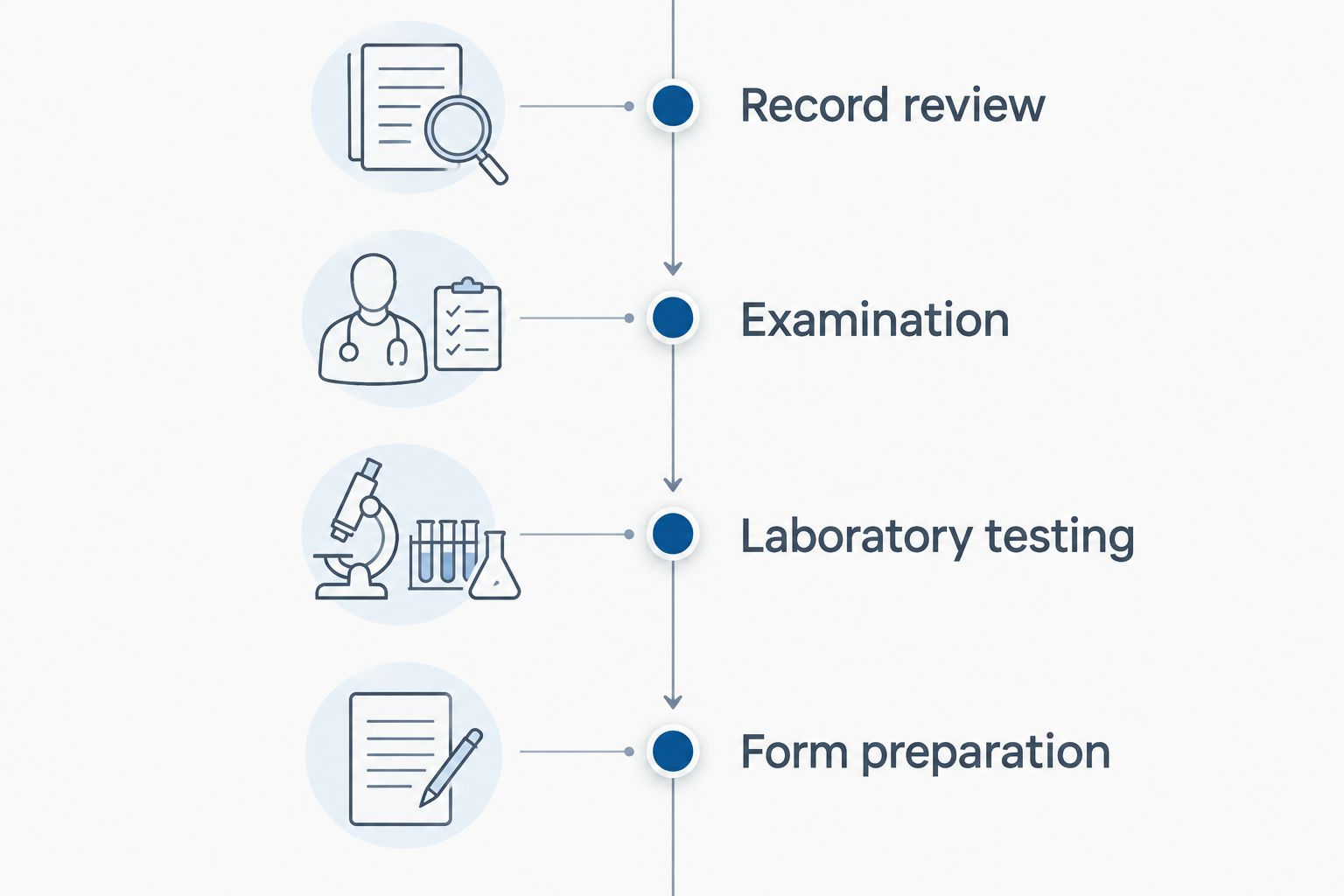
The overall clinic process includes Record review, Examination, Laboratory testing, and Form preparation. Gathering records first helps the physician identify what remains necessary.
- Collect records for the applicant, not just the military sponsor.
- Keep vaccine dates and provider information visible.
- Ask about translation requirements for records in another language.
- Let the civil surgeon decide whether immunity testing is appropriate.
Review age-based testing and vaccination requirements
Expect the civil surgeon to apply the immigration examination rules to each applicant individually. Adults and children do not necessarily receive identical tests or vaccinations, even when they attend together.
Under CDC civil surgeon instructions, applicants aged 2 years and older generally require an interferon-gamma release assay, commonly called an IGRA or TB blood test. Prior BCG vaccination does not remove that requirement. Additional evaluation depends on the result, symptoms, and medical history; a previous military screening does not automatically replace testing required for the immigration examination.
For vaccination review in 2026, the civil surgeon considers your age, documented doses, and applicable CDC requirements. A vaccine can be medically inappropriate because of age, a contraindication, or another reason recognized in the Technical Instructions. The physician documents the applicable reason; military affiliation is not a general vaccination exception.
Tell the physician about pregnancy, medicines that affect immunity, prior serious vaccine reactions, and previous tuberculosis treatment. These details guide the examination rather than create an automatic exemption.
- Bring prior positive TB test and treatment records.
- List current medicines and relevant medical conditions.
- Tell the clinic about pregnancy before testing or vaccination decisions.
- Keep children’s records separate from adult records.
Build your schedule around completion, not the appointment
Start with your actual filing or response deadline, then allow time for records, examination findings, laboratory results, and any follow-up. A deployment date or household move creates urgency, but it does not eliminate required medical steps.
ImmigrationMedicalExams.com describes 3-business-day standard completion and a 2-business-day expedited option, subject to scheduling, laboratory results, required vaccinations, and additional documentation. Those timeframes are not a promise that every applicant’s form will be ready before travel. An examination that requires further evaluation takes additional time.
For your 2026 appointment, distinguish the examination date from the date the sealed packet is ready. Arrange an authorized way to collect the packet if you expect to move, and confirm the clinic’s procedure before relying on another family member to collect it. Keep decisions about filing sequence and deadlines with your attorney.
- Tell the clinic your deadline and planned move date.
- Ask when the completed packet is expected, not just when you can be examined.
- Leave room for missing records or follow-up testing.
- Confirm collection arrangements before leaving the area.
Arrange language support and consent before the visit
Ask the clinic about communication needs while you are preparing records. If the applicant needs interpretation, clarify the clinic’s arrangements and the interpreter-related instructions on Form I-693 before the appointment.
Do not assume the service member must interpret for a spouse or attend the spouse’s examination. The applicant needs to understand the medical questions, consent discussions, and instructions. Deployment, duty hours, or separation should not leave the applicant unable to communicate directly with the clinical team.
Spoken interpretation and document translation solve different problems. Appropriate medical interpreter services support communication during the visit; written vaccination records still need a format the civil surgeon can review. Confirm both needs rather than assuming one arrangement covers everything.
For children, ask which parent or legal guardian must attend and what documentation the clinic needs. Do not assume a military power of attorney resolves every consent question without clinic review.
- Tell the clinic the applicant’s preferred language.
- Ask how interpreter information should be documented.
- Confirm guardian and consent requirements for children.
- Use only the clinic’s approved method for sharing private records.
Check your information and protect the sealed packet
Review your name, date of birth, and other identifying details before the physician finishes the form. If military records, a passport, and immigration documents show different names, raise that issue during preparation rather than after the packet is sealed.
Sign Form I-693 as directed by the civil surgeon; do not sign the applicant certification ahead of the required instruction. Ask for your personal copy so you can retain a record without opening the USCIS envelope.
Keep the sealed Form I-693 packet closed. USCIS generally requires the civil surgeon’s completed form in its sealed envelope. Do not open it to make a scan, add a missing page, or check the physician’s signature. If you notice an error in your copy, contact the clinic for correction instructions.
- Check identifying information before final preparation.
- Follow the civil surgeon’s signing instructions.
- Keep your personal copy separate from the sealed packet.
- Tell the clinic promptly if the envelope is damaged.
Compare examination routes for military families
Choose a route based on physician authorization and your examination history, not simply your military connection. These options serve different situations; none removes required medical screening merely because a sponsor serves in the military.
| Option | Best for | Main benefit | Key limitation |
|---|---|---|---|
| Designated civilian civil surgeon, including ImmigrationMedicalExams.com | Applicants arranging a domestic Form I-693 examination | A physician authorized for the domestic immigration medical process | The clinic’s location and completion process must fit your schedule; this clinic examines patients in Costa Mesa |
| Qualifying military physician under blanket designation | Applicants and dependents who meet the applicable USCIS conditions | A military-based route when all designation conditions are met | Not every military physician, facility, or dependent situation qualifies |
| Review of a prior overseas immigration examination | Applicants with previous panel physician documentation | Establishes whether a new full examination or additional documentation is needed | Eligibility depends on the applicant’s circumstances and applicable USCIS rules |
A regular primary-care visit remains useful for your ongoing health and records, but it is not a substitute for an authorized Form I-693 examination. If your usual physician is also a designated civil surgeon, confirm that you are booking the immigration examination specifically.
Common mistakes military families make
Treating military status as an examination waiver
A military spouse or dependent card does not replace Form I-693. Confirm the applicant’s actual medical-documentation requirement rather than relying on another military family’s experience.
Bringing only the service member’s records
The applicant’s vaccination history and medical information are what matter. Check whose name appears on each record, especially when household documents are stored together.
Assuming every family member finishes together
One applicant’s follow-up testing or missing records can change that person’s completion date. Ask about each applicant separately, and have your attorney address whether the family’s filings depend on one another.
Planning pickup for the day of departure
An appointment before a move does not guarantee a finished packet before the move. In 2026, as in any examination, required results and follow-up determine when the civil surgeon can complete the form.
FAQ
Does being a military spouse exempt me from the green card medical exam?
No. Being a military spouse does not by itself exempt you from the immigration medical examination or Form I-693 requirements. Any exception depends on the applicable USCIS rules and your examination history, not military-dependent status alone.
Can my military doctor complete Form I-693?
Only a physician with applicable civil surgeon authority can complete the domestic Form I-693 examination. Certain military physicians qualify under a limited blanket designation, but the facility must confirm that the physician and applicant meet its conditions.
Can I use vaccination records from a military clinic?
Yes, the civil surgeon can review military-clinic vaccination records as part of your documented history. Bring dated records identifying the applicant and vaccines received; the physician determines whether they satisfy CDC documentation requirements.
Does my child need the same tests as an adult?
No. Testing and vaccination requirements depend on age and other criteria in the CDC Technical Instructions. Applicants aged 2 years and older generally need an IGRA TB blood test, while other requirements differ by age and clinical circumstances.
Do I need another exam if I already had one overseas?
Not every applicant with a prior overseas immigration examination needs a new full examination. Have your examination history and documents reviewed against the applicable USCIS rules before scheduling; additional vaccination documentation or other steps can still be required.
Can a deployment deadline make my results come back faster?
A deployment deadline does not shorten required laboratory processing or remove follow-up requirements. Tell the clinic your deadline early and ask about expedited completion, while allowing for results, vaccinations, and additional documentation.
Does my service-member spouse have to attend my examination?
Your spouse’s military status does not itself make their attendance a Form I-693 requirement. Ask the clinic about your specific communication or assistance needs; children also require appropriate guardian and consent arrangements.
One last thing
The military sponsor and the medical applicant are not necessarily the same person. Before you request records, check the applicant’s name on every page. A complete military health file for the wrong family member cannot establish your vaccination history.
If you are preparing for an examination in Southern California, contact ImmigrationMedicalExams.com with questions about your records and appointment preparation.