

Green Card Medical Exam: What Every Applicant Must Know

If you are filing Form I-485 to adjust your status to lawful permanent resident, you almost certainly need to complete a green card medical exam and submit a sealed Form I-693 signed by a USCIS-designated civil surgeon. That is not optional, and as of December 2, 2024, USCIS requires the I-693 to be submitted with your I-485 or your application may be rejected outright.
Here is what to do right now:
- Book an appointment with a USCIS-designated civil surgeon. Use the USCIS “Find a Civil Surgeon” tool to locate one near you.
- Gather your vaccination records before the appointment. Missing records are the single most common cause of extra costs and delays.
- Expect the clinic visit to take 60–90 minutes. Full processing from appointment to sealed I-693 in hand typically runs 3–7 business days, depending on the clinic’s lab workflow.
- Confirm all-inclusive pricing when you call. USCIS does not regulate civil surgeon fees, so costs vary widely by clinic.
Immigrationmedicalexams operates USCIS-approved civil surgeon clinics in Southern California with a fast turnaround on sealed I-693 forms, on-site labs, and multilingual staff.
Table of Contents
- What Form I-693 is and why USCIS requires it
- Who can perform your exam and how to find the right provider
- Exactly what the exam includes: tests, vaccines, and physical checks
- What to bring and what happens during the visit
- How long results are valid and how to submit Form I-693
- Medical conditions that affect admissibility and what to do next
- How much the exam costs and how to avoid surprise charges
- Key takeaways
- What clinics actually see: the mistakes that delay cases
- Immigrationmedicalexams makes the I-693 process straightforward
- Authoritative sources and next-step links
What Form I-693 is and why USCIS requires it
The immigration medical exam is a federally mandated health screening that determines whether an applicant is medically admissible to the United States under INA section 212(a)(1). The results are recorded on Form I-693, the official document USCIS reviews as part of your I-485 adjudication. Think of it less as a physical and more as a public-health compliance check: civil surgeons are not your primary care doctor for this visit.
The exam has three narrow legal purposes:
- Communicable disease screening. Civil surgeons check for diseases of public-health significance, including tuberculosis, syphilis, and gonorrhea (when required by age).
- Vaccination verification. Required vaccines must meet CDC Advisory Committee on Immunization Practices (ACIP) schedules; any missing doses must be administered or documented.
- Mental health and substance use assessment. Civil surgeons evaluate for disorders associated with harmful behavior or active substance addiction that could affect admissibility.
The exam is not a general wellness visit. Civil surgeons follow CDC technical instructions precisely, which is why having accurate medical and immunization records significantly reduces the chance of additional testing or repeated vaccines. Bring everything you have, even partial records.
A note on scope: USCIS will not accept a Form I-693 completed by a regular physician, urgent care provider, or your personal doctor unless that provider holds a current USCIS civil surgeon designation.
Who can perform your exam and how to find the right provider
Only two categories of physicians are authorized to complete an immigration medical exam for a green card applicant, and which one you need depends entirely on where you are in the process.
Civil surgeons (U.S.-based applicants)
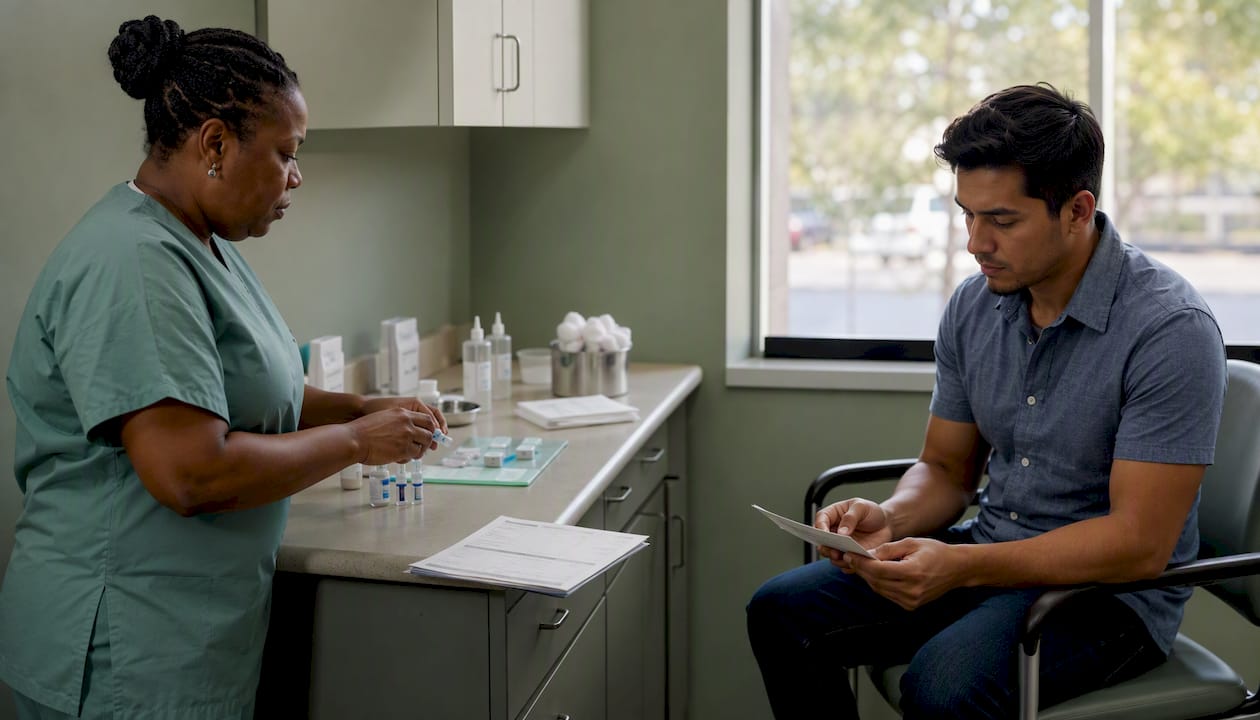
A civil surgeon is a licensed physician in the United States who has been specifically designated by USCIS to perform immigration medical exams and complete Form I-693. If you are adjusting status inside the U.S., a civil surgeon is the only provider whose work USCIS will accept.
To find one, go to the USCIS “Find a Civil Surgeon” tool, enter your ZIP code, and filter by distance. Before booking, verify:
- Current USCIS designation status (designations can lapse)
Panel physicians (consular processing abroad)
If you are applying for an immigrant visa at a U.S. consulate overseas rather than adjusting status inside the U.S., you will see a panel physician instead. Panel physicians are designated by the U.S. Department of State, not USCIS. They complete a different form and their results go directly to the consulate. A panel physician exam does not replace a civil surgeon exam if you later file an I-485.
| Feature | Civil surgeon | Panel physician |
|---|---|---|
| Location | United States | Outside the United States |
| Designated by | USCIS | U.S. Department of State |
| Form completed | Form I-693 | — |
| Used for | Adjustment of status (I-485) | Consular immigrant visa processing |
| Report submitted to | USCIS (sealed envelope) | U.S. consulate |
Pro Tip: When you call a civil surgeon clinic, ask two specific questions: “Do you seal the I-693 before I leave?” and “Does your pricing include labs and vaccines, or are those billed separately?” The answers will tell you immediately whether you are dealing with a clinic that handles immigration exams routinely or one that treats them as an occasional add-on.
Exactly what the exam includes: tests, vaccines, and physical checks
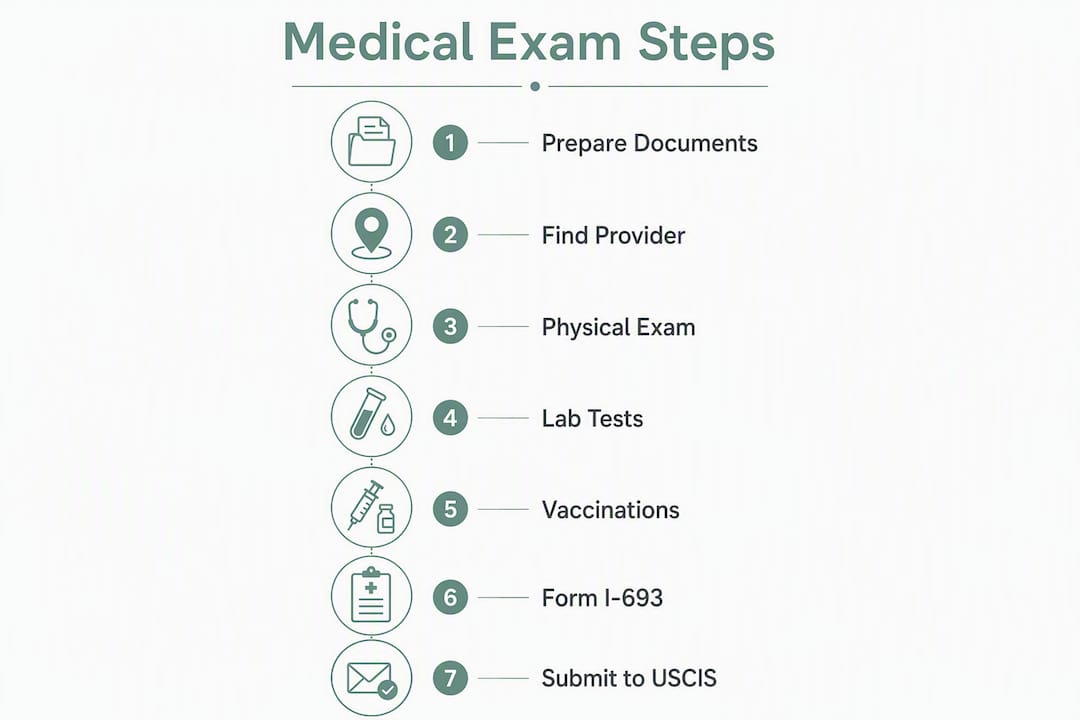
The civil surgeon will work through a structured checklist derived from CDC technical instructions. Here is what to expect.

Vaccination review
Required vaccines follow CDC ACIP schedules and vary by age. COVID-19 vaccination is no longer required for immigration medical exams. Core vaccines that remain on the USCIS/CDC list include:
- Influenza (seasonal, for applicants 6 months and older)
- Td/Tdap (tetanus, diphtheria, pertussis)
- MMR (measles, mumps, rubella)
- Varicella
- Pneumococcal (age-dependent)
- Hepatitis A and B
- Meningococcal
- HPV (for applicants through age 26)
- Polio
For a complete age-stratified breakdown, see the USCIS vaccination requirements guide.
Laboratory tests
| Test | When required |
|---|---|
| IGRA (TB blood test) | Standard for most applicants; replaces TST in most immigration settings |
| Chest X-ray | Ordered when IGRA is positive or clinical symptoms warrant it |
| Syphilis serology | Required for applicants 15 years and older |
| Gonorrhea culture/test | Required for applicants 15 years and older |
| Additional blood/urine tests | Ordered at civil surgeon’s discretion based on clinical findings |
IGRA is the standard TB screening method for immigration exams. A chest X-ray follows only if the IGRA result is positive or if the civil surgeon identifies symptoms that warrant imaging. For a full breakdown of what each lab test involves, the immigration exam lab testing guide covers syphilis, gonorrhea, and TB screening in detail.
Physical examination
The civil surgeon will review your medical history, check vital signs, examine eyes, ears, nose, throat, heart, lungs, abdomen, lymph nodes, skin, and extremities, and conduct a basic neurological and mental status assessment. Pregnancy does not disqualify you, but certain vaccines are deferred during pregnancy. If you are pregnant, tell the civil surgeon before the exam begins so they can adjust the vaccination plan accordingly. Applicants who cannot receive a vaccine due to a documented medical contraindication may qualify for an exemption, which the civil surgeon documents on Form I-693.
When vaccination records are missing, civil surgeons can run titer tests to confirm existing immunity rather than automatically repeating doses. Titers cost money, but they can be cheaper than a full catch-up series if immunity is confirmed.
What to bring and what happens during the visit
Showing up prepared cuts your appointment time and reduces the chance of a follow-up visit.
What to bring
- Form I-693, Part 1 completed (do not sign it until the civil surgeon directs you to)
- Government-issued photo ID (passport, driver’s license, or state ID)
- Alien Registration Number (A-number), if you have one
- Original vaccination records (bring every document you have, including foreign records)
- Prior medical records relevant to any chronic conditions or past treatments
- Payment (most civil surgeon clinics do not bill insurance; confirm payment methods when booking)
For a complete pre-visit checklist, what to bring to your immigration medical exam covers every document category.
Visit timeline
- Check-in and paperwork review. Staff verify your ID, A-number, and confirm Part 1 of Form I-693 is complete.
- Medical history interview. The civil surgeon reviews your health history, current medications, prior diagnoses, and any relevant conditions.
- Physical examination. Head-to-toe review per CDC technical instructions, typically 15–20 minutes.
- Lab orders and specimen collection. Blood draw for IGRA and serology tests; results may take 24–72 hours depending on the lab.
- Vaccination review and administration. The civil surgeon compares your records to the required list and administers any missing doses on the spot if the clinic stocks them.
- Form completion and sealing. Once all results are in, the civil surgeon completes and signs Form I-693, places it in an envelope, and seals it in your presence.
Before you leave, verify that your full legal name, date of birth, and A-number on the completed form match your immigration documents exactly. An error on a sealed form means the envelope must be opened, the form corrected, and the whole thing resealed, which some clinics charge for.
How long results are valid and how to submit Form I-693
Timing the exam correctly matters as much as passing it.
- Submit I-693 with your I-485 — As of December 2, 2024, USCIS requires Form I-693 to be submitted with Form I-485 or USCIS may reject the filing. Do not file I-485 without it.
Pro Tip: Schedule your exam at least two to three weeks before you plan to file your I-485. That buffer accounts for lab turnaround, any follow-up testing, and the time needed to gather missing vaccination records without rushing.
For detailed guidance on the sealed envelope requirement and what happens if your form expires before USCIS decides your case, see sealed Form I-693 requirements and the expired I-693 guide.
Medical conditions that affect admissibility and what to do next
Not every health finding on Form I-693 will derail your green card application, but some will require action.
USCIS divides medical findings into two classes under INA section 212(a)(1):
- Class A conditions — are grounds for inadmissibility. These include active tuberculosis, untreated syphilis or gonorrhea, certain mental disorders associated with harmful behavior, and active substance addiction. A Class A finding does not automatically end your case, but it does require resolution before USCIS can approve your application.
If the civil surgeon flags a concern, here is what to do:
A finding on Form I-693 is not automatically the end of your application. Many Class A conditions are manageable with the right documentation, treatment records, or a waiver. For condition-specific guidance, the medical conditions and immigration exam guide covers common scenarios in detail.
How much the exam costs and how to avoid surprise charges
USCIS does not regulate what civil surgeons charge, which means pricing varies significantly from clinic to clinic and region to region. The base exam fee, lab work, IGRA, chest X-ray (if needed), and vaccine doses are often billed separately, unless the clinic offers an all-inclusive package.
What drives the price variation:
- Base exam fee. Covers the civil surgeon’s time and Form I-693 completion.
- IGRA test. A separate lab charge in many clinics.
- Serology tests. Syphilis and gonorrhea testing billed individually at some offices.
- Chest X-ray. Only ordered when clinically indicated, but adds cost when it is.
- Vaccine doses. Each dose administered is typically billed separately unless bundled.
Most health insurance plans do not cover the immigration medical exam, so plan to pay out of pocket. The vaccine and lab components may qualify for FSA or HSA reimbursement when itemized, so always request an itemized receipt.
Questions to ask every clinic before booking:
- Does your quoted price include labs, IGRA, and vaccines, or are those billed separately?
- Do you use IGRA or TST for TB screening?
- What payment methods do you accept?
- Can you provide an itemized receipt for FSA/HSA reimbursement?
- What is your turnaround time from appointment to sealed I-693?
Pro Tip: Bring your original vaccination records to every appointment. If the civil surgeon can verify your existing immunity from documentation, you avoid both repeat doses and titer tests. That single step can save a meaningful amount on the total bill.
USCIS recommends calling multiple civil surgeons to compare fees. All-inclusive flat-rate pricing is the clearest option because it eliminates the risk of surprise charges after the visit.
Key takeaways
The green card medical exam is a mandatory, public-health-focused screening completed by a USCIS-designated civil surgeon, documented on Form I-693, and submitted sealed with your I-485 or your application risks rejection.
| Point | Details |
|---|---|
| I-693 must be submitted with I-485 | As of December 2, 2024, USCIS requires the sealed I-693 to accompany your I-485 filing or the application may be rejected. |
| Only civil surgeons can complete Form I-693 | A USCIS-designated civil surgeon is the only authorized provider for adjustment-of-status applicants inside the U.S. |
| Sealed envelope integrity is non-negotiable | An opened or altered envelope will be rejected by USCIS; verify your name, DOB, and A-number before the form is sealed. |
| I-693 is single-use | A form signed on or after November 1, 2023 cannot be reused if your I-485 is denied or withdrawn; a new exam is required. |
| Immigrationmedicalexams | Offers USCIS-approved civil surgeon exams in Southern California with a 2–3 business-day sealed I-693 turnaround and all-inclusive pricing. |
What clinics actually see: the mistakes that delay cases
Most I-693 problems are preventable, and they tend to cluster around the same handful of errors.
The most common reason for rework is missing vaccination records. Applicants arrive without any documentation, the civil surgeon cannot verify immunity, and the appointment turns into a titer-testing session or a catch-up vaccination visit. That adds cost, adds time, and sometimes requires a second appointment before the form can be sealed. Bringing every vaccination record you own, even handwritten foreign records, gives the civil surgeon something to work with.
The second most common issue is an incorrect name or A-number on the completed form. It sounds minor until the envelope is already sealed. At that point, the civil surgeon must open it, correct the error, and reseal it, which creates a chain-of-custody question that some USCIS officers will flag. Verify every field on the form before the civil surgeon reaches for the envelope.
Opened envelopes are the third category, and they are entirely avoidable. Some applicants open the sealed I-693 out of curiosity or to make a copy. USCIS will reject it. Make a copy of the completed form before the civil surgeon seals it, keep that copy for your records, and never open the sealed envelope under any circumstances.
A few other practical warnings worth knowing: a prior overseas medical exam completed for a visa application does not replace a civil surgeon exam for I-485 purposes. Panel physician exams and civil surgeon exams are separate processes for separate applications. And if you have had a prior I-485 denied or withdrawn, the I-693 from that filing cannot be reused regardless of how recent it is.
On pricing, request an itemized receipt at every clinic. Many offices separate the administrative form-completion fee from the medical bill, and those categories may be treated differently for FSA or HSA reimbursement purposes. Knowing which line items qualify before you submit a reimbursement claim saves a follow-up conversation with your benefits administrator.
Immigrationmedicalexams makes the I-693 process straightforward
Applicants in Southern California who want a clinic built exclusively around immigration medical exams have a direct option in Immigrationmedicalexams. Every appointment is handled by a USCIS-approved civil surgeon, with on-site labs and vaccinations so you are not shuttled between facilities. The sealed I-693 is completed and ready within a few business days, which is faster than the typical processing time at general-practice civil surgeon offices.
What sets the clinics apart in practice:
- All-inclusive flat-rate pricing with no surprise a la carte lab or vaccine charges
- On-site IGRA testing, serology, and vaccine administration
- Sealed-envelope handling completed in front of you before you leave
- Multilingual staff across multiple Southern California locations, including Orange County and Los Angeles
- Same-day and weekend appointments for applicants who cannot take time off during the week
This is not a general medical practice that handles immigration exams on the side. Every appointment, every staff member, and every workflow is built around Form I-693 compliance and fast turnaround. To see which locations serve your area or to book an appointment, visit the immigration medical exam services page or review the step-by-step exam process to know exactly what to expect before you arrive.
This article provides general information about the USCIS green card medical exam process. It is not legal or medical advice. Confirm current requirements with USCIS directly or consult a qualified immigration attorney for guidance specific to your situation.
Authoritative sources and next-step links
Official government sources:
- Form I-693: Report of Immigration Medical Examination and Vaccination Record — USCIS official form page, instructions, and submission guidance
- Find a Civil Surgeon — USCIS locator tool for designated civil surgeons
- Finding a Medical Doctor — USCIS guidance on fees, insurance, and what to ask civil surgeons
- USCIS Policy Manual, Volume 8, Part B, Chapter 3 — Medical examination and vaccination requirement applicability
- Medical Examinations FAQs — State Department FAQs distinguishing consular and adjustment-of-status medical exams
Clinic resources from Immigrationmedicalexams:
- What to bring to your appointment
- USCIS vaccination requirements overview
- Complete guide to Form I-693
- Sealed envelope rule explained
- Lab tests for immigration medical exams
- Medical conditions and Form I-693
Recommended
- Immigration Medical Exam Knowledge Center — USCIS I-693 Resource | ImmigrationMedicalExams.com
- Medical Conditions and the Immigration Medical Exam — Form I-693 Guide | ImmigrationMedicalExams.com
- What to Bring to Your Immigration Medical Exam | ImmigrationMedicalExams.com
- Who Needs an Immigration Medical Exam? | USCIS Form I-693 Requirements