

Avoid I-693 Delays: U.S. Flu Vaccine Rules and 2 Day Clinic Fix

The influenza vaccine is required for Form I-693 when your civil surgeon exam falls between September 1 and March 31 and you are 6 months of age or older, subject to the civil surgeon’s judgment about medical appropriateness and vaccine availability. This rule comes directly from USCIS policy and CDC technical guidance for civil surgeons. The section below on flu season dates explains exactly how that window applies to your specific appointment.
TL;DR:
- The flu vaccine requirement applies only if your civil surgeon exam occurs between September 1 and March 31 and you are 6 months or older, regardless of season year.
- Civil surgeons may document the vaccine as administered, transferred, medically inappropriate, or unavailable, depending on their judgment and stock availability.
- Getting vaccinated before your exam is not always advisable; it’s often better to let the civil surgeon determine if an exemption or vaccination is necessary during the appointment.
- A flu shot from a previous season does not count; only a current-season vaccine given within the flu season window is valid for Form I-693.
- Those with valid medical or religious reasons can request exemptions, but missing or vague documentation can trigger delays or RFEs; clear annotation is critical.
Table of Contents
- Why USCIS Requires the Flu Vaccine for Form I-693
- When the Flu Shot Becomes Mandatory for Your Exam
- What Civil Surgeons Must Document on Form I-693
- Proving You Already Got the Flu Shot
- Getting Excused from the Flu Vaccine Requirement
- [A little preparation before your civil surgeon exam saves you a second appointment later, including using a helpful Checkliste medizinische Unterlagen to organize your documents.](#a-little-preparation-before-your-civil-surgeon-exam-saves-you-a-second-appointment-later-including-using-a-helpful-checkliste-medizinische-unterlagenhttpsmein-arztbefundde20260131checkliste-medizinische-unterlagen-7-wichtige-punkte-to-organize-your-documents)
- How a Specialist I-693 Clinic Handles Flu Vaccine Documentation
- Why the Flu Vaccine Trips Up More Applicants Than It Should
- Book Your I-693 Exam With Flu Vaccine Timing Handled Right
- Where This Article’s Information Comes From
- Sources
- FAQ
Why USCIS Requires the Flu Vaccine for Form I-693
Form I-693 vaccination requirements don’t come from a single checklist. They trace back to two controlling sources: the USCIS Policy Manual, Volume 8, Part B, Chapter 9, and the CDC’s Technical Instructions for Civil Surgeons. Civil surgeons across the country use these two documents as their operating manual, and every vaccine box on your I-693 traces back to one or the other.
Influenza sits alongside a longer list of vaccines that USCIS requires civil surgeons to verify or administer during the medical exam. That list generally includes:
- Measles, mumps, and rubella (MMR)
- Polio
- Tetanus, diphtheria, and pertussis (Tdap)
- Varicella (chickenpox)
- Hepatitis A and hepatitis B
- Haemophilus influenzae type b (Hib), for applicants under 5
- Pneumococcal vaccine
- Rotavirus, for applicants under 5
- Seasonal influenza
What separates influenza from most of the others is that it isn’t a one-and-done shot verified once in your lifetime. It’s tied to a specific season and a specific viral strain, updated annually based on Advisory Committee on Immunization Practices (ACIP) recommendations. A flu shot from two years ago does nothing for this year’s I-693, even if your MMR or Tdap history from a decade ago still counts.
One related note that trips people up: COVID-19 vaccination is no longer required for Form I-693 as of January 20, 2025. If you’re applying for adjustment of status now, you do not need to produce COVID-19 vaccine records, even though older guides and forums still mention it. Influenza, by contrast, remains firmly on the required list.
When the Flu Shot Becomes Mandatory for Your Exam
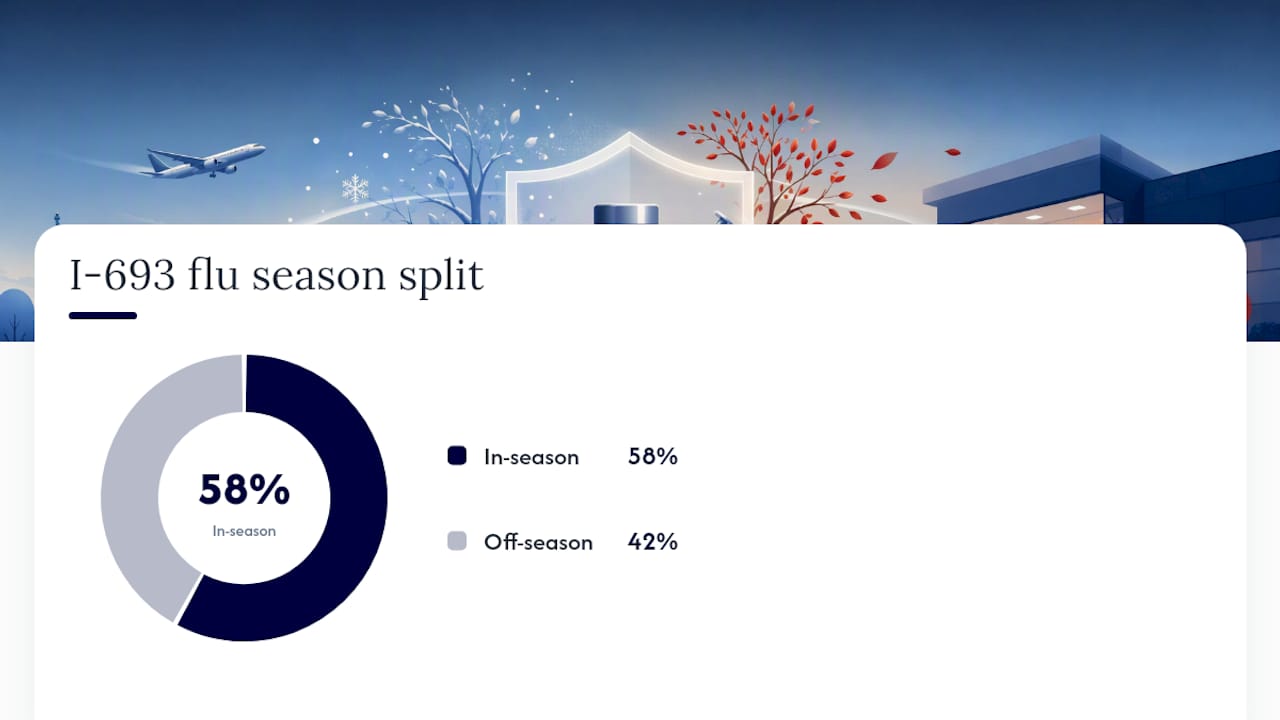
USCIS defines the flu season for I-693 purposes as September 1 through March 31. If your civil surgeon exam date falls inside that window, the influenza vaccine requirement applies. If your exam happens in April, May, June, July, or August, it doesn’t, because you’re outside the designated season entirely.
The date that matters is the exam date, not your filing date, not your interview date, and not the date you happened to schedule a follow-up. A civil surgeon determines your vaccination requirements based on the day they physically examine you and sign off on your I-693.
The age rule is simple: applicants 6 months of age or older fall under the influenza requirement. There’s no upper age cutoff. A senior applicant in their 80s and an infant just past their half-birthday are both subject to the same seasonal rule, though civil surgeons weigh medical appropriateness differently depending on age and health history.
A few edge cases deserve attention:
- Exams right at the season boundary. If your exam lands on September 1 or March 31, you’re inside the window. A day earlier or later can change your obligation entirely, which is one more reason to confirm your exact appointment date with your civil surgeon’s office.
- Vaccine supply lag at season start. New seasonal formulations don’t always arrive at every clinic on September 1. If the current-season vaccine isn’t in stock yet, the civil surgeon documents that as unavailable rather than skipping the box silently.
- Leftover stock near season end. Clinics sometimes still have current-season doses on hand into March, which is fine, since the vaccine remains valid for the entire defined season regardless of when in that window it’s administered.
Quick fact: The I-693 flu season window (September 1 to March 31) covers seven months of the year, meaning most applicants scheduling a fall, winter, or early spring exam will need to address the influenza vaccine one way or another.
What Civil Surgeons Must Document on Form I-693
Part 10 of Form I-693 is where your entire vaccination history lives, and it’s also where influenza gets sorted into one of several outcomes. Civil surgeons generally have four ways to annotate the flu vaccine box:
- Vaccine administered. The civil surgeon gave you the current-season flu shot during your visit and records the date and, often, the manufacturer or lot number.
- Vaccine history transferred. You brought verifiable proof of a current-season flu shot given elsewhere, and the civil surgeon copies that record onto your I-693 instead of re-vaccinating you.
- Not medically appropriate. The civil surgeon checks this box for one of four HHS-recognized reasons: your age, a genuine medical contraindication, an insufficient interval since a prior dose, or because it isn’t currently flu season according to the September 1 to March 31 window.
- Not available. The civil surgeon notes that the vaccine simply isn’t obtainable at their location at the time of your exam, which CDC guidance explicitly permits as a valid annotation.
Determining which box applies comes down to the civil surgeon’s professional judgment. They’re the ones who know whether their clinic has current-season stock, whether your medical history rules out vaccination, and whether the interval since a previous dose is long enough to justify skipping a repeat shot. This decision isn’t something an applicant can override or negotiate around. It’s a clinical call, and USCIS treats it that way.
What happens if a flu annotation is missing entirely? USCIS generally won’t issue a Request for Evidence over it unless the exam is still within the same flu season and getting the vaccine within the RFE response window is genuinely feasible. If your exam happened in February and USCIS reviews your case in June, they’re not going to send you chasing a vaccine that’s already out of season.
Pro Tip: Ask your civil surgeon’s office, before you book, whether they currently stock the seasonal flu vaccine. Clinics that see high volumes of I-693 applicants tend to keep better records on hand and fewer supply gaps than general urgent care offices juggling dozens of unrelated services.
Proving You Already Got the Flu Shot
If you got your flu shot before your I-693 appointment, the goal is simple: hand the civil surgeon something they can verify without hesitation. Acceptable documentation typically includes:
- An official vaccination record from a doctor’s office, health department, or clinic, showing the vaccine name, date, and administering provider
- A pharmacy printout or receipt that lists the brand, lot number, and administration date, since most chain pharmacies keep digital records you can request on the spot
- A certified translation of any vaccine record originally issued in a language other than English
- Titer test results in specific cases where blood testing can substitute for direct vaccine documentation, though this applies far more often to vaccines like MMR or varicella than to influenza
If you’re bringing outside records, bring the originals, not photos on your phone that a civil surgeon has to squint at. If a record was issued abroad, get it translated by a certified translator before your appointment rather than trying to explain it verbally during the exam. If you got your shot at a pharmacy weeks earlier, call ahead and request a printed immunization record instead of relying on memory of the date.
One timing detail matters more than people expect: a flu shot from last season doesn’t satisfy this season’s requirement. If you got vaccinated in November 2025 and your I-693 exam happens in October 2026, that earlier dose is outside the current flu season and won’t count. The designated civil surgeons vaccination page reinforces that civil surgeons are the ones responsible for confirming which season’s dose applies. If you’re unsure whether your prior shot still counts, our guide on I-693 vaccination supplements walks through how a single additional dose often resolves an otherwise incomplete record.
Getting Excused from the Flu Vaccine Requirement
Not every applicant ends up with a flu shot on their I-693, and that’s by design. USCIS built specific off-ramps into the process for people who genuinely shouldn’t or can’t receive the vaccine. The civil surgeon can mark influenza as “not medically appropriate” under any of these HHS-recognized reasons:
- Age-based exemption. Applicants under 6 months old are excluded outright, since the vaccine isn’t approved for that age group.
- True medical contraindication. A documented allergy, immune condition, or other medical reason means vaccination would pose a real health risk.
- Insufficient time interval. If you received a dose too recently to medically justify another one this season, the civil surgeon notes that instead of doubling up.
- Outside flu season or unavailable. If your exam falls outside the September 1 to March 31 window, or the vaccine simply isn’t stocked at that location, this covers it.
Religious or moral objections work differently from medical exemptions. USCIS does allow applicants to request a waiver on religious or moral grounds, but this is a separate legal process filed on Form I-690, not something a civil surgeon can simply check off during the exam. It requires a written statement explaining the objection, and USCIS reviews it independently of your medical exam. A denied waiver request can leave you without a path to satisfy the vaccine requirement other than proceeding with vaccination, so this route needs careful thought before you commit to it.
Blanket waivers are different again. These are broader policy decisions USCIS occasionally issues covering specific vaccines, situations, or applicant categories, rather than something you request individually. They apply automatically when in effect. The bottom line: whichever path applies to you, the civil surgeon’s written annotation on Form I-693 is what carries weight with USCIS reviewers. Vague notes or missing checkboxes are what generate RFEs, not the underlying medical reality.
A little preparation before your civil surgeon exam saves you a second appointment later, including using a helpful Checkliste medizinische Unterlagen to organize your documents.
A little preparation before your civil surgeon exam saves you a second appointment later. Here’s the order that actually works:
- Call ahead and ask about vaccine stock. Confirm the clinic currently has the seasonal flu vaccine available, especially if you’re booking early in September or late in March.
- Gather any existing vaccine records. Pull pharmacy printouts, provider records, or immunization registry reports for any flu shot you already received this season.
- Get translations done in advance. If any record is in a language other than English, have it certified and translated before your appointment, not the morning of.
- Time your exam deliberately when possible. If you have flexibility, scheduling after new seasonal vaccine shipments typically arrive in early fall can reduce the chance of a “not available” annotation.
- Bring the whole family’s records to group appointments. For family exams, mismatched or missing vaccine documentation for one child or spouse is one of the most common causes of delay.
- Ask the civil surgeon to annotate clearly if the vaccine isn’t given. Whether it’s contraindication, timing, or unavailability, make sure the box reflects the actual reason.
Pregnant applicants, seniors, and infants often have distinct considerations civil surgeons weigh differently. Titer testing is rarely useful for influenza specifically, since it doesn’t have the same long-term antibody tracking value that vaccines like varicella or hepatitis B do. Save titer requests for those vaccines instead.
Pro Tip: If you’re coordinating a family exam, book everyone with the same civil surgeon on the same day. It keeps vaccine records, annotations, and any waiver paperwork consistent across the whole household instead of scattered across different providers.
How a Specialist I-693 Clinic Handles Flu Vaccine Documentation
Since 2007, Immigrationmedicalexams has focused exclusively on immigration medical exams and Form I-693. We don’t run a primary care practice or handle urgent care visits, which means every civil surgeon on staff spends their working hours on exactly this form, not splitting attention between flu shots for the general public and the specific documentation USCIS expects on I-693.
That specialization shows up in the small details that actually cause delays elsewhere. When a patient arrives with a pharmacy flu shot receipt from three weeks earlier, our team knows immediately whether that record transfers cleanly onto Part 10 or needs a supplemental note. When a family books a group exam, we verify everyone’s vaccine history against the current flu season before the appointment even starts, so nobody sits through an exam only to realize a document is missing.
We frequently see applicants who already went through an exam elsewhere and came away with an incomplete or incorrectly annotated I-693, sometimes because a general practitioner’s office wasn’t familiar with the specific HHS reason codes or the flu season window. Fixing that after the fact costs more time than getting it right the first time.
Our flat-package pricing structure means an applicant doesn’t get hit with surprise charges if a titer test or an extra vaccine turns out to be necessarily partway through the visit. Standard processing runs about 3 days, with a 2-day expedited option for applicants working against a filing deadline.
Why the Flu Vaccine Trips Up More Applicants Than It Should
The influenza vaccine gets treated as an afterthought by a lot of applicants, and that’s the mistake. People spend weeks tracking down decades-old MMR records or chasing a childhood polio certificate from a doctor who retired years ago, then walk into their exam having given zero thought to whether they need a seasonal flu shot that day. It’s the vaccine most likely to catch someone off guard precisely because it resets every single year.
The conventional wisdom treats vaccination requirements as a fixed checklist you can research once and forget. That works fine for hepatitis B or varicella. It doesn’t work for influenza, because the requirement itself moves with the calendar. An applicant who did their homework in July and shows up for an October exam has homework that’s already gone stale on this one specific item.
What we’d push back on is the assumption that getting vaccinated before the exam is always the safer move. It can backfire if you can’t produce a verifiable record, because a civil surgeon who can’t confirm your shot has no choice but to treat you as unvaccinated for this season and give you another dose. The smarter approach, in most cases, is letting the civil surgeon make that determination during the visit itself, armed with whatever documentation you already have. That’s what the process is built for, and fighting it by pre-empting the civil surgeon’s judgment usually just adds a redundant shot to your arm.
— ImmigrationMedicalExams Medical Team
Book Your I-693 Exam With Flu Vaccine Timing Handled Right
Immigrationmedicalexams is the alternative to piecing your medical exam together across multiple providers. Instead of chasing down a primary care doctor for vaccine records, a separate lab for testing, and a general clinic that may not know the current flu season window, one visit here covers the civil surgeon exam, on-site vaccination, titer testing when needed, and a properly sealed Form I-693.

We’ve specialized exclusively in immigration medical exams since 2007, which means our civil surgeons already know how to annotate Part 10 correctly for influenza, whether that means administering the current-season shot, transferring verified outside records, or documenting a legitimate contraindication or availability issue. Family and group exams, pediatric and senior appointments, and cases referred by attorneys all move through the same accuracy-focused process. Our flat-package pricing avoids the surprise add-on charges that catch people off guard elsewhere, and you can choose standard 3-day processing or the 2-day expedited option if a filing deadline is close.
If you’ve already run into a delay, an RFE, or an incomplete vaccination record from an exam performed elsewhere, we resolve that regularly. Schedule your immigration medical exam online, any time, day or night, and get your flu vaccine documentation handled correctly the first time.
Where This Article’s Information Comes From
- USCIS Policy Manual, Volume 8, Part B, Chapter 9: the controlling source for flu season dates, age rules, and the “not medically appropriate” reason codes.
- CDC Technical Instructions for Civil Surgeons, Vaccination: defines how civil surgeons should document vaccine availability and history.
- Form I-693, Report of Immigration Medical Examination and Vaccination Record (PDF): the actual form and instructions showing Part 10 annotation options.
- I-693 overview page: explains sealed-envelope handling and submission timing alongside Form I-485.
This article is general information, not a substitute for advice from a qualified doctor. Consult a qualified healthcare professional about your own circumstances before acting on anything here.
Sources
- Chapter 9 - Vaccination Requirement | USCIS
- Vaccination | Technical Instructions for Civil Surgeons | CDC
- Form I-693, Report of Immigration Medical Examination and Vaccination Record | USCIS
- I-693, Report of Immigration Medical Examination and Vaccination Record | USCIS
FAQ
Which vaccines are required for immigration in the USA?
Required vaccines generally include MMR, polio, Tdap, varicella, hepatitis A and B, and seasonal influenza, among others, based on age and vaccination history. Civil surgeons check each against your existing records using CDC Technical Instructions before deciding what’s still needed.
What vaccines are needed for U.S. residency?
The same list applies to green card and adjustment of status applicants: MMR, polio, Tdap, varicella, hepatitis A and B, and influenza during flu season, plus a few age-specific vaccines like Hib and rotavirus for young children. Your civil surgeon reviews your existing records first and only administers what’s missing or expired.
What are the vaccine requirements for USCIS civil surgeon applications?
Civil surgeons follow USCIS Policy Manual Chapter 9 and CDC technical instructions to determine which vaccines each applicant needs based on age, medical history, and, for influenza specifically, the September 1 through March 31 flu season. They document every decision directly on Form I-693, Part 10.
Can I get a vaccination exemption from USCIS?
Yes, through two separate paths: a civil surgeon can mark a vaccine “not medically appropriate” for documented medical or timing reasons, or you can file a religious or moral objection using Form I-690, which USCIS reviews independently of your medical exam. A denied religious waiver generally means you’ll need to proceed with vaccination to complete your case.
Does a flu shot from last year count for this year’s I-693?
No. Influenza vaccines are strain-specific and tied to the current flu season, so a prior-season dose doesn’t satisfy this year’s requirement even if you’re otherwise up to date. Your civil surgeon needs proof of a shot administered within the current September 1 to March 31 window that applies to your exam date.
How much does an I-693 exam with flu vaccine included cost?
Pricing depends on your specific package and whether you need standard or expedited processing, along with any additional vaccinations or titer testing. Current pricing details are available on the Immigrationmedicalexams pricing page.