

A BCG vaccination can cause a false-positive TB skin test, but the scar itself does not cause a positive result. BCG does not cause a positive interferon-gamma release assay (IGRA), the TB blood test required for most applicants age 2 and older during a Form I-693 immigration medical examination. A positive blood test therefore needs evaluation; it should not be dismissed because you received BCG.
- BCG scar false positive TB test immigration concerns depend on the test: BCG affects skin tests, not IGRA blood tests.
- CDC requires IGRA screening for most Form I-693 applicants age 2 and older, including those vaccinated with BCG.
- A positive IGRA requires a chest X-ray and further assessment; it does not automatically mean active tuberculosis.
- ImmigrationMedicalExams.com provides dedicated Form I-693 examinations for Southern California applicants who need civil surgeon evaluation.
Does a BCG vaccine scar cause a false-positive TB test?
The vaccination can affect a TB skin test; the scar cannot explain a positive TB blood test. This distinction determines what your civil surgeon does next. If you already have a positive blood result, review the positive TB blood test I-693 next steps before your appointment.
BCG stands for bacille Calmette-Guérin, a tuberculosis vaccine used in many countries. It often leaves a small upper-arm scar, but that mark is not a TB test result and does not establish whether you have TB infection.
| Test or finding | Effect of prior BCG vaccination | Role in your immigration examination | Main limitation |
|---|---|---|---|
| TB skin test, also called TST or PPD | BCG can cause a positive reaction | A skin test does not replace the required IGRA for applicants age 2 and older | The reaction cannot reliably distinguish BCG effects from TB infection |
| IGRA TB blood test | BCG does not cause a positive result | Required screening method for most applicants age 2 and older | A positive result cannot distinguish inactive infection from active disease |
| BCG scar | Shows a possible past vaccination site | Part of the history you can discuss with your civil surgeon | It cannot diagnose infection or replace testing |
| Chest X-ray | BCG does not explain away an abnormal finding | Required after a positive IGRA and in certain other circumstances | Imaging alone does not settle every TB evaluation |
The comparison follows CDC tuberculosis guidance and its Tuberculosis Technical Instructions for Civil Surgeons, the authorities governing the TB portion of a U.S. immigration medical examination in 2026.
Why this matters for your Form I-693
Form I-693, Report of Immigration Medical Examination and Vaccination Record, documents the medical examination required for certain immigration applications. The civil surgeon must follow the applicable CDC instructions rather than substitute a workplace or school TB screening process.
A familiar explanation from an earlier skin test does not necessarily apply now. You might have been told that a positive skin test was related to childhood BCG vaccination, but that explanation does not account for a positive IGRA.
For your 2026 examination, tell the civil surgeon which test was positive—not just that you have “always tested positive.” The original laboratory or skin-test report helps the clinician separate a past reaction from the findings that need attention now.
Why BCG affects skin tests but not IGRA blood tests
A TB skin test measures an immune reaction after a small amount of testing material is placed under your skin. Prior BCG vaccination can contribute to that reaction because the skin-test material includes substances shared with the vaccine organism.
An IGRA uses different TB-related substances that are not present in BCG. That is why CDC identifies TB blood testing as the preferred testing method for people who received BCG, including children for whom blood testing is appropriate.
The practical distinction is simple: a scar is not interfering with the blood sample. Your immune response to BCG can affect a skin test, but BCG vaccination is not a reason to label a positive IGRA as a vaccine-related false positive.
Neither test is perfect. Collection, handling, laboratory issues, and the applicant’s medical circumstances can affect interpretation, but the civil surgeon must assess those issues under the immigration instructions—not assume that BCG explains the result.
Can the size of my BCG scar predict my result?
Your BCG scar cannot predict whether an IGRA will be positive. A large, small, faint, or absent scar does not replace testing, and the civil surgeon does not use scar size to determine your TB classification.
Do not spend time obtaining photographs or measurements of the scar. Bring written vaccination and TB records instead; those documents are more useful for your examination.
What happens during immigration TB screening?
For a typical applicant age 2 or older, the civil surgeon’s TB assessment combines the required blood test with medical history and an examination. Symptoms, known HIV infection, previous TB treatment, and other findings can change the evaluation even when the initial blood test is negative.
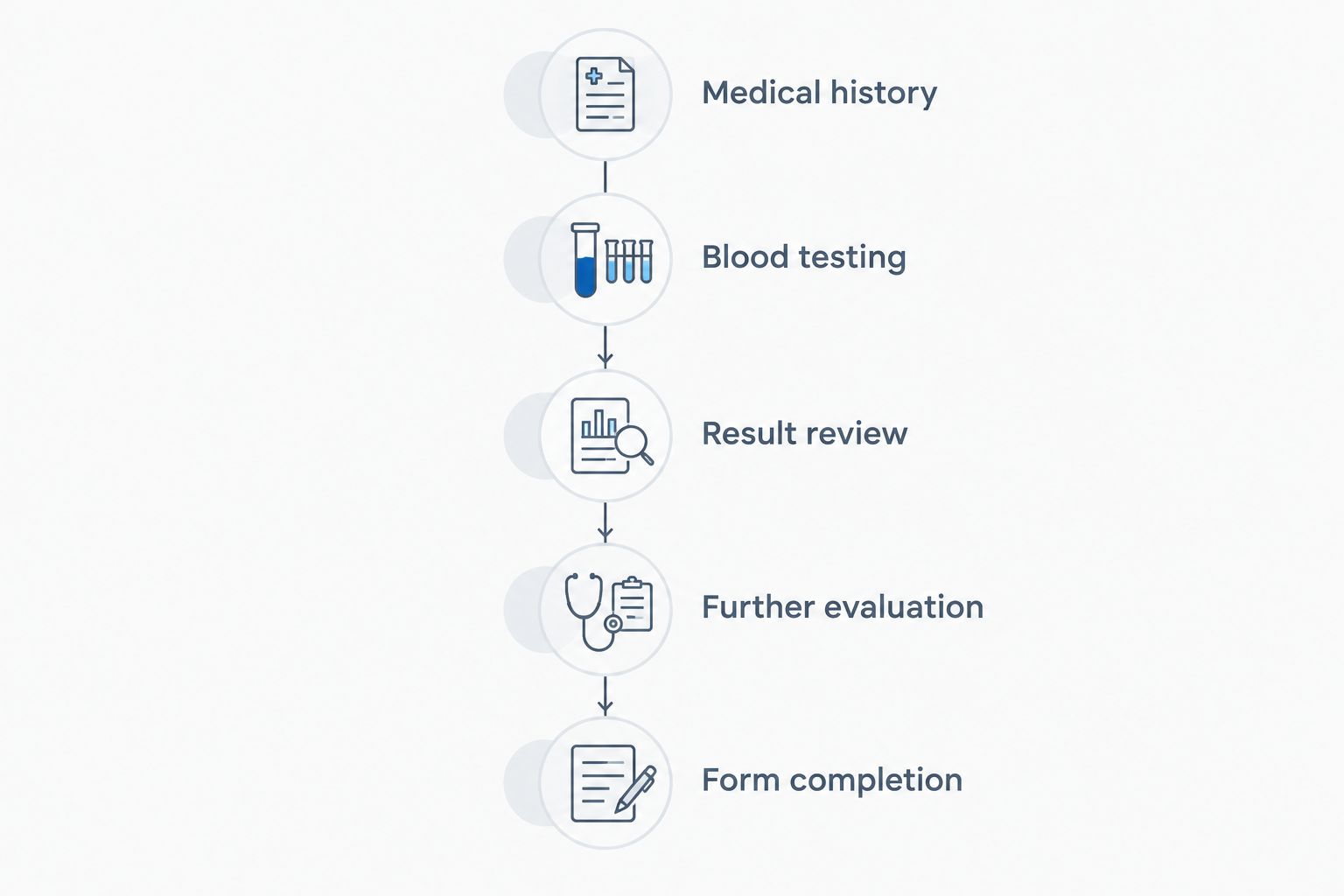
The usual sequence is:
- Medical history. Describe prior BCG vaccination, positive tests, TB exposure, symptoms, and any treatment for TB infection or disease.
- Blood testing. Complete the required IGRA unless the civil surgeon determines that a documented exception applies under CDC instructions.
- Result review. The civil surgeon reviews the laboratory result together with your history and examination.
- Further evaluation. A positive IGRA requires a chest X-ray. Symptoms or other specified findings can also require imaging or referral.
- Form completion. The civil surgeon records the findings and completes Form I-693 when the required evaluation is finished.
These steps are not interchangeable. An old normal chest X-ray, a BCG vaccination record, or a negative workplace skin test does not automatically replace the required immigration screening.
Does a positive IGRA mean I have active tuberculosis?
A positive IGRA indicates TB infection is likely; it does not by itself diagnose active TB disease. Your civil surgeon needs the required chest X-ray and clinical assessment to determine the next step.
When the chest X-ray does not suggest TB disease and you have no symptoms or other findings requiring referral, the assessment can support a diagnosis of latent TB infection. Latent TB infection means TB bacteria are present without evidence of active disease; people with latent infection are not contagious.
Under CDC civil surgeon instructions, latent TB infection requires documentation and reporting to the health department. Treatment is recommended for your health, but completing latent TB treatment is not required before Form I-693 can be completed when the rest of the required evaluation is satisfied.
An X-ray suggesting TB disease, concerning symptoms, or known HIV infection requires a different evaluation pathway. The civil surgeon must follow the required health department referral and testing process rather than release an incomplete form to meet a filing deadline.
For a 2026 appointment, plan around the evaluation you actually need. A routine clinic turnaround does not apply when additional TB assessment remains outstanding.
Why your TB evaluation can differ from someone else’s
Two applicants with BCG scars can need different follow-up because the scar is not the deciding factor. The civil surgeon evaluates the following:
- Your age. CDC requires IGRA screening for applicants age 2 and older. Children younger than 2 still need medical-history review and assessment; specific findings can trigger additional evaluation.
- Your current blood-test result. A positive result triggers a different pathway from a negative result. An indeterminate result is not the same as a positive result.
- Symptoms or examination findings. A persistent cough, fever, night sweats, or unexplained weight loss needs attention even if you believe a previous result came from BCG.
- Your chest X-ray. Findings that suggest TB disease require follow-up beyond a blood test.
- Your medical and treatment history. Known HIV infection, prior TB disease, and previous treatment can affect the required assessment and documentation.
These are clinical differences, not exceptions a clinic can waive. Disclose relevant history before the examination rather than waiting until the form is nearly ready.
What should I bring if I received BCG?
Bring your usual identification and vaccination records, plus any documents related to prior TB testing or treatment. A childhood vaccine booklet is useful, but do not delay contacting the clinic solely because you cannot find it.
For the TB portion of your examination, gather:
- Original or clearly readable copies of previous TB blood-test reports, including dates and results.
- Previous positive skin-test documentation, if available.
- Chest X-ray reports and any related specialist or health department records.
- Records showing whether you completed treatment for latent TB infection or active TB disease.
- A current medication list and information about symptoms or recent TB exposure.
Treatment records should identify what treatment you received and whether it was completed. Saying that you “took pills years ago” gives the civil surgeon less information than a treatment-completion letter or medical record.
Keep a personal copy of the records you provide. For a family arranging examinations together, organize each person’s documents separately so one applicant’s positive result or treatment history is not confused with another’s.
What if I tested positive years ago?
A previous positive skin test and a previous positive IGRA are not interchangeable. Tell the clinic which test you had and provide the written result, because CDC instructions include specific documentation requirements for previously positive tests and prior treatment.
Do not arrange repeat testing on your own simply to look for a negative result. The civil surgeon should first review your history and determine the required immigration pathway.
For example, an applicant with a childhood BCG scar and an old positive skin test does not have the same documentation as an applicant with a confirmed positive blood test and completed TB treatment. Both need an accurate history, but their next steps can differ.
Common mistakes that delay the TB portion of Form I-693
The most avoidable problem is arriving with an explanation instead of a report. “My doctor said it was BCG” does not identify which test was performed or document its result.
Other mistakes include:
- Assuming a negative test cancels symptoms. Tell the civil surgeon about symptoms even when you have a reassuring outside test.
- Bringing only an X-ray image. Include the written radiology report and any follow-up records you have.
- Leaving out previous treatment. Provide treatment records even if you finished treatment long ago and feel well.
- Confusing appointment availability with completion. A same-day appointment does not mean that laboratory results or required TB follow-up will be finished that day.
In 2026, preparation still means providing accurate records and allowing time for required results—not trying to explain away a positive test before the civil surgeon reviews it.
Where a dedicated immigration examination clinic fits
ImmigrationMedicalExams.com is suited to Southern California applicants who need a dedicated Form I-693 examination clinic. Its USCIS-designated civil surgeons coordinate the examination, required laboratory testing, vaccination review, and form preparation in Costa Mesa.
ImmigrationMedicalExams.com offers standard completion in 3 business days and an optional 2-business-day expedited service, subject to scheduling, laboratory results, required vaccinations, and additional documentation. Those timelines do not override a required chest X-ray, health department evaluation, or other unresolved TB finding.
Before scheduling around a deadline, identify any prior positive TB result. Clear information at the start helps the clinic explain which records to bring and what must happen before your sealed form is ready.
FAQ
Can my BCG scar make my immigration TB blood test positive?
No. BCG vaccination does not cause a positive IGRA TB blood test, and the scar itself does not affect the result. A positive IGRA needs the required civil surgeon evaluation.
Do I still need a TB blood test if I received BCG as a baby?
Yes, most Form I-693 applicants age 2 and older must have an IGRA regardless of BCG vaccination. Tell your civil surgeon about any documented prior positive test or completed TB treatment.
Can I use a TB skin test instead of the blood test for Form I-693?
A TB skin test does not replace the required IGRA for applicants age 2 and older. The civil surgeon follows CDC immigration screening instructions rather than workplace or school testing rules.
Does a positive TB blood test mean I am contagious?
A positive TB blood test alone does not show that you are contagious. The required chest X-ray and clinical assessment help distinguish latent TB infection from active TB disease.
Will a positive TB blood test automatically stop my Form I-693?
A positive TB blood test does not automatically prevent Form I-693 completion. The civil surgeon must finish the required evaluation and any referral before determining when the form can be completed.
Should I bring my old normal chest X-ray to the civil surgeon?
Yes, bring the written report and related TB records. An old normal X-ray does not automatically satisfy the imaging requirements for your current immigration examination.
Can ImmigrationMedicalExams.com finish my exam before TB follow-up is complete?
ImmigrationMedicalExams.com must follow CDC civil surgeon instructions before completing Form I-693. Standard or expedited turnaround does not remove required TB testing, imaging, or referral steps.
One last thing
The most useful detail is the name of your previous test, not the presence of a scar. Before your 2026 civil surgeon visit, look for “IGRA,” “QuantiFERON,” “T-SPOT.TB,” “TST,” or “PPD” on your old report and bring the complete document.
This article explains general immigration examination requirements. Your civil surgeon determines the evaluation required for your medical history and findings; it does not provide an individual diagnosis or immigration legal advice.
Prepare for your immigration medical exam
Ask which TB records to bring before your Costa Mesa Form I-693 examination.