

Chest X-Ray for Immigration: What U.S. Applicants Need to Know
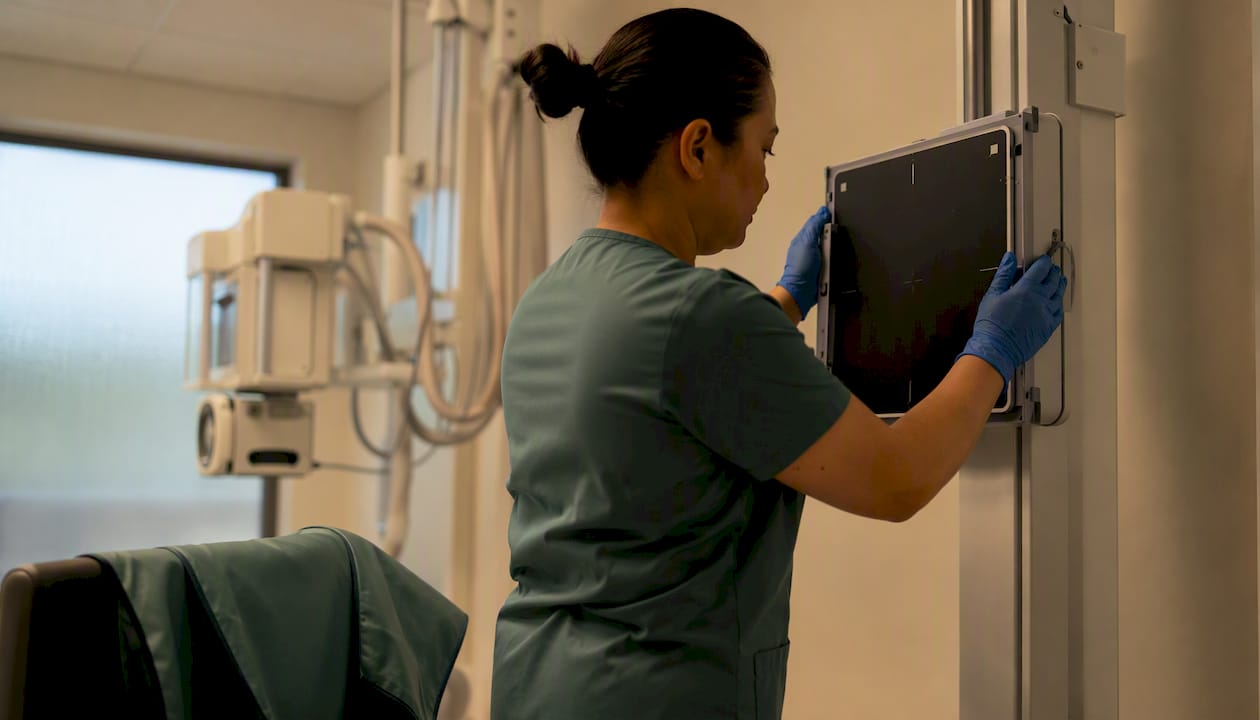
Most U.S. immigration applicants will need a chest X-ray as part of their medical exam, but the trigger is specific: a positive tuberculosis skin test (TST) or blood test (IGRA), TB symptoms, known HIV, or a prior abnormal chest film. If any of those apply to you, two things must happen immediately. First, confirm you meet one of the clinical triggers listed below. Second, book your appointment with a USCIS-authorized civil surgeon, the only provider whose results USCIS will accept on Form I-693. CDC, USCIS, and the U.S. Department of State all govern this process, and using an unapproved clinic means starting over.
Key Takeaways
A chest X-ray for immigration is required when a TB test is positive, symptoms are present, or other clinical triggers apply, and only a USCIS-authorized civil surgeon can certify the results on Form I-693.
| Point | Details |
|---|---|
| Who needs an X-ray | Applicants with a positive IGRA/TST, TB symptoms, HIV, or prior abnormal film require a chest X-ray. |
| Approved providers only | Only USCIS-designated civil surgeons can certify immigration X-rays; unapproved clinics invalidate results. |
| Bring prior films | CDC requires radiologists to compare current images with prior films; missing films can trigger unnecessary follow-up. |
| Timeline to sealed I-693 | Results must be available within 3 business days; sputum testing for abnormal films adds weeks. |
| Immigrationmedicalexams | Offers USCIS-approved civil surgeon exams in Southern California with a guaranteed 2–3 business day I-693 turnaround. |
This article is general information, not a substitute for advice from a qualified doctor. Consult a qualified healthcare professional about your own circumstances before acting on anything here.
Table of Contents
- What an immigration chest X-ray actually screens for
- Who needs a chest X-ray for immigration
- Who is authorized to perform your immigration X-ray
- What to expect before, during, and after the X-ray
- How abnormal X-ray results affect your immigration case
- What to bring and how the X-ray is recorded for USCIS
- Typical turnaround times and what the X-ray costs
- Pregnancy rules and radiation safety
- How to pick the right clinic for your immigration X-ray
- How Immigrationmedicalexams handles chest X-ray requirements
- What to do next: your chest X-ray checklist
- What most guides get wrong about the immigration chest X-ray
- Immigrationmedicalexams: civil surgeon exams with a 3-day turnaround
- Sources
What an immigration chest X-ray actually screens for
The chest X-ray used in the U.S. immigration medical exam is a tuberculosis screening tool, not a general health check. Its primary job is to detect signs of active pulmonary TB, the form of the disease that spreads person to person. That distinction matters because a positive IGRA or TST alone does not confirm active disease. The X-ray is the next step that tells the civil surgeon whether the infection appears active or latent.
The required view is a posteroanterior (PA/AP) projection. Lateral views are added for children under 10 when the PA film is abnormal. If the film shows anything suspicious, such as cavitation, infiltrates, or nodules consistent with TB, the civil surgeon cannot close the case. The applicant is referred to the local health department for sputum smear and culture testing before any immigration determination is made.
This is where many applicants misread the process. An abnormal X-ray is not a denial. It is a referral. The CMS guidance on medical necessity reinforces why documentation matters here: immigration-specific panels are clinically indicated by definition, which is why the exam must be performed by a civil surgeon operating under CDC technical instructions, not a general radiology clinic.
Key conditions the civil surgeon considers when reviewing the film:
- Active pulmonary tuberculosis (primary screening target)
- Prior TB treatment evidence (scarring, calcified nodules)
- Other pulmonary abnormalities that may require additional evaluation
- Comparison with any prior chest films the applicant provides
Who needs a chest X-ray for immigration
Not every applicant gets an X-ray. The triggers are defined by CDC technical instructions for civil surgeons. You need one if any of the following apply:
- Positive IGRA (QuantiFERON-TB Gold or T-SPOT) or TST result
- Signs or symptoms of active TB (persistent cough, night sweats, unexplained weight loss, hemoptysis)
- Known HIV-positive status
- Prior history of TB disease or abnormal chest film
- Age 15 and older in some visa categories where X-ray is required by default under specific technical instructions
- Prior chest X-ray that was abnormal, even if treated
Children under 15 are generally exempt from chest X-rays unless they have a positive TB test or clinical symptoms. For children under 10 with an abnormal PA film, a lateral view is also required.
Pro Tip: Bring your actual prior chest X-ray films, not just the written report. CDC instructions require radiologists to compare current images against prior films when available. Showing up with only a summary letter means the radiologist is working blind, which can trigger unnecessary follow-up testing and delay your I-693.
For a deeper look at how IGRA testing interacts with the X-ray requirement, the QuantiFERON TB Gold guide at Immigrationmedicalexams walks through the sequencing clearly.
Who is authorized to perform your immigration X-ray
Only a USCIS-designated civil surgeon can perform and certify the immigration medical exam, including the chest X-ray component, for adjustment-of-status applicants inside the U.S. Using a general radiologist or urgent care clinic, even a reputable one, produces results USCIS will not accept. The Department of State’s medical exam FAQ confirms that panel physicians perform required immigration medical examinations, and that incomplete or missing records from unapproved providers cause substantial processing delays or outright rejection of the medical package.
Here is how to find and verify a civil surgeon before booking:
- Go to the USCIS civil surgeon locator and search by ZIP code or city.
- Call the clinic and confirm the physician is currently designated as a civil surgeon (designations can lapse).
- Ask whether the clinic handles Form I-693 in-house, including the sealed envelope, or whether they refer you elsewhere for paperwork.
- Confirm the clinic can produce a labeled PA/AP view and a lateral view when required for younger applicants.
- Ask about turnaround time for the radiologist’s interpretation and when the sealed I-693 will be ready.
- Verify the clinic compares current films with prior X-rays if you bring them.
A clinic that hedges on any of these questions is a red flag. Immigration-specific radiology is a narrow workflow, and experienced civil surgeon offices know the answers immediately.
What to expect before, during, and after the X-ray
Before your appointment
- Gather your government-issued photo ID or passport.
- Collect any prior chest X-ray films (actual images on film or CD, not just reports).
- Bring your vaccination records and a current medication list.
- Disclose pregnancy at the time of booking, not at the appointment. This allows the clinic to prepare lead shielding in advance.
- Confirm your payment method. Most civil surgeon offices do not bill insurance for immigration exams.
During the exam
You will be asked to undress from the waist up and remove all jewelry, necklaces, and underwire bras. The technician positions you against the X-ray plate, arms slightly out, and asks you to take a deep breath and hold it for two to three seconds while the image is captured. The actual exposure takes less than a second. The entire process from undressing to redressing typically takes only a short time.
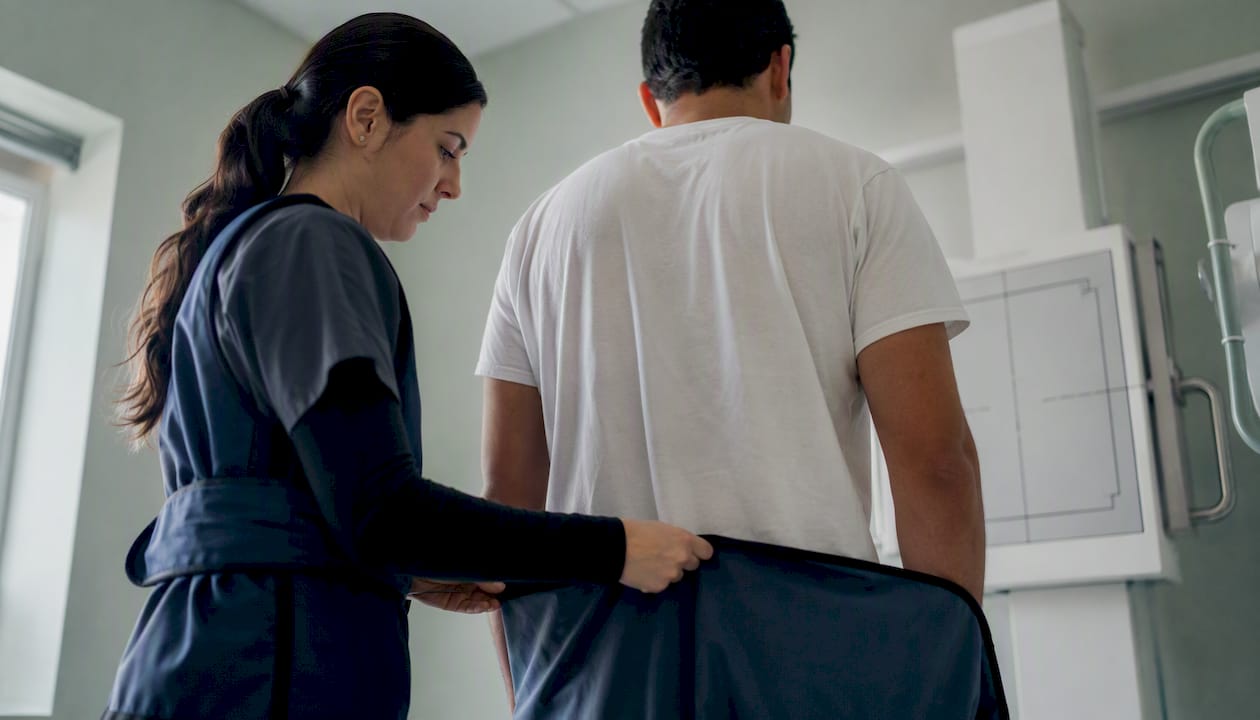
Pro Tip: If the technician flags the image as suboptimal due to poor inspiration or motion artifact, the film must be retaken. A retake on the same visit is routine and does not delay your case. A retake discovered after you leave can cost you an extra appointment and push your I-693 timeline back by days.
After the exam
The radiologist interprets the film, and the civil surgeon reviews that interpretation in the context of your full medical history. Per CDC technical instructions, results should be available the same day and must be available no later than 3 business days from the time the X-ray was taken.
How abnormal X-ray results affect your immigration case
An abnormal finding does not automatically derail your application, but it does add steps. Here is the typical sequence:
- The radiologist notes findings consistent with possible active TB or another pulmonary condition.
- The civil surgeon reviews the radiologist’s report alongside your clinical history and any prior films.
- If active TB cannot be ruled out, the civil surgeon refers you to the local or county health department.
- The health department orders sputum smear microscopy, culture, and often an IGRA if not already done.
- Results from sputum testing determine whether you receive a Class B1 (TB, no disease) or Class B2 (TB, disease) classification on your I-693, or whether the case is cleared entirely.
- Applicants with a Class B classification may still be approved for a visa but are flagged for follow-up medical monitoring after arrival.
For more detail on what happens when lab results come back outside normal ranges, the abnormal lab results guide at Immigrationmedicalexams covers the referral and follow-up workflow step by step.
Documents to have ready if your film is flagged: prior treatment certificates, names and dates of any TB medications taken, prior chest X-ray films, and contact information for any physician who previously treated you for TB or a pulmonary condition.
What to bring and how the X-ray is recorded for USCIS
The chest X-ray result does not travel separately. It becomes part of the sealed Form I-693 package that your civil surgeon prepares and that you hand to USCIS, either at your adjustment-of-status interview or by mailing it with your application. The I-693 documentation guide at Immigrationmedicalexams explains exactly how findings are recorded and how the sealed envelope must be handled.
Bring to your appointment:
- Passport or government-issued photo ID
- Prior chest X-ray films (actual images, not just written reports)
- Vaccination records
- Any prior TB treatment documentation
- Payment (cash, card, or check depending on the clinic)
- Photos if required by the specific civil surgeon’s intake process
Never open the sealed I-693 envelope after the civil surgeon hands it to you. A broken seal renders the form invalid. Keep a personal copy of your X-ray report and any referral letters for your own records before the envelope is sealed.
Typical turnaround times and what the X-ray costs
Civil surgeon exam fees vary by clinic and region. The X-ray component is often bundled into an all-inclusive immigration exam fee rather than billed as a standalone radiology charge. Ask for an itemized estimate before booking so there are no surprises at checkout.
Pregnancy rules and radiation safety
Pregnant applicants are not automatically exempt from the chest X-ray requirement. Under certain CDC and State Department technical instructions, pregnant women who meet the clinical triggers for TB screening must still have a chest X-ray. When the X-ray is performed during pregnancy, the clinic is required to provide double-layer, wrap-around lead shielding for abdominal and pelvic protection.
The radiation dose from a single chest X-ray is very low, lower than typical environmental background exposure over the same period, according to Mayo Clinic guidance. Modern digital equipment reduces dose further. The clinical benefit of detecting active TB in a pregnant applicant outweighs the minimal radiation risk.
Disclose your pregnancy when you book, not when you arrive. This gives the clinic time to prepare the correct shielding and confirm the civil surgeon’s protocol. For a full breakdown of how pregnancy affects every component of the immigration medical exam, including which vaccines can be deferred, the pregnancy and immigration medical exam guide at Immigrationmedicalexams covers the specifics.
How to pick the right clinic for your immigration X-ray
The civil surgeon locator gets you a list. Choosing well from that list requires a few targeted questions.
Before booking, ask:
- Is the physician currently designated as a USCIS civil surgeon (not just a general practitioner who once was)?
- Does the clinic handle Form I-693 in-house, including the sealed envelope?
- Can the clinic produce labeled PA/AP views and lateral views for applicants under 10?
- What is the turnaround time from X-ray to sealed I-693?
- Does the radiologist compare current films with prior images when provided?
- Does the clinic offer same-day or weekend appointments?
- Is there multilingual support if English is not your primary language?
Red flags to watch for: a clinic that cannot explain the difference between a PA and AP view, vague answers about I-693 submission, or a radiologist who will not review prior films. These are signs the clinic handles immigration exams infrequently, which increases the chance of a technical error that forces a retake or delays your case.
For applicants coordinating the medical exam with a citizenship interview or consulate appointment, understanding what happens at a citizenship consulate interview can help you sequence the sealed medical packet correctly.
How Immigrationmedicalexams handles chest X-ray requirements
Immigrationmedicalexams operates exclusively as a USCIS-approved civil surgeon practice in Southern California, with clinics in Orange County and Los Angeles. The workflow is built around one goal: no rework, no delays.
The clinic’s process for chest X-ray cases:
- Pre-screening at booking to identify TB test history, symptoms, and prior films
- Same-day or weekend appointment scheduling with a designated civil surgeon
- On-site X-ray with labeled PA/AP views and lateral views when required
- Radiologist interpretation with mandatory comparison against prior films when provided
- Civil surgeon review integrated into the same appointment workflow
- Sealed Form I-693 preparation with a guaranteed 2–3 business day turnaround
The clinic provides multilingual support, on-site lab testing for TB and other required screenings, and a patient checklist sent before the appointment so applicants arrive with everything they need. For applicants who want to understand the full step-by-step process before booking, the immigration medical exam process guide walks through every stage from pre-screening to sealed form delivery.
The 2–3 business day processing guarantee is the practical difference between a specialist clinic and a general practice that handles immigration exams occasionally. When a film is flagged as abnormal, the civil surgeon at Immigrationmedicalexams coordinates the referral to the appropriate health department directly, so applicants are not navigating that step alone.
What to do next: your chest X-ray checklist
- Self-assess your triggers: positive TB test, TB symptoms, HIV status, prior abnormal film, or age-based requirement.
- Use the USCIS civil surgeon locator to find an authorized provider near you.
- Gather prior chest X-ray films (actual images) and vaccination records before your appointment.
- Disclose pregnancy at booking so the clinic prepares lead shielding.
- Budget for the civil surgeon fee, which typically includes the X-ray, and ask for an itemized estimate.
- Plan for a 3-business-day minimum from X-ray to sealed I-693, and longer if sputum testing is required.
The most common delay point is not the X-ray itself. It is the applicant arriving without prior films, forcing the radiologist to interpret without a baseline, or the applicant booking with a clinic that is not current on civil surgeon designation.
What most guides get wrong about the immigration chest X-ray
The standard advice online is to “find a civil surgeon and get your X-ray.” That is not wrong, but it skips the part that actually causes delays.
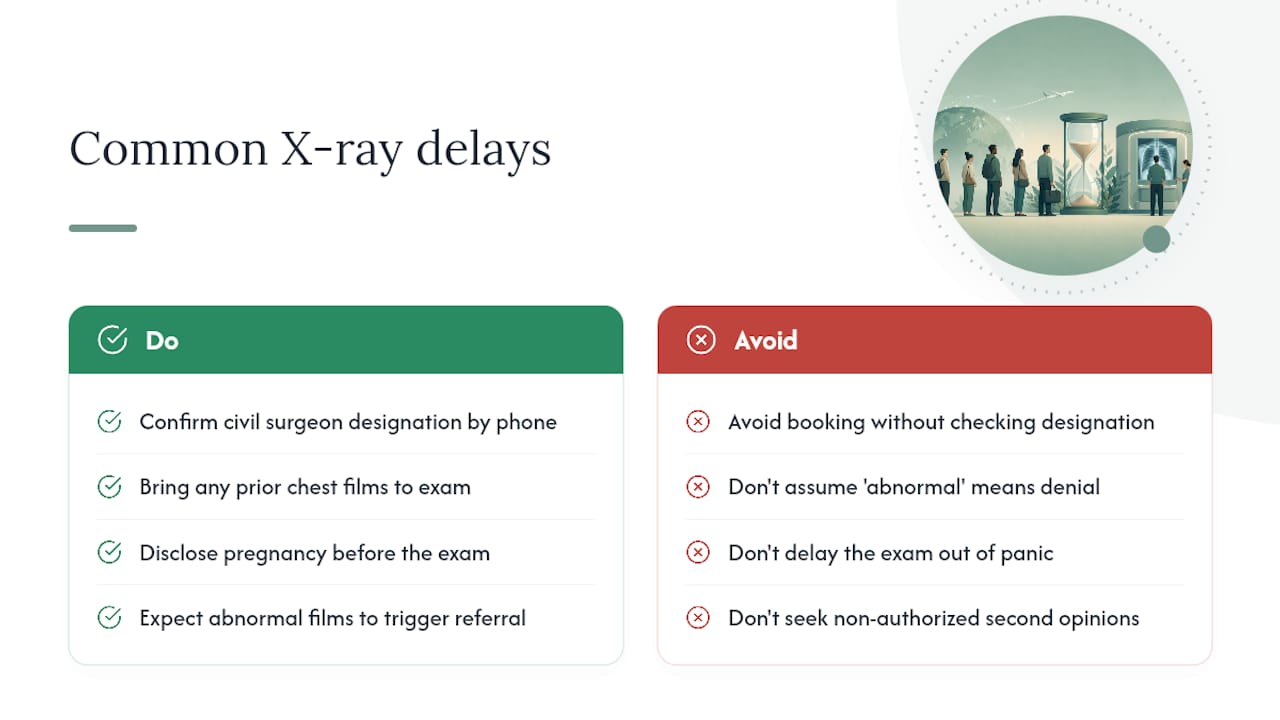
The chest X-ray is not the bottleneck. The bottleneck is everything around it: showing up without prior films, booking with a clinic that has let its civil surgeon designation lapse, or not disclosing pregnancy until you are standing in the exam room. These are not edge cases. They are the most common reasons applicants end up rescheduling or waiting weeks longer than necessary.
There is also a widespread misreading of what an abnormal film means. Applicants see “abnormal” and assume denial. The reality is that an abnormal finding triggers a referral, not a rejection. The health department follow-up exists precisely because the X-ray is a screening tool, not a diagnostic one. A film that looks suspicious can resolve cleanly after sputum testing. Applicants who understand this are far less likely to panic and make poor decisions, like delaying the exam or seeking a second opinion from a non-authorized provider, which only adds time.
The one thing worth prioritizing above everything else: verify that your civil surgeon’s designation is current before you book. Designations lapse. A physician who was authorized two years ago may not be today. That single check, which takes one phone call, is the difference between a smooth process and starting over.
Immigrationmedicalexams: civil surgeon exams with a 3-day turnaround
Getting the chest X-ray right the first time means choosing a clinic that does nothing but immigration medical exams. Immigrationmedicalexams operates USCIS-approved civil surgeon clinics in Orange County and Los Angeles, with same-day and weekend appointments, on-site labs, and a guaranteed 2–3 business day turnaround on sealed Form I-693 paperwork.
Every appointment includes the civil surgeon examination, labeled X-ray views, radiologist interpretation with prior film comparison when you bring them, and complete I-693 documentation. Multilingual staff and a pre-appointment checklist mean applicants arrive prepared. If your film requires a health department referral, the civil surgeon coordinates that step directly.
Applicants with pregnancy-related questions can review the pregnancy and immigration medical exam guide before booking. Ready to schedule? Visit Immigrationmedicalexams to book your civil surgeon appointment and get your sealed I-693 back within 3 business days.
Sources
- Tuberculosis | Technical Instructions for Civil Surgeons | Immigrant and Refugee Health | CDC
- Medical Examinations FAQs
- Chest X-rays - Mayo Clinic
- Find a civil surgeon | USCIS
Recommended
- What to Bring to Your Immigration Medical Exam | ImmigrationMedicalExams.com
- Who Needs an Immigration Medical Exam? | USCIS Form I-693 Requirements
- What Vaccines Are Required for Immigration? | Immigration Medical Exams
- Medical Conditions and the Immigration Medical Exam — Form I-693 Guide | ImmigrationMedicalExams.com