

Yes—family members can complete their own Form I-693 immigration medical examinations without waiting for one absent family member. Each applicant who needs Form I-693, Report of Immigration Medical Examination and Vaccination Record, needs an individual examination and report; one person's completed form does not cover another person. Whether you should submit separate immigration application packages is a different question: follow the current USCIS filing instructions and ask your immigration attorney about your family's filing sequence.
- You can file I-693 without one family member's report only when each submitted application meets USCIS requirements.
- USCIS requires individual medical documentation; an absent relative cannot be examined through another family member.
- Completed examinations need not wait medically for a relative, but application filing decisions require separate review.
- Keep each applicant's sealed Form I-693 matched to that applicant's immigration paperwork.
Can you file I-693 forms for a family without one member?
You can complete medical reports separately; you cannot treat a missing family member's medical requirement as satisfied. For 2026 preparation, use the current USCIS Instructions for Form I-693 and Form I-485 to determine what each applicant must submit.
The practical distinction is between completing the examination and submitting an immigration application. Your civil surgeon handles the medical report. Your immigration attorney can address whether the family's applications should be submitted together or separately.
Before sending completed reports, review how to handle the sealed I-693 packet. An applicant's own correctly prepared report belongs with that applicant's paperwork, according to the applicable submission instructions.
| Family situation | What can happen medically | What needs separate attention |
|---|---|---|
| One relative cannot attend the appointment | Other applicants can attend their own examinations | Arrange a separate examination for the absent applicant |
| One applicant's laboratory results are pending | Other reports can be completed once their requirements are met | The pending report must wait for required results and follow-up |
| One relative is not applying for adjustment of status | Applicants who need examinations can proceed | Confirm whether the other relative needs medical documentation at all |
| One applicant has missing vaccination records | Other applicants' records can be reviewed independently | The civil surgeon must resolve that applicant's vaccination documentation |
| Everyone has completed the medical process | Each applicant can receive an individual sealed report | Confirm the correct filing instructions for each application |
Why this matters
A family appointment is a scheduling arrangement, not a shared medical examination. Each applicant has a separate medical history, vaccination record, testing requirements, and Form I-693.
That means an absent relative does not automatically stop everyone else's examination. It also means you cannot substitute a spouse's laboratory results, a sibling's vaccine record, or another applicant's sealed envelope for your own.
For a family preparing in 2026, the useful question is not simply whether everyone can attend together. Ask which medical requirements remain unfinished for each person and which documents belong in each person's filing.
If one family member cannot attend the civil surgeon visit
The available family members can attend their own examinations. The absent applicant still needs the required personal examination; a relative cannot answer questions or provide specimens in that person's place.
Tell the clinic before your appointment that someone will be absent. Identify who is attending and ask what the absent applicant must arrange separately. This avoids confusing a change in the family schedule with cancellation of every applicant's visit.
A parent or caregiver can help gather a child's records, but gathering records does not replace the child's required examination. Likewise, dropping off an adult relative's vaccination history does not complete that adult's medical evaluation.
For families seeking a dedicated Form I-693 clinic in Costa Mesa, ImmigrationMedicalExams.com is best suited to applicants who want their immigration medical examination, required testing, and vaccination review coordinated in one location. Its immigration-exam-only focus does not replace an attorney's advice about when family applications should be filed.
If one family member's medical report is unfinished
A report remains unfinished until the civil surgeon has the information needed to complete it correctly. The reason matters: an outstanding laboratory result is different from a missing record or a required medical referral.
Other family members do not automatically need to wait for that report before completing their own medical process. However, medical readiness alone does not determine whether separate application submissions are appropriate.
For example, a parent's examination can be ready while a child's vaccination documentation still needs review. The clinic should assess the child's requirements individually rather than copy the parent's vaccine assessment or leave required entries unresolved.
Ask what remains outstanding, not just when the envelope will be ready. A clear answer helps you distinguish an ordinary processing step from an issue requiring your action.
How to organize separate family examinations
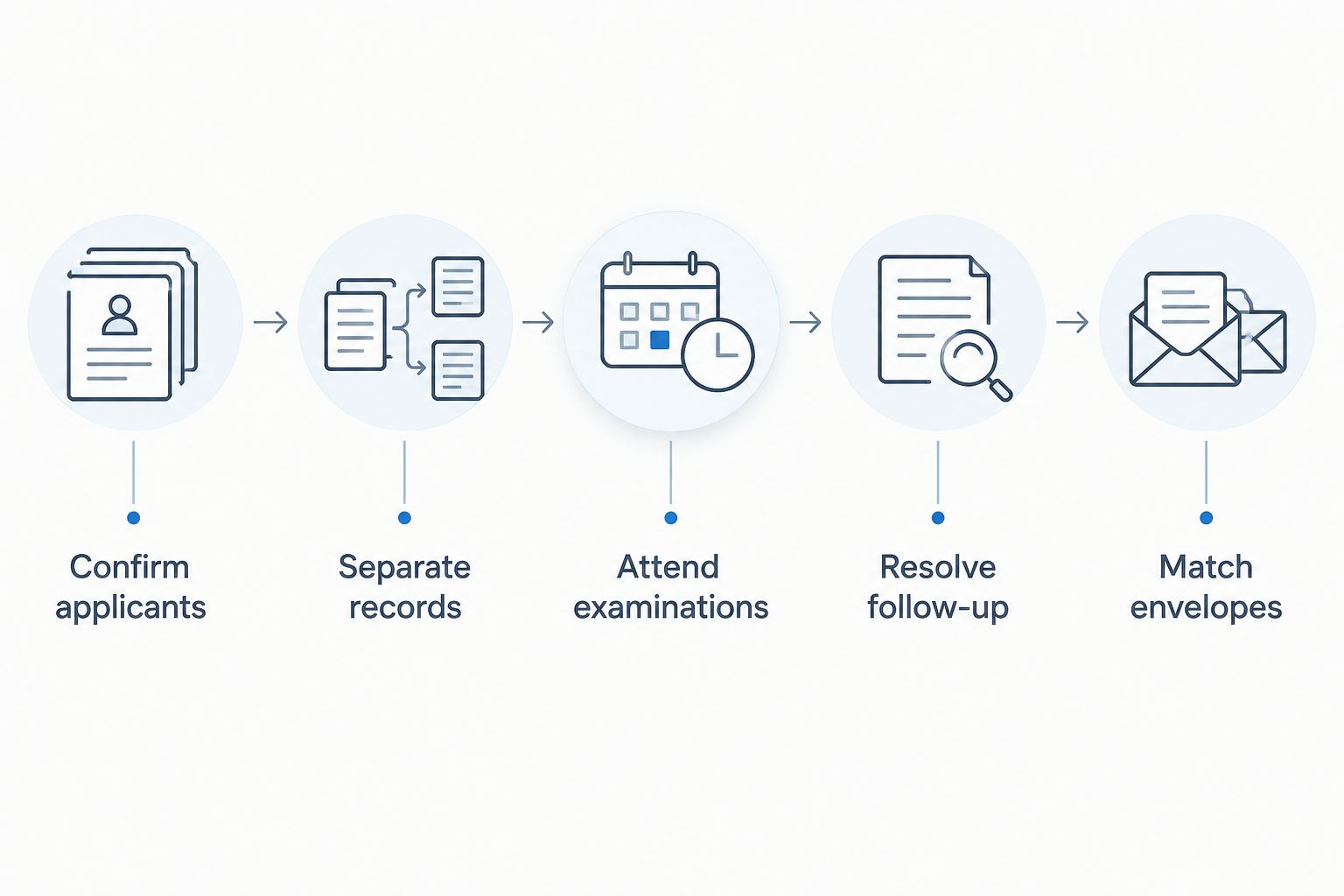
Use this sequence to keep appointments, medical records, and sealed reports matched correctly. It works whether your family attends together or on different days.
- Confirm applicants. Identify which family members need Form I-693. Tell the clinic if someone already had an immigration medical examination overseas or has existing immigration medical documentation.
- Separate records. Gather identification, vaccination records, medication information, and relevant medical documents for each applicant. Keep each person's records in a separate folder.
- Attend examinations. Each applicant attends the required examination and completes the testing and vaccination review that apply to that person.
- Resolve follow-up. Respond to requests for missing documentation, required vaccinations, further testing, or referrals. Ask which applicant each request concerns.
- Match envelopes. Keep each completed sealed report with the correct applicant's paperwork. Confirm the submission method before mailing or delivering it.
For 2026 appointments, ask the clinic which identification documents to bring for adults and children. Give the clinic each applicant's name exactly as it appears on the relevant identity and immigration documents, and raise spelling differences before the report is sealed.
Why completion time varies within a family
Even relatives attending the same appointment can finish on different dates. The civil surgeon follows the CDC Technical Instructions for Civil Surgeons, including the requirements that apply to each applicant's age and medical findings.
These factors can separate a family's completion dates:
- Age-based testing: Under CDC tuberculosis instructions, applicants aged 2 years and older generally require an interferon-gamma release assay, often called a TB blood test. Other testing requirements also depend on age and applicable instructions.
- Vaccination documentation: One applicant can have an acceptable vaccination record while another needs additional records, an applicable laboratory assessment, or vaccination.
- Laboratory results: A report cannot be completed by assuming a pending result will be normal.
- Required follow-up: Certain findings require further evaluation before the civil surgeon can finish the medical report.
- Missing information: Unclear identity details, incomplete medical history, or unavailable supporting records can require clarification.
Age differences do not mean that children are automatically exempt from immigration medical examinations. The civil surgeon applies the requirements for each child's age rather than treating the family as one medical case.
What should each family member bring?
Prepare a separate set of documents for every applicant. A shared folder is convenient only if the individual records remain clearly separated.
Bring identification accepted by the clinic, vaccination records, a current medication list, and relevant medical records. Tell the clinic beforehand about prior tuberculosis treatment, significant medical follow-up, or an earlier immigration medical examination so staff can explain what documentation to bring.
Do not assume that relatives need identical vaccines. CDC vaccination instructions account for age, documented vaccination history, acceptable evidence of immunity where permitted, and medical reasons a vaccine is not appropriate.
Missing records also do not automatically mean every vaccine must be repeated. The civil surgeon reviews what evidence is acceptable and documents the appropriate next step. The guide to vaccination records and antibody titers explains the distinction between written records and laboratory evidence of immunity.
Can we submit the ready reports and send the missing one later?
Do not assume that sending a required medical report later is an acceptable filing plan. Under USCIS filing requirements applicable in 2026, applicants required to submit Form I-693, or the required portion, with Form I-485 must include it as instructed; omission can result in rejection.
That rule concerns each applicant's required documentation. It does not turn a completed spouse's medical report into evidence that satisfies the absent applicant's requirement.
If applications are already pending, follow the specific USCIS notice and instructions for the applicant concerned. Do not send an unsolicited family bundle or use another relative's receipt information as a substitute for the correct case details.
Your clinic can explain whether a medical report is ready. Your attorney should address the consequences of submitting different family members' applications at different times.
Can one family member collect everyone's sealed reports?
Ask the clinic about authorized pickup before sending a relative. Medical privacy rules and the clinic's release procedures apply even when the applicants are spouses, parents, or adult children.
Do not assume that a shared appointment authorizes unrestricted access to every adult applicant's medical information. Explain who will collect the reports and complete any authorization the clinic requires.
Keep the USCIS envelopes sealed after collection. Ask for an applicant copy for your records rather than opening the submission envelope to check what is inside.
How long should families allow for completion?
ImmigrationMedicalExams.com describes standard Form I-693 completion as 3 business days, with a 2-business-day expedited option, subject to scheduling, laboratory results, required vaccinations, and any additional documentation. Those conditions apply individually, even when relatives attend together.
A same-day appointment is not the same as same-day completion. An applicant who needs additional evaluation cannot bypass that requirement because another family member's report is ready.
When planning in 2026, work backward from the actual document-submission deadline and explain that deadline to the clinic. Ask what remains outstanding for each person before arranging pickup or promising a delivery date to your attorney.
FAQ
Can I file I-693 without one family member's medical report?
Your own completed Form I-693 does not require a relative's report to be medically complete. Whether you can submit your application separately depends on the applicable USCIS filing requirements and your case; confirm the filing sequence with your immigration attorney.
Does every family member need a separate Form I-693?
Each applicant who is required to provide Form I-693 needs individual medical documentation. A spouse's or parent's report does not cover other family members, and the applicable requirements can differ by applicant.
Can my spouse attend the immigration medical exam for me?
No, your spouse cannot complete your required personal examination for you. A relative can help organize records or accompany you when permitted, but cannot replace your examination or required testing.
Will one person's pending TB result delay everyone else's medical forms?
One person's pending TB result does not automatically delay other applicants' completed medical reports. Each report depends on that applicant's examination, required results, vaccination review, and any necessary follow-up.
Can children skip the examination if both parents complete it?
No, a parent's completed examination does not satisfy a child's medical requirement. A child who needs Form I-693 must have an individual assessment under the applicable age-based instructions.
Should I open the sealed envelopes to check which report belongs to whom?
No, keep the USCIS submission envelopes sealed. Ask the clinic to confirm the recipient information and request an applicant copy instead of opening the sealed report.
Can our family finish the immigration medical exam on the appointment day?
A same-day appointment does not mean same-day completion. ImmigrationMedicalExams.com describes standard completion as 3 business days and an optional 2-business-day expedited service, subject to scheduling, results, vaccinations, and documentation.
One last thing
Track medical readiness separately from filing readiness. A simple family checklist with each applicant's name, outstanding medical items, sealed-report status, and attorney-confirmed submission plan prevents one person's delay from being mistaken for a rule that applies to everyone.
If you need help arranging separate family visits, contact ImmigrationMedicalExams.com with questions about the examination process. Explain who can attend and which documents are still being gathered; keep case-specific filing decisions with your immigration attorney.