
The lowest quote you receive for an I-693 is often the most expensive bill you will eventually pay. Many generalist clinics lure applicants with a base price that excludes the very things USCIS actually requires. You might start with a low exam fee, only to realize the total uscis medical exam cost has ballooned significantly once you add mandatory labs and missing vaccinations. This creates a frustrating cycle of hidden fees and unexpected trips to outside pharmacies.
We understand that you want certainty, not a medical scavenger hunt. You deserve a process that is as predictable as your filing deadline. This 2026 price guide exposes the hidden expenses of immigration medical exams and shows you how to find the best value for your I-693. We will compare the traditional a-la-carte billing model against all-inclusive, specialized clinics. You will learn how to secure fast results and professional documentation in a single visit, ensuring your application stays on track without the risk of a Request for Evidence.
Key Takeaways
- Understand how clinic specialization and regional market demand directly influence the total uscis medical exam cost in 2026.
- Identify the mandatory laboratory screenings and vaccination requirements that often trigger unexpected fees at generalist medical offices.
- Evaluate the financial security of all-inclusive flat-rate packages compared to the high-risk "a-la-carte" pricing models used by many competitors.
- Learn why dedicated immigration-only clinics provide faster processing and higher documentation accuracy than standard urgent care centers.
- Discover the efficiency of the "no reason to run around" model, which completes all exams, labs, and vaccines in a single location.
The Reality of USCIS Medical Exam Costs in 2026
Understanding the true uscis medical exam cost requires looking past the surface of a simple doctor's visit. Fees for the I-693 process are not set by the government; they are entirely market-driven. This means prices fluctuate based on your region, the clinic's overhead, and the level of specialization the office provides. In 2026, the gap between generalist clinics and specialized immigration centers has widened. You aren't just paying for a physical. You are paying for the administrative precision required to ensure you are not inadmissible to the United States on public health grounds.
Most applicants are surprised to find a split in their bill. There are administrative fees for the complex I-693 paperwork and medical service fees for the actual clinical work. Health insurance creates another layer of confusion. Standard plans are designed to cover wellness and illness. They rarely cover the administrative portion of an immigration exam because the visit is a legal requirement rather than a medical necessity. This leaves many applicants responsible for the full amount out of pocket.
A significant trend in 2026 is the move toward specialized immigration-only clinics. General practitioners often treat the I-693 as a side task. This leads to slow processing and unpredictable billing. Specialized clinics have replaced this chaos with predictable, transparent pricing models. They focus exclusively on immigration, allowing them to streamline the entire process from the first blood draw to the final sealed envelope.
Why USCIS Does Not Regulate Civil Surgeon Fees
The government designates civil surgeons but allows the private sector to manage the business operations. Doctors determine their own rates based on their local economy. In high-demand markets like Orange County or Los Angeles, rent and specialized staffing costs naturally drive prices higher. Recent 2026 regulatory updates have also introduced more rigorous testing protocols. These updates require more time and more expensive laboratory equipment. Specialized clinics often manage these costs better by handling a high volume of applicants, whereas generalists may pass the cost of these updates directly to the consumer through higher individual fees.
The Difference Between 'Base Price' and 'Total Cost'
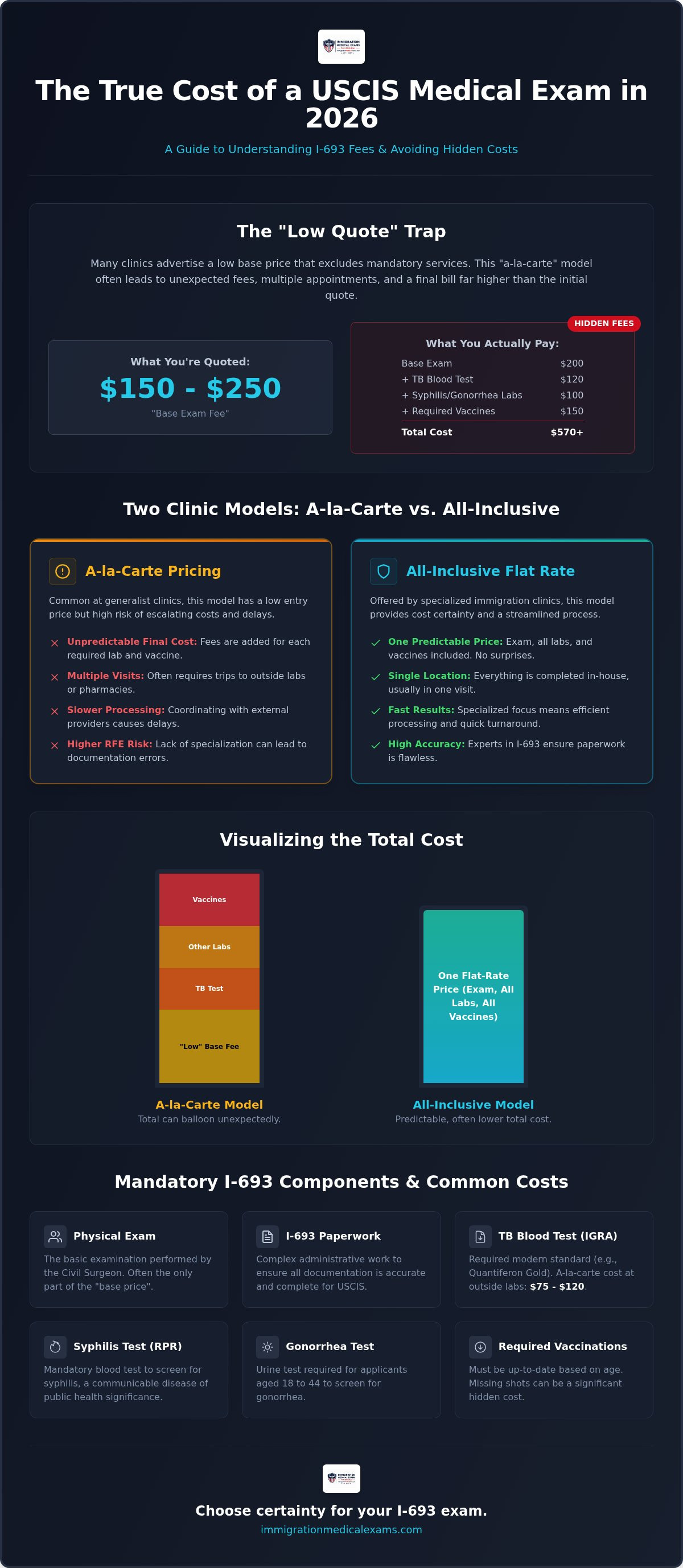
Beware of "low-cost" marketing traps. Many offices advertise a base price that only covers the doctor's signature. This price often excludes mandatory laboratory tests for tuberculosis, syphilis, and gonorrhea. Once you arrive, the clinic might add charges for every lab requisition and every required vaccine. These "a-la-carte" fees can quickly double your initial estimate. You may also find yourself forced to visit outside labs or pharmacies, adding travel time and extra service fees to your total bill. Total Cost is the absolute sum of the physical exam, all mandatory laboratory tests, and all required vaccinations.
Breakdown of Mandatory Component Costs: Labs and Tests
Mandatory laboratory screenings are the most common source of surprise charges. While a clinic might quote a low exam fee, the clinical work required for Form I-693 is non-negotiable. USCIS mandates specific tests to identify communicable diseases of public health significance. These screenings are the primary drivers of the total uscis medical exam cost. If you aren't careful, a-la-carte lab fees can quickly exceed the cost of the physical exam itself.
Choosing a clinic that handles everything in-house is the only way to avoid the headache of third-party billing. When you are sent to an outside lab, you lose control over your timeline. You also face separate invoices from providers who may not understand the specific requirements of immigration law. A specialized clinic acts as your advocate. It ensures every sample is collected and processed according to strict USCIS protocols without the need for additional appointments.
Tuberculosis (TB) Screening and Blood Work Fees
Skin tests are a relic of the past. In 2026, the Interferon-Gamma Release Assay (IGRA), such as the Quantiferon TB Gold test, is the required standard. It is more accurate. It eliminates the need for a second visit to "read" a skin reaction. Typical market rates for Quantiferon testing at third-party labs range from $75 to $120. Specialized clinics often bundle these tests to reduce your out-of-pocket expenses. This prevents the "billing creep" that happens when each vial of blood is charged as a separate line item.
There is also the financial risk of a positive result. A positive TB blood test does not always mean you are sick, but it does mandate a chest X-ray. This follow-up screening is a legal requirement for the I-693. Generalist offices may send you to a hospital or imaging center, adding another $80 to $150 to your total bill. Specialized clinics streamline this process. They often provide faster referrals or integrated imaging to keep your case moving without additional delays.
Age-Specific Lab Requirements and Price Shifts
Medical requirements change based on the applicant's age. Adult applicants within specific age groups must undergo Syphilis screening. Those in the required range for Gonorrhea testing must also provide samples. These tests typically cost between $15 and $80 each when billed separately at general labs. Pediatric applicants under 15 generally avoid these specific blood and urine tests. This significantly lowers the uscis medical exam cost for families with young children. Understanding these Factors That Influence I-693 Examination Costs helps you budget accurately for every family member.
Vaccination needs also shift by age group. Pediatric cases often require more shots, while adults may only need boosters. If you don't have your records, the clinic must perform "titers" to check for immunity. These are additional blood tests that carry their own fees. Learning Why All-in-One Locations Benefit Green Card Applicants will show you how to avoid these individual charges. To simplify your filing, you can secure an all-inclusive flat-rate package that covers all mandatory lab draws in one visit.
Flat-Rate vs. A-la-Carte: Which Billing Model Saves You More?
The a-la-carte billing model is a trap for the unprepared. It begins with a deceptively low entry fee that only covers the basic physical exam. From there, the clinic adds separate charges for every blood draw, urine test, and vaccination. This creates a volatile uscis medical exam cost that is impossible to budget for accurately. You might walk in expecting to pay a small amount and walk out with a bill three times higher. Every "add-on" is a new financial hurdle. It turns a professional medical requirement into a series of unexpected expenses.
The all-inclusive flat rate offers total financial transparency. You pay one price for the entire process. This includes the medical evaluation, all mandatory laboratory tests, and every required vaccine. This model provides the psychological peace of mind that strict immigration budgets require. You know exactly what you'll pay before you ever step into the clinic. There are no surprise invoices, no hidden administrative fees, and no unexpected laboratory bills. It's a clean, professional transaction designed for your success.
The Hidden Fees of Generalist and Urgent Care Clinics
Generalist clinics and urgent care centers don't prioritize your I-693 filing. They focus on "sick visits" and acute injuries. You're often left waiting in a crowded lobby while the staff handles emergencies. These facilities also frequently add surcharges for standard administrative tasks. You might be charged extra for form completion, civil surgeon signature fees, or the simple act of sealing your envelope. Their vaccine stock is often outdated or incomplete. This forces you to make extra trips to outside pharmacies. These extra stops add travel time and multiple co-pays to your final bill, turning a simple exam into a multi-day ordeal.
The Value of an All-Inclusive I-693 Package
Specialized clinics operate with a different philosophy. They focus exclusively on the immigration process, which allows them to secure bulk vaccine pricing from suppliers. They pass these significant savings directly to the patient. This level of efficiency is detailed in our Immigration Medical Exam: 2026 Efficiency Guide. You benefit from a "no reason to run around" guarantee. Everything happens in one location. You save hours of time and gallons of gas by avoiding Southern California's notorious traffic. You get your results faster. Your paperwork is handled with the precision of a dedicated specialist who knows exactly what USCIS expects. This is the most cost-effective path to a successful filing.
Factors Influencing Your Final Price in Southern California
Southern California is a unique market for immigration services. The high density of civil surgeons in Costa Mesa and Los Angeles doesn't always lead to lower prices. Instead, it often creates a wide range of service quality and hidden fees. The total uscis medical exam cost in this region is heavily influenced by how quickly you need your results and how accurately the paperwork is handled. In a high-stakes environment, the cheapest option can become the most expensive if it results in a Request for Evidence (RFE). An RFE delays your green card and forces you to pay for new exams or legal consultations. Specialized clinics mitigate this risk by focusing exclusively on I-693 precision.
Local expertise matters when navigating the density of Orange County and LA markets. Generalist offices often struggle with the volume of paperwork, leading to errors that trigger USCIS rejections. You aren't just paying for a medical checkup; you're paying for a successful administrative outcome. Specialized clinics streamline their operations to handle the specific needs of Southern California applicants, ensuring that geographic demand doesn't translate into administrative delays.
Expedited 2-Day vs. Standard 3-Day Processing
Time is literally money when your filing window is closing. Most generalist clinics take a week or more to return your sealed envelope. Specialized clinics in Costa Mesa offer standard 3-day or expedited 2-day processing. Paying for speed is a calculated investment if it prevents your application from expiring. These clinics achieve fast turnarounds because they don't treat sick patients. They focus entirely on I-693 workflows. This specialization removes the administrative bottlenecks found in urgent care centers, allowing you to meet your deadline with confidence.
Vaccination Records: How Your History Affects Your Bill
Your medical history is a major variable in your final bill. If you have a certified, translated vaccination record, you can avoid the cost of new shots. If your records are missing, you have two choices: get new vaccines or take "titers" blood tests to prove immunity. Titers can sometimes save you money if you've been vaccinated but lost the paperwork. However, an all-inclusive model is the safest financial bet for those with incomplete records. It covers any necessary shots without adding individual charges to your uscis medical exam cost. To lock in your price and avoid the stress of missing records, you should book an all-inclusive I-693 package that handles everything in one visit.
Conclusion: Choosing the Most Cost-Effective Path for Your I-693
Specialized immigration clinics offer the highest return on investment for your green card journey. They eliminate the financial volatility often found in traditional medical offices. Generalist providers frequently use "low-ball" pricing as a marketing tactic. They quote a low base fee but omit the mandatory labs and vaccines required by USCIS. This approach makes your final uscis medical exam cost impossible to predict. You deserve a transparent process that respects your budget and your time.
Before you book an appointment, always demand a "total out-the-door" quote. This quote should include the physical exam, all laboratory work, and every required vaccination. If a clinic cannot provide a single flat rate, you are at risk for hidden fees. A specialized clinic provides this certainty. It acts as a dedicated ally, ensuring your I-693 is completed with clinical precision and administrative accuracy. This is the only way to avoid the costly delays of a Request for Evidence.
The Efficiency of Specialization: No Sick Visits, Just I-693s
A dedicated clinic environment is designed for speed and accuracy. Our civil surgeons perform immigration exams exclusively. They don't treat the flu; they don't handle urgent care emergencies. This singular focus allows for a streamlined workflow that generalist offices cannot match. It reduces the risk of documentation errors that lead to application rejections. When you work with a specialist, you're working with someone who understands the gravity of your legal requirements. Use this checklist to compare your options:
- Does the price include all mandatory blood and urine tests?
- Are all required vaccinations included in the flat rate?
- Is the clinic an immigration-only facility?
- Can the clinic guarantee results within 2 or 3 business days?
Ready for Your All-Inclusive Exam in Costa Mesa?
ImmigrationMedicalExams.com is the premier Southern California provider for flat-rate certainty. We have simplified the process into a single, efficient visit. Our clinic serves applicants across Orange County, Los Angeles, San Diego, and Riverside. We offer standard 3-day and expedited 2-day processing to meet even the tightest deadlines. We eliminate hidden expedited traps and pharmacy runs. Everything you need is handled in one location. Secure your appointment today and experience the "no reason to run around" benefit for your uscis medical exam cost. Your successful filing starts with a specialist who prioritizes your outcome.
Secure Your Filing with Financial Certainty
Managing your uscis medical exam cost shouldn't be a guessing game. You've learned that low entry fees at generalist clinics often mask significant hidden charges for labs and vaccines. Specialization is the only true safeguard against these unexpected expenses. A dedicated clinic environment eliminates the delays of urgent care and ensures clinical precision for every Form I-693. You deserve a process that is fast, transparent, and medically accurate.
Our immigration-only clinic provides the reliability your application demands. We offer a flat-rate package that includes all required vaccines and laboratory work in a single visit. There is no reason to run between outside pharmacies and labs. With expedited 2-day results available, you can meet your USCIS deadlines with complete confidence. Don't let administrative errors or billing surprises jeopardize your future.
Book Your All-Inclusive Flat Rate I-693 Exam Today
Take control of your immigration journey with a partner who understands the high stakes. Your path to a green card is closer than ever.
Frequently Asked Questions
Does health insurance cover the cost of a USCIS medical exam?
Most health insurance plans do not cover the administrative or physical exam portion of the I-693. Standard insurance is designed for clinical necessity rather than legal or immigration requirements. While some providers might cover certain laboratory tests if performed at an in-network facility, the civil surgeon's professional fee is almost always an out-of-pocket expense for the applicant.
Why do some civil surgeons charge so much more than others?
Pricing is entirely market-driven and reflects the clinic's overhead and level of specialization. Doctors in high-demand areas like Costa Mesa or Los Angeles often have higher operating costs. Specialized immigration clinics may also charge a premium for faster lab processing and dedicated administrative support. Generalists often quote a low base fee but add surcharges that increase the total uscis medical exam cost.
What is included in an all-inclusive flat-rate I-693 package?
A comprehensive flat-rate package includes the physical examination, all mandatory laboratory screenings for tuberculosis, syphilis, and gonorrhea, and every required vaccination. It also covers the precise completion and sealing of Form I-693. This model provides total financial transparency. It eliminates surprise bills from third-party laboratories and ensures you have everything needed for a successful filing in a single visit.
Are vaccines always extra at an immigration medical exam?
Vaccines are typically a separate, additional charge at generalist medical offices and urgent care centers. These facilities often lack the specific vaccine stock required by USCIS, which forces you to make extra trips to a pharmacy. Specialized clinics that offer flat-rate packages include all necessary vaccinations in the initial price. This prevents "billing creep" and saves you from paying multiple pharmacy co-pays.
How much does it cost to expedite my immigration medical results to 2 days?
Expedited fees vary depending on the clinic's internal laboratory capabilities and current demand. Specialized immigration facilities can often guarantee 2-day or 3-day processing because they don't treat sick patients. While expedited service carries an additional fee, it is a critical investment if your filing window is closing. Meeting your USCIS deadline prevents the much higher costs of a denied application.
What happens if I test positive for TB during my exam—is there an extra cost?
A positive tuberculosis blood test requires a mandatory chest X-ray to rule out active disease according to USCIS protocols. At most generalist clinics, this X-ray is an additional charge performed at an outside imaging center. You should ask your civil surgeon if follow-up coordination is included or if you will be responsible for separate third-party diagnostic fees and travel to a different facility.
Can I bring my own vaccines from a local pharmacy to save money?
You can bring proof of vaccination from a pharmacy to satisfy USCIS requirements. However, if you choose an all-inclusive package, the uscis medical exam cost already covers these shots. Bringing outside records is most useful for proving your existing immunity through previous vaccinations. It ensures you don't receive unnecessary boosters, but it may not lower the price of a fixed-rate specialized package.
Is the cost of the USCIS medical exam tax-deductible?
The IRS generally does not allow deductions for medical exams required for legal or immigration purposes. These visits are classified as a personal expense rather than a treatment for a specific illness or injury. You should consult with a qualified tax professional to discuss your individual situation. They can determine if any specific components of your medical spending might qualify under broader healthcare deduction rules.
