Name Mismatch on Form I-693: How to Prevent and Fix It

A name mismatch on Form I-693 is fixable, and the easiest fix happens before the form is sealed. Use your legal name in Part 1, bring a valid government-issued photo ID, and bring the document that links any older or different name to it, such as a marriage certificate. If the form is already filed and USCIS asks for a correction, only a civil surgeon can correct it, and the response goes back in a new sealed envelope. We are a practice that performs only Form I-693 exams, so this is the kind of problem we work on every day.
TL;DR
- Part 1 of the I-693 should carry your legal name. A married surname you have adopted is the one to use, and the civil surgeon notes any difference from your ID.
- Bring an unexpired passport or driver’s license. If the ID shows a maiden or former name, bring the marriage certificate or court order too.
- The civil surgeon checks the name and A-Number at the top of every page and records your ID type and number in Part 5.
- If USCIS finds a deficiency, it issues a Request for Evidence (RFE). The civil surgeon corrects the form in one of three ways, always in a new sealed envelope.
- Do not alter a sealed or completed form yourself. Go back to the civil surgeon who signed it, or to one who can redo it.
Table of Contents
- What a name mismatch on Form I-693 looks like
- Which name belongs in Part 1
- What the civil surgeon must do at the appointment
- If your ID shows a different name than Part 1
- Does the I-693 name have to match every other record exactly?
- How USCIS handles an I-693 with a name problem
- Fixing a name mismatch after the form is submitted
- Mistakes that cause name problems
- Perspective
- Getting the exam done with the right name
- FAQ
- Sources
What a name mismatch on Form I-693 looks like
Form I-693 is the Report of Immigration Medical Examination and Vaccination Record. A civil surgeon, a physician designated by USCIS to perform these exams, completes it and seals it in an envelope. USCIS then compares what is on it with the rest of your green card file.
A “mismatch” is any difference between the name on the I-693 and the name on your identity documents or on your other USCIS filings. The common patterns are:
- Married versus maiden name. Your passport shows one surname, your marriage certificate and your new driver’s license show another.
- Name order and construction. Many cultures put the family name first or use multiple family names. The USCIS Policy Manual says officers should check that the legal name entered in USCIS systems follows U.S. customary order (given name, middle name, family name) and should be aware that foreign names are built differently, as described in USCIS Policy Manual, Volume 1, Part E, Chapter 5.
- Spelling and transliteration. A passport transliterated from another alphabet may differ by a letter from a birth certificate or an earlier visa.
- A legal name change that happened after your last document was issued. Your court order says one thing, your ID still says another.
- A wrong or missing name or A-Number at the top of a page. This is often a clerical slip at the clinic, not a difference in your documents, and it is just as capable of drawing an RFE.
Not every difference is a problem. What causes trouble is a difference nobody explained on the form, or a difference that the civil surgeon did not catch at the appointment.
Which name belongs in Part 1
The guidance from the American Immigration Lawyers Association on Form I-693 is that the applicant should use their legal name in Part 1. It adds that when a married person, male or female, has adopted a new surname, that surname is the one to use on the form. That guidance dates from 2012, so treat it as background and rely on the current form instructions for the procedure itself.
The practical rule is to enter the name that matches the legal evidence you will present, and to keep it consistent with the name you use on your Form I-485 or other filing. If you are unsure what your legal name is, the Policy Manual lists the evidence that establishes it. Acceptable documents include:
- a birth certificate
- a civil marriage, domestic partnership or civil union certificate
- a divorce decree
- a family registry entry
- a government-issued ID, including a passport
- a certificate of naming
- a court order
- documentation of a name change by operation of state or local law
The same chapter says that for a common-law name change in the United States, a driver’s license or state non-driver ID can serve as evidence if it shows the issue date, the acquired name and at least one other identifying detail, such as date of birth, place of birth, age, photograph or Social Security number. A foreign name change counts if it is legally valid and documented under that country’s law. All of this is in Chapter 5 of the Policy Manual, which USCIS announced as a legal-name policy update on July 12, 2024.
What the civil surgeon must do at the appointment
The Form I-693 instructions put the identity check on the civil surgeon. In practice, the civil surgeon is required to:
- Verify your identity with a valid government-issued photo ID, such as an unexpired passport or driver’s license.
- Record the type of ID and the ID number in Part 5.
- Check that the name and A-Number at the top of each page are correct.
- Have you sign the Part 2 certification in the civil surgeon’s presence at the start of the exam.
The CDC’s Technical Instructions, which govern civil surgeons, also require comparing your face and signature against an official government document that has a recent photograph and signature, according to the CDC Technical Instructions for Civil Surgeons. The Policy Manual adds that you or the civil surgeon may fill in your applicant information, but the identity verification always belongs to the civil surgeon, and you sign only when instructed, at the beginning of the exam, per Volume 8, Part B, Chapter 4.
That last point matters for mismatches. If you or a front-desk form filled out your name and nobody compared it against your ID in the room, the mismatch gets sealed in. Reading the top of the form before you sign takes ten seconds and prevents most of these problems.
If your ID shows a different name than Part 1
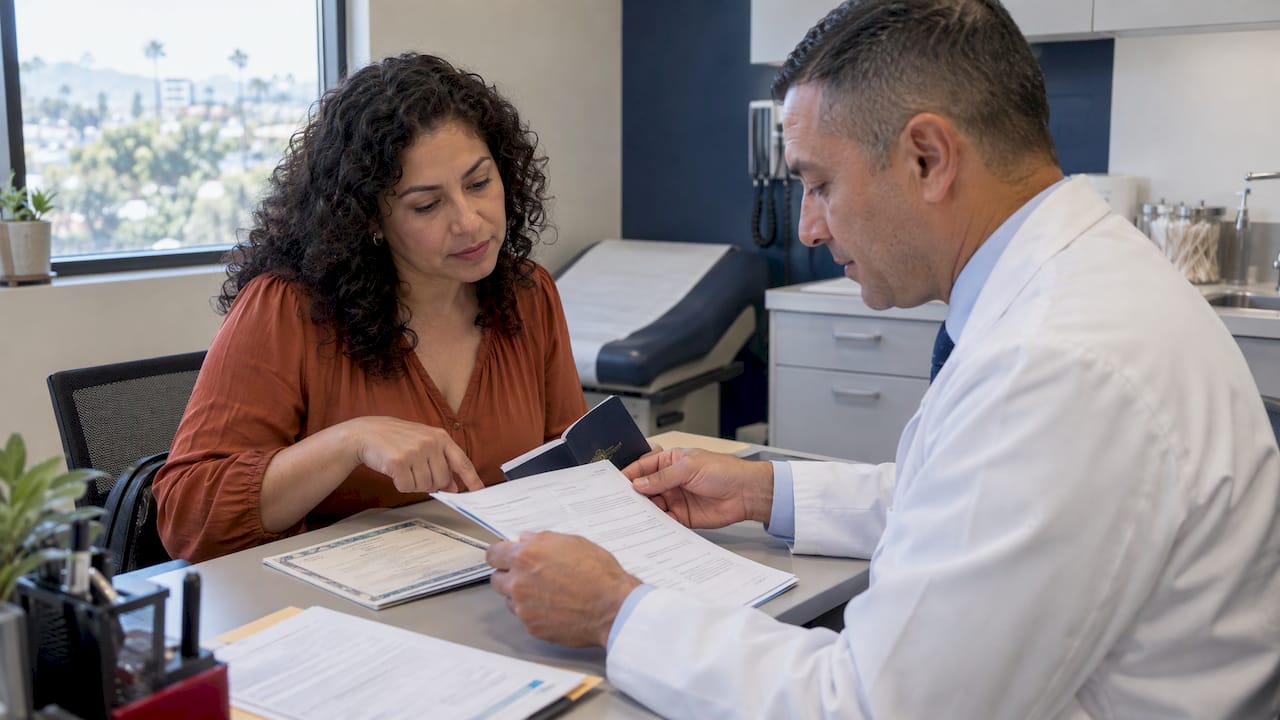
This is the classic married-name case. The AILA guidance says a civil surgeon can accept an ID issued in a maiden name when the applicant also provides a marriage certificate, and the surgeon can note on the form that the Part 1 name differs from the ID because it is the applicant’s married or maiden name. Bring both documents, even if you think the clinic will not need the certificate.
A simple checklist before the appointment:
| Your situation | What to bring |
|---|---|
| Passport in maiden name, using married surname on the form | Passport plus marriage certificate |
| Driver’s license newer than passport, names differ | Both IDs plus the document that explains the change |
| Legal name changed by court order | Court order plus the most recent ID |
| Name spelled differently across documents | The documents, so the civil surgeon can note the variance |
| Child under 14 | Documents showing name, date and place of birth, and parents’ full names, such as a birth certificate with translation if needed |
The child requirements come from the USCIS form instructions. For more on children’s exams, see our guides on the I-693 exam for children under 18 and the pediatric checklist. Our I-693 ID requirements checklist goes through the identity documents item by item.
One point to be clear about: a civil surgeon who believes an applicant is presenting false identification should refuse to perform the exam, according to the AILA guidance. This is why an unexplained mismatch can stall an appointment. A mismatch you can document is routine. One you cannot document is a problem at the door.
Does the I-693 name have to match every other record exactly?
It should not conflict with them. The name on the I-693 needs to be your legal name, with any difference from an ID explained on the form. USCIS reviews aliases and name variants during adjustment of status adjudication, so a documented difference is something the officer expects to see, while an undocumented one invites questions.
Three habits keep the file consistent:
- Use the same legal name on the I-485, the I-693 and any supporting evidence unless a document specifically needs the old name.
- List other names you have used where the forms ask for them.
- Keep copies of the name-change evidence with your records so you can produce them if USCIS asks.
If you have an attorney, ask them which name they used on the I-485 before your exam. A lawyer or consultant who files many cases can save an applicant a correction cycle simply by sending the exact name format to the clinic in advance.
How USCIS handles an I-693 with a name problem
The USCIS Policy Manual says that when a Form I-693 does not meet requirements, or the form or envelope appears tampered with, the officer should issue an RFE to correct the deficiencies. If USCIS rejects a package and returns an opened envelope, you may refile the original form together with the rejection notice and the supporting documents you previously included. Both points are in Volume 8, Part B, Chapter 4.
Also useful: officers review the form against the CDC Technical Instructions in effect on the date the civil surgeon signed it, and applicants are not held to new requirements that did not exist on that date. A name mismatch is not a new rule. It is an identity and completeness issue, and it is judged against the standards in place at signing.
For what an RFE and a rejection mean in practice, see our guides on what happens if an I-693 is rejected and fixing missing or deficient exams after an RFE.
Fixing a name mismatch after the form is submitted
When USCIS asks for a corrected form, the Policy Manual says that if possible the officer returns the original form. The response must be completed by a civil surgeon, and there are three acceptable ways:
- Annotate the original. The civil surgeon corrects the deficient parts on the original form, you and the civil surgeon both re-sign and re-date, and the form goes into a new sealed envelope.
- Complete a new Form I-693. An entirely new form, sealed in a new envelope.
- Partial new form. The civil surgeon completes the applicant-information part, the deficient parts and the civil surgeon’s certification on a new form, then includes the original I-693 and its documentation, all in a new sealed envelope.
Two rules follow from this. First, you cannot correct a name with a pen. Any change on a completed or sealed form that you make yourself can look like tampering, which is itself a ground for an RFE. Second, the sealed envelope is part of the process, not a courtesy: the corrected package must come back sealed.
The civil surgeon who made the error is usually the fastest route, because that office has the original record. If that clinic is closed, unreachable or unwilling, another civil surgeon can complete the correction using the documents you provide. Our walkthrough on I-693 form corrections through your civil surgeon covers the sequence, and the signature requirements explain who signs and when, which matters because re-signing and re-dating is part of two of the three methods. If a new filing window or pendency rule affects your timing, our note on civil surgeon signature rules is the place to check.
A correction is a record-amendment task like any other: the entry has to be traced to its source, the error identified and the right person must sign off. Patients correcting other medical records can find general background in this guide to fixing medical record errors. For a Form I-693, though, the three methods above are the ones USCIS accepts.
A worked example
Maria married in 2023 and uses her husband’s surname. Her passport still shows her maiden name. She writes her married name in Part 1 of the I-693 and brings her passport and marriage certificate. The civil surgeon checks both, records the passport number in Part 5 and notes that the Part 1 name is her married name, which differs from the passport name. The name and A-Number at the top of each page match her I-485 filing, and the form is sealed.

Had she shown up with only the passport and no certificate, the surgeon would have no document explaining the difference. That is the scenario that tends to produce an RFE months later, when the fix costs time that an interview calendar does not always give you.
Mistakes that cause name problems
- Filling in Part 1 from memory or from an old document and not from your current legal evidence.
- Bringing an expired ID. The instructions call for an unexpired passport or driver’s license.
- Leaving the marriage certificate or court order at home.
- Signing the Part 2 certification before the civil surgeon has checked your ID.
- Not reading the top of each page for the name and A-Number before the envelope is sealed.
- Opening the sealed envelope to “check” it.
Perspective
We perform immigration medical exams and nothing else, and that narrow focus shapes how we handle names. The identity check is not a formality at the start of the appointment. It is the step that decides whether the form will hold up months later, when an officer reads it against a file the clinic never sees.
Our approach is to settle the name question before the exam begins: compare the ID with the legal name, ask for the marriage certificate or court order whenever the two differ, and read the name and A-Number at the top of each page against your records before the envelope is sealed. Our clinic is designed around completing the I-693 correctly the first time, with an internal quality review before it is sealed.
We have specialized in Form I-693 since 2007, and we frequently help applicants whose exams elsewhere ended in delays, errors or incomplete documentation. A name mismatch is one of the most avoidable of those problems, and when it has already happened, the right response is a clean correction by a civil surgeon in a new sealed envelope.
ImmigrationMedicalExams Medical Team
Getting the exam done with the right name
Our practice provides the civil surgeon exam, required lab testing, vaccination review and any required vaccinations, and the preparation of Form I-693 in one location, with a flat-package approach designed to minimize unexpected costs. The Standard 3-Day Immigration Medical Exam is our regular processing, and the 2-Day Expedited exam is available when your timeline is tight. Appointments can be booked online 24/7 at ImmigrationMedicalExams.com, and we serve applicants across Southern California.

If you already have a form with a name error, bring the RFE notice, the returned form if you have it, and your name documents. Details on related services, such as a replacement sealed envelope, are on our pricing page. The full description of the exam is on our Form I-693 exam page.
FAQ
Does my name on the I-693 have to match my passport?
Not necessarily, but any difference needs to be explained. Part 1 should show your legal name. If your passport carries a maiden or former name, bring the marriage certificate or court order, and the civil surgeon can note the difference on the form.
Can I fix a wrong name on my I-693 myself?
No. Changes to a completed form should be made by a civil surgeon, and the correction goes into a new sealed envelope. Altering or opening the envelope yourself can look like tampering and can lead to an RFE.
What happens if USCIS sends an RFE for a name problem?
USCIS issues an RFE to correct the deficiency and, if possible, returns the original form. A civil surgeon then annotates the original, completes a new form, or completes a partial new form with the original attached, and you submit the result in a new sealed envelope with your RFE response.
Which documents prove a legal name change?
The USCIS Policy Manual lists a birth certificate, marriage, domestic partnership or civil union certificate, divorce decree, court order, family registry entry, certificate of naming, government ID, and documentation of a name change by operation of law. Bring the one that connects your ID name to the name in Part 1.
Does the civil surgeon check the A-Number too?
Yes. The form instructions require the civil surgeon to confirm the name and A-Number at the top of each page, and to record your ID type and number in Part 5. Read those lines yourself before the form is sealed.
Sources
- USCIS Policy Manual, Volume 1, Part E, Chapter 5: Verification of Identifying Information
- USCIS Policy Manual, Volume 8, Part B, Chapter 4: Review of Medical Examination Documentation
- USCIS Form I-693 Instructions
- CDC Technical Instructions for Civil Surgeons
- AILA, Medical Exams and Form I-693