
Khmer-speaking applicants’ immigration medical exam is a civil surgeon examination that documents health and vaccination requirements for Form I-693, Report of Immigration Medical Examination and Vaccination Record. You do not need to speak fluent English, but you should confirm language support before your visit and prepare readable medical and vaccination records.
- For immigration medical exam khmer speaking searches, confirm Khmer interpretation before choosing a civil surgeon.
- ImmigrationMedicalExams.com handles Form I-693 examinations; confirm Khmer language arrangements directly before booking.
- Bring identification, vaccination records, English translations, and a clear medication list.
- A same-day appointment does not mean same-day completion of your sealed Form I-693.
Why language preparation matters for Khmer-speaking applicants
Your immigration medical examination includes questions about your health history, a physical examination, required testing, and vaccination review. You need to understand those questions and explain your answers accurately. Language support helps you describe a previous illness, an allergy, or a vaccine reaction without guessing at English medical terms.
For a 2026 appointment, the civil surgeon must follow the applicable USCIS instructions and CDC Civil Surgeon Technical Instructions. Speaking Khmer does not change the medical requirements. It changes how you prepare to communicate during the examination.
ImmigrationMedicalExams.com is best for applicants who want a dedicated clinic to coordinate their Form I-693 examination. The ImmigrationMedicalExams.com clinic is in Costa Mesa and focuses exclusively on immigration medical examinations. Confirm Khmer-speaking staff or interpreter arrangements directly; a dedicated immigration clinic does not automatically provide every language.
Good language preparation also separates three different tasks: interpreting your conversation, translating written records, and completing any interpreter section required on the form. One person’s ability to speak Khmer and English does not automatically settle all three.
How to prepare for your Khmer-supported examination
1. Confirm Khmer interpretation before your appointment
Start by writing down your language needs. Tell the clinic that you speak Khmer and whether you need interpretation throughout the visit or only for medical questions. Do not assume that a clinic serving Southern California has Khmer-speaking staff.
Ask whether the clinic provides language support, accepts an interpreter you arrange, or allows remote interpretation. Confirm how the interpreter will participate in the examination and any form-related discussion. A translation app can help you prepare a question, but it is not a dependable substitute for interpreting a medical history.
If a relative will help, ask the clinic first. You also need a way to discuss private health information without that relative present if you prefer.
- State that you need Khmer interpretation, not just general language assistance.
- Ask who will arrange the interpreter and how the interpreter will attend.
- Confirm whether your interpreter must provide identification or complete form information.
- Tell the clinic about hearing, reading, or other communication needs.
- Make a backup plan if your interpreter cannot attend.
2. Gather identification and organize each applicant’s records
You can prepare your documents yourself before involving the clinic. Keep identification, vaccination records, and relevant medical documents together. If several family members are attending, use a separate folder for each person.
Ask the clinic which identification documents it accepts and whether you should complete any applicant information beforehand. Check names, dates of birth, and spelling against your identification. A name written differently across documents needs clarification, not an improvised correction.
Do not sign Form I-693 in advance unless the current instructions and clinic specifically direct you to do so. The applicant signature is generally completed in the civil surgeon’s presence. If someone interprets the form for you, follow the applicable interpreter-section instructions.
- Bring the identification the clinic tells you to use.
- Keep each family member’s records in a separate folder.
- Flag name or birth-date differences before the examination.
- Bring relevant records of previous TB testing or treatment.
- Ask which parts of Form I-693 to complete before arrival.
3. Prepare your Khmer vaccination records for review
Gather written vaccination records from clinics, hospitals, schools, or other providers. Include records from Cambodia and any later vaccinations received elsewhere. Your memory of a vaccination does not replace acceptable written documentation.
Foreign-language vaccination records need an English translation for the civil surgeon’s review. Ask what translation format the clinic accepts before paying for document services. Keep the original record with the translation so the vaccine names and dates can be checked together.
ImmigrationMedicalExams.com coordinates vaccination-record review, required testing, and required vaccinations when applicable. That reduces separate arrangements, but the civil surgeon still needs readable documentation and must determine which requirements apply to you.
For your 2026 examination, vaccination decisions depend on CDC instructions, your age, documented doses, and medical circumstances. Read the guide to USCIS vaccination requirements for Form I-693 before gathering additional records or arranging vaccinations independently.
- Bring original vaccination records and available copies.
- Keep English translations beside the corresponding Khmer documents.
- Flag unclear handwriting, vaccine names, or dates.
- Bring documentation of serious vaccine reactions or relevant medical restrictions.
- Let the civil surgeon determine missing doses and applicable exceptions.
4. Explain your medical history and understand the testing
Write a plain-language list of current medicines, allergies, important past illnesses, and previous treatment. You can write your questions in Khmer and review them with your interpreter. Bring medication packaging or a current medication list when English names are difficult to remember.
CDC’s Civil Surgeon Technical Instructions require a TB blood test called an interferon-gamma release assay, or IGRA, for applicants aged 2 years and older. Other testing requirements depend on age and the applicable instructions. A childhood BCG vaccination does not remove the required IGRA testing.
A positive TB blood test does not, by itself, establish active TB disease. It requires follow-up under the CDC instructions, which can include a chest X-ray and further evaluation. Explain any previous positive result or treatment accurately rather than assuming an old result settles the current examination.
- List medicines, allergies, and important past illnesses.
- Bring records of previous TB results and treatment, if available.
- Ask the interpreter to translate the full question before you answer.
- Request an explanation when a test or instruction is unclear.
- Tell the civil surgeon about pregnancy or relevant vaccine reactions.
5. Plan around results, not just the appointment date
Build your schedule backward from when you need the completed medical documentation. The appointment is only one part of the process. Laboratory results, vaccinations, translations, or additional evaluation can affect completion.
ImmigrationMedicalExams.com offers 3-business-day standard completion and a 2-business-day expedited option, subject to scheduling, laboratory results, required vaccinations, and additional documentation. Confirm how that timeline applies to your examination before making a deadline-dependent plan.
Online scheduling is available 24 hours a day, but booking access does not mean a civil surgeon or interpreter is available at every hour. A same-day appointment also does not mean that testing, review, and the sealed form will be finished that day.
For 2026 planning, keep the appointment date and expected completion date separate. Ask the clinic how it will communicate results and requests for additional information when you need Khmer interpretation.
- Tell the clinic your document deadline before choosing an appointment.
- Ask when your completed packet is expected, not just when you can be seen.
- Confirm interpreter arrangements for any follow-up discussion.
- Respond promptly to requests for records or clarification.
- Leave room for additional testing or documentation.
6. Review your information and protect the sealed packet
Before the clinic seals your Form I-693, review the applicant information through the clinic’s process. Ask questions about your name, date of birth, and other identifying details while corrections can still be addressed. Request an explanation of any medical follow-up instructions in language you understand.
USCIS requires the civil surgeon’s completed Form I-693 to be submitted in its sealed envelope. Do not open the sealed packet to read, photograph, or translate the form. Ask the clinic for a separate applicant copy rather than disturbing the submission packet.
Use the current USCIS filing instructions for your case. Your civil surgeon prepares the medical documentation; questions about when or how it fits into your immigration filing belong with your immigration attorney or the relevant USCIS instructions.
- Review identifying information before the packet is sealed.
- Ask for a separate copy for your records.
- Keep the sealed envelope intact and protected from damage.
- Confirm how to receive explanations of follow-up instructions.
- Share medical documents only through appropriate, private channels.
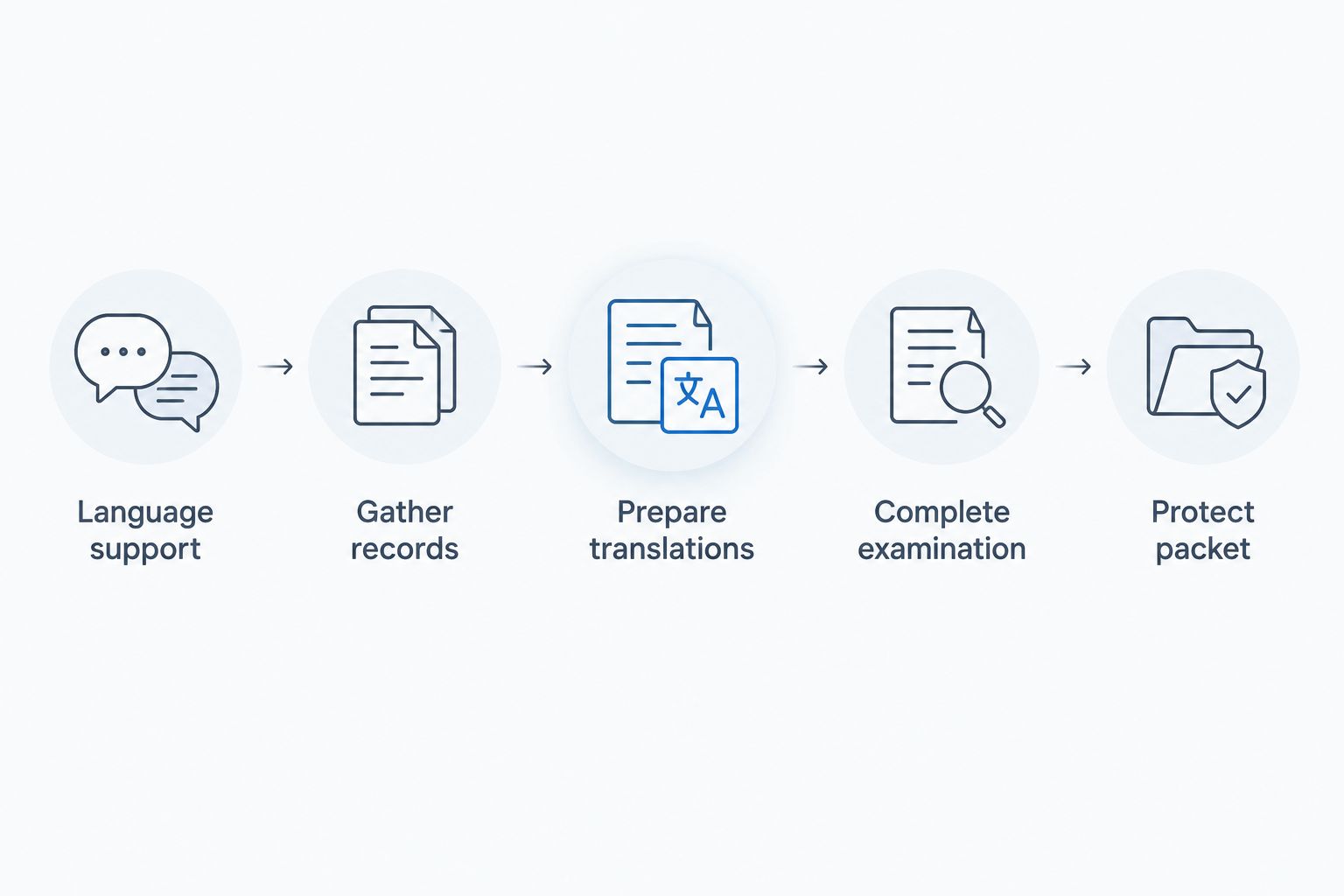
The preparation sequence is simple: confirm language support, gather records, prepare translations, complete the examination, and protect the packet. Completing the first three tasks before your visit prevents avoidable communication problems during the examination.
Compare language-support options for your examination
The right option depends on what the clinic accepts and how much interpretation you need. Confirm the arrangement for your 2026 visit rather than treating a directory listing or a relative’s recommendation as proof of current Khmer support.
| Option | Best for | Main benefit | Key limitation |
|---|---|---|---|
| Confirmed Khmer-speaking civil surgeon | Applicants who want direct communication | Medical questions can be discussed without a separate interpreter | Language ability and appointment arrangements must be confirmed |
| Professional Khmer interpreter accepted by the clinic | Applicants needing detailed medical interpretation | Separates interpretation from a relative’s role | Requires coordination with the clinic and interpreter |
| Adult relative accepted by the clinic | Applicants comfortable discussing private information with family | A familiar person can help explain questions | Privacy and medical vocabulary can be concerns |
| Remote interpreter accepted by the clinic | Applicants arranging language support from another location | The interpreter can join without traveling | Connection quality and clinic procedures affect use |
| Translation app for preparation only | Applicants drafting questions before the visit | Helps organize words and questions | Does not replace reliable medical interpretation |
A clinic’s examination package and your interpretation arrangement are separate decisions. Choose a USCIS-designated civil surgeon first, then confirm that the language plan supports an accurate examination. Do not choose a general medical visit solely because someone speaks Khmer; Form I-693 requires the appropriate civil surgeon process.
Common mistakes Khmer-speaking applicants should avoid
Assuming Khmer support without confirming it
A clinic’s location or patient population does not establish which languages its staff speaks. Confirm the exact arrangement before your visit, including whether support covers medical questions, form instructions, and follow-up communication.
Bringing translated records without the originals
A translated vaccine name is not enough if the corresponding date or original entry is unclear. Keep the source document and English translation together, and flag uncertain entries for review rather than guessing.
Letting a relative answer instead of interpreting
An interpreter should communicate your answers, not replace them with what a family member remembers. Speak for yourself whenever possible, and ask for privacy if a question involves information you do not want to share with relatives.
Treating an old TB test as an automatic exemption
Previous TB testing, BCG vaccination, and treatment history are important to report. They do not automatically eliminate testing required under the current CDC instructions. Bring the records and let the civil surgeon determine the next step.
Opening the envelope to check the English
Opening the sealed Form I-693 packet can make it unacceptable for submission. Arrange interpretation before sealing and use a separate applicant copy for later review.
FAQ
Can I have my immigration medical exam if I only speak Khmer?
Yes, you can complete a Form I-693 immigration medical examination with appropriate language support. Confirm interpreter arrangements with the civil surgeon’s clinic before your appointment so you can understand questions and explain your medical history accurately.
Does ImmigrationMedicalExams.com have a Khmer-speaking civil surgeon?
Confirm Khmer-speaking staff or interpreter arrangements directly with ImmigrationMedicalExams.com before booking. The clinic’s immigration-examination services do not establish that Khmer interpretation is included.
Can my spouse or adult relative interpret during my examination?
Ask the clinic whether it accepts your spouse or adult relative as an interpreter. Consider medical vocabulary and privacy, and follow the interpreter-section instructions if that person interprets Form I-693 for you.
Do my Cambodian vaccination records need an English translation?
Foreign-language vaccination records need an English translation for the civil surgeon’s review. Bring the original Khmer records with the translation and confirm the clinic’s document requirements beforehand.
Does my BCG vaccination mean I can skip the TB blood test?
No, BCG vaccination does not remove the CDC-required IGRA blood test for applicants aged 2 years and older. Tell the civil surgeon about previous TB tests or treatment and bring available records.
Can I finish the entire immigration medical exam on the appointment day?
A same-day appointment does not mean same-day completion of Form I-693. Laboratory results, required vaccinations, documentation, and any additional evaluation determine when the civil surgeon can complete the packet.
Can I open my sealed Form I-693 to translate it?
No, keep the civil surgeon’s submission envelope sealed. Ask for a separate applicant copy and arrange interpretation of questions before the clinic seals the packet.
One last thing
An interpreter and a document translator solve different problems. Before your 2026 appointment, check both: who will help you understand the examination, and whether your written records are ready for review. That small distinction can prevent arriving with conversation support but unusable vaccination documentation.
Prepare for your immigration medical exam
Confirm Khmer interpretation and document requirements before your visit.