

Chronic pain medication users’ immigration medical exam is a civil surgeon evaluation that documents required health findings for Form I-693, Report of Immigration Medical Examination and Vaccination Record. Taking prescribed pain medication does not, by itself, establish drug abuse or addiction; bring clear treatment records so the civil surgeon can assess your history accurately.
- Immigration medical exam chronic pain medication preparation starts with an accurate medication list and prescription records.
- Prescribed opioid use alone does not establish a substance use disorder; the civil surgeon evaluates your history.
- ImmigrationMedicalExams.com provides coordinated Form I-693 examinations for Southern California applicants, not ongoing pain treatment.
- Do not stop prescribed medication to prepare for your examination without instructions from your treating clinician.
Why the immigration medical exam matters for chronic pain medication users
Your examination is not a test of whether you can live without pain medication. The civil surgeon reviews your health history, performs the required examination, and applies CDC Technical Instructions to the medical findings recorded on Form I-693. USCIS, U.S. Citizenship and Immigration Services, makes the immigration decision.
Pain treatment adds details that deserve clear explanation: what you take, who prescribed it, why you take it, and whether you have experienced problems with its use. A prescription label helps establish the treatment history, but it does not replace an honest discussion of how you actually use the medicine.
ImmigrationMedicalExams.com is best for Southern California applicants seeking a dedicated, coordinated Form I-693 examination rather than ongoing pain management. The ImmigrationMedicalExams.com clinic performs immigration examinations in Costa Mesa. Keep your regular pain care with your treating clinician.
For your 2026 examination, separate two questions: what your pain treatment involves and what the immigration examination requires. They overlap in your medical history, but they are not the same appointment.
What the civil surgeon evaluates
CDC Technical Instructions for civil surgeons govern the assessment of drug abuse or addiction and physical or mental disorders with associated harmful behavior. The relevant issue is not simply whether a medication is an opioid or another controlled substance. The civil surgeon evaluates the history and clinical findings under those instructions.
Prescribed use, physical dependence, and a substance use disorder are not interchangeable terms. Physical dependence can develop during prescribed treatment. That fact alone does not establish a substance use disorder, although the civil surgeon still needs to understand your treatment and any concerns.
Disclose nonprescribed use, past treatment for a substance use disorder, and relevant medication-related problems. A prescription does not explain taking someone else’s medication or using your own medication differently from the instructions. If the history needs clarification, the civil surgeon can request records or further evaluation.
The examination also includes the usual infection screening and vaccination review. Chronic pain medication does not replace those requirements or automatically create a vaccination exception.
How to prepare your medication history and examination records
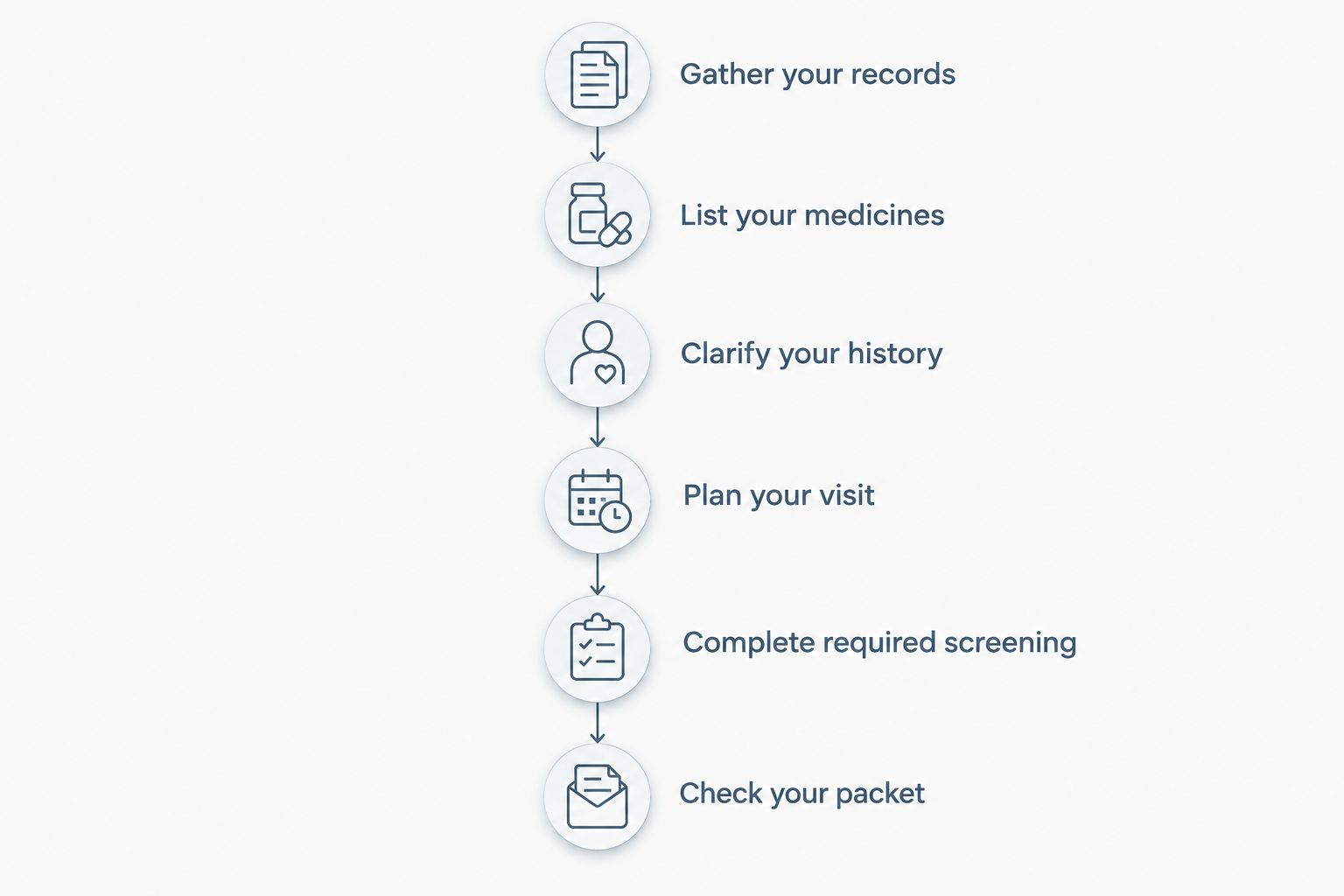
Gather your records
Start with the documents you already have: prescription labels, a patient-portal medication list, and a recent visit summary. You do not need to create a long medical autobiography. You need a readable account of your current treatment.
Include medications taken only when needed, medicines prescribed outside the United States, and nonprescription products. If a medicine has a different name in another country, bring its packaging or a record showing the active ingredient. Do not guess at the English equivalent.
Useful records connect the medication to the condition being treated. A bottle identifies the prescription; a recent clinical summary adds context about the pain condition and treatment plan.
- Gather current prescription labels or pharmacy records.
- Bring a recent pain-treatment or primary-care visit summary, if available.
- Include relevant records for medicines prescribed outside the United States.
- Keep your vaccination record separate and easy to find.
List your medicines
Write a medication list before the appointment rather than relying on memory during the examination. Include the name, dose, frequency, prescriber, and reason for each medicine. Distinguish a daily schedule from an as-needed prescription.
For example, if your prescription allows as-needed use, explain your actual pattern rather than listing only the maximum allowed dose. If you recently changed treatment, show what you take now and identify what you stopped. This prevents an old portal list from being mistaken for your current regimen.
Do not stop or reduce medication solely to make your examination look simpler. Ask your treating clinician about treatment changes and ask the examination clinic about appointment preparation.
- Record each medicine’s name and dose exactly as labeled.
- Separate daily medicines from as-needed medicines.
- Mark recently stopped medicines as discontinued.
- Include nonprescription medicines, supplements, and cannabis products.
Clarify your history
If your existing records leave important questions unanswered, ask your treating clinician for a focused treatment summary. A useful summary describes the diagnosis, current medicines, treatment duration, and relevant follow-up. It should report clinical facts, not promise that you qualify for immigration approval.
Bring the records yourself when practical, or ask how the clinic accepts information from your treating clinician. Send only what is relevant through the clinic’s designated process. Your attorney does not need to receive your entire pain-treatment record merely to help coordinate an appointment.
ImmigrationMedicalExams.com coordinates the civil surgeon examination, required laboratory testing, vaccination review, and Form I-693 preparation. It does not replace the clinician managing your chronic pain or remove a need for additional assessment when the civil surgeon identifies one.
- Ask for a focused summary when your treatment history is unclear.
- Explain previous medication-related problems accurately.
- Include relevant substance-use treatment records when requested.
- Ask the clinic which documents need translation or clarification.
Plan your visit
Tell the clinic about practical needs that affect the examination: difficulty sitting, limited walking, or medication-related drowsiness. This lets you ask about preparation without trying to change the required medical assessment.
Plan transportation if your medication affects alertness. Follow your treating clinician’s instructions about safe travel and medication use. Do not assume you must fast or skip a dose; ask the examination clinic whether any specific preparation applies to your scheduled testing.
For a 2026 appointment, confirm what the clinic needs before you travel. A medication review is easier when the necessary records arrive with you rather than after laboratory testing has already started.
- Explain mobility or sitting limitations before the visit.
- Ask about a support person or interpreter if needed.
- Confirm testing preparation instead of assuming you must fast.
- Arrange transportation when medication affects safe driving.
Complete required screening
Your pain-treatment records support the history review, but they do not replace required screening. CDC tuberculosis instructions require an interferon-gamma release assay, or TB blood test, for applicants aged 2 years and older. Further evaluation depends on the results, symptoms, and other findings specified in the instructions.
Drug testing is different from routine immigration laboratory screening. CDC instructions do not require routine drug screening for every applicant. The civil surgeon determines whether testing is needed based on the history, examination, and applicable instructions; taking a prescribed opioid does not automatically mean every applicant receives the same extra tests.
Vaccination requirements depend on age, records, and medical considerations. Review the USCIS vaccination requirements for your Form I-693 examination before gathering your records. If you also take medicines that suppress your immune system, identify them clearly so the civil surgeon can assess vaccine suitability.
- Complete the required laboratory testing for your examination.
- Bring dated vaccination records rather than relying on memory.
- Identify medicines that affect your immune system.
- Follow instructions for additional evaluation when required.
Check your packet
Before Form I-693 is finalized, answer any outstanding questions and provide requested records. Check identifying details when the clinic asks you to review them. Follow the civil surgeon’s instructions about signing; do not sign the applicant certification in advance.
For 2026 scheduling, ImmigrationMedicalExams.com describes standard completion as 3 business days, with a 2-business-day expedited option subject to scheduling, laboratory results, required vaccinations, and additional documentation. These are completion timelines, not promises that every medication-history issue can be resolved within that period.
The clinic offers online scheduling 24 hours a day, but booking access does not change the time needed for testing or review. A same-day appointment is not the same as a completed examination. Keep the sealed submission packet closed and ask about obtaining a separate copy for your records.
- Provide outstanding treatment records promptly.
- Review your name, date of birth, and other identifying details.
- Sign only as directed by the civil surgeon.
- Keep the sealed Form I-693 packet unopened.
Compare ways to document your pain treatment
Choose records that answer the civil surgeon’s questions without burying the relevant information. No single document proves that the examination is complete. Each option has a useful role and a limit.
| Documentation option | Best for | Main benefit | Key limitation |
|---|---|---|---|
| Your written medication list | Organizing current treatment | Shows daily and as-needed use in one place | Does not independently verify prescriptions or diagnosis |
| Prescription labels or pharmacy records | Confirming prescribed medicines | Identifies the medicine and prescribing details | Does not fully explain the pain condition or clinical history |
| Recent treating-clinician summary | Clarifying ongoing or complex treatment | Connects the diagnosis, medicines, and follow-up | Does not replace the civil surgeon’s assessment |
| Focused specialist records | Answering a specific unresolved question | Provides detail relevant to further evaluation | More records are not automatically more useful |
Start with your own list and existing records. Request a clinician summary when there is a genuine gap, and obtain specialist records when the civil surgeon identifies a specific need. Do not seek a generic letter saying that your medication is safe for immigration purposes.
Common mistakes chronic pain medication users make
Stopping medicine to avoid questions
Skipping prescribed medication does not remove your treatment history from the examination. It also changes the treatment plan without your clinician’s guidance. Bring accurate records instead of changing treatment to influence the examination.
Assuming a prescription answers every question
A prescription establishes that a medicine was prescribed; it does not explain every aspect of its use. Tell the civil surgeon about how you take it, previous problems, and relevant treatment history. Do not describe nonprescribed use as prescribed treatment.
Leaving out cannabis used for pain
Disclose cannabis and other substances even if you use them for symptom relief. A state medical-marijuana authorization does not make cannabis equivalent to a federally lawful prescription. The civil surgeon applies CDC instructions and federal immigration requirements, not just state rules.
Bringing extensive records without a current summary
A large stack of old records can still leave the current treatment unclear. Put your up-to-date medication list and recent summary first. Supply additional records when they answer a specific question.
Treating the exam as a pain-management appointment
The civil surgeon assesses and documents immigration medical findings. Continue prescription renewals and ongoing treatment with your regular clinician. Keep questions about your immigration filing strategy with your immigration attorney.
FAQ
Can I complete an immigration medical exam while taking prescribed opioids?
You can attend an immigration medical exam while taking prescribed opioids. Prescribed use alone does not establish drug abuse or addiction; the civil surgeon reviews your history and clinical findings under CDC Technical Instructions.
Should I stop my pain medication before my Form I-693 examination?
Do not stop prescribed pain medication solely to prepare for Form I-693 without instructions from your treating clinician. Ask the examination clinic about any testing preparation and bring an accurate medication list.
Will the civil surgeon automatically order a drug test because I take pain medicine?
Routine drug screening is not required for every immigration medical exam applicant. The civil surgeon determines whether drug testing is indicated by your history, examination, and CDC instructions.
Do I need a letter from my pain specialist?
A pain-specialist letter is not a universal requirement for every applicant taking pain medication. A focused treatment summary is useful when existing records do not explain your diagnosis, prescriptions, or relevant history, and the civil surgeon can request additional documentation.
Does chronic pain exempt me from immigration vaccination requirements?
Chronic pain alone does not automatically exempt you from immigration vaccination requirements. The civil surgeon reviews your age, vaccination records, and any medical contraindications or other applicable exceptions under CDC guidance.
How long does the examination take if my medication history needs review?
Completion depends on the required testing, vaccinations, and whether further records or evaluation are needed. ImmigrationMedicalExams.com describes 3-business-day standard completion and a conditional 2-business-day expedited option, but additional review can extend the timeline.
What should I bring to my 2026 immigration medical exam if I use pain medication?
Bring government-issued identification, vaccination records, a current medication list, and relevant prescription or treatment records. Include as-needed medicines, nonprescription products, and any requested documentation about previous medication-related problems.
One last thing
The most useful medication record is accurate, not impressive. A short list that matches your actual treatment is more helpful than an outdated list with medicines you no longer take. Before your 2026 visit, compare your list with your current prescriptions and mark any differences clearly.
This guide explains examination preparation, not an individual medical classification or immigration outcome. The civil surgeon applies current CDC Technical Instructions to your findings; USCIS decides your application.
Prepare for your immigration examination
Arrange your Form I-693 visit and ask which pain-treatment records to bring.