
An immigration medical exam for applicants with obesity is a civil surgeon evaluation for Form I-693, Report of Immigration Medical Examination and Vaccination Record; obesity alone does not make you medically inadmissible, and there is no immigration BMI cutoff. Your examination focuses on the required health screening, vaccination review, and accurate documentation—not reaching a target weight before your appointment.
- Immigration medical exam obesity BMI guidance: obesity alone is not a medical inadmissibility ground, and no BMI cutoff applies.
- Bring your vaccination record, medication list, and relevant medical records; do not stop treatment to change examination results.
- ImmigrationMedicalExams.com is best for Southern California applicants seeking a dedicated Form I-693 immigration medical exam clinic.
- Your civil surgeon evaluates required screening and relevant medical conditions; USCIS makes the immigration decision.
Why this matters for applicants with obesity
You do not need to lose weight before scheduling your immigration medical examination. Waiting to reach a particular BMI does not satisfy an additional USCIS requirement. It only postpones the examination you actually need.
Applicants with obesity sometimes have related conditions, such as diabetes, high blood pressure, or sleep apnea. Those conditions belong in your medical history when applicable, but they do not turn the appointment into a weight-loss assessment. Explain your current treatment and any limitations that affect the visit.
If you are unsure what to discuss, use this guide to prepare questions for your civil surgeon visit. A clear question about your medication or mobility needs is more useful than trying to predict whether a weight measurement will affect your case.
What USCIS and CDC requirements mean for your BMI
For a 2026 Form I-693 examination, the controlling authorities are USCIS medical examination requirements and the CDC Technical Instructions for Civil Surgeons. USCIS is U.S. Citizenship and Immigration Services. CDC is the Centers for Disease Control and Prevention, which provides the medical screening instructions civil surgeons follow.
The medical grounds of inadmissibility include specified communicable diseases, failure to meet applicable vaccination requirements, certain physical or mental disorders with associated harmful behavior, and drug abuse or addiction. Obesity by itself is not one of those grounds.
BMI, or body mass index, is a screening measure based on height and weight. It is not a pass-or-fail immigration score. A civil surgeon considers your history and examination findings rather than using a BMI threshold to decide whether you qualify for immigration.
A civil surgeon can document a significant medical condition as a Class B condition when it meets the applicable criteria. A Class B finding is not the same as a Class A finding that establishes a health-related ground of inadmissibility. Do not assume that any mention of obesity or another chronic condition on your medical documentation means your application will be denied.
Your civil surgeon completes the medical assessment. USCIS decides your immigration application, and your immigration attorney addresses case-specific legal questions.
How to prepare for your civil surgeon visit
1. Separate your weight concerns from the examination requirements
Start with the actual purpose of the appointment: completing the required medical assessment and documenting it correctly on Form I-693. There is no required weight-loss program, target BMI, or obesity-specific fitness test before the visit.
Tell the civil surgeon if a related condition affects your daily activities or requires ongoing treatment. For example, explain whether knee pain makes standing difficult or whether you use treatment for sleep apnea. These details help the clinician understand your health history and plan the examination appropriately.
Do not omit a diagnosis because you worry that naming it will cause a denial. Accurate information is more useful than an incomplete history.
- Write down the health conditions you currently receive treatment for.
- Note any symptoms or limitations that affect the examination.
- Separate questions about medical documentation from questions about your immigration case.
- Avoid postponing your visit solely to reach a lower BMI.
2. Gather records that explain your current care
You can prepare without buying a special record service. Start with documents you already have: your vaccination record, a current medication list, and relevant summaries from your treating clinician.
A short, current summary is often easier to review than a large collection of unrelated records. If you have had bariatric surgery, a recent hospital stay, or treatment for a significant complication, ask the clinic which documents are useful before sending them. Keep personal health information within the clinic's designated communication process rather than posting it publicly.
For your 2026 appointment, confirm the clinic's identification and paperwork instructions. Do not assume that an old checklist covers the current Form I-693 edition or signing procedure.
- Bring the identification the clinic requests.
- Gather dated vaccination records with the vaccine names shown.
- List each medication, its dose, and why you take it.
- Bring relevant treatment summaries or specialist information when requested.
- Ask before sending a full medical chart or sensitive records.
3. Choose a USCIS-designated civil surgeon
A regular medical appointment does not replace an immigration medical examination. For a domestic Form I-693 examination, choose a clinician authorized by USCIS to perform the civil surgeon assessment.
You can check civil surgeon designation through USCIS and ask the office how it coordinates the examination, required testing, vaccination review, and sealed documentation. Ask about the process rather than assuming that every doctor's office handles these steps in the same way.
ImmigrationMedicalExams.com is a dedicated immigration medical exam clinic in Costa Mesa staffed by USCIS-designated civil surgeons. Its coordinated process includes the examination, required laboratory and tuberculosis testing, vaccination-record review, required vaccinations when applicable, and preparation of the sealed Form I-693.
The limitation is practical: this is an immigration-exam-only clinic, not a substitute for ongoing obesity treatment or general primary care.
- Verify that the examining clinician is USCIS-designated.
- Ask which documents you should bring before the appointment.
- Confirm how required testing and vaccination review are coordinated.
- Ask how additional medical documentation is handled.
- Keep your usual clinician involved in ongoing health treatment.
4. Explain medication and examination needs in advance
Bring an accurate medication list, including prescribed weight-management medicines, diabetes medicines, and other treatments you use. Do not stop or change prescribed medication simply to prepare for Form I-693. Ask your treating clinician about changes to your regular treatment.
Obesity does not create a separate USCIS fasting requirement. Follow the clinic's instructions for the tests it actually orders, and ask if anything is unclear. Do not start fasting because a friend needed fasting blood work at a different medical appointment.
If standing, walking, or moving onto an examination table is difficult, describe that need before the visit. Asking about assistance is preparation, not a statement that you cannot complete the examination. The clinic can explain what arrangements it can provide.
- Share your current medication list with the civil surgeon.
- Ask whether the ordered tests require any special preparation.
- Describe mobility limitations before arriving.
- Ask about a support person or chaperone if you want one present.
- Continue prescribed care unless your treating clinician directs otherwise.
5. Complete the screening and vaccination review that apply to you
The examination requirements depend on factors such as your age, medical history, and the CDC instructions—not your BMI alone. Under the CDC tuberculosis instructions for civil surgeons, applicants aged 2 years and older generally require an interferon-gamma release assay, commonly called a TB blood test.
A positive TB blood test requires further evaluation under the instructions. A chest X-ray is not ordered simply because an applicant has obesity. The civil surgeon determines whether an X-ray or other follow-up is required based on the tuberculosis screening findings and applicable criteria.
Vaccination requirements also need an individual review. In 2026, your civil surgeon checks the current CDC instructions, your age, your records, and any medically appropriate exceptions. Obesity alone does not provide a blanket vaccination exemption.
Use the USCIS vaccination requirements guide to organize your records before the visit. The civil surgeon, not an online checklist, determines what applies to your examination.
- Provide vaccination records rather than relying on memory alone.
- Complete the required TB testing and any indicated follow-up.
- Tell the civil surgeon about prior serious vaccine reactions.
- Discuss conditions or treatments that could affect vaccination decisions.
- Ask which outstanding items must be resolved before Form I-693 is completed.
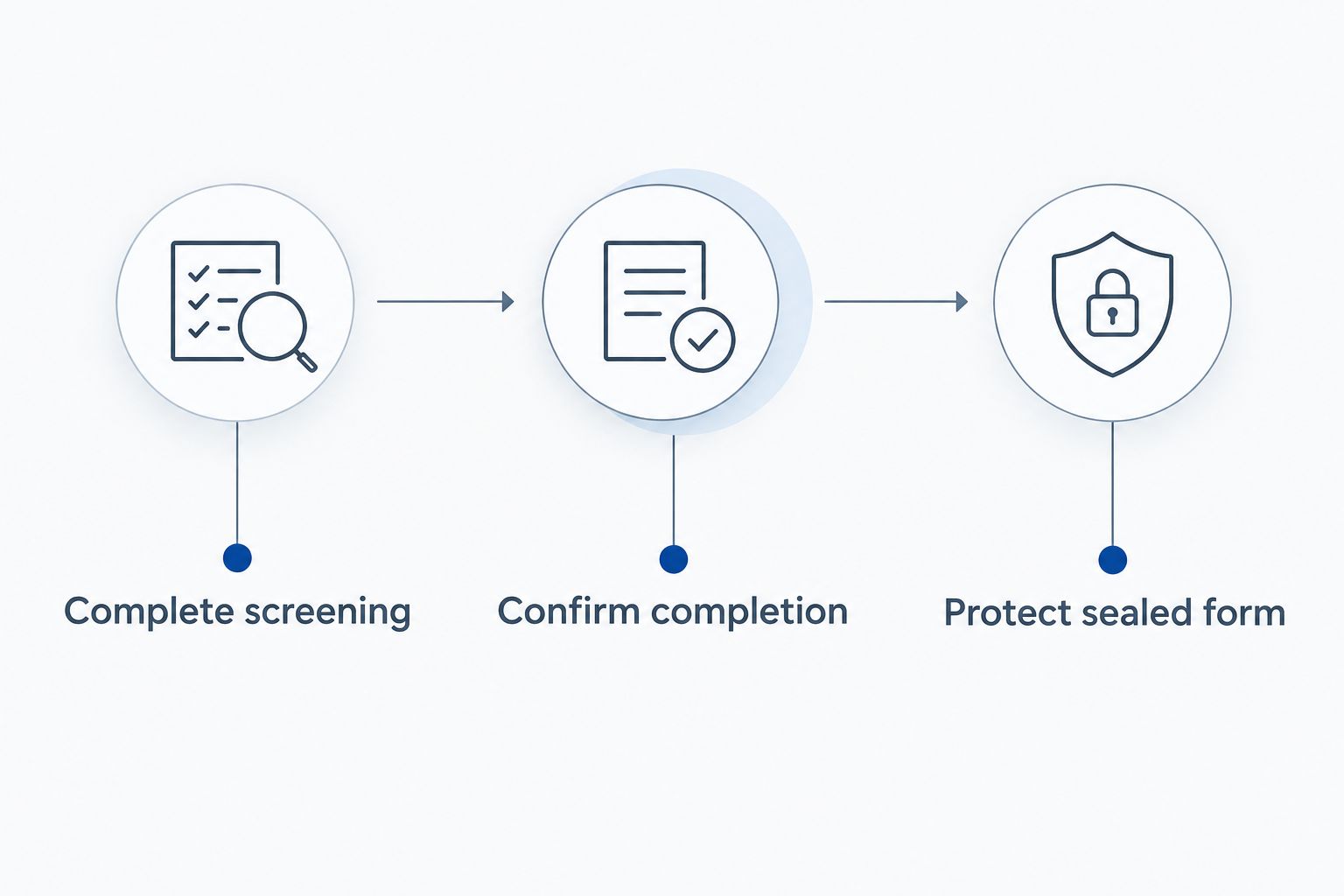
6. Confirm completion and protect the sealed form
An appointment and a completed Form I-693 are different milestones. Your civil surgeon must have the information needed to finish the form, including required laboratory results, vaccination documentation, and any necessary follow-up.
ImmigrationMedicalExams.com describes standard completion as 3 business days, with a 2-business-day expedited option subject to scheduling, laboratory results, required vaccinations, and additional documentation. Those timeframes are not promises that every applicant's examination can finish before an unresolved medical issue is evaluated.
Before leaving, ask what remains outstanding and how the clinic will communicate the next step. When you receive the sealed form, keep the envelope sealed for USCIS. Ask for a separate personal copy rather than opening the submission packet.
- Confirm whether any laboratory results or records remain outstanding.
- Ask who will contact you about required follow-up.
- Check the identifying information on your personal copy.
- Keep the USCIS submission envelope sealed.
- Coordinate submission timing with your attorney when applicable.
Compare your options for the examination and supporting care
Choose the clinician based on the task you need completed. Immigration documentation and ongoing obesity care serve different purposes, even when both involve reviewing your health history.
| Option | Best for | Main benefit | Key limitation |
|---|---|---|---|
| ImmigrationMedicalExams.com | Southern California applicants seeking a dedicated Form I-693 clinic | Coordinates the civil surgeon examination, required testing, vaccination review, and sealed form | Examinations take place in Costa Mesa; the clinic does not replace ongoing primary care |
| Another USCIS-designated civil surgeon | Applicants seeking a different location or office arrangement | Can perform the authorized domestic immigration medical examination | You need to confirm that office's testing, vaccination, and documentation process |
| Your usual treating clinician | Managing obesity and related conditions or supplying treatment records | Knows your ongoing health history and treatment | Cannot replace the Form I-693 civil surgeon examination unless also USCIS-designated |
Choose a designated civil surgeon for Form I-693 and your treating clinician for ongoing health management. You do not need to choose one role instead of the other.
Common mistakes applicants with obesity make
Delaying the visit to lower BMI
A lower BMI is not a prerequisite for Form I-693. Schedule around your document needs and filing plan, not an invented immigration weight target.
Leaving weight-related treatment off the medication list
Include treatment for obesity and related conditions when you report your medications. The civil surgeon needs an accurate history; hiding treatment does not improve the quality of your examination.
Assuming obesity changes every testing requirement
Obesity alone does not replace the age-based and clinical rules for tuberculosis screening or vaccination review. Follow the requirements that apply to your examination rather than requesting extra tests based only on BMI.
Confusing a quick appointment with a completed packet
An early appointment does not remove the need for laboratory results or follow-up. For a 2026 filing plan, leave room for the actual completion process and ask about any unresolved items.
Using the immigration visit as a replacement for regular care
The civil surgeon visit documents the required immigration medical assessment. Continue your usual care for weight management, diabetes, blood pressure, or other conditions with the clinician who manages those treatments.
FAQ
Can obesity make me fail my immigration medical exam?
Obesity alone does not establish a health-related ground of inadmissibility. Your civil surgeon evaluates the required screening and any relevant medical conditions, while USCIS makes the immigration decision.
Is there a maximum BMI for a green card medical exam?
There is no USCIS BMI cutoff for the Form I-693 immigration medical examination. BMI is not a pass-or-fail score, and you do not need to reach a target weight before scheduling.
Do I need to lose weight before my civil surgeon appointment?
No, weight loss is not a prerequisite for the civil surgeon examination. Bring accurate records and explain any treatment or limitations that affect your visit.
Should I stop my weight-loss medication before the examination?
Do not stop prescribed medication solely to prepare for your immigration medical examination. Bring your medication list and ask your treating clinician about any treatment changes.
Does obesity mean I need a chest X-ray for Form I-693?
Obesity alone does not require a chest X-ray for Form I-693. The civil surgeon follows the CDC tuberculosis instructions and determines whether screening findings or other applicable criteria require an X-ray.
Can my regular doctor complete my immigration medical form?
Your regular doctor can perform the domestic Form I-693 civil surgeon examination only if the doctor is USCIS-designated. A treating clinician who is not designated can still provide relevant medical records.
Will obesity make my immigration medical exam take longer?
Obesity alone does not create a separate examination timeline. Completion depends on required results, vaccination review, relevant documentation, and any indicated follow-up—not BMI by itself.
One last thing
The most useful preparation is not a new weight measurement. It is a clear explanation of your current health: what you take, what treatment you receive, and what assistance you need during the visit.
For your 2026 examination, focus on complete records and correct Form I-693 preparation. That keeps the appointment centered on the requirements rather than a BMI rule that does not exist.
Schedule Your Immigration Medical Exam
Arrange your civil surgeon visit in Costa Mesa and confirm what to bring.