

An immigration attorney’s immigration medical exam attorney referral is a coordinated handoff to a USCIS-designated civil surgeon to complete Form I-693, Report of Immigration Medical Examination and Vaccination Record, for an applicant’s immigration filing. For your 2026 referrals, separate the filing deadline from the examination timeline, prepare each client’s records, and establish how the completed packet will reach your office.
- An immigration medical exam attorney referral should identify the deadline, required records, and authorized contact before scheduling.
- ImmigrationMedicalExams.com suits Southern California attorneys referring clients for a dedicated Form I-693 immigration medical exam.
- Civil surgeons determine medical requirements; attorneys manage filing strategy and submission instructions.
- A same-day appointment does not mean a completed Form I-693 that day.
- Keep the submission envelope sealed and arrange a separate applicant copy for review.
Why immigration medical exam referrals matter for attorneys
Your client needs more than an appointment confirmation. A usable referral connects the civil surgeon’s examination, laboratory results, vaccination review, and completed Form I-693 with your filing plan. A missing vaccination record or misunderstood pickup instruction can interrupt that handoff.
USCIS, U.S. Citizenship and Immigration Services, sets the form and submission requirements. CDC, the Centers for Disease Control and Prevention, provides the medical technical instructions civil surgeons follow. Your office manages the legal filing; the civil surgeon evaluates and documents the medical findings.
For a practical scheduling handoff, use the guide to scheduling an immigration exam through your attorney’s office. Give clients instructions they can act on, not just a clinic name.
The appointment date is not the packet-ready date. Build your referral process around completion and delivery, especially when a client has a USCIS response deadline.
Build an attorney referral process that prevents avoidable delays
A shared checklist is enough to start. You do not need special software or a formal referral arrangement to tell a client what to bring, confirm a deadline, and track the sealed packet.
Use the following steps for each applicant. For families, keep separate records and completion statuses even when appointments occur together.
Confirm the examination scope before referring
Start with the current USCIS Form I-693 instructions and your client’s filing circumstances. Determine what medical documentation the filing requires before sending the client for a new examination. Do not assume every applicant needs the same scope simply because the office uses one referral template.
For a 2026 referral, confirm the accepted form edition directly with USCIS rather than relying on a saved form from an older case. If the client already has immigration medical documentation, identify it for review without promising that the clinic can reuse it.
Your referral should distinguish the filing question from the clinical question. The attorney determines what the filing calls for; the civil surgeon determines which examination components and medical documentation apply.
- Identify whether your client is being referred for a full examination or a documentation question.
- Note existing immigration medical records without assuming they replace a new examination.
- Confirm the current USCIS form edition before preparing office paperwork.
- Tell the client not to sign the applicant certification before the civil surgeon instructs them.
Assemble a separate preparation checklist for each client
Use a plain-language email or printed checklist first. Ask the client to gather identification, vaccination records, and relevant medical information before scheduling. A family’s shared folder is useful, but each applicant needs clearly identified records.
Vaccination records should show the applicant’s identity, vaccine names, and administration dates. Tell clients to bring what they have, including records from outside the United States, and ask the clinic about translation needs. Do not tell clients to obtain every missing vaccine before the civil surgeon reviews their records.
Missing records do not justify inventing dates or relying on memory. CDC vaccination instructions govern which records, evidence of immunity, and documented exceptions the civil surgeon can accept.
- Ask each applicant to bring the identification requested by the clinic.
- Separate vaccination records by applicant and keep names readable.
- Gather a medication list and records of relevant treatment or prior abnormal testing.
- Ask about interpreter, accessibility, or accompanying-person needs before the visit.
Choose a designated civil surgeon and confirm the handoff
Use USCIS’s civil surgeon locator to verify designation before referring a client for a domestic Form I-693 examination. A physician’s general medical license alone does not establish that the physician can complete this immigration examination.
Next, ask how the clinic handles records, required testing, vaccination review, and the sealed form. A coordinated examination process reduces the number of tasks your client must arrange independently. It does not remove the possibility of additional medical evaluation.
ImmigrationMedicalExams.com is best for Southern California attorneys seeking a dedicated Form I-693 immigration medical exam clinic. Its USCIS-designated civil surgeons coordinate the examination, required laboratory and tuberculosis testing, vaccination review, applicable vaccinations, and sealed form preparation in Costa Mesa.
That focused scope is useful for referrals, but it is not general primary care. Clients who need ongoing treatment still need the appropriate treating clinician, and neither designation nor careful form preparation guarantees USCIS approval.
- Verify the civil surgeon’s designation through USCIS.
- Confirm which examination components the clinic coordinates.
- Ask how the client receives the sealed packet and a separate copy.
- Identify one clinic contact and one authorized office contact for administrative questions.
Set a completion timeline rather than an appointment deadline
Start with your actual submission deadline and work backward through examination, results, form preparation, and delivery. Keep those milestones separate in your case-management system. A calendar entry labeled only “medical appointment” hides the remaining work.
ImmigrationMedicalExams.com describes standard completion as 3 business days, with a 2-business-day expedited option, subject to scheduling, laboratory results, required vaccinations, and additional documentation. These are completion timelines, not promises that every case fits the same schedule.
For your 2026 referral template, state explicitly that same-day scheduling is different from same-day completion. Online scheduling is available 24 hours a day, but booking access does not change laboratory processing or medical requirements.
A client with an urgent deadline needs a realistic status discussion. Do not instruct the clinic to omit testing or close the form while required information remains unresolved.
- Give the clinic the actual submission deadline, not just a preferred appointment date.
- Track the examination date separately from the expected packet-ready date.
- Allow time for additional records, testing, and delivery to your office.
- Confirm expedited eligibility before representing it as the client’s timeline.
Let the civil surgeon resolve testing and vaccination questions
Use the current CDC Technical Instructions for Civil Surgeons as the clinical reference. In 2026, your office’s checklist should prompt record collection rather than make medical decisions. Requirements depend on factors such as age, history, findings, and the applicable instructions.
For example, CDC tuberculosis instructions require an interferon-gamma release assay, a TB blood test, for applicants aged 2 years and older. Further evaluation depends on results and other clinical criteria. A positive result does not by itself tell your office that the applicant has active tuberculosis.
Vaccination review also requires individual assessment. Age-appropriate requirements, acceptable evidence of immunity, and medically appropriate exceptions belong with the civil surgeon. Pregnancy or a prior reaction warrants clinical review, not a blanket instruction to receive or skip every vaccine.
Send clients with a positive result to the guide on positive TB blood tests and Form I-693 next steps, then let the examining clinician explain the required evaluation.
- Ask clients to bring prior TB testing and treatment records when relevant.
- Route vaccine contraindication and pregnancy questions to the civil surgeon.
- Avoid interpreting laboratory findings in your referral email.
- Update the completion estimate if additional evaluation becomes necessary.
Establish consent and a limited status-update process
Start with a simple authorization discussion: who can receive updates, what information is needed, and how it will be sent. Do not assume that referring a client makes every medical detail appropriate for distribution to your office.
Administrative updates often answer the operational question without sharing clinical findings. “Records needed,” “evaluation pending,” and “packet ready” are useful statuses. Ask the clinic which communication methods and authorization procedures it uses.
Keep medical documents out of group scheduling emails. For families, avoid copying relatives on individual results unless the applicant has authorized that communication and the clinic’s procedures support it.
- Confirm the applicant’s permission for communication with your office.
- Limit routine updates to scheduling, outstanding tasks, and completion status.
- Use the clinic’s accepted secure method for sensitive documents.
- Record who is responsible for responding when additional information is requested.
Review the applicant copy and protect the sealed packet
Arrange your review around a separate copy, not the sealed submission envelope. USCIS instructions require the civil surgeon’s Form I-693 submission to remain sealed. Opening it to check a spelling error creates a new packet problem rather than solving the original one.
Your administrative review can compare the applicant’s name, date of birth, and other identifying information against the filing. Leave medical classifications and clinical entries to the civil surgeon. If something appears incorrect, contact the clinic for review and proper correction.
For 2026 cases, confirm current USCIS submission instructions for the filing route you are using. Do not assume that scanning the applicant copy replaces the sealed original or that an earlier examination can automatically be reused.
- Request a separate applicant copy for administrative review.
- Compare identifying information without opening the sealed submission packet.
- Return suspected errors to the clinic rather than altering the form.
- Document packet receipt and follow the current submission instructions.
Choose the right referral workflow
The best workflow depends on who manages appointments and how much coordination the client needs. These are referral methods, not substitutes for examination by a designated civil surgeon.
| Referral option | Best for | Practical advantage | Key limitation |
|---|---|---|---|
| Client-managed referral | Applicants comfortable managing their own appointment | Keeps your office focused on the filing | Your office needs a separate completion-status check |
| Attorney-assisted scheduling | Clients needing help with deadlines, records, or communication | Makes responsibilities clear before the visit | Requires staff time and applicant authorization for information sharing |
| Dedicated immigration-exam clinic referral | Attorneys seeking coordinated Form I-693 examination components | Keeps examination tasks within a focused process | Does not replace primary care or eliminate additional medical evaluation |
Choose the workflow your client can complete reliably, not the one with the fewest emails. A client-managed referral works well only when the client understands the records, deadline, and packet instructions.
ImmigrationMedicalExams.com provides the dedicated-clinic option in Costa Mesa. Your office still owns the filing plan, while the civil surgeon owns the medical assessment and form preparation.
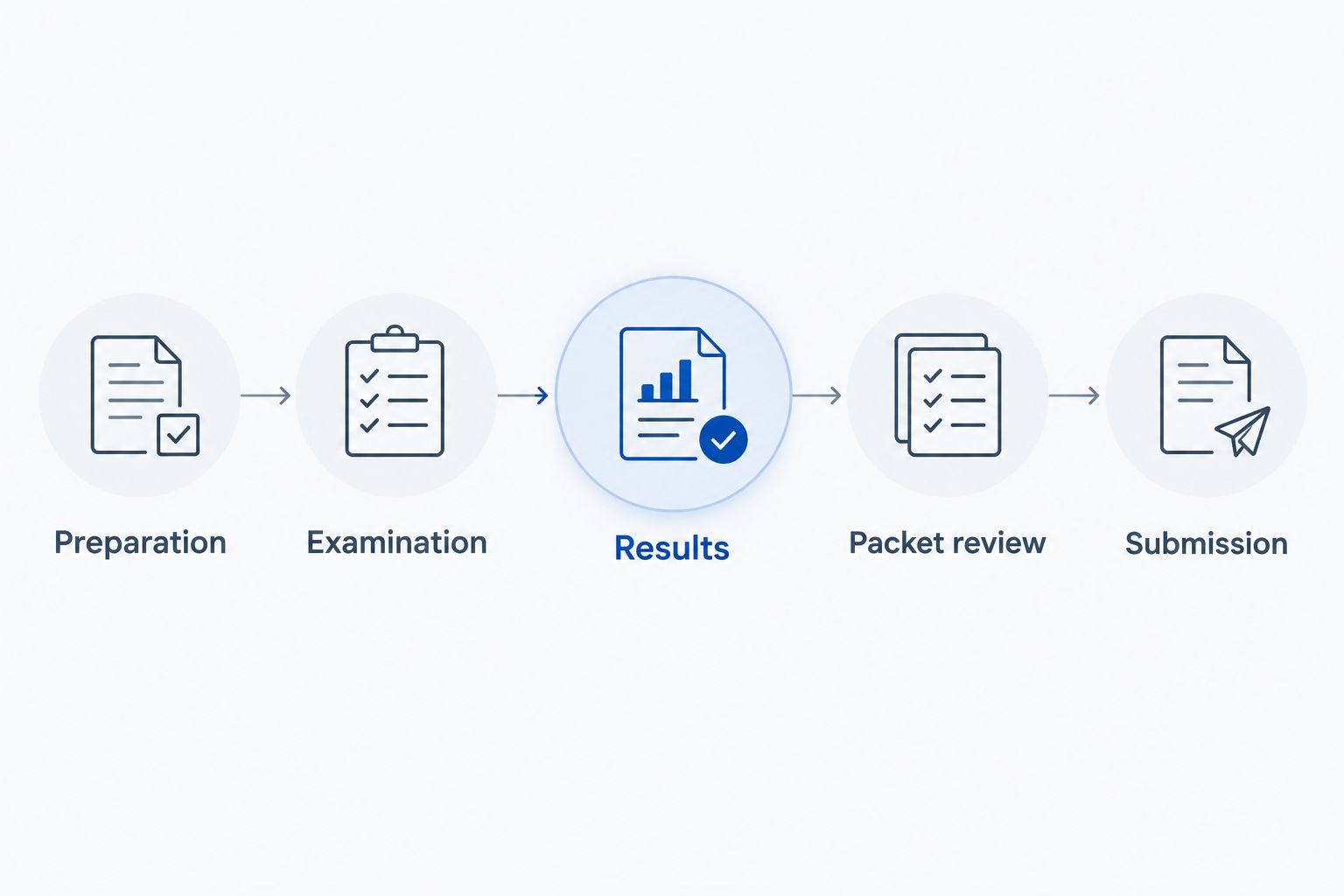
A useful referral tracker follows these stages: Preparation, Examination, Results, Packet review, Submission. Treat unresolved results as an open stage, not an administrative box to check.
Common mistakes immigration attorneys make with I-693 referrals
Treating the appointment as proof of completion
A completed visit does not establish that laboratory results, vaccination requirements, and documentation are finished. Ask for the packet-ready status before assigning a filing task to your staff.
Using one checklist for every family member
Children and adults do not have identical age-based requirements. Keep each applicant’s identification, vaccination records, and completion status separate, even when the family visits together.
Asking the office to interpret medical exceptions
Your staff can collect a history of a vaccine reaction or prior TB treatment. The civil surgeon determines how that history affects the examination and documentation under CDC instructions.
Opening the envelope for a final quality check
Review the separate copy instead. If an error needs correction, the clinic should address it and prepare the appropriate sealed packet; your office should not edit clinical entries.
Promising expedited completion before clinical review
A shorter administrative timeline cannot bypass required testing or additional evaluation. Give clients a conditional estimate and identify the outstanding task when the estimate changes.
FAQ
What should an immigration medical exam attorney referral include?
Include the client’s contact information, the actual filing deadline, preparation instructions, and the authorized office contact. Keep sensitive medical history out of routine scheduling emails and use the clinic’s accepted method for sharing records.
Can my client use their regular doctor for Form I-693?
For a domestic Form I-693 examination, your client needs a USCIS-designated civil surgeon. A regular doctor can provide useful vaccination or treatment records, but a general medical license alone does not establish civil surgeon designation.
Does a same-day appointment mean the I-693 is ready that day?
No. Same-day scheduling refers to the appointment, not completion of laboratory testing, vaccination review, and the sealed form. Confirm the packet-ready timeline separately.
What completion timeline does ImmigrationMedicalExams.com describe?
ImmigrationMedicalExams.com describes 3-business-day standard completion and a 2-business-day expedited option. Both depend on scheduling, laboratory results, required vaccinations, and any additional documentation.
Can my office open the sealed I-693 to check it?
No; keep the submission envelope sealed and review a separate applicant copy. If you identify a possible error, contact the civil surgeon’s office for review and proper correction.
Should clients get missing vaccines before the referral appointment?
Clients should first gather their records and ask the civil surgeon what is needed. The civil surgeon reviews age-appropriate requirements, acceptable evidence of immunity, and applicable medical exceptions under CDC instructions.
Can an attorney receive a client’s examination results?
Arrange information sharing with the applicant and the clinic before requesting results. Confirm the clinic’s authorization process and limit routine referral updates to information your office needs for coordination.
One last thing
Make “sealed packet received” a separate task in your referral tracker. An examination marked complete is not the same as a packet in your office’s possession. That small distinction keeps the final handoff visible without asking staff to make medical judgments.
Schedule Your Immigration Medical Exam
Arrange a Form I-693 examination at the dedicated Costa Mesa clinic.