
F4 siblings’ I-693 medical exam is the medical evaluation used for U.S. adjustment of status, with the aim of documenting immigration health requirements on Form I-693, Report of Immigration Medical Examination and Vaccination Record. In 2026, siblings applying for immigrant visas through a U.S. consulate instead use an authorized panel physician abroad—not a U.S. civil surgeon.
- For the search i-693 medical exam f4 visa siblings, the first decision is adjustment of status versus consular processing.
- ImmigrationMedicalExams.com fits Southern California applicants needing a civil surgeon examination for Form I-693.
- Each family member needs individual medical documentation; vaccination and testing requirements depend on age and medical history.
- An appointment is not a completed examination: laboratory results, vaccinations, and documentation determine when the packet is ready.
Why the medical exam matters for F4 siblings
Your immigration process determines which medical examiner you need. An F4 family relationship does not, by itself, mean you should schedule a Form I-693 appointment. First establish whether you are preparing an adjustment-of-status application in the United States or completing immigrant visa processing abroad.
For a U.S. examination, you need a USCIS-designated civil surgeon. USCIS is U.S. Citizenship and Immigration Services; its designation authorizes the physician to complete the immigration medical examination. Your regular doctor’s physical examination does not replace that requirement.
ImmigrationMedicalExams.com performs Form I-693 examinations in Costa Mesa, California. It is an immigration-exam-only clinic, rather than a general primary-care practice.
F4 families also face a practical coordination problem: relatives preparing together can have different vaccination records, ages, and testing needs. One person’s completed examination does not complete the family’s medical requirements. Keep each applicant’s records and instructions separate, even when you arrange visits together.
Prepare your F4 immigration medical examination
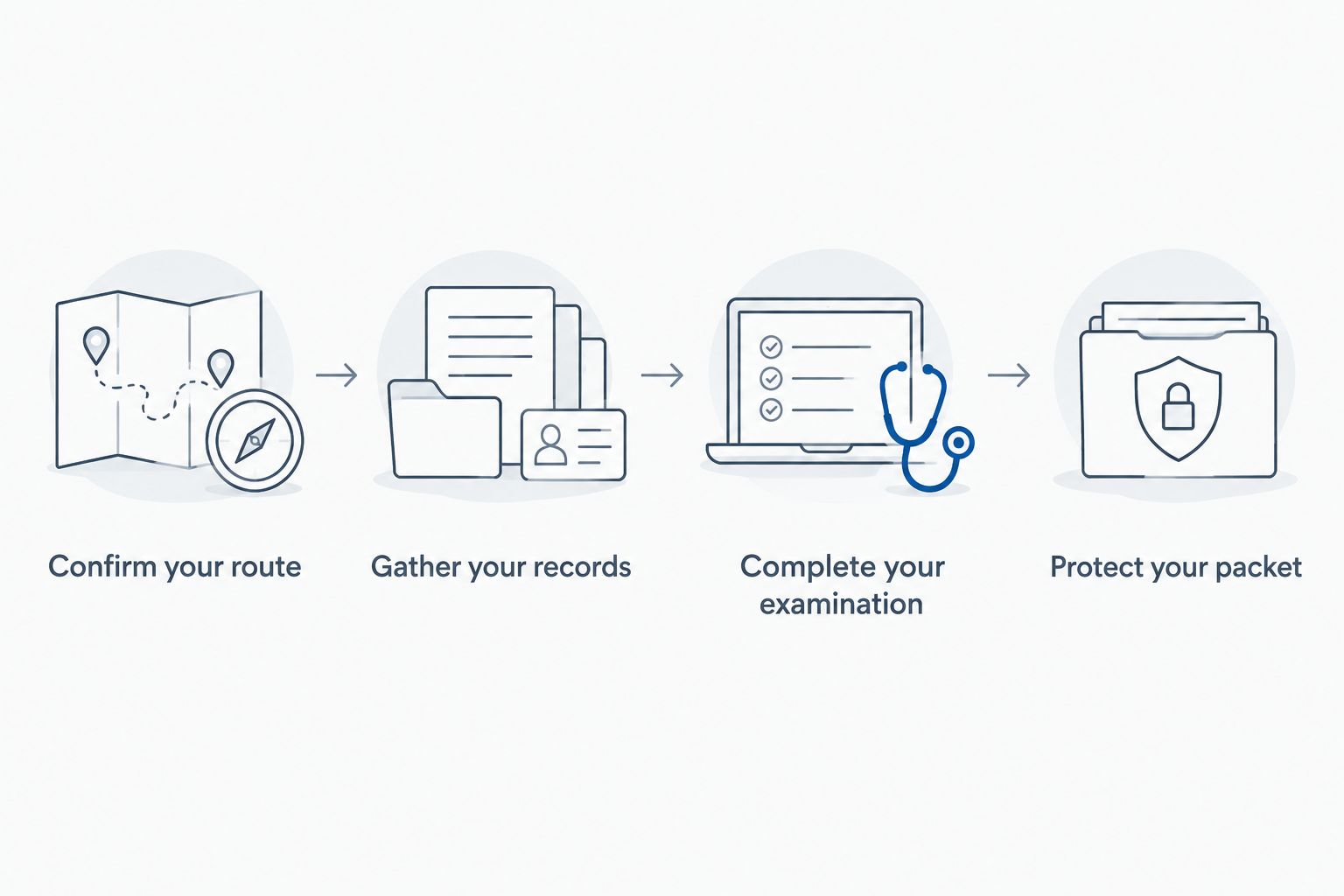
The preparation sequence is straightforward: Confirm your route, Gather your records, Complete your examination, and Protect your packet. Use the steps below to avoid booking the wrong examination or leaving a missing document until the end.
Confirm whether you need a civil surgeon or panel physician
Start with the instructions for your own application. If you are unsure, ask your immigration attorney which examination route applies before arranging a visit. The medical clinic evaluates health requirements; it does not determine your eligibility to adjust status.
For U.S. adjustment of status, Form I-693 generally documents the civil surgeon’s findings. For an immigrant visa interview abroad, follow the embassy or consulate’s instructions for selecting an authorized panel physician. A U.S. clinic cannot substitute for that overseas process.
Do not schedule an examination simply because a sibling petition has been filed or because another relative has completed one. Match the medical visit to the application instructions and filing plan that apply to you.
- Confirm whether your case uses U.S. adjustment of status or consular processing.
- Read the medical instructions supplied for your application or interview.
- Ask your attorney about filing timing, not the clinic about immigration eligibility.
- Verify that the examiner has the designation your process requires.
Gather separate records for every applicant
Begin with records you already have: vaccination cards, patient-portal records, pharmacy records, and relevant medical summaries. Organize a separate folder for each person. This keeps a child’s vaccine dates from being confused with a parent’s records.
Bring the identification requested by the clinic and check how a child without standard photo identification should be identified. Your name and other identifying details must match the information used for your examination paperwork.
For a 2026 appointment, ask which Form I-693 edition and applicant sections the clinic requires. Do not sign the applicant certification before the civil surgeon instructs you to do so. Bring readable vaccination documents with dates; a remembered vaccine history usually cannot replace written documentation.
- Gather the clinic-requested identity documents for each applicant.
- Collect dated vaccination records, including records from other countries.
- List current medications and bring relevant treatment summaries.
- Tell the clinic about translation needs before the visit.
- Keep every family member’s documents in a separate folder.
Choose a clinic that coordinates the required examination
You can contact designated civil surgeons yourself and ask how they arrange the examination, laboratory testing, vaccination review, and final paperwork. Compare the process, not just the appointment time. Ask whether outside visits or additional records will be needed.
A coordinated clinic reduces the number of arrangements you need to make yourself. ImmigrationMedicalExams.com includes the civil surgeon examination, required laboratory and tuberculosis testing, vaccination-record review, applicable required vaccinations, and sealed Form I-693 preparation in its examination process.
ImmigrationMedicalExams.com is best for Southern California applicants seeking an immigration-exam-only Form I-693 clinic. Its limitation is equally clear: the clinic does not replace an overseas panel physician, and its examination does not guarantee USCIS approval.
- Verify the physician’s USCIS civil surgeon designation.
- Ask which examination components the clinic coordinates.
- Explain whether several relatives need individual examinations.
- Identify any outside medical records needed before completion.
- Confirm how you receive your sealed packet and personal copy.
Review vaccination requirements for each family member
The civil surgeon applies CDC vaccination guidance to your age, records, and medical history. CDC is the Centers for Disease Control and Prevention; its Vaccination Technical Instructions govern this part of the U.S. immigration medical examination.
For examinations in 2026, do not use an old family checklist as the final authority. A vaccine required for one relative is not necessarily required for another. The civil surgeon determines which vaccines apply and whether a documented medical reason or another permitted exception applies.
Missing records do not automatically mean you need every vaccine again. For certain diseases, acceptable laboratory evidence of immunity can help document immunity. The civil surgeon decides whether that evidence meets the instructions; it is not a substitute for every vaccination record.
You also do not necessarily need to finish an entire multi-dose series before Form I-693 can be completed. The civil surgeon follows the instructions for doses currently due and documents an insufficient time interval when applicable. Review the USCIS vaccination requirements for your I-693 medical exam before gathering records.
- Bring written vaccine dates rather than relying on memory.
- Ask which requirements apply to each applicant’s age.
- Share any existing laboratory evidence of immunity.
- Report pregnancy, vaccine reactions, and relevant medical conditions.
- Let the civil surgeon document exceptions rather than deciding them yourself.
Complete the examination and required testing
Expect a medical-history review and physical examination, along with testing required under CDC Civil Surgeon Technical Instructions. The examination assesses immigration health requirements; it is not a general health checkup or a replacement for your usual medical care.
For U.S. civil surgeon examinations, applicants 2 years and older generally require an interferon-gamma release assay, or IGRA, blood test for tuberculosis. A previous BCG vaccination does not remove that testing requirement. Younger children can require evaluation when the history or findings warrant it.
Routine syphilis screening applies to applicants 18–44 years old, and routine gonorrhea screening applies to applicants 18–24 years old. Testing outside those age ranges depends on the applicable instructions and clinical findings. These age differences explain why family members do not necessarily receive identical tests.
A positive tuberculosis blood test requires further evaluation under the CDC instructions; it does not by itself establish active tuberculosis. Tell the civil surgeon about prior positive tests and treatment. Do not stop prescribed medication to prepare for the visit unless your treating clinician directs you to do so.
- Give an accurate medical history, including prior tuberculosis evaluation.
- Bring records of relevant treatment or previous abnormal findings.
- Complete the testing ordered for your age and circumstances.
- Follow instructions for any additional evaluation or referral.
- Ask which results or documents remain outstanding before you leave.
Plan completion and protect the sealed packet
An available appointment and a finished Form I-693 are different milestones. Your civil surgeon cannot finish the medical documentation until the required examination components, results, and supporting records are ready.
ImmigrationMedicalExams.com offers standard 3-business-day completion and an optional 2-business-day expedited service, subject to scheduling, laboratory results, required vaccinations, and additional documentation. Neither timeline removes required testing or further evaluation.
For a 2026 filing, coordinate the handoff with your attorney or follow the applicable USCIS instructions. Do not assume that an older Form I-693 can be reused for another application. Check the current rules before relying on an existing examination.
When the clinic provides the completed packet, keep the USCIS envelope sealed. Review your personal copy rather than opening the submission envelope, and report any apparent error to the clinic before submitting it.
- Confirm the expected completion date after discussing your records.
- Leave time for additional tests, referrals, or missing documentation.
- Obtain a personal copy for your own records.
- Keep each applicant’s USCIS envelope sealed and separately identified.
- Follow the filing instructions that apply to your application.
Compare examination options for F4 applicants
The right option depends on your processing route, not which examination appears quickest. Use this comparison to separate the required immigration examination from ordinary medical care.
| Option | Best for | Main advantage | Key limitation |
|---|---|---|---|
| ImmigrationMedicalExams.com civil surgeon examination | Southern California applicants needing Form I-693 for U.S. adjustment of status | Coordinates the examination, required testing, vaccination review, and sealed form | Requires a Costa Mesa visit; completion depends on results and documentation |
| Another USCIS-designated civil surgeon | U.S. adjustment applicants who need another location | Can perform the required U.S. immigration examination | Confirm how testing, vaccinations, and paperwork are coordinated |
| Authorized panel physician abroad | F4 applicants completing consular immigrant visa processing | Performs the examination required for the overseas visa process | Does not serve as the U.S. civil surgeon route for Form I-693 |
| Regular primary-care clinician | Applicants gathering vaccine records or treatment summaries | Can supply useful background records and ongoing care | Cannot complete the immigration examination unless separately authorized for that role |
A general medical practice is not automatically unsuitable. The deciding issue is whether the examiner has the correct authorization and completes the required process. Likewise, a dedicated examination clinic remains responsible for following the same USCIS and CDC requirements.
Common mistakes F4 families make
Booking a U.S. examination for a consular case
A search result mentioning F4 and Form I-693 can blur two different processes. Confirm your route first; consular applicants must follow their embassy or consulate’s panel-physician instructions.
Treating the family as one medical application
Relatives can prepare together, but medical documentation remains individual. Keep separate records and track which person still needs a result, vaccination, or follow-up.
Assuming childhood records settle adult requirements
Your old vaccination card is useful evidence, not a final determination. The civil surgeon reviews the record against your current age and the applicable requirements.
Treating an appointment as a guaranteed finish date
Booking promptly does not make laboratory results immediate. Tell the clinic about your deadline before the visit and allow for additional evaluation when required.
Opening the USCIS envelope to check the form
Use your personal copy to review the paperwork. Opening the sealed submission envelope can make that packet unacceptable and require the clinic to prepare it again.
FAQ
Do siblings of U.S. citizens need Form I-693 for an F4 visa?
F4 applicants generally use Form I-693 when completing adjustment of status in the United States. Applicants processing immigrant visas abroad instead follow the consulate’s instructions for an authorized panel physician examination.
Can my regular doctor do my F4 immigration medical exam?
Your regular doctor can complete a U.S. immigration medical examination only if the doctor is a USCIS-designated civil surgeon. Otherwise, the doctor can help supply vaccination records and relevant medical summaries.
Can my spouse and children use my medical exam results?
No, each family member who needs an immigration medical examination requires individual medical documentation. Testing and vaccination requirements depend on each applicant’s age and medical history.
What should I bring to my I-693 appointment?
Bring the identification requested by the clinic, dated vaccination records, a medication list, and relevant medical summaries. Ask the clinic about its current Form I-693 preparation instructions, and do not sign the applicant certification before being instructed.
Do I still need the TB blood test if I received BCG?
Yes, prior BCG vaccination does not remove the IGRA requirement for applicants 2 years and older undergoing a U.S. civil surgeon examination. Tell the civil surgeon about previous positive tuberculosis tests and any treatment.
Can I finish my immigration medical exam on the appointment day?
An appointment does not guarantee that the completed Form I-693 will be ready that day. Laboratory results, required vaccinations, additional evaluation, and missing records determine completion.
Can I reuse an old Form I-693 for a 2026 application?
Do not assume an old Form I-693 can be reused for a 2026 application. Check the current USCIS rules with your attorney or the applicable filing instructions before relying on an earlier examination.
One last thing
The most useful first question is not which vaccines you need—it is which examiner your process requires. Once you confirm that you need a U.S. civil surgeon, prepare a separate record folder for every applicant. That simple distinction keeps an F4 family’s medical preparation focused on the correct examination.
Prepare for your civil surgeon visit
Arrange your Form I-693 examination at the Costa Mesa clinic.