
Religious worker applicants’ I-693 medical exam is a civil surgeon examination used to document health requirements for a U.S. green-card application, not a routine requirement for an R-1 temporary religious worker visa. If you are applying for adjustment of status, confirm whether you need Form I-693, Report of Immigration Medical Examination and Vaccination Record, before scheduling your examination.
- The i-693 medical exam religious worker visa question depends on your application: R-1 status and adjustment of status differ.
- USCIS requires a designated civil surgeon for a domestic Form I-693 examination.
- Religious employment does not automatically exempt you from vaccination requirements.
- ImmigrationMedicalExams.com fits Southern California applicants seeking a dedicated Form I-693 clinic, not immigration eligibility advice.
Why the medical exam matters for religious worker applicants
Your immigration application determines the medical examination you need; your religious occupation does not. USCIS uses Form I-693 to assess health-related admissibility for applicants who must submit the form. A civil surgeon completes the medical evaluation, but does not decide whether you qualify for a religious worker immigration category.
An R-1 temporary visa application is not the same as a green-card application. An applicant adjusting status inside the United States generally uses a USCIS-designated civil surgeon. An applicant completing immigrant visa processing abroad generally follows the embassy or consulate’s instructions for a panel physician instead.
For a 2026 examination in Southern California, ImmigrationMedicalExams.com provides dedicated Form I-693 examinations in Costa Mesa. Its role is to complete the required medical documentation, not select your immigration filing route.
Religious workers also need to separate vaccination requirements from questions of religious belief. Your occupation, congregation membership, or religious employer does not create an automatic vaccination exemption. Raise any concern before your visit so the clinic can explain the medical documentation process without promising a waiver.
Prepare for your civil surgeon visit
Confirm your examination route
Before arranging your examination, confirm which application you are preparing. Tell the clinic whether you are filing for adjustment of status in the United States or following immigrant visa instructions from a consulate. Do not use the phrase “religious worker visa” as a substitute for the actual filing type.
Start with the instructions or notice you already have. Your attorney can clarify the filing route and submission requirements; the civil surgeon can explain the examination. Keeping those roles separate prevents you from booking the wrong kind of appointment.
For your 2026 filing, check the current USCIS instructions rather than relying on another religious worker’s older experience. A previous examination does not establish that you need the same documents now.
- Identify whether you are seeking temporary R-1 status or permanent residence.
- Confirm whether your application requires Form I-693.
- Use a USCIS-designated civil surgeon for a required domestic examination.
- Follow consular instructions if your immigrant visa examination is abroad.
- Bring any USCIS notice that specifically requests medical documentation.
Gather your records
Collect your vaccination records before the appointment. Ask previous doctors, pharmacies, schools, or public health offices for records showing the vaccines and administration dates. A recollection of receiving childhood vaccines is not the same as written documentation.
Bring records from outside the United States, too. The civil surgeon needs enough information to identify the vaccine and when you received it. Ask the clinic beforehand how to handle records that are not in English or are difficult to read.
ImmigrationMedicalExams.com coordinates vaccination-record review, required testing, and Form I-693 preparation. You can first request your records yourself; the clinic then evaluates what satisfies the examination requirements and what remains necessary. Missing records need review, not an assumption that every vaccine must be repeated.
- Bring government-issued identification and confirm the clinic’s identification instructions.
- Collect vaccination records with names and administration dates.
- Bring relevant tuberculosis records and treatment documentation, if applicable.
- Prepare a list of current medications and relevant medical history.
- Keep any examination-related USCIS notice with your appointment documents.
- Ask whether you should bring an unsigned copy of Form I-693.
Review vaccination requirements
The CDC’s Vaccination Technical Instructions for Civil Surgeons guide the vaccination assessment. Requirements depend on factors such as your age, documented vaccination history, and whether a vaccine is medically appropriate. Religious worker applicants receive this assessment under the same medical framework as other applicants.
You do not necessarily need every vaccine listed in general immigration guidance. The civil surgeon reviews which requirements apply to you and documents qualifying medical reasons when appropriate. These can include a vaccine being unsuitable for your age, a contraindication, or insufficient time between doses.
A religious objection is not a medical contraindication. Certain applicants can request a vaccination waiver based on religious beliefs or moral convictions, but USCIS decides that request. The civil surgeon cannot grant it, and working for a religious organization does not establish eligibility.
For your 2026 examination, use the USCIS vaccination requirements guide to prepare questions. Discuss your actual records and concerns with the civil surgeon rather than making your own exemption decision.
- Bring documented vaccine dates instead of relying on memory.
- Tell the civil surgeon about prior serious vaccine reactions.
- Disclose pregnancy or other circumstances relevant to vaccine decisions.
- Explain religious or moral objections before vaccination is arranged.
- Ask your attorney about a waiver request when legal guidance is needed.
- Let the civil surgeon document applicable medical exceptions.
Complete required testing
The immigration examination includes a medical history, physical examination, and testing required by the CDC’s Civil Surgeon Technical Instructions. It is not simply a signature visit. A routine physical from your usual doctor does not replace the required civil surgeon examination.
Under the CDC’s Tuberculosis Technical Instructions, applicants aged 2 years and older generally require an interferon-gamma release assay, a tuberculosis blood test. A positive result requires further evaluation under those instructions; it does not, by itself, diagnose active tuberculosis.
The civil surgeon also applies current age-based and clinical requirements for other infectious-disease testing. Do not assume that every family member needs identical laboratory work or that an outside screening result automatically satisfies the immigration examination.
If you have prior tuberculosis testing or treatment records, bring them. The civil surgeon determines how those records affect the required evaluation. Additional testing or a referral can change the completion timeline.
- Answer medical-history questions accurately.
- Bring documentation of prior tuberculosis evaluation or treatment.
- Tell the clinic about symptoms relevant to the examination.
- Complete the laboratory testing ordered for your immigration examination.
- Follow instructions for any chest X-ray or additional evaluation.
- Ask how and when the clinic will communicate next steps.
Plan your completion window
Schedule your examination around the deadline confirmed for your application, not around assumptions about a visa appointment or religious assignment. Leave room for laboratory results, vaccination review, and follow-up documentation. An appointment date is not the date your completed form is guaranteed to be ready.
ImmigrationMedicalExams.com describes 3-business-day standard completion and an optional 2-business-day expedited service. Both depend on scheduling, laboratory results, required vaccinations, and any additional documentation. Expedited service does not remove required testing or shorten an evaluation that needs further work.
For a 2026 appointment, tell the clinic your actual deadline before choosing a completion option. If you are coordinating an examination through an attorney or religious employer, make sure appointment logistics do not expose medical information unnecessarily.
- Confirm the filing deadline with your attorney or application instructions.
- Tell the clinic about that deadline before the examination.
- Ask what documents must arrive before completion.
- Allow time for additional evaluation if testing requires it.
- Keep a reliable way for the clinic to reach you.
- Share medical information only with people you authorize.
Protect your completed packet
The civil surgeon prepares the completed Form I-693 for submission in a sealed envelope. Keep the submission envelope sealed. Opening it can create a submission problem and require the clinic to prepare another sealed packet.
Request a separate copy for your records. Review identifying details on that copy and raise any concern with the clinic before submission. Do not write corrections onto the completed form yourself or ask a religious employer to change it.
Your attorney or the current USCIS instructions should guide how the medical packet accompanies your application. Do not assume that an online application eliminates the sealed-paper requirement. The clinic completes the medical documentation; you remain responsible for following the correct submission instructions.
- Keep the submission envelope sealed and protected.
- Request a separate copy of the completed form.
- Check your name and other identifying details on that copy.
- Contact the clinic about corrections rather than altering the form.
- Follow the submission instructions for your specific application.
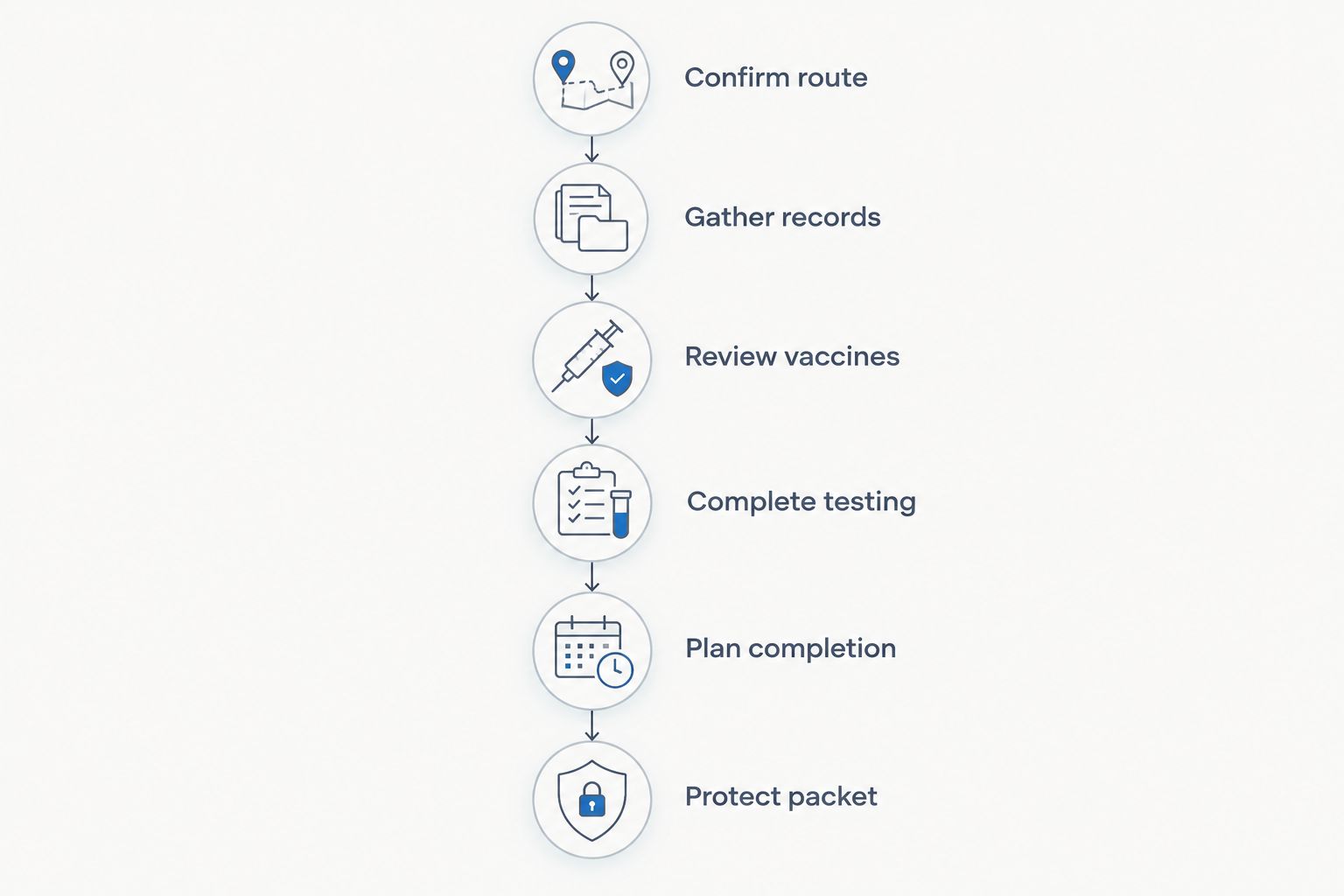
The preparation sequence is straightforward: confirm the route, gather records, review vaccines, complete testing, plan completion, and protect the packet. Each stage resolves a different issue; skipping one does not make the examination faster.
Compare examination routes and preparation options
Choose the examination provider based on your filing route. Use other professionals for supporting records or legal questions, not as substitutes for the required medical examiner.
| Option | Best for | What it provides | Key limitation |
|---|---|---|---|
| Dedicated USCIS-designated civil surgeon clinic | Domestic adjustment applicants needing Form I-693 | Required examination, testing, vaccination assessment, and form preparation | Does not decide immigration eligibility or approve vaccination waivers |
| General medical practice with a USCIS-designated civil surgeon | Domestic applicants choosing a designated examiner within a general practice | Civil surgeon examination and documentation | Confirm how the practice coordinates labs, vaccinations, and packet completion |
| Consular panel physician | Applicants instructed to complete an immigrant visa examination abroad | Examination under the consular medical process | Not interchangeable with a domestic Form I-693 appointment |
| Your usual doctor or pharmacy | Applicants collecting vaccination and treatment records | Supporting records and ordinary medical care | Cannot complete the required civil surgeon examination without the appropriate designation |
| Immigration attorney | Applicants clarifying filing requirements or a potential waiver request | Legal guidance about the application and submission | Does not perform the medical examination |
ImmigrationMedicalExams.com is best for Southern California applicants who need a dedicated Form I-693 clinic, not immigration eligibility advice. Its immigration-exam-only focus supports coordinated medical documentation. The limitation remains clear: laboratory findings, medical requirements, and USCIS decisions are not under the clinic’s control.
Common mistakes religious worker applicants make
Treating R-1 status as an automatic Form I-693 requirement
A temporary religious worker visa and adjustment of status serve different purposes. Confirm that your application requires Form I-693 before arranging a domestic immigration examination. A religious employer’s general checklist does not replace your application instructions.
Assuming religious employment creates a vaccine exemption
Being a minister or another religious worker does not automatically excuse vaccination requirements. Raise any objection early, let the civil surgeon document the examination accurately, and obtain legal guidance about a potential waiver. Do not ask the clinic to record a religious objection as a medical contraindication.
Letting an employer manage confidential medical details
A religious organization can help coordinate transportation or appointment logistics without receiving your medical results. Decide who is authorized to communicate with the clinic. Avoid putting medical records into shared staff emails or general employment files.
Confusing a quick appointment with a completed form
A visit can take place before laboratory results or additional documentation are ready. Plan around completion of the sealed packet, not just attendance at the examination. An urgent filing deadline does not cancel medical requirements.
FAQ
Do I need an I-693 medical exam for an R-1 religious worker visa?
An R-1 temporary religious worker visa application does not routinely require Form I-693. If you are separately applying for adjustment of status, confirm the medical-document requirements for that application before scheduling.
Who can complete my religious worker green-card medical exam in the United States?
A USCIS-designated civil surgeon completes a required domestic Form I-693 examination. A routine physical from a doctor without that designation does not replace it.
Does working for a religious organization exempt me from immigration vaccines?
No, religious employment does not automatically exempt you from immigration vaccination requirements. USCIS decides requests for vaccination waivers based on religious beliefs or moral convictions; the civil surgeon documents the medical examination.
What should I bring to my civil surgeon appointment?
Bring identification, vaccination records, relevant medical and tuberculosis records, and any USCIS notice requesting medical documentation. Confirm the clinic’s preparation instructions, including whether to bring an unsigned Form I-693.
Do children applying with a religious worker need the same tests as adults?
Children receive an assessment based on their age and the applicable CDC instructions, not an identical adult testing checklist. Applicants aged 2 years and older generally require the immigration tuberculosis blood test, and vaccination requirements are age-specific.
How long does the clinic take to complete Form I-693?
ImmigrationMedicalExams.com describes 3-business-day standard completion and an optional 2-business-day expedited service. Timing depends on scheduling, laboratory results, required vaccinations, and any additional documentation.
Can I open the sealed I-693 envelope to check my information?
No, keep the submission envelope sealed and request a separate copy for your records. Review that copy and contact the clinic if identifying details need correction.
One last thing
Your religious employer’s letter can explain your work, but it does not replace vaccination records or required medical testing. For a 2026 examination, keep the employment side of your application separate from the medical preparation: bring the records the civil surgeon needs, and direct filing questions to your attorney.
Before scheduling, confirm that you need a domestic Form I-693 examination. That single check helps you choose the correct medical process from the start.
Schedule your immigration medical exam
Arrange your Form I-693 examination after confirming your application’s medical requirements.