
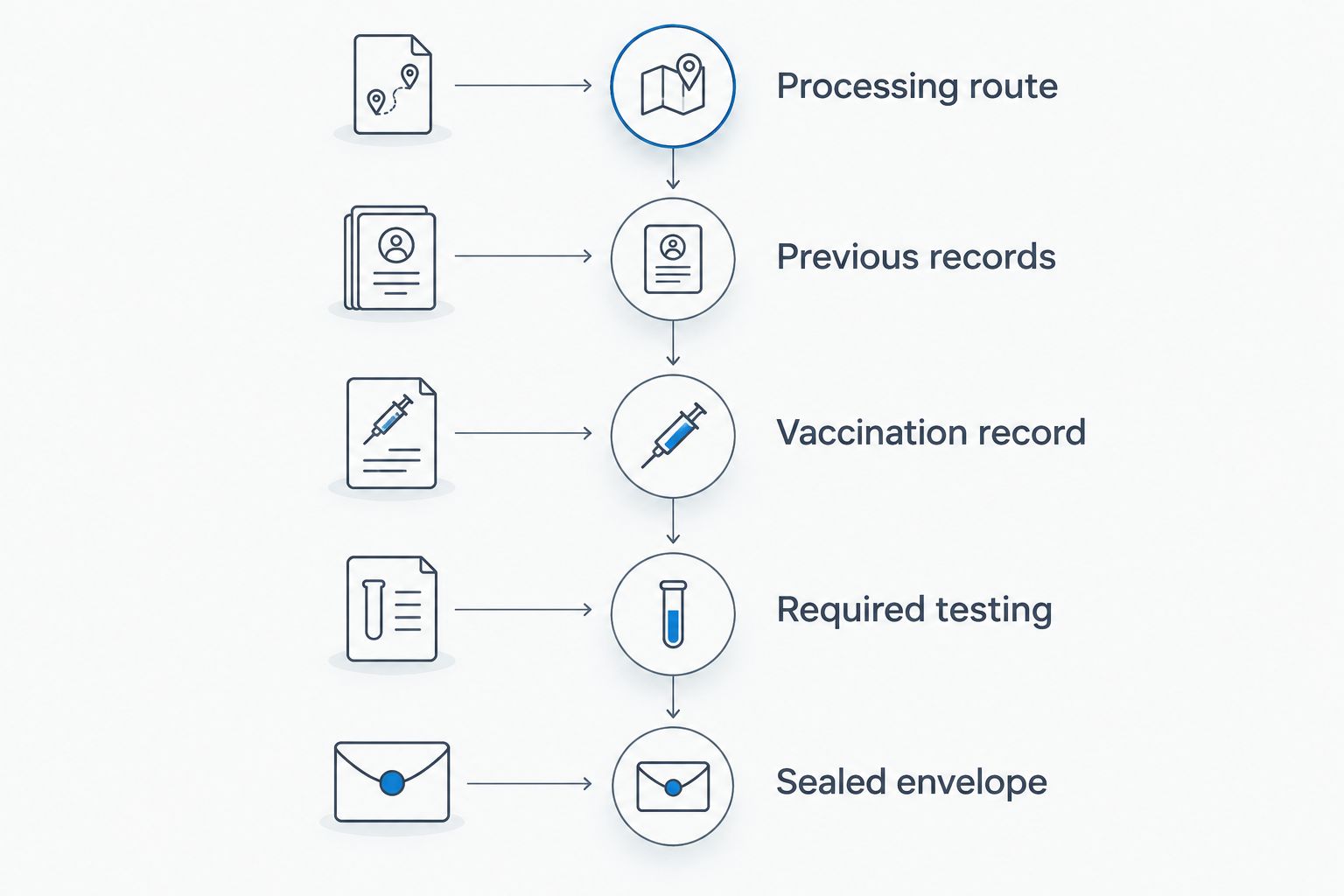
Afghan and Iraqi special immigrant applicants need a U.S. Form I-693 medical examination when their adjustment-of-status case requires it; applicants completing immigrant visa processing abroad generally use an authorized panel physician instead. Your processing route and previous immigration medical records—not your nationality alone—determine which examination you need.
- For an I-693 medical exam, Afghan Iraqi special immigrant visa applicants should confirm their processing route first.
- An overseas panel physician examination and a U.S. civil surgeon examination serve different processing routes.
- ImmigrationMedicalExams.com is best for Southern California applicants who need a dedicated Form I-693 examination clinic.
- Bring identification, vaccination records, and any previous immigration medical documentation before repeating an examination.
Why the medical exam matters for special immigrant applicants
An Afghan or Iraqi special immigrant visa, often called an SIV, does not create a separate medical examination based only on nationality. The practical question is whether you are completing an immigrant visa application abroad, applying to adjust status inside the United States, or already entered as a lawful permanent resident.
That distinction matters because an overseas examination and Form I-693 are not interchangeable documents. Form I-693 is the Report of Immigration Medical Examination and Vaccination Record, completed by a USCIS-designated civil surgeon for the applicable U.S. process.
Families also need separate medical records for each applicant. A parent's vaccination history does not establish a child's vaccination history, and family members can have different age-based testing requirements.
For your 2026 preparation, use USCIS medical examination instructions to confirm the required documentation and CDC Civil Surgeon Technical Instructions for clinical requirements. The clinic's USCIS vaccination requirements guide explains how vaccination records fit into a U.S. examination.
Confirm the examination you need before arranging tests or vaccinations. A routine physical examination from your regular doctor does not replace a required civil surgeon examination.
How to prepare for your special immigrant medical examination
Confirm your processing route
Start with your own paperwork and any instructions from USCIS, the consulate, or your immigration attorney. Identify whether you need an overseas immigrant visa examination or a U.S. adjustment-of-status examination. Do not book a civil surgeon simply because a document mentions a medical exam.
If you entered the United States on an immigrant visa as a permanent resident, the fact that you hold special immigrant status does not by itself mean you need a new Form I-693. If you are applying for adjustment inside the United States, confirm what medical evidence that application requires.
Afghan nationality, parole, refugee admission, and special immigrant status are not interchangeable. Do not apply another applicant's examination exemption to your own case.
- Locate the instructions for your current application.
- Identify whether your case is being processed abroad or inside the United States.
- Check your admission documents rather than relying on a remembered status label.
- Ask your attorney about case-specific filing requirements.
- Tell the clinic about any previous immigration medical examination.
Gather your previous immigration medical records
Look for records from an overseas panel physician, prior civil surgeon, resettlement provider, or vaccination clinic. Previous immigration examinations can include Department of State medical forms and a vaccination worksheet, often called Form DS-3025.
These records help establish what was already documented. They do not automatically prove that a new examination is unnecessary. Whether previous medical evidence satisfies your current application depends on the applicable USCIS rules and your circumstances.
Keep medical preparation separate from legal filing decisions. A civil surgeon reviews medical evidence and completes the examination; USCIS decides whether the submitted evidence satisfies the application requirements.
- Gather previous immigration examination documents available to you.
- Bring your vaccination worksheet and other written vaccination records.
- Include records of previous tuberculosis testing or treatment.
- Keep documents for each family member in a separate folder.
- Ask the clinic how to submit records securely before your visit.
Choose the correct examiner
For a U.S. examination that requires Form I-693, confirm that the physician is designated by USCIS as a civil surgeon. Being a licensed physician alone does not establish that designation. For immigrant visa processing abroad, follow the consulate's panel physician instructions instead.
ImmigrationMedicalExams.com is best for Southern California applicants who need a dedicated Form I-693 examination clinic. The Costa Mesa practice performs immigration medical examinations rather than general primary care.
That focus supports coordinated examination, laboratory testing, vaccination review, and form preparation. Its limitation is equally important: a U.S. civil surgeon clinic does not replace the consulate-authorized panel physician process abroad or provide a decision on your immigration eligibility.
- Verify the physician's USCIS civil surgeon designation.
- Explain that your question concerns a special immigrant application.
- Ask which records the clinic needs before the examination.
- Confirm any interpreter or accessibility arrangements you need.
- Separate questions about medical preparation from questions about legal eligibility.
Prepare your vaccination record
Bring written vaccination records even if they are incomplete. The civil surgeon reviews the documented vaccine names, dates, and your age against CDC requirements. A spoken history alone generally does not establish vaccination documentation.
Missing records do not mean that every vaccine must automatically be repeated. Under CDC instructions, acceptable evidence of immunity can satisfy certain vaccination requirements. The civil surgeon determines when that evidence is appropriate and whether additional vaccination is required.
Some vaccines are not required for a particular applicant because of age or a recognized medical reason. Other doses cannot yet be given because the required interval has not passed. These findings must be documented correctly; they are not informal exceptions you select yourself.
- Bring records from every vaccination provider you can identify.
- Ask whether records in another language need translation for review.
- Tell the civil surgeon about pregnancy or previous serious vaccine reactions.
- Bring existing immunity test results without ordering new tests independently.
- Let the civil surgeon identify required doses and applicable medical exceptions.
Complete the required examination and testing
The civil surgeon reviews your medical history, performs the required examination, and arranges testing under CDC instructions. For a 2026 civil surgeon examination, tuberculosis screening uses an interferon-gamma release assay, or IGRA blood test, for applicants aged 2 years and older.
A childhood BCG tuberculosis vaccination does not remove that testing requirement. A positive IGRA does not, by itself, establish active tuberculosis; additional evaluation is needed under the technical instructions. A chest X-ray is not automatically required for every applicant.
Other required tests depend on age and the applicable instructions. Children do not simply receive the same laboratory panel as their parents. Symptoms, examination findings, and medical history can also require further evaluation.
- Bring a list of current medicines and relevant medical history.
- Tell the civil surgeon about previous positive tuberculosis tests.
- Bring tuberculosis treatment records if you have them.
- Complete the testing the civil surgeon orders for your age and circumstances.
- Follow any instructions for additional evaluation before form completion.
Plan completion around results and documentation
An examination appointment and a completed Form I-693 are different milestones. Laboratory results, vaccination requirements, and additional documentation must be resolved before the civil surgeon can finish the form.
ImmigrationMedicalExams.com offers 3-business-day standard completion with a 2-business-day expedited option, subject to scheduling, laboratory results, required vaccinations, and additional documentation. A same-day appointment does not mean that your completed examination packet will be ready that day.
For a 2026 filing deadline, tell the clinic the actual date and identify any missing records early. Additional tuberculosis evaluation or other required follow-up can extend completion beyond the usual clinic timeline.
- Share your deadline when arranging the examination.
- Ask what could prevent standard or expedited completion.
- Provide requested records promptly through the clinic's approved process.
- Confirm how the clinic will notify you about unfinished requirements.
- Avoid promising a packet delivery date before the clinic confirms completion.
Protect your completed Form I-693
Before final preparation, check that your identifying information is accurate and that any required applicant signatures were completed as instructed. Do not sign the applicant certification ahead of time when the form requires signing in the civil surgeon's presence.
The civil surgeon prepares the completed Form I-693 in a sealed envelope for submission to USCIS. Do not open that envelope to make your own copy. Ask the clinic for a separate patient copy and follow the filing instructions that apply to your application.
The sealed Form I-693 packet guide explains why protecting the envelope matters. Online filing does not mean you should open the packet and upload its contents without checking USCIS instructions.
- Check your name and date of birth before final preparation.
- Follow the civil surgeon's signature instructions.
- Request a separate copy for your records.
- Keep the USCIS envelope sealed and undamaged.
- Confirm submission instructions with USCIS or your attorney.
Which examination option fits your situation?
Choose the examiner based on your processing route, not convenience alone. The options below serve different purposes; they are not substitutes for one another.
| Option | Best for | Main benefit | Key limitation |
|---|---|---|---|
| Consulate-authorized panel physician | Applicants completing immigrant visa processing abroad | Performs the medical examination for the overseas visa process | Does not serve as a U.S. civil surgeon appointment for Form I-693 |
| USCIS-designated civil surgeon | Applicants whose U.S. adjustment application requires Form I-693 | Completes the required U.S. medical examination and documentation | Does not determine immigration eligibility or guarantee USCIS approval |
| ImmigrationMedicalExams.com | Southern California applicants needing a dedicated Form I-693 clinic | Coordinates the examination, required testing, vaccination review, and sealed form | Operates in Costa Mesa; completion depends on results and required follow-up |
| Regular primary-care clinician | Applicants collecting existing medical and vaccination records | Can help supply records from previous care | Cannot replace the required examiner unless appropriately authorized for that process |
For 2026 applications, use current USCIS instructions to decide whether existing medical evidence remains usable. Do not assume a prior form can be reused because it was accepted for a different application.
Common mistakes special immigrant applicants make
Assuming every SIV applicant needs a new Form I-693
An applicant completing consular processing abroad and an applicant adjusting status inside the United States have different examination routes. Confirm your route before paying for or repeating an examination.
Treating Afghan nationality as a medical exemption
Nationality alone does not establish an exemption from examination, testing, or vaccination documentation. Your admission category and application circumstances matter. Ask about your actual documents rather than using a rule shared in a community chat.
Leaving overseas records at home
Previous vaccination worksheets and immigration medical records can help the civil surgeon assess your documentation. Bring available records even when you are unsure whether they are complete or usable.
Preparing the family as one applicant
Each person needs individual identification and medical records. Keep a separate checklist for every family member, especially when children have different vaccination and testing requirements.
Confusing an appointment with a finished packet
A booked visit is the start of the examination process, not proof that the sealed Form I-693 is ready. Build your schedule around confirmed completion, particularly when follow-up testing is required.
FAQ
Do all Afghan and Iraqi special immigrant visa applicants need Form I-693?
No. Applicants completing immigrant visa processing abroad generally use a panel physician, while applicants adjusting status inside the United States must follow the medical evidence requirements for that application. Special immigrant status alone does not determine whether a new Form I-693 is required.
Can I use my overseas immigration medical exam instead of getting another exam?
Whether your overseas examination satisfies your current application depends on the applicable USCIS rules and your circumstances. Bring the previous examination and vaccination documents, and confirm the filing requirement with USCIS or your attorney before arranging a repeat examination.
Does an Afghan or Iraqi SIV exempt me from required vaccines?
Special immigrant status alone does not establish a blanket vaccination exemption. The civil surgeon reviews CDC requirements, your age, documented vaccinations, and any applicable medical exceptions.
Do I need a tuberculosis blood test if I received BCG?
Yes, applicants aged 2 years and older undergoing a civil surgeon examination require an IGRA tuberculosis blood test under CDC instructions. BCG vaccination does not replace this screening requirement.
Can my regular doctor complete Form I-693?
Your regular doctor can complete the required examination only if the doctor is appropriately designated by USCIS as a civil surgeon. Otherwise, your doctor can help provide existing vaccination and medical records for the designated examiner.
Can my family's exams be completed on the same schedule?
Each family member's completion depends on that person's testing, vaccination requirements, and documentation. Ask the clinic about coordinating visits, but do not assume everyone will have the same completion date.
Does a same-day appointment mean I receive the sealed form that day?
No. An appointment does not mean the examination is complete. Laboratory results, required vaccinations, and any additional evaluation must be addressed before the civil surgeon prepares the sealed Form I-693.
Should I open my sealed Form I-693 to check it before filing?
No. Keep the USCIS envelope sealed and ask the clinic for a separate patient copy. Follow the submission instructions for your application rather than opening the packet to scan it.
One last thing
Your most useful preparation step is finding your previous immigration medical documents—not ordering new tests yourself. Those records help the civil surgeon identify what is documented and what still needs attention.
For a 2026 visit, bring the records you have and a clear description of your processing route. That gives the clinic a practical starting point without assuming that every special immigrant applicant needs the same examination.
Schedule Your Immigration Medical Exam
Arrange your Form I-693 examination with a dedicated civil surgeon clinic in Costa Mesa.