

Class A vs Class B on Form I-693: What It Means for You

A Class A finding on Form I-693 means you have a health-related ground of inadmissibility under HHS and USCIS rules. A Class B finding does not make you inadmissible, but it flags a notable medical condition that USCIS will review. Here is what to do right now:
- If you received a Class A: Notify your immigration attorney immediately, follow your civil surgeon’s treatment instructions, and prepare for either a waiver application or a re-examination after treatment completion.
- If you received a Class B: Collect your treatment records and any documentation showing the condition is stable or being managed. Your attorney should review whether a public-charge concern is possible.
- Either way: Keep your sealed I-693 secure, request copies of all lab results and clinical notes, and do not submit the form until your attorney confirms it is complete.
The CDC Technical Instructions set the clinical criteria civil surgeons follow. USCIS adjudicators apply the legal standard. Those are two separate steps, and confusing them is the most common mistake applicants make.
Table of Contents
- What Class A and Class B actually mean under CDC and USCIS rules
- Who assigns Class A or Class B, and how the decision gets made
- What a Class A or Class B finding means for your application
- How a Class A classification can change after treatment
- Step-by-step checklist after a Class A or Class B finding
- Where Class A and Class B appear on Form I-693
- Common conditions that produce Class A or Class B findings
- How a USCIS-approved clinic handles Class A and Class B findings
- Key Takeaways
- The part most applicants get wrong
- Get your I-693 exam done right, the first time
- Useful sources and further reading
What Class A and Class B actually mean under CDC and USCIS rules
USCIS policy defines Class A conditions as those that render an applicant inadmissible on health-related grounds. The four categories are: communicable diseases of public-health significance, failure to meet vaccination requirements, physical or mental disorders with associated harmful behavior, and drug abuse or addiction.
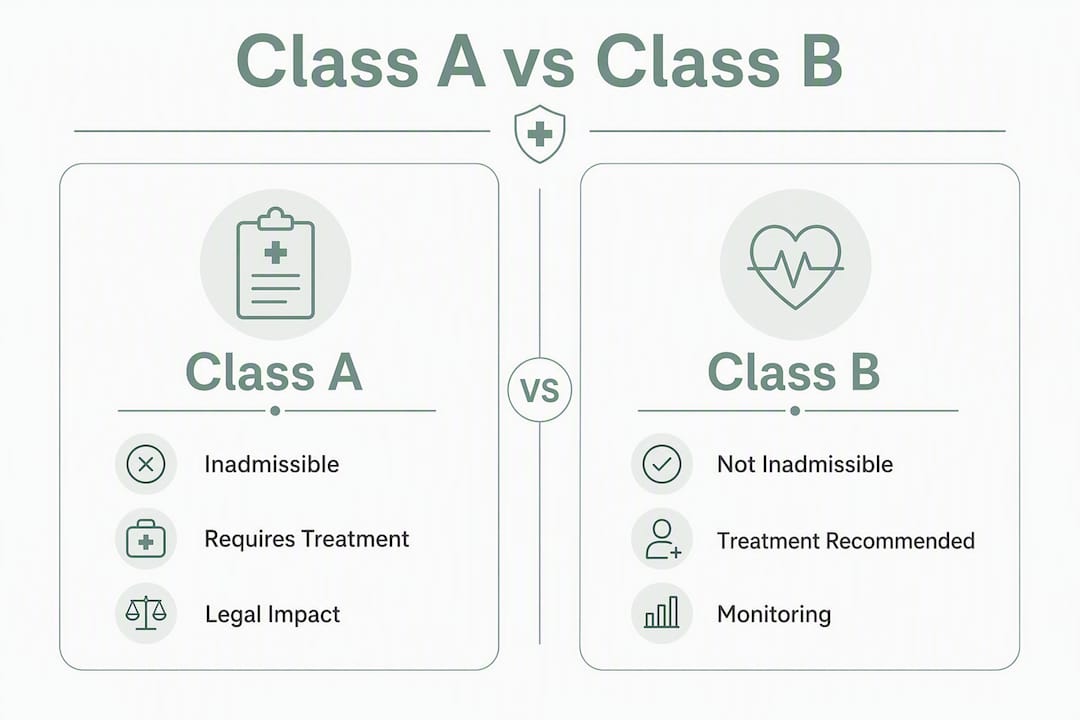
Class B is different in a critical way. HHS defines Class B as a physical or mental health condition, disease, or disability that is serious in degree or permanent in nature but does not make the applicant inadmissible. Think of it as a medical flag, not a legal bar.
Clinical examples make this concrete:
- Missing required vaccinations — → Class A until vaccinations are administered per CDC technical instructions
The CDC’s physical examination guidance frames the exam’s purpose precisely: determine whether the applicant has a condition that renders them ineligible (Class A) or a condition that departs from normal health significantly enough to warrant notation (Class B).
Who assigns Class A or Class B, and how the decision gets made
Civil surgeons and panel physicians conduct the exam and record objective clinical findings. They do not make legal eligibility decisions. That authority belongs to USCIS adjudicators. This separation matters because applicants sometimes expect the civil surgeon to “clear” them. The surgeon classifies; USCIS decides.

The clinical threshold that separates Class A from Class B for mental and physical disorders is “associated harmful behavior.” Per CDC Technical Instructions, if harmful behavior is present or likely to recur, the condition is Class A. If the behavior is absent or in remission, the condition is Class B. That single criterion drives a large share of mental-health classifications on the I-693.
For communicable diseases, the criteria are more categorical: active infection with a disease of public-health significance is Class A regardless of behavior.
USCIS reviews the completed I-693 during adjudication. If the officer has questions, they may issue a Request for Evidence (RFE), order a further medical review, or refer the applicant for re-examination. They will not simply accept an incomplete or internally inconsistent form.
What to ask your civil surgeon to document:
- Specific diagnosis with ICD code and clinical basis
- Dates of all relevant tests and results
- Treatment start and end dates with medication names
- A clear summary finding in the designated form section
- Notes on behavioral history if a mental-health condition is involved
Pro Tip: Ask your civil surgeon to include dated follow-up test results that explicitly tie back to the treatment episode. Well-organized records speed USCIS review and reduce RFE risk.
What a Class A or Class B finding means for your application
A Class A designation is conclusive evidence of medical inadmissibility unless you complete required treatment and get the classification updated, or you obtain a waiver. There is no middle ground. USCIS will not approve an adjustment of status application with an unresolved Class A on file.
Class B never triggers health-related inadmissibility on its own. However, USCIS policy warns that a Class B finding can raise public-charge concerns if the condition suggests a likely future need for extensive treatment or institutionalization. Attorneys should review the clinical notes carefully and prepare a financial sufficiency response when that risk exists.
| Finding | Admissibility impact | Typical USCIS action |
|---|---|---|
| Class A | Inadmissible; application cannot be approved | RFE, denial, or referral to waiver unit |
| Class B | Not inadmissible | Notation reviewed; possible public-charge inquiry |
| No Class A or B | No health-related bar | Standard adjudication proceeds |
One additional timing risk: if a panel physician found a Class A condition during an exam abroad, USCIS generally requires a full repeat I-693 exam when you later apply for adjustment of status inside the United States. Coordinating treatment completion before that filing can eliminate a significant delay.
How a Class A classification can change after treatment
A Class A designation is not permanent for most conditions. USCIS instructs officers not to reject a form based on reclassification if the information is internally consistent. Once treatment is documented and complete, the civil surgeon updates Form I-693 to reflect Class B or “No Class A or Class B.”
| Condition | Typical treatment window | Re-examination interval |
|---|---|---|
| Active pulmonary TB | 9 months standard therapy | After treatment completion with negative cultures |
| Vaccination gap | Days to weeks depending on vaccine schedule | After series completion or titer confirmation |
| Untreated syphilis | 2 weeks (benzathine penicillin) | After serologic follow-up confirms response |
Civil surgeons can and should update the I-693 after documented treatment completion. Well-organized, dated medical records that explicitly connect follow-up test results to the treatment episode are what make reclassification move quickly.
Pro Tip: Time your treatment completion, follow-up testing, and I-693 re-submission as a coordinated sequence. Submitting the updated form before all test results are finalized forces a second re-examination.
Step-by-step checklist after a Class A or Class B finding
Immediately (both classes):
- Secure the sealed I-693 and request copies of all supporting lab and clinical documents
- Notify your immigration attorney before taking any other action
- Ask the civil surgeon for written clarification of the finding and the recommended next steps
If Class A:
- Begin or complete required treatment under a licensed provider and keep dated records of every visit
- Obtain a letter from your treating physician confirming diagnosis, treatment, and outcome
- Schedule a re-examination with a USCIS-approved civil surgeon once treatment is complete
- Evaluate waiver eligibility with your attorney; Form I-693 instructions specify when repeat exams are required for certain visa categories
If Class B:
- Obtain documentation showing the condition is stable or actively managed
- Prepare a treatment plan or specialist letter if the condition could raise public-charge concerns
- Review what happens with abnormal lab results so you understand the clinic’s follow-up process
Documents to gather for either class: lab results with reference ranges, treatment records, medication adherence logs, vaccination records, and all civil surgeon notes.
Pro Tip: Keep a single dated folder with every document in chronological order. USCIS officers and attorneys both work faster when the record is organized rather than scattered across multiple envelopes.
Where Class A and Class B appear on Form I-693
The summary finding sits in Part 8 of the I-693 (Civil Surgeon Worksheet), where the civil surgeon checks the applicable box: No Class A or Class B, Class A, or Class B. Supporting entries appear across earlier parts of the form covering physical examination, lab results, and the vaccination record.
USCIS policy instructs officers to check other form sections when the summary finding is missing or conflicts with supporting entries. The officer may return the form for correction rather than immediately denying the application, but that correction process adds weeks.
What to verify before the form is sealed:
- The summary finding box is checked and matches the clinical narrative
- TB classification is recorded (No Class A or Class B TB, Class A Pulmonary TB Disease, Class B0, or Class B Other Chest Condition)
- Syphilis classification is recorded if applicable (untreated = Class A; treated = Class B)
- All required vaccination entries are complete with dates and lot numbers
- No section is left blank when a finding was documented elsewhere on the form
Common conditions that produce Class A or Class B findings
Tuberculosis is the most frequently encountered Class A condition in immigration exams. Active pulmonary TB is Class A until treatment is complete and documented. A history of treated TB with no active disease produces a Class B0 notation. TB testing during the exam typically involves a QuantiFERON-TB Gold blood test and, when indicated, a chest X-ray.
Mental and behavioral disorders follow the harmful-behavior rule from CDC Technical Instructions. A disorder with active or likely-to-recur harmful behavior is Class A. The same disorder in remission, or any disorder without harmful behavior, is Class B. The civil surgeon documents behavioral history, not just diagnosis.
Vaccination gaps are a straightforward Class A ground for immigrants. Missing required vaccines means Class A until the series is completed per USCIS vaccination requirements. Most gaps can be resolved at the exam appointment itself when on-site vaccines are available.
Communicable STIs: Untreated syphilis is Class A. Treated syphilis with documented serologic response is Class B. Gonorrhea is evaluated similarly. Lab testing for these conditions is a standard part of the I-693 exam.
Stable chronic conditions (controlled hypertension, well-managed diabetes, past resolved infections) typically produce Class B findings or no finding at all, depending on severity and treatment status.
How a USCIS-approved clinic handles Class A and Class B findings
A well-run immigration medical clinic follows a defined sequence: clinical examination, lab confirmation, classification per CDC technical instructions, treatment coordination or referral when needed, documentation assembly, and sealed I-693 delivery. Civil surgeons at these clinics document clinical facts. They do not decide legal admissibility, and a good clinic makes that distinction clear to every applicant.
Immigrationmedicalexams operates USCIS-approved civil surgeon clinics in Southern California, including Orange County and Los Angeles. On-site labs mean TB testing, syphilis serology, and other required panels are drawn and processed without sending applicants to a separate facility. Vaccinations are administered at the same visit when gaps are identified. The I-693 is typically completed and sealed within 2–3 business days.
For applicants with Class A findings, the clinic can coordinate re-examination appointments after treatment completion and assemble the updated documentation package the civil surgeon needs to reclassify the finding.
Pro Tip: Share your attorney’s contact information with the clinic at intake. When an RFE arrives, the clinic can respond to documentation requests faster if the communication channel is already established.
Key Takeaways
A Class A finding on Form I-693 blocks admissibility until treatment is complete or a waiver is approved; a Class B finding does not block admissibility but may trigger public-charge review and requires documented management.
| Point | Details |
|---|---|
| Class A means inadmissibility | USCIS cannot approve your application with an unresolved Class A on file. |
| Class B is a flag, not a bar | Class B does not block approval but may prompt a public-charge inquiry from USCIS. |
| Reclassification is possible | Completing documented treatment allows the civil surgeon to update the I-693 to Class B or no class. |
| Civil surgeons classify; USCIS decides | The surgeon records clinical findings; the USCIS adjudicator applies the legal standard. |
| Immigrationmedicalexams | Provides USCIS-approved civil surgeon exams, on-site labs, vaccinations, and 2–3 day I-693 turnaround in Southern California. |
The part most applicants get wrong
The most consequential misunderstanding in immigration medical exams is treating the civil surgeon’s classification as the final word on admissibility. It is not. The surgeon reports clinical findings under CDC criteria. USCIS applies a legal standard to those findings. Those are genuinely different acts, performed by different people under different authority.
The practical consequence: applicants who receive a Class A finding sometimes assume the case is over. It usually is not. Treatable infectious diseases, vaccination gaps, and even some behavioral-health findings can be reclassified after documented intervention. The window between classification and USCIS adjudication is exactly where good attorney-clinic coordination pays off.
Class B findings get underestimated in the other direction. Applicants assume a non-inadmissible finding is harmless and ignore it. When the condition suggests future treatment needs, USCIS officers have a clear policy basis to probe financial sufficiency. A one-page letter from a treating specialist explaining that the condition is stable and self-managed costs almost nothing to obtain and can prevent an RFE that delays the case by months.
Get your I-693 exam done right, the first time
If your exam is coming up or you need a re-examination after a Class A finding, Immigrationmedicalexams offers USCIS-approved civil surgeon exams with on-site labs, vaccinations, and sealed I-693 forms delivered within 2–3 business days. Clinics are located across Southern California, with same-day and weekend appointments available.
For applicants dealing with abnormal findings, the clinic’s civil surgeons document treatment completion and prepare updated I-693 packages for reclassification or waiver support. You get a single point of contact who understands both the clinical and the documentation requirements. Book your appointment or review available services to get started.
This article provides general information about USCIS and CDC immigration medical classifications. It is not legal or medical advice. Confirm current requirements with USCIS, CDC, or a qualified immigration attorney and licensed civil surgeon.
Useful sources and further reading
- USCIS Policy Manual, Volume 8, Part B, Chapter 2 — Definitions of Class A and Class B conditions under HHS regulation; primary legal authority for admissibility classifications.
- USCIS Policy Manual, Volume 8, Part B, Chapter 11 — Public-charge considerations arising from Class B findings.
- USCIS Form I-693 Landing Page — Official form page with instructions, filing requirements, and repeat-exam rules.
- Form I-693 Instructions (PDF) — Detailed instructions for completing the form, including when re-examination is required.
- CDC Technical Instructions — Mental Health — Clinical criteria for Class A vs Class B mental and behavioral disorder classifications, including the harmful-behavior threshold.
- CDC Panel Physicians — Role and Responsibilities — Explains the civil surgeon’s scope: clinical reporting, not legal eligibility determination.
- CDC Medical History and Physical Examination Technical Instructions — Full clinical framework for the immigration medical exam and classification criteria.
- USCIS Policy Manual, Volume 9, Part D, Chapter 1 — Background on how Form I-693 establishes medical admissibility in the adjustment-of-status process.
- Immigrationmedicalexams — Medical Conditions Guide — Clinic-level explanation of which conditions commonly appear on I-693 and how they map to Class A or Class B.
- Immigrationmedicalexams — TB Testing Resource — Detailed guidance on TB testing methods and treatment timelines relevant to Class A infectious findings.